Showing posts with label Lançon (Auguste). Show all posts

Sunday, 20 September 2026

Auguste Lançon, “Couching Dromedary”, 1866

Auguste-André Lançon (signed in the plate “André Lançon”—the name he used prior to 1872) (1836–1885)

“Couching Dromedary” (Dromadaire couché), 1866

Historical Context & The Van Gogh Connection:

This rare early print belongs to the Realist tradition of the 19th-century French Etching Revival. Auguste Lançon’s animal studies were highly influential and deeply respected by his contemporaries—most notably by Vincent van Gogh.

Van Gogh was a passionate collector of Lançon’s prints. In his personal letters to his brother Theo, Vincent frequently lauded Lançon’s genius for capturing the raw, unidealised character of animals, noting that Lançon’s draftsmanship possessed a rare honesty drawn straight from life.

Technical Details & Condition:

Etching with plate tone on wove paper, with full margins as issued. This superb study depicts a camel with tents and the Great Sphinx in the background, from the rare early series “Animal Studies Drawn from Life” (Études d'animaux dessinées d'après nature). 

The etching was printed by Auguste Delâtre (1822–1907) and published in Paris by R. Schultz (active 1866–1872). 

The impression is strong and evenly inked, with crisp detail and no signs of wear to the printing plate. Aside from foxing marks confined to the upper right margin, the sheet remains in very good condition, with no tears, holes, folds, or abrasions.

Dimensions:

• Sheet: 24.9 x 34.9 cm
• Platemark: 10.7 x 17.7 cm
• Image borderline: 10 x 17 cm

In-Plate lettering:

• Lower left: “1866 André Lançon”

References:

• Bibliothèque Nationale de France: Jacques Lethève & Françoise Gardey 1963, “Inventaire du Fonds Français après 1800: KA–LAURENCE”, Paris, Département des Estampes, vol. 12, pp. 380–85, unrecorded/not described — https://gallica.bnf.fr/ark:/12148/bpt6k5488490f/f392.item
• British Museum: Museum number 1872,1012.1465 — https://www.britishmuseum.org/collection/object/P_1872-1012-1465
• PROANTIC Marketplace: Reference number 828867— https://www.proantic.com/en/828867-etching-by-lancon-dromedary.html

Price & Shipping:

AU$212 (approximately US$150.98 / €131.39 / £112.73, subject to daily exchange rates). Price includes worldwide express shipping. Please note that destination import duties and local taxes remain the sole responsibility of the buyer.

If you’re interested in acquiring this curiously wonderful study of a camel settled squarely on its pads, please contact me at oz_jim@printsandprinciples.com. I’ll gladly provide a secure PayPal invoice for a seamless transaction.


Wednesday, 13 December 2023

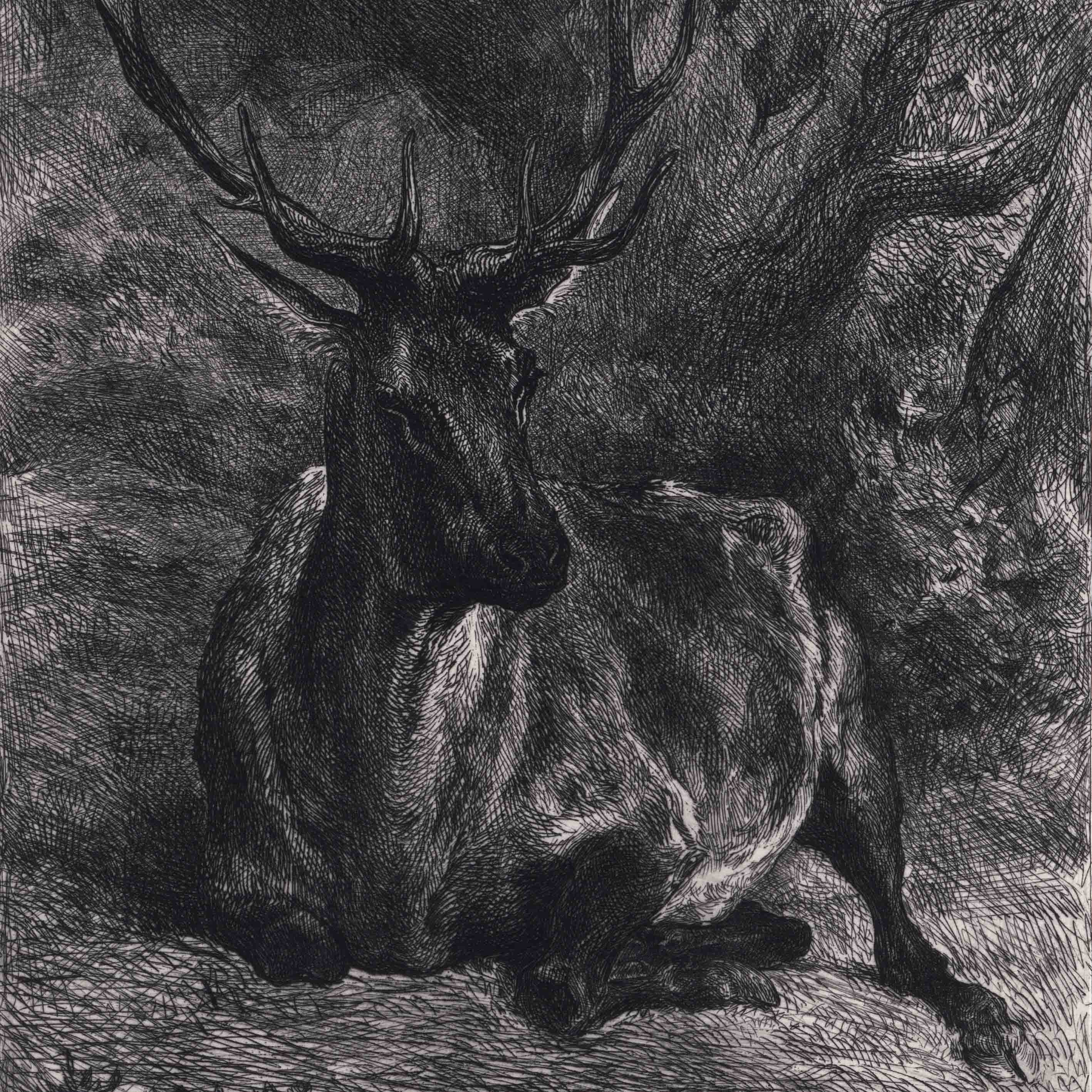
Auguste Lançon’s etching, “North American Elk (Wapiti)”, 1876

Auguste Lançon (aka Auguste André Lançon; Auguste Lançon) (1836–1885)

“North American Elk (Wapiti)” (aka “Cerf Wapeti de l'Amérique du Nord” [as titled in plate]), 1876, from the series, “Etudes d'Animaux” (Animal Studies), printed in Paris by Alfred Salmon (aka Adolphe Ardail; Salmon & Ardail; Alfred Fortuné Salmon) (fl.1863–1894) and published in the art periodical, “L'Art”, in 1876, volume VII, page 143.

Etching on cream laid paper with wide margins.

Size: (sheet) 36.9 x 25.3 cm; (plate) 25.5 x 17.4 cm; (image borderline) 23 x 15.5 cm.

Lettered in plate above the image borderline: (centre) “ÉTUDES D'ANIMAUX.”

Lettered in plate below the image borderline: (left) “Aug. Lançon del. & sculp./ L’Art.”; (centre) “CERF WAPETI DE L'AMÉRIQUE DU NORD./ (Ayant appartenu au Jardin d'Acclimatation)”; (right) “Imp. A. Salmon.”

IFF 18 (Bibliothèque Nationale de France 1939–, “Inventaire du Fonds Français: Graveurs du XIXe Siècle”, Paris, Bibliothèque Nationale, Départment des Estampes, cat. no. 18).

See also the description of this print offered by the British Museum: https://www.britishmuseum.org/collection/object/P_1877-0210-609.

Interestingly, Artchive.org offers and on-line view of Auguste Lançon’s 1882 publication, “Les Animaux chez Eux” (Paris, L. Baschet), illustrated with the artist’s animal studies (but not this etching): https://archive.org/details/gri_33125016448587/page/n11/mode/2up.

Condition: a richly inked and well-printed (faultless) impression with generously wide margins in pristine condition with no tears, holes, folds, abrasions, stains, foxing or signs of handling.

I am selling this wonderful etching of an elk in forest shadow—note how the artist has extended the outward rhythm of the elk’s horns through lean of the background trees—for AU$246 (currently US$164.43/EUR148.77/GBP164.43 at the time of this listing) including Express Mail postage and handling to anywhere in the world, but not (of course) any import duties/taxes imposed by some countries.

If you are interested in purchasing this superb etching by a master draughtsman of animals (among other subjects), please contact me (oz_jim@printsandprinciples.com) and I will send you a PayPal invoice to make the payment easy.


Tuesday, 17 May 2016

Auguste Lançon, “Le Goûter”, c.1870–77, after Juriaan van Streek


Auguste Lançon (aka André Lançon before changing his name to Auguste Lançon after his imprisonment in 1871) (1836–85)
“Le Goûter” [The Taste/Afternoon Tea] also known by the English title, “Still Life with a Chinese Lidded Jar” (c.1870–77) after the painting in the Wallraf-Richartz-Museum, Cologne, by Juriaan van Streek (active 1647–87), from “Tableaux de premier ordre anciens et modernes composant la galerie de M. John W. Wilson”, printed and published by François Liénard.
Etching on fine cream laid paper watermarked “EB”
Size: (sheet) 33.7 x 24.4 cm; (plate) 20.9 x 16 cm; (image) 16.8 x 13.4 cm.
Inscribed below the image (lower left) “Juriaan van Streek, pinx.”; (lower centre) “LE GOÛTER. / Fçois Liénard. Imp. Paris.”; (lower right) Aug. Lançon, sc.” The British Museum offers the following description of this print: “Still-life, after Juriaan van Streek; with orange and orange slice on a plate, and behind a Chinese jar.” (http://www.britishmuseum.org/research/collection_online/collection_object_details.aspx?objectId=3499811&partId=1&searchText=Auguste+Lan%u00e7on+Le+Gouter&page=1). IFF 27.
Condition: richly inked and well-printed impression on fine laid paper with generous margins in near pristine condition.

I am selling this original and superbly executed etching for a total cost of  AU$227 (approximately US$161.66 / €140.69 / £120.71, subject to daily exchange rates). Price includes worldwide express shipping. Please note that destination import duties and local taxes remain the sole responsibility of the buyer.

If you are interested in purchasing this darkly glowing still-life etching from the 19th century, please contact me at oz_jim@printsandprinciples.com and I will email you a PayPal invoice.


The left image is Lançon’s etching and the right image is a black and white photographic reproduction of Juriaan van Streek’s original painting.

The tradition of making reproductive prints (i.e. prints that “copy” the tones, textures and surface patina of other artworks) of master paintings, sculptures and drawings dates back to the Renaissance. For me, the true glory days of the reproductive print was the nineteenth century. This was the time when printmakers had acquired the technical skills of the preceding centuries and had the discipline and economic compulsion to translate other artists’ works into a meaningful code of lines, squiggles, dots and tones that rivalled a photographic image. Some of the reproductive prints executed during these glory days may seem impersonal and even perfunctory to contemporary tastes. Moreover, they can even look as if they were made by a machine rather than by human hands. Nevertheless, the finest prints—like this one—are those that portray another artist’s artwork in a way that seems to genuinely capture the essential spirit of the original artwork. By this I mean that the print is able to connote the colour and the facture of the original artwork’s surface (i.e. the quality of an artist’s handling of paint or whatever the medium of the original happens to be) even though the print in reality is only a black and white sheet of paper.

As an experiment, I have juxtaposed the print and a black-and-white reproduction of the original painting as a way of evaluating whether Lançon’s etching captures the “essential spirit” of Juriaan van Streek’s painting.