Showing posts with label Steiner (Heinrich). Show all posts

Tuesday, 14 November 2023

Hans Weiditz II’s woodcut, “From a Volcanic and Fertile Field”, c.1532


Hans Weiditz II (aka The Petrarch Master) (1500–1536) (Designer)

“From a Volcanic and Fertile Field” (aka “Twee ploegers en andere landarbeiders” [Rijksmuseum title]; “Two Ploughmen and Other Farm Workers”; “Von einem wolgebawten und fruchtbaren Acker”; “Of a Fertile Field”; “Von einem fruchtbaren Acker”), c.1532 (1514 –1532 [Rijksmuseum dates]), originally published in Augsburg in 1532 and printed by Heinrich Steiner (fl.1522–1548) (see http://hdl.handle.net/10934/RM0001.COLLECT.726091).

This impression (with breaks in the image borderline at left) is from the 1572 edition of Francesco Petrarca’s (1304–1374) “Trostspiegel in Glück vnd Vnglück..”, published in Frankfurt-am-Main by Christian Egenolff I’s (aka Egenolph) (1502–1555) widow, Margarethe, on the verso of page LVII (57). Note that the plate was published with an unbroken borderline in Petrarca’s “Von der Artzney bayder Glück, des gůten und widerwertigen” (1532, p. LXXIII) and Petrarca’s “Das Glückbuch, Beydes dess Guten und Bösen” (1539, p. LVI [verso]). Be mindful there are other editions from 1532 leading up to 1572 that I have not examined.

Woodcut on laid paper trimmed with a small margin around the image borderline, with letterpress text verso concealed under a backing support sheet.

Size: (sheet) 11 x 16.1 cm; (image borderline) 9.7 x 15.6 cm.

Letterpress printed text above the image borderline in German: “Trostspiegels erste Buch/” (Trostspiegel's first book/).

Musper 39 ([Heinrich] Theodor Musper 1927, “Die Holzschnitte des Petrarkameisters : ein kritisches Verzeichnis mit einleitung”, Munich, p, 119, cat. no. 39); Walther Scheidig 1955, “Die Holzschnitte des Petrarca-Meisters zu Petrarcas Werk von der Arzney bayder Glück des guten und widerwärtigen: Augsburg 1532”, Berlin, p. 108.

See also the description of this print offered by the Rijksmuseum: http://hdl.handle.net/10934/RM0001.COLLECT.726091.

Condition: a strong and well-printed impression from the slightly damaged plate in 1572, trimmed with a small margin around the image borderline and laid onto a support of archival (millennium quality) washi paper providing wide margins.

I am selling this wonderful woodcut showing the ploughing and harvesting practices of the 16th century—interesting for me, I can see that the ploughmen do not use the customary ox-turn/ boustrophedon movement at the end of each furrow and that there is an overseer on horseback in the distance suggesting a system of serfdom (but, of course, I may be wrong)—for AU$238 (currently US$159.08/EUR143.93/GBP126.70 at the time of this listing) including postage and handling to anywhere in the world, but not (of course) any import duties/taxes imposed by some countries.

If you are interested in purchasing this finely detailed woodcut from the German Renaissance, please contact me (oz_jim@printsandprinciples.com) and I will send you a PayPal invoice to make the payment easy.

This print has been sold


Thursday, 6 July 2023

Hans Weiditz II’s woodcut, “The Devil and the Rich Man”, 1531


Hans Weiditz II (aka The Petrarch Master) (1500–1536) (Designer)

“The Devil and the Rich Man” (aka “Vertwijfelde man en duivel bij kisten gevuld met munten” [Rijksmuseum title]; “Desperate man and devil near chests filled with coins”), 1531, woodcut printed and published in 1531 in Augsburg by Heinrich Steiner (fl. 1522–1548) as illustration to the verso of page 10 (X) of Johann Neuber and Johann von Schwarzenberg’s translation of Marcus Tullius Cicero’s (106–43 BC), “Officia M.T.C.: ein Bůch, so Marcus Tullius Cicero der Römer, zů seynem Sune Marco, von den tugentsamen Ämptern vnd Zůgehörungen, eynes wol vnd rechtlebenden Menschen” (Official M.T.C. [Marcus Tullius Cicero]: a book, according to Marcus Tullius Cicero the Romans, zů seynem [in addition to?] Sune Marco, of the virtuous offices and belongings, one who wants to live with the law; see https://archive.org/details/gri_33125012281362/page/n37/mode/2up).

The Royal Academy offers the following insights regarding the publication in which this print features: “Cicero's De Officiis is a treatise on duties, in three books in the form of a letter to the author's son, Marcus. It was written in 44 B.C. In the first book Cicero analyses the virtues of Wisdom, Justice, Fortitude and Temperance; in the second and third he discusses how they may harmonise with social and political expediency - taking examples from ancient Greek and Roman history” (https://www.royalacademy.org.uk/art-artists/book/officia-m-t-c-ejn-bu-sup-e-sup-ch-so-marcus-tullius-cicero-der-ro-sup-e-sup).

Woodcut on laid paper trimmed with a small margin around the image borderline, with letterpress text verso concealed under a backing sheet.

Size: (sheet) 10.5 x 16.5 cm; (image borderline) 10.1 x 15.8 cm.

Scheidig 200 (Walther Scheidig 1955, “Die Holzschnitte des Petrarca-Meisters zu Petrarcas Werk von der Arzney bayder Glück des guten und widerwärtigen: Augsburg 1532”, Berlin, p. 42, cat.no.200).

See also the description of this print offered by the Rijksmuseum: http://hdl.handle.net/10934/RM0001.COLLECT.725890.

Condition: a strong and well-printed impression showing minor signs of wear to the printing plate—note the gap in the printing of the rich man’s cloak—trimmed with a narrow margin around the image borderline and laid onto a support of archival (millennium quality) washi paper. The sheet is in a good condition with no tears, holes, folds, significant stains or foxing.

I am selling this curiously wonderful woodcut showing in graphic terms that rich are chained by their desperate desires—here a rich man looking at chests of coins is chained at his legs to the devil (his desire) who points to the treasures and offers the rich man a neck ring extension to his chains—for AU$248 (currently US$165.76/EUR149.98/GBP132.03 at the time of this listing) including postage and handling to anywhere in the world, but not (of course) any import duties/taxes imposed by some countries.

If you are interested in purchasing this finely detailed woodcut from the German Renaissance, please contact me (oz_jim@printsandprinciples.com) and I will send you a PayPal invoice to make the payment easy.

This print has been sold 


Thursday, 11 May 2023

Hans Weiditz II’s woodcut, “A Woman Standing, Almost Nude”, 1531

Hans Weiditz II (aka Petrarch Master; Meister des Trostspiegels) (c1500–c1536)

“A Woman Standing, Almost Nude” (Dobson title; cat. no. 93), 1531, woodcut illustration facing page 31 (XXXI) to Marcus Tullius Cicero’s (106–43 BCE) “Officia” (aka “Officia M.T.C.: ein Bůch, so Marcus Tullius Cicero der Römer, zů seynem Sune Marco, von den tugentsamen Ämptern vnd Zůgehörungen, eynes wol vnd rechtlebenden Menschen”), translated by Johann Neuber and Johann von Schwarzenberg (1463–1528), published in Augsburg and printed by Heinrich Steiner (1522–1548). Note that Dobson (1911) advises that there were three editions of the “Offiia” published in the year 1531 and mentions that later editions were published between 1532 and 1545 (see vol. 2, p.177).

Archive.org offers an online view of this print in its context in the publication: https://archive.org/details/gri_33125012281362/page/n77/mode/2up.   

Woodcut on laid paper trimmed with a narrow margin around the image borderline with letterpress German text and a fragment of another woodcut verso (see https://archive.org/details/gri_33125012281362/page/n76/mode/1up).

Size: (sheet) 16 x 8.4 cm; (image borderline) 15.8 x 8.2 cm.

Dodgson 93 (Campbell Dodgson 1911, “Catalogue of Early German and Flemish Woodcuts Preserved in the Department of Prints and Drawings of the British Museum”, vol. 2, London, British Museum, p. 176, cat. no. 93).

See the description of this print offered by the British Museum: https://www.britishmuseum.org/collection/object/P_E-7-87.

Condition: a strong early/lifetime impression (based on the quality of line showing minimal signs of wear to the printing plate). The sheet is in an excellent condition with no tears, holes, folds or significant stains. The verso of the sheet has remnants of mounting and pencil notations from a previous collector.

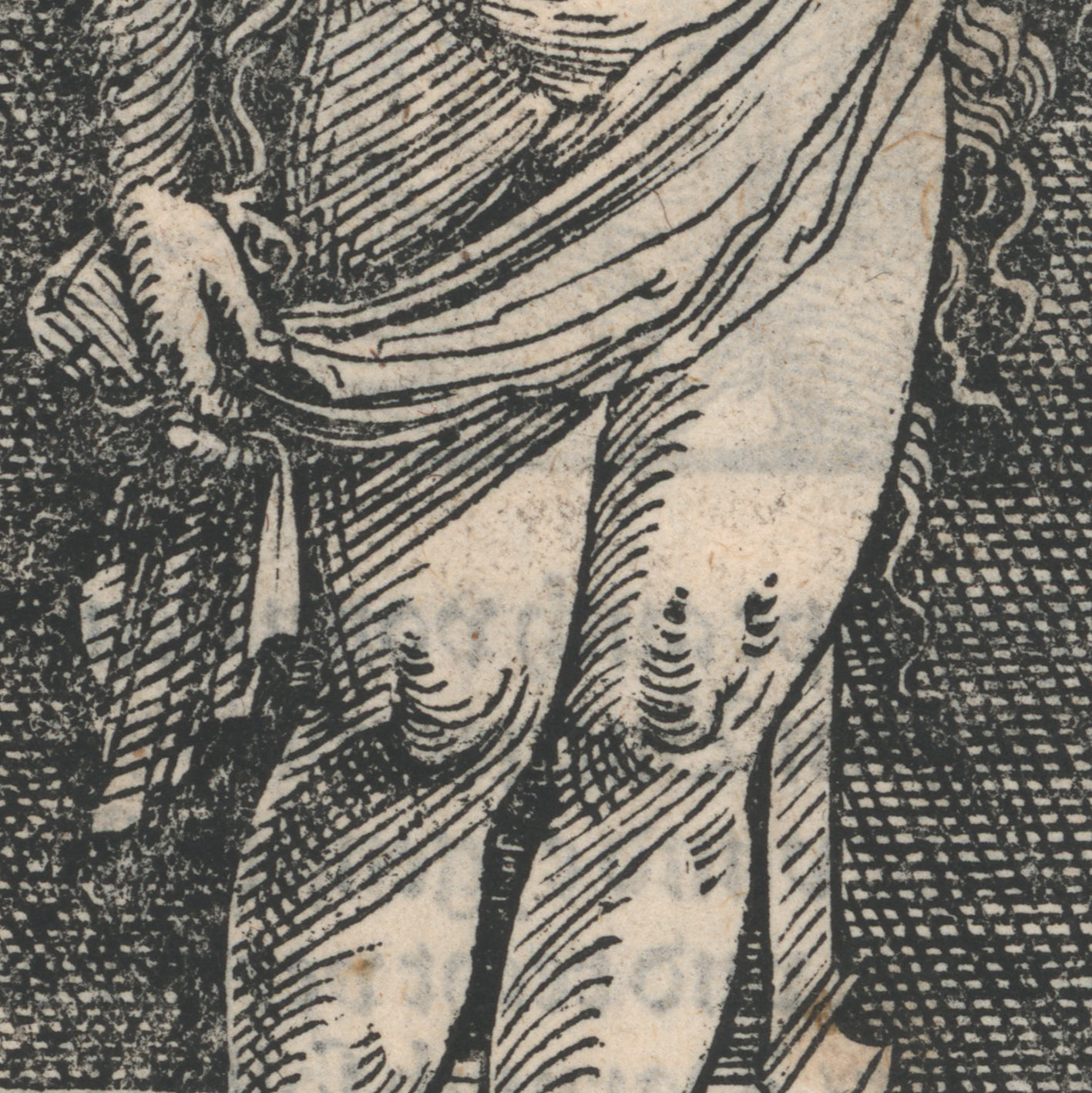
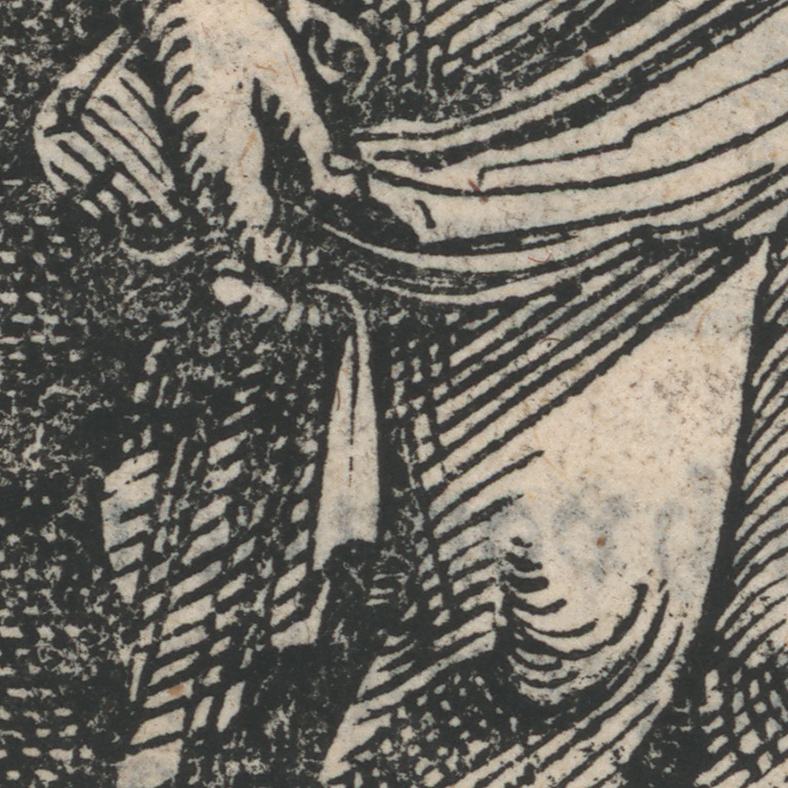
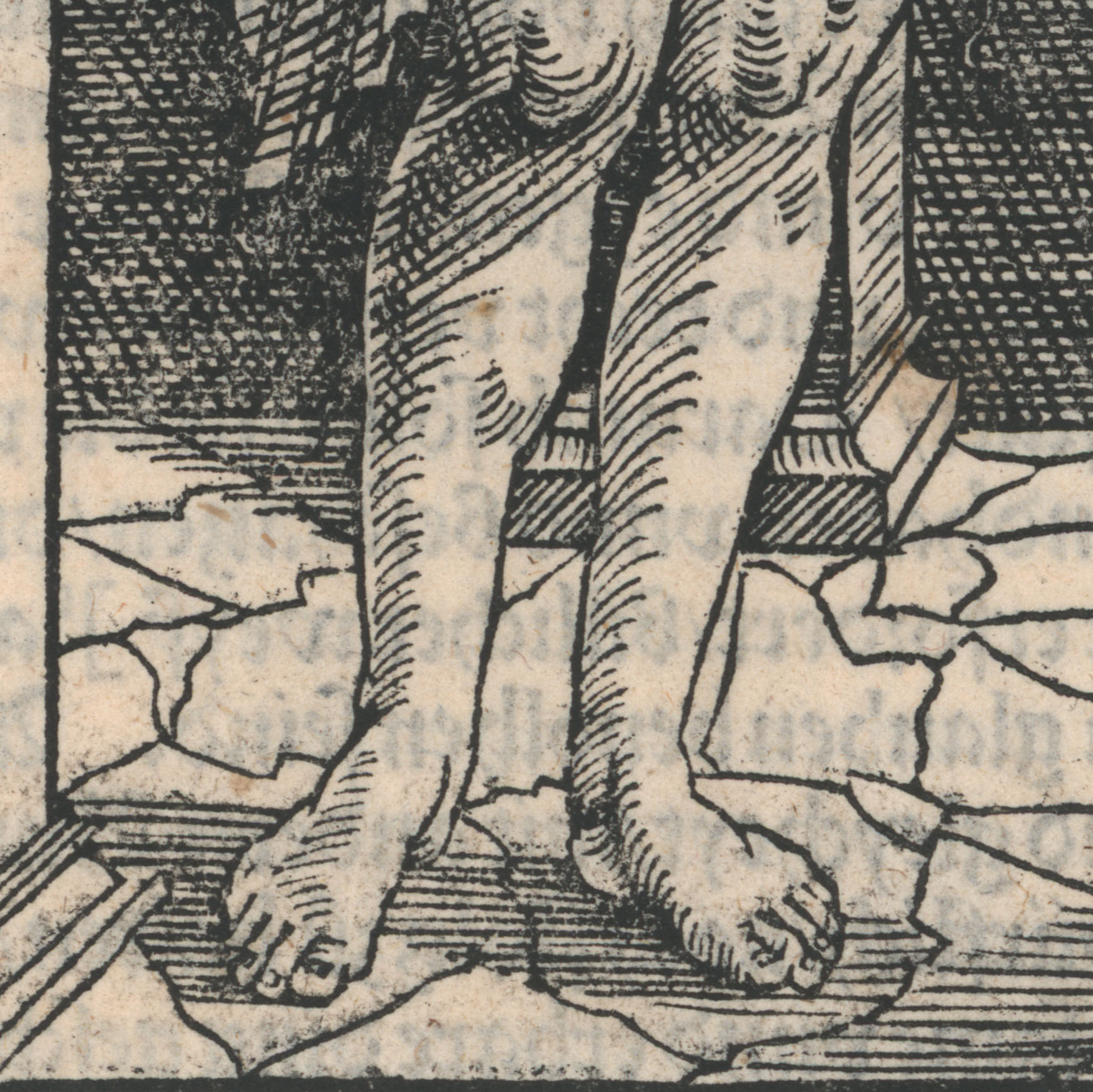
I am selling this remarkable woodcut of a loosely draped female standing in an archway—note the skill required to cut the wood plate with tiny lozenge/diamond shapes aligned in such a way as to create the illusion that the background is shaded with cross-hatched strokes—for the total cost of AU$257 (currently US$171.78/EUR155.43/GBP136.82 at the time of this listing) including Express Mail (EMS) postage and handling to anywhere in the world (but not, of course, any import duties/taxes imposed by some countries).

If you are interested in purchasing this rarely seen old master woodcut on the art market, please contact me (oz_jim@printsandprinciples.com) and I will send you a PayPal invoice to make the payment easy.

This print has been sold


Thursday, 4 November 2021

Hans Weiditz II’s woodcut, “Cicero”, 1531


Hans Weiditz II (aka The Petrarch Master) (1500–1536)

“Cicero”, 1531, woodcut printed and published in 1531 in Augsburg by Heinrich Steiner (fl. 1522–1548) as an illustration to the first page of Johann Neuber and Johann von Schwarzenberg’s translation of Marcus Tullius Cicero’s (106–43 BC), “Officia M.T.C.: ein Bůch, so Marcus Tullius Cicero der Römer, zů seynem Sune Marco, von den tugentsamen Ämptern vnd Zůgehörungen, eynes wol vnd rechtlebenden Menschen” (Official M.T.C. [Marcus Tullius Cicero]: a book, according to Marcus Tullius Cicero the Romans, zů seynem [in addition to?] Sune Marco, of the virtuous offices and belongings, one who wants to live with the law; see https://archive.org/details/gri_33125012281362/page/n17/mode/2up.

The Royal Academy offers the following insights regarding this publication:

“Cicero's De Officiis is a treatise on duties, in three books in the form of a letter to the author's son, Marcus. It was written in 44 B.C. In the first book Cicero analyses the virtues of Wisdom, Justice, Fortitude and Temperance; in the second and third he discusses how they may harmonise with social and political expediency - taking examples from ancient Greek and Roman history” (https://www.royalacademy.org.uk/art-artists/book/officia-m-t-c-ejn-bu-sup-e-sup-ch-so-marcus-tullius-cicero-der-ro-sup-e-sup).

According to Wikipedia, Marcus Tullius Cicero (106–43 BC), “was a Roman statesman, lawyer, scholar, philosopher and [an academic sceptic]”, who wrote extensively including “treatises on rhetoric, philosophy and politics, and he is considered one of Rome's greatest orators and prose stylists” (https://en.wikipedia.org/wiki/Cicero).

Woodcut (recto and verso) on laid paper trimmed from a larger sheet with letterpress text.

Size: (sheet) 15.6 x 15.9 cm.

Condition: a strong, early impression (recto and verso) showing no sign of wear to the printing plate. The sheet has a minor stain along the lower edge otherwise the sheet is in excellent condition with no tears, holes, folds, significant stains or foxing.

I am selling this superb woodcut from the German Renaissance—note what I assume may be implements for crafting quills on the table—for AU$298 (currently US$221.53/EUR191.65/GBP162.41 at the time of this listing) including postage and handling to anywhere in the world, but not (of course) any import duties/taxes imposed by some countries.

If you are interested in purchasing this finely detailed woodcut exemplifying the 100 years of advances in the use of linear perspective since the principle was first documented in 1435, please contact me (oz_jim@printsandprinciples.com) and I will send you a PayPal invoice to make the payment easy.

This print has been sold 


(woodcut verso)