Saturday, 6 August 2022

Jan Sadeler I’s engraving, “Title-Plate: Oraculum Anachoreticum”, c1600, after Maarten de Vos

Jan Sadeler I (aka Johann Sadeler; Johannes Sadeler) (1550–1600)

“Title-Plate: Oraculum Anachoreticum”, 1595–1600, title-page to the series of 25 engravings, “Oraculum Anachoreticum: Hermits” (aka “Lives of the Hermits”), after a lost drawing by Maarten de Vos (aka Marten de Vos; Maerten de Vos) (1532–1603), published in Venice.

Engraving on laid paper with wide margins backed with a support sheet.

Size: (sheet) 25.7 x 32.3 cm; (plate) 16.6 x 20.7 cm; (image borderline) 15.4 x 20.7 cm.

Lettered in plate above the image borderline in two columns of two lines: “Templa vetusta …/ …// …/ …subbesse facit.”

Inscribed in plate within the image borderline: (lower left) “Cum priuil/ Sumi Pont. et Cæs. Maies”; (centre) “ORACVLVM ANACHORETICVM/ REQVIES/ ANIMAE”; (left of centre) “OBEDIENTIA”; (right of centre) “HVMILITAS”; (lower right) “Marti de Vos figur./ Ioa Sadeler scalpsit Venetijs.”

Lettered in plate below the image borderline: “SANCTISSIMO [coat-of-arms of Pope Clement VIII] PATRI NOSTRO./ D. CLEMENTI VIII […] PONTci. OPTo. MAXmo./ ANo. D. MDC [1600]”

State i (of i)

TIB 7001. 407 (Isabelle de Ramaix 2001, “The Illustrated Bartsch”, vol. 70, Part 2 [Supplement], New York, Abaris Books, p. 273, cat. no. [7001].407); Hollstein (Johann Sadeler I) 437 (Dieuwke de Hoop Scheffer [comp.] 1980, “Dutch and Flemish Etchings, Engravings and Woodcuts ca. 1450–1700: Aegidius Sadeler to Raphael Sadeler II: text”, vol. 21, Amsterdam, Van Gendt & Co, cat. no. 437); Hollstein (Vos) 1050 (Christiaan Schuckman [comp.] 1996, “Dutch and Flemish Etchings, Engravings and Woodcuts ca. 1450–1700: Maarten de Vos: text”, vol. 44, Rotterdam, Sound and Vision Rijksprentenkabinet, cat. no. 1050); Edquist 79a (p. 69).

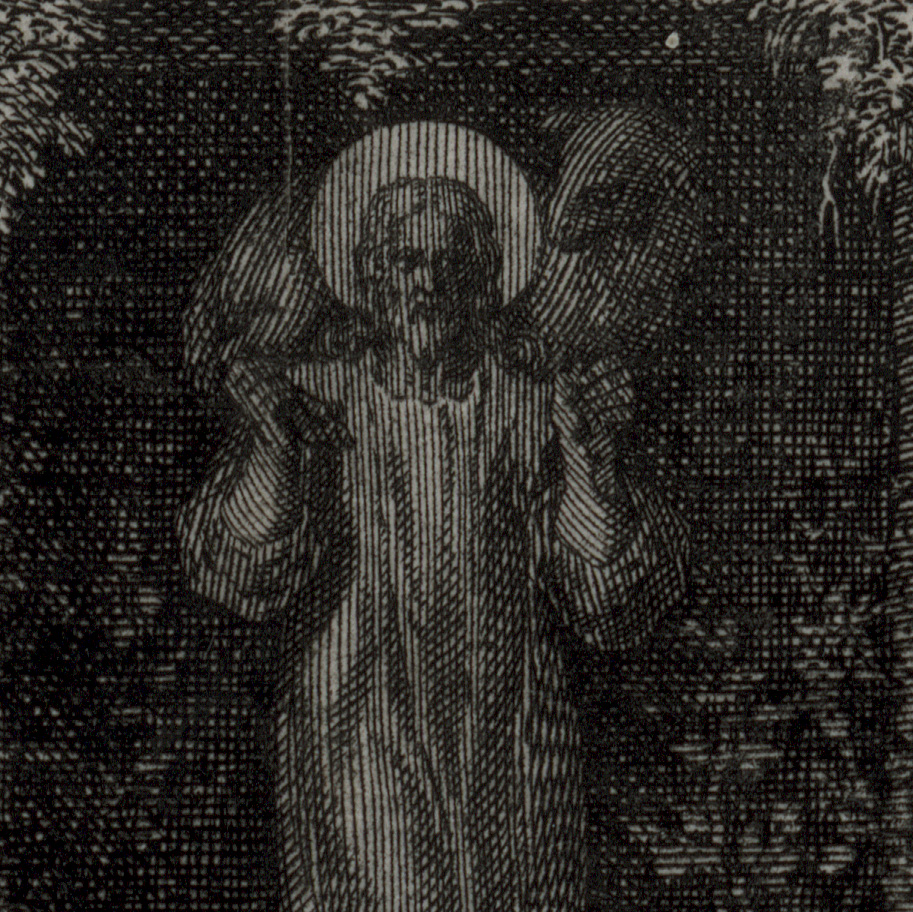
The British Museum offers the following description of this print: “Title-page to 'Oraculum Anachoreticum'; a monument with Christ as the Good Shepherd labelled "REQVIES / ANIMAE" flanked by reliefs of Abraham's sacrifice of Isaac labelled "OBEDIENTIA" (left) and David beheading Goliath labelled "HUMILITAS" (right); two personifications sit on either side before the monument by an oak and palm, labelled "PAX" (left) and the other holding his fingers to his lips and holding a book labelled "SILEN / TIUM" (right); after Maarten de Vos Engraving” (https://www.britishmuseum.org/collection/object/P_1958-0712-220).

Condition: a well-printed, lifetime impression (based on the quality of line showing no sign of wear to the printing plate) with wide margins around the platemark and laid upon an archival support sheet of millennium quality washi paper. There are printer’s creases (see lower margin and within the image) the sheet is in a good condition for its considerable age with no significant stains or foxing.

I am selling this sensitively executed and very beautiful engraving by one of the most famous of the Flemish old masters, for AU$296 (currently US$204.62/EUR200.93/GBP169.50 at the time of posting this print) including Express Mail (EMS) postage and handling to anywhere in the world, but not (of course) any import duties/taxes imposed by some countries.

If you are interested in purchasing this seldom seen title-plate to a series of twenty-five engravings of hermits, please contact me (oz_jim@printsandprinciples.com) and I will send you a PayPal invoice to make the payment easy.

This print has been sold 


Friday, 5 August 2022

Gabriel Spitzel’s mezzotint, “The Taleteller”, c1730

Gabriel Spitzel (aka Gabriel Spizel) (1698–1760)

“The Taleteller”, c1730, plate 24 from a series of allegorical figures designed and published by Gabriel Spitzel in Augsburg (as inscribed in plate).

See a related colour mezzotint by Gabriel Spitzel, plate 6, “Woman with letter stating that she is cheating on her husband” (aka “Vrouw met brief waarin staat dat ze haar man bedriegt”) c1720, in the collection of the Rijksmuseum: http://hdl.handle.net/10934/RM0001.COLLECT.368893.

Mezzotint printed in Prussian blue on laid paper.

Note that as the artificially manufactured colour, Prussian blue, was made available to artists in 1724 (see http://www.webexhibits.org/pigments/indiv/history/prussblue.html) this print must be one of the first etchings published in this vibrant colour.    

Size: (sheet) 27.5 x 20.9 cm; (plate) 23.4 x 18 cm; (image borderline) 21.9 x 18 cm.

Lettered and numbered in plate below the image borderline in a column of Latin and a column of German text: (left) “Os Semper garrit, quia multum di,,/ cere quærit,/ Hoc etenim nunumguam, crede, ta,, cere potest./ 24// …/ …/ …/ …/ Gabriel Spize. Inv. et exc. Aug Vind” ([transl.] “The mouth is always chattering, because it is asking for a lot of money”).

Nagler 7 (?) (G.K. Nagler (1847), “Neues allgemeines Künstler-Lexicon oder Nachrichten von dem Leben und den Werken der Maler, Bildhauer, Kupferstecher, Formschneider, Lithographen: Sole, G.G.–Surugue, L”, vol. 17, pp. 167–68). Note that the reference number, "7", is based on the pencil notation from a previous collector shown verso on the sheet: “Nag VII”. The connection of this print with this reference number, however, is not clear to me [see https://archive.org/details/bub_gb_du1QAAAAcAAJ/page/166/mode/2up]).

Condition: a richly inked and well-printed impression with small margins (1.5 to 2 cm). Beyond minor marks in the margin, the sheet is in an excellent condition with no tears, holes, abrasions, significant stains or foxing.

I am selling this rare and historically significant mezzotint—one of the first prints to be inked with the newly discovered and artificially manufactured colour, Prussian blue—for AU$322 (currently US$223.80/EUR218.71/GBP184.37 at the time of posting this print) including postage and handling to anywhere in the world, but not (of course) any import duties/taxes imposed by some countries.

If you are interested in purchasing this visually arresting mezzotint—my eyes see it as almost electrically charged! —please contact me (oz_jim@printsandprinciples.com) and I will send you a PayPal invoice to make the payment easy.

This print has been sold 


Thursday, 4 August 2022

Charles Émile Jacque’s etching, “Death Playing the Violin”, 1846

Charles Émile Jacque (1813–1894)

“Death Playing the Violin” (aka “La Mort Jouant du Violon”), 1846, signed in the plate.

Etching with plate tone on warm grey chine collé on wove paper.

Size: (sheet) 26.3 x 17.3 cm; (plate) 11.9 x 8.9 cm; (chine collé) 11.6 x 8.6 cm; (image borderline) 11.3 x 8.2 cm.

Inscribed in plate at upper right: “ch J.”

Guiffrey 122 (J-J Guiffrey 1866, “L'Oeuvre de Charles Jacque: catalogue de ses eaux-fortes et pointes seches”, Paris, p. 73, cat. no. 122); IFF 145 (Jean Adhémar & Jacques Lethève 1954, “Inventaire du Fonds Français: Bibliothèque Nationale”, Paris, Département des Estampes, cat. no. 145); Beraldi 124 (Henri Béraldi 1885–1892, “Les Graveurs du XIXe Siècle: Guide de l'Amateur d'Estampes Modernes”, vol. VIII, Paris, Librairie L. Conquet, p. 184, cat. no. 122 [https://archive.org/details/lesgraveursdu19e08berauoft/page/184/mode/1up]).

Guiffrey (1866) offers the following description of this print: (transl.) “A skeleton, the head covered with a few dishevelled hairs, plays the violin in front of a large open book of music. We only see this macabre fantasy halfway up the body. 1846. Signed: Ch. J. This plate must be grouped with the collection of pseudo-Ribera [etchings], begun in 1845 (See [Guiffrey catalogue] numbers 53 to 56.)” (p. 74).

See also the descriptions of this print offered by the British Museum and the MET: https://www.britishmuseum.org/collection/object/P_1889-0608-176; https://www.metmuseum.org/art/collection/search/829839.

Condition: a richly inked and near faultless impression with wide margins. The sheet is in a near pristine condition with no stains, foxing or signs of handling.

I am selling this visually arresting etching by one of the luminaries of the Barbizon School for AU$277 (currently US$192.96/EUR189.73/GBP158.78 at the time of posting this print) including postage and handling to anywhere in the world, but not (of course) any import duties/taxes imposed by some countries.

If you are interested in purchasing this fascinatingly macabre etching portraying the personification of the death playing a violin while reading from the symbolic manuscript of life—possibly the artist’s response of deep despair following the death of his daughter the year before (forgive me if I am wrong about this)—please contact me (oz_jim@printsandprinciples.com) and I will send you a PayPal invoice to make the payment easy.

This print has been sold 


Wednesday, 3 August 2022

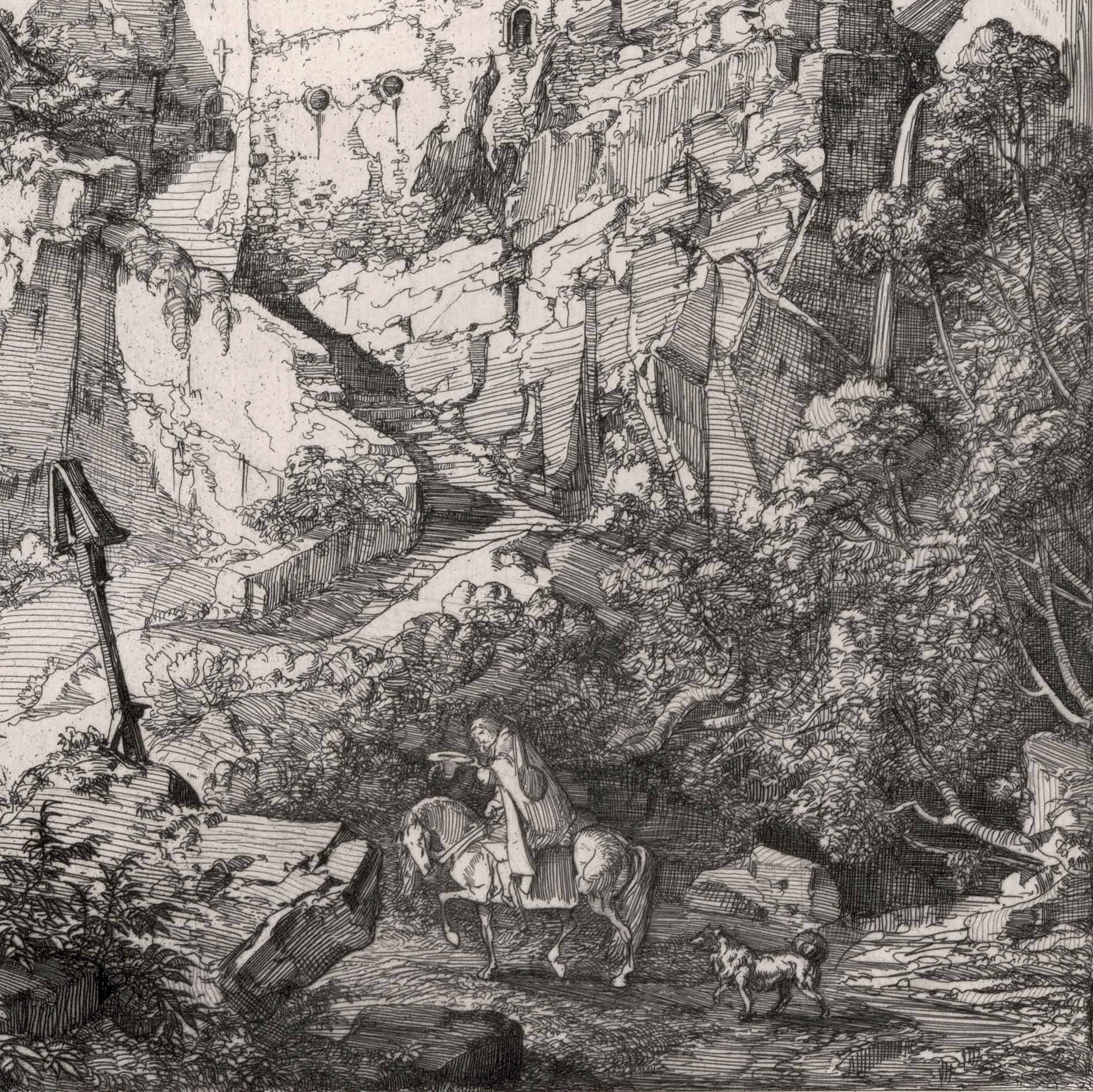
Caspar Johann Nepomuk Scheuren’s etching, “Monastery in the Mountains”, 1844


Caspar Johann Nepomuk Scheuren (aka Kaspar Johann Nepomuk Scheuren) (1810–1887)

Monastery in the Mountains”, 1844, plate 21 published in Düsseldorf in 1846 and 1850 by Julius Buddeus (fl.1830s–1852) as an illustration to “Deutsche Dichtungen mit Randzeichnungen Deutscher Künstler”, volume 2. 

Archive.org offer an online view of this publication and this featured print: https://archive.org/details/bub_gb_kwpQAAAAcAAJ/page/n56/mode/2up.

Etching on chine collé (China) on wove paper, backed with a support sheet providing wide margins.

Size: (sheet) 33.9 x 24.8 cm; (plate) 28.7 x 23 cm; (chine collé) 27.9 x 22.1 cm; (image borderline) 23.1 x 18.5 cm.

Inscribed in plate below the image borderline: (left) “C.Scheuren”; (centre) “–21–”; (right) “imJuli1844.”

The Moravská Galerie offers a brief description of this print: https://sbirky.moravska-galerie.cz/dielo/CZE:MG.MM_1328-b.

Condition: a strong and well-printed (near faultless) impression laid upon an archival support sheet of millennium quality washi paper providing wide margins. The sheet is in a near pristine condition with no tears, holes, folds, abrasions, significant stains, foxing or signs of handling.

I am selling this extraordinarily fine etching showing a curiously wonderful monastery built into the hillside and, arguably, expressing the artist’s romantic leaning to the work of Caspar David Friedrich (1774-1840)—see for example, “Hermit Reading in Mountain Valley” (https://collection.museum.virginia.edu/objects-1/info/12933)—for the total cost of AU$234 (currently US$161.92/EUR159.04/GBP133 at the time of this listing) including Express Mail (EMS) postage and handling to anywhere in the world, but not (of course) any import duties/taxes imposed by some countries.

If you are interested in purchasing this amazing etching showcasing the etcher’s breathtaking skill and discipline, please contact me (oz_jim@printsandprinciples.com) and I will send you a PayPal invoice to make the payment easy.


Tuesday, 2 August 2022

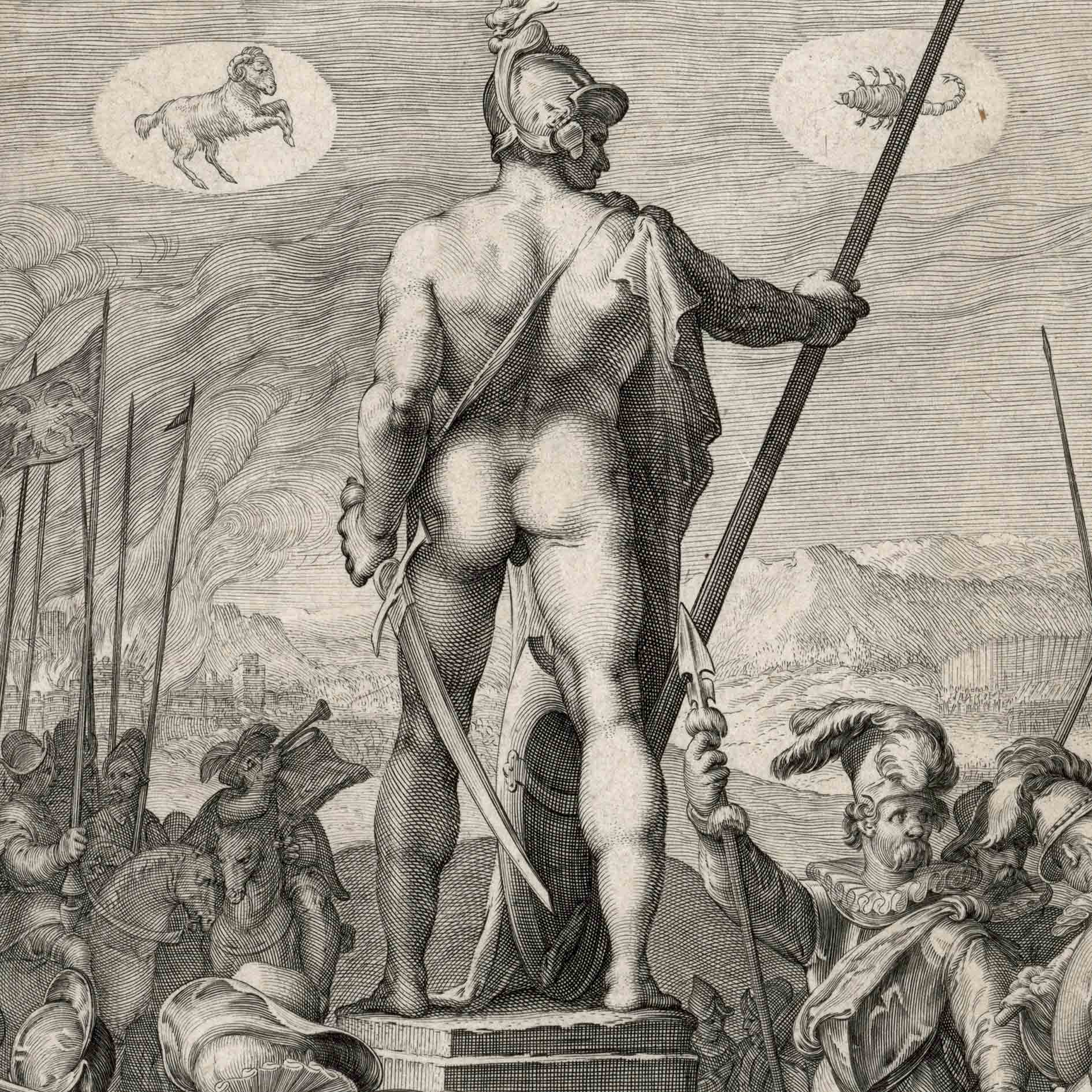
Jan Saenredam’s engraving, “Mars Presiding over War”, 1596, after Goltzius


Jan Saenredam (c1565–1607)

“Mars Presiding over War” (TIB title) (aka “Mars” [Rijksmuseum title]; “Mars, à la guerre” [Bartsch title]), 1596, plate 3 from the series of seven engravings, “Gods of the Seven Planets”, after the design by Hendrik Goltzius (aka Hendrick Goltzius) (1558–1617) and with two lines of Latin text by Cornelis Schonaeus (aka Cornelius Schonæus) (1541–1611): (transl.) “It is seen in doubt how great the potential of war is, Through me death is trifling, through me joyous victory.”

Engraving on laid paper trimmed slightly within the platemark with replenished losses of the two upper corners and backed with a support sheet.

Size: (sheet) 25 x 17.8 cm; (image borderline) 23.8 x 17.6 cm.

Numbered in plate within the image borderline: (lower-left corner) “3”.

Lettered in plate below the image borderline: (centre) “Cernitur in dubio mea magua potential bello,/ Per me mors trisfis, per me victoria læta.”

State ii with the addition of the number (“3”) at lower left.

TIB 4 (3).75 (245) (Walter L Strauss [ed.] 1980, “The Illustrated Bartsch: Netherlandish Artists”, vol. 4, New York, Abaris Books, p. 391, cat. no. 75 (245); Hollstein Dutch 52.II (George Shepard Keyes [comp.] 1980, “Dutch and Flemish Etchings, Engravings and Woodcuts ca. 1450–1700: Jan Saenredam to Roelandt Savery”, vol. 23, Amsterdam, Van Gendt & Co, p. 42, cat. no. 52).

The British Museum offers the following description of this print:

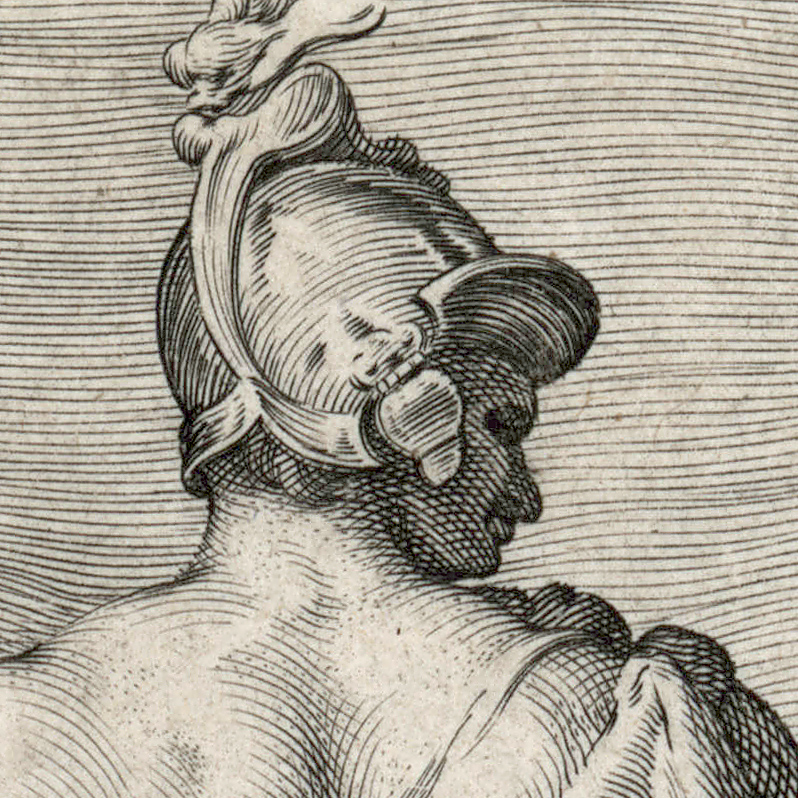
“Plate 3: Mars presiding over the arts of war. A statue of Mars seen from behind, surrounded by soldiers and cavalry, a drummer seen from behind and stooping in foreground; zodiacal signs (Aries and Scorpio) in top corners; second state with number; after Hendrik Goltzius. 1596 Engraving” (https://www.britishmuseum.org/collection/object/P_D-5-251 ).

See also the description of this print offered by the Rijksmuseum: http://hdl.handle.net/10934/RM0001.COLLECT.169371.

Condition: a well-printed early impression (based on the quality of line showing no sign of wear to the printing plate), trimmed slightly within the platemark and laid upon an archival support sheet of millennium quality washi paper. The two upper corners have been replenished, otherwise the sheet is in a good condition with no significant stains or foxing.

I am selling this masterpiece of engraving exemplifying the period style of Mannerism, for the total cost of AU$438 (currently US$303.54/EUR296.74/GBP248.90 at the time of this listing) including Express Mail (EMS) postage and handling to anywhere in the world, but not (of course) any import duties/taxes imposed by some countries.

If you are interested in purchasing this engraving executed with exceptional sensitivity by one of the most famous of the old master printmakers, please contact me (oz_jim@printsandprinciples.com) and I will send you a PayPal invoice to make the payment easy.

This print has been sold