Monday, 22 February 2021

Philips Galle’s engraving, “Rodanus”, 1586

Philips Galle (aka Philippe Galle; Philippus Gallaeus) (1537–1612)

Rodanus”, 1586, plate 14 from the series of seventeen plates (TIB 5601.090:1–17; Hollstein 316-32), “Semideorum Marinorum Amnicorumque Sigillariæ Imagines Perelegantes” (aka “Sea and River Gods”), published by Philips Galle in Antwerp.

Edition-Originale.com offer a superb description of the publication of this series and images of the plates: https://www.edition-originale.com/en/antique-books-1455-1820/editions-originales/-semideorum-marinorum-amnicorumque-1586-50148.

Engraving on laid paper, trimmed with thread margins close to the image borderline and backed with a support sheet.

Size: (sheet) 16.8 x 10 cm.

Lettered and numbered on plate below the image borderline: (left) “Phls Gall. Inue./ et fecit.”; (centre) “RODANVS.”; (right) “14.”

State i (of ii) Note that the attribution of this impression to the first state is based on the text line being the same as the first state impression held by the Rijksmuseum (RP-P-1898-A-19958; 1942,0720.1.36).

TIB 1987 5601.090:14 (Arno Dolders [ed.] 1987, “The Illustrated Bartsch: Netherlandish Artists: Philips Galle”, vol. 56, Supplement, New York, Abaris Books, p. 351, cat. no. [5601].090:14); New Hollstein Dutch 426-1 (2) (Marjolein Leesberg & Manfred Sellink [comp.] 2001, Rotterdam, “The New Hollstein: Dutch and Flemish Etchings, Engravings and Woodcuts 1450–1700: Philips Galle”, Sound and Vision, p. 115; p. 130 [fig.], cat. no. 426).

The British Museum offers the following description of this print:

“Personification of the river Rhone as a youthful, nude male figure holding an oar and seated on a rock at the water's edge amongst the reeds, his foot resting on a large seashell spilling water”

(https://www.britishmuseum.org/collection/object/P_1942-0720-1-36).

See also the description offered by the Rijksmuseum:”

http://hdl.handle.net/10934/RM0001.COLLECT.114835.

Condition: well-printed impression trimmed with thread margins around the image borderline and has been laid upon a support sheet of archival (millennium quality) washi paper. The sheet is in an excellent condition with no tears, holes, folds, stains or foxing.

I am selling this Renaissance period engraving showing the river god of the Rhone holding an oar while his foot rests on a trident shell outflowing with water (symbolic of the figure’s personification as a river god), for AU$338 (currently US$267.75/EUR219.94/GBP190.14 at the time of this listing) including Express Mail (EMS) postage and handling to anywhere in the world, but not (of course) any import duties/taxes imposed by some countries.

If you are interested in purchasing this marvellous print engraved only a couple of decades after Michelangelo put down his brushes after completing the “Last Judgement” in the Sistine Chapel, please contact me (oz_jim@printsandprinciples.com) and I will send you a PayPal invoice to make the payment easy.

This print has been sold


Eugène Delacroix’s etching, “Tiger Lying in the Desert”, c1846

Eugène Delacroix (aka Ferdinand Victor Eugène Delacroix) (1798–1863)

Tiger Lying in the Desert” (aka “Tigre Couché dans le Désert”), c1846, printed by Auguste Delâtre (1822–1907) and published in “L'Artiste" in its sixth and final state on 1st January 1870 (plate insert between pages 56 and 57) in Paris. This impression is from the published state in “L'Artiste.”

Etching with roulette, drypoint, foul-biting, sandpaper scratches and burnishing on wove paper with full margins as published.

Size: (sheet) 18.2 x 26.7 cm; (plate) 8.7 x 13.4 cm; (image borderline) 7.4 x 12.5 cm.

Inscribed on plate below the image borderline: (left) “Eug. Delacroix”; (right) “Imp. Delâtre, Paris.

State vi (of vi), published state with the printer’s publication details.

Delteil/Strauber 24 vi (Loys Delteil, Susan Strauber [transl. & rev.] 1997, “Delacroix: The Graphic Work: A Catalogue Raisonné”, San Francisco, Alan Wofsy Fine Arts, pp. 60–63, cat. no. 24); IFF 22 (Département des Estampes 1930–, “Inventaire du Fonds Francais Après 1800”, vol. 6, Paris, Bibliothèque Nationale de France, p. 122, cat. no. 22).

The British Museum offers the following description of this print from an earlier state:

“In the centre foreground, with head on ground and paws in front and to one side; dunes in the background”

(https://www.britishmuseum.org/collection/object/P_1862-1011-682).

See also the descriptions of this print offered by the Rijksmuseum:

http://hdl.handle.net/10934/RM0001.COLLECT.102950 & http://hdl.handle.net/10934/RM0001.COLLECT.102949.

The Metropolitan Museum of Art offers the following very interesting insights regarding the time that Delacroix executed this print:

“Eugène Delacroix worked alongside the artist Antoine-Louis Barye (1796–1875) on numerous animal studies between 1828–1830 in the Jardin des Plantes in Paris. During this time, he studied the anatomy of cats in detail, even observing their dissections, which resulted in successful works on paper and paintings depicting tigers in the years to follow. His contemporary Théophile Gautier (1811–1872) once likened the artist to his subject matter: ‘He was mellow, soft as velvet, seductive as one of those tigers whose extraordinary supple grace he excelled in rendering.’"

(https://www.metmuseum.org/art/collection/search/337305).

Condition: a richly-inked impression with full margins as published in pristine condition.

I am selling this rare etching executed by Delacroix (as opposed to prints by other artists after Delacroix’s design), for the total cost of [deleted] including Express Mail (EMS) postage and handling to anywhere in the world, but not (of course) any import duties/taxes imposed by some countries.

If you are interested in purchasing this small etching by Delacroix that not only exemplifies his intense fascination with tigers, but also reveals in the portrayed animal’s “supple grace”, something of the artist’s own “mellow, soft as velvet” disposition—as proposed by Théophile Gautier (see MET description of this print)—please contact me (oz_jim@printsandprinciples.com) and I will send you a PayPal invoice to make the payment easy.

This print has been sold


Sunday, 21 February 2021

Jan Sadeler I’s engraving, “Asher and Naphthali”, 1585, after Crispijn van den Broeck

Jan Sadeler I (aka Johannes Sadeler; Johann Sadeler; Johan Sadeler) (1550–1600)

“Asher and Naphthali”, 1585, plates 9 and 10 from the series, “The Patriarchs of the Twelve Tribes of Israel” (TIB title; see 7001.065–.070, p. 90), after Crispijn van den Broeck (aka Chrispijn van den Broecke; Paludanus) (1524–1589/91), originally published in Antwerp in 1585 by Gerard de Jode (aka Geeraert de Jode; Geerart de Jode; Gerardo de Jode; Gheerde de Jode; Gheraerde de Jode; Girard de Jode; Gerard de Jode (1516/17–1591) before titling on the plate (state i) in “Thesaurus Sacrarum Historiarum Veteris Testamenti”. This impression with the titles to both images (state ii) was published in “Theatrum Biblicum” by Claes Jansz. Visscher (aka Nicolaes Jansz.Visscher; Nicolas Joannis Visscher II; Piscator) (1587–1652) in 1643 in Amsterdam.

Engraving of two compositions (“Aser” and “Naphthali”) printed from a single plate on fine laid paper with wide margins backed with a support sheet.

Size: (sheet) 28.3 x 35.8 cm; (plate) 22 x 31.3 cm.

Lettered on plate: (upper left of centre) “ASLER”; (upper right) “NAPHTHALI”; (lower centre) “.9.”; (lower right) “.10”; (below the image borderlines) “Pingue solum …/ …// …/ … dapes// […] Neptalin ex multis …/ …// …/ … fuit.”

State ii (of ii) with the addition of the titles and correction of the word “Pingne” to “Pingue”.

TIB 7001.069 S2 (Isabelle de Ramaix & Walter L Strauss [eds.] 1999, “The Illustrated Bartsch: Johan Sadeler I”, vol. 70, Part 2 [Supplement], New York, Abaris Books, pp. 96–97, cat. no. [7001].069.S2); Mielke, no. 9.5; Hollstein 1980, vol. 21, no. 70.

Condition: a well-printed impression showing no sign of wear to the printing plate and laid onto a support of archival (millennium quality) washi paper. There is a tear to the margin at lower left otherwise the sheet is in very good condition for its considerable age with no significant stains or foxing.

I am selling this very rare impression with the two images of Patriarchs of Israel intact on the same sheet—they are usually cut into separate images as is the case with the impressions held by the British Museum (https://www.britishmuseum.org/collection/object/P_1968-1018-1-49 & https://www.britishmuseum.org/collection/object/P_1968-1018-1-48)—for the total cost of AU$306 (currently US$240.87/EUR198.64/GBP171.94 at the time of posting this print) including Express Mail (EMS) postage and handling to anywhere in the world, but not (of course) any import duties/taxes imposed by some countries.

If you are interested in purchasing this pair of sensitively executed images of Jacob’s sons, please contact me (oz_jim@printsandprinciples.com) and I will send you a PayPal invoice to make the payment easy.

This print has been sold 


Saturday, 20 February 2021

Jan Collaert II’s etching, “King Arsaces Tries to Tame a Leopard”, 1596, after Jan van der Straet

Jan Collaert II (aka Jan Collaert; Hans Collaert) (c1561–c1620)

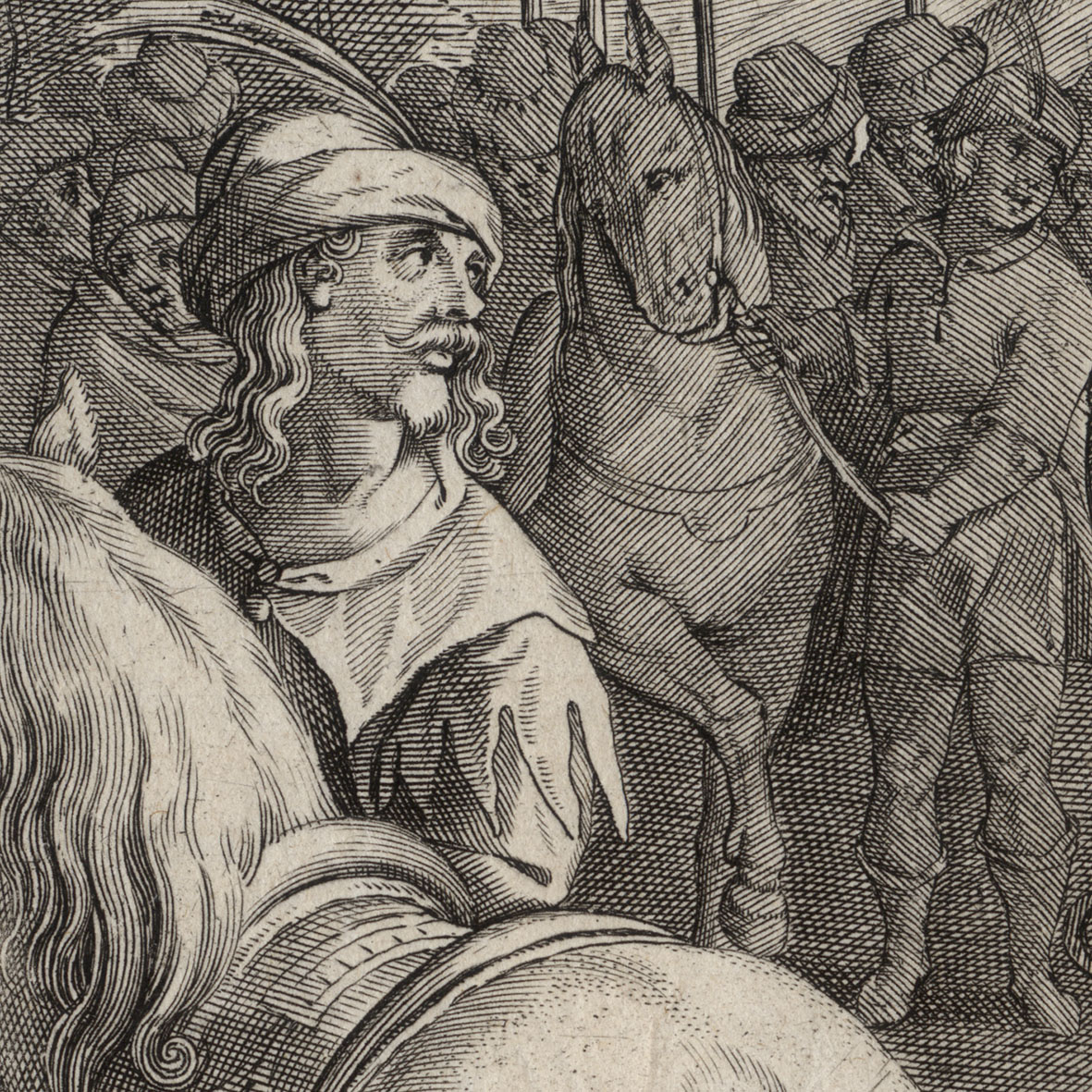
King Arsaces Tries to Tame a Leopard (Koning Arsaces tracht een luipaard te temmen [Rijksmuseum title]) (aka King Arsaces Dedicating a Panther to Dionysus [MIA title]), 1596, plate 9 from the series of 104 plates, Venationes Ferarum, Avium, Piscium. Pugnae Bestiariorum: & mutuae Bestiarum, after the ink drawing by Jan van der Straet (aka Joannes Stradanus; Ioannes Stradanus) (1523–1605) (see https://collections.artsmia.org/art/9211/king-arsaces-dedicating-a-panther-to-dionysus-joannes-stradanus), with Latin text by Cornelis Kiliaan (c1529–1607), published by Philips Galle (aka Philippus Gallaeus; Philippe Galle) (1537–16120) in Antwerp.

Engraving on laid paper (watermark from 1625 [see WA Churchill 1965, Watermarks in Paper, p. 235/CCXLV, no. 312]) with small margins.

Size: (sheet) 21.6 x 28.3 cm; (plate) 18.7 x 26.3 cm; (image borderline) 18.2 x 26.1 cm.

Inscribed on plate within the image borderline along lower edge: (left of centre) “'Ioan. Stradanus inuent. […] Ioan. Collaert Sculp.”; (right) “Phls Galle excud.”

Numbered and lettered on plate below the image borderline: (left) “9.”; (centre) “Magnus Parthorum maculis Rex versicolorem/ Venatu nactus Pantheram, ornare monili,// Atque feram facili satagit ratione domare: Sed domita in siluas demum transcurrit agrestes.”

New Hollstein Dutch 505 (Johannes Stradanus) (Marjolein Leesberg [comp.] 2008, The New Hollstein: Dutch and Flemish Etchings, Engravings and Woodcuts 1450–1700: Johannes Stradanus, vol. 3, Ouderkerk aan den Ijssel, Sound and Vision, p. 191; p. 220 [illus.], cat. no. 505); New Hollstein Dutch 1501 (Collaert Dynasty) (Ann Diels & Marjolein Leesberg [comp.] 2005–06, The New Hollstein: Dutch and Flemish Etchings, Engravings and Woodcuts 1450–1700: The Collaert Dynasty, vol. 8, Ouderkerk aan den Ijssel, Sound and Vision, p.196; p.210 [illus.], cat. no. 1501)

The Rijksmuseum offers the following description of this print:

(Transl.) “King Arsaces of the Parthians surrounded by his retinue. He has a leopard on a leash next to him. In the background, this tamed leopard walks away. The print has a Latin caption and is part of a series about hunting scenes”

(http://hdl.handle.net/10934/RM0001.COLLECT.97373).

See also the British Museum’s description:

“Panther Caught and Tamed by King Arsaces; centre, King Arsaces tames the panther; another male figure, carrying a bow and arrows, places two fingers on the panther's back; to the left and right, two men look on in amazement; behind, a group of hunters, some holding spears, watch the scene; to far right, a panther runs amongst the trees”

(https://www.britishmuseum.org/collection/object/P_1901-0611-47).

Condition: a near faultless impression in almost pristine condition with no tears, holes, folds, abrasions, losses, stains, foxing or signs of handling.

I am selling this rare and remarkable engraving showing the first king of Parthia (north-eastern Iran) about to touch a tame leopard he holds with a leash—please don’t ask me what happened to the tips of the king’s fingers as they seem to have disappeared!—for the total cost of AU$319 (currently US$251.10/EUR207.08/GBP179.25 at the time of this listing) including Express Mail (EMS) postage and handling to anywhere in the world, but not (of course) any import duties/taxes imposed by some countries.

If you are interested in purchasing this exceptionally fine Renaissance period engraving pf Iranian historical significance, please contact me (oz_jim@printsandprinciples.com) and I will send you a PayPal invoice to make the payment easy.

This print has been sold


Friday, 19 February 2021

Circle of Cornelis Galle II & Pierre de Loisy II’s engraving, “Order of the Golden Fleece”, 1632

Unidentified printmaker from the circle of Cornelis Galle II (1615–1678) (based on the close connection of Cornelis Galle II with the Plantin Press in Antwerp where this print was published and stylistic similarities [see https://www.britishmuseum.org/collection/object/P_O-5-173) and Pierre de Loisy II (1619-1670) (based on Pierre de Loisy II’s role as illustrator for another publication [Vesontio Civitas Imperialis Libera Sequanorum Metropolis, 1618] by the same author for which this print served as the title page).

Order of the Golden Fleece, 1632, possibly after Peter Paul Rubens (aka Petrus Paulus Rubens; Rubenius) (1577–1640), title page to Jean-Jacques Chifflet‘s (aka Chiflet) (1588–1660) Insignia Gentilitia Equitum Ordinis Velleris Aure, published by Balthasar Moretus I (aka Balthasar Moerentorf I) (1574–1641) in Antwerp.

I understand that this publication arose from the Archduchess Isabella Clara Eugenia, Sovereign of the Netherlands, having given Chifflet the “responsibility to write the history of the Order of the Golden Fleece”—a mission purportedly designed “to keep him near her” (see Camille Sourget Librairie: https://camillesourget.com/en-13028-rare-books-first-edition-precious-books-chifflet-jean-jacques-lilium-francicum-veritate-historica-botanica-a-very-pure-copy-preserved-.html).

Archive.org offers an online view of this print in its context as published along with its full publication details:

https://archive.org/details/bub_gb_ffk1prDJdOMC/page/n5/mode/2up.

The British Museum offers the following description of this print:

“Allegory of the origin of the Order of the Golden Fleece; at centre Jason holding the dead ram in his right hand and stepping onto a defeated dragon while leaning on his club; the Argonauts in a ship in left background and a tree with a scroll in right background; within oval decorated with the chain of the Golden Fleece; frame surrounded by decorative flames and with scroll at bottom”

(https://www.britishmuseum.org/collection/object/P_1891-0414-926).

Engraving on laid paper trimmed around the platemark and backed with a support sheet.

Size: (sheet) 20 x 13.9 cm; (image borderline) 19.5 x 13.5 cm.

Lettered on plate: (upper banderole) “PRETIVM CVRSVS AVREA PELLIS" (The price of our cruise is the golden coat); (oval banderole) “IGNEVS EST NOSTRIS VIGOR ET CAELESTIS ORIGO PRINCIPIBVS.” (Our princes have a fiery power and a heavenly origin); (lower banderole) "MERCES PRIMÂ DIGNA CARINÂ." (A wage worthy of the first ship).

Note: the translations for the Latin inscriptions (and many other details about this print) have been extracted from the exceptional essay by Andries Welkenhuysen (2007), “Aries seu Aurei Velleris encomium of Godefridus Wendelinus” (The Gulden Passer, vol. 85: https://www.dbnl.org/tekst/_gul005200701_01/_gul005200701_01_0004.php).

Condition: a strong and well-printed impression in excellent condition, trimmed around the platemark and laid onto a support sheet of archival (millennium quality) washi paper.

I am selling this amazing engraving showing Jason holding aloft with his right hand the golden fleece—a tiny one! —while simultaneously crushing the head of the Colchian dragon with his club with his other hand watched in the distance by his fellow Argonauts n their ship, the Argo, for the total cost of AU$245 (currently US$192.29/EUR158.39/GBP137.39 at the time of this listing) including Express Mail (EMS) postage and handling to anywhere in the world, but not (of course) any import duties/taxes imposed by some countries.

If you are interested in purchasing this title plate for descriptive explanations about the coats of arms of the eight grand masters of the Order of the Golden Fleece, please contact me (oz_jim@printsandprinciples.com) and I will send you a PayPal invoice to make the payment easy.

This print has been sold