Monday, 26 June 2023

Ferdinand Gaillard’s engraving, “Léon XIII”, 1880

Ferdinand Gaillard (aka Claude-Ferdinand Gaillard) (1834–1887)

“Léon XIII”, 1880, engraving of Pope Leo XIII (aka Gioacchino Vincenzo Pecci) (1810-1903), printed by Charles Chardon aîné (fl. mid-1800s; Charles Chardon [1832–1896]) and published in Paris in the art periodical, “Gazette des Beaux Arts” (1st September, 1880), inserted between pages 210 and 215.

The Curator of the British Museum advises: “The print was exhibited at the Paris Salon in 1880 (no.7010)” (https://www.britishmuseum.org/collection/object/P_1981-U-435).

Engraving on chine collé on wove paper trimmed with a small margin around the platemark and backed with a support sheet providing wide margins.

Size: (sheet) 24.9 x 17.2 cm; (plate) 23.7 x 16.8 cm; (chine collé) 22.3 x 15.3 cm; (image borderline) 17.3 x 13 cm.

Lettered in plate below the image borderline: (left) “F. GAILLARD del. et sc./ Gazette des Beaux Arts”; (centre) “LÉON XIII”; (right) “Salon de 1880/ Imp. Ch. Chardon aîné”.

Final state as published in the Gazette des Beaux-Arts. According to Beraldi (1887), the final state is state vi (of vi) but this must be a state after the sixth as the lettering does not match Beraldi’s description (see p. 204).

Beraldi 39 (Henri Beraldi 1887, “Les Graveurs du dix-neuvième siècle”, Paris, Librairie L. Conquet, vol. 6, pp. 204–07, cat. no. 39; see: https://archive.org/details/lesgraveursdu19e06berauoft/page/204/mode/2up); IFF 68.

For a superb analysis of Gaillard’s contribution and historical context, see Stephen Bann’s article, “Photography by Other Means? The Engravings of Ferdinand Gaillard” in “The Art Bulletin”, vol. 88, No. 1 (Mar., 2006), pp. 119–138 (https://www.jstor.org/stable/25067228).

Condition: a strong and well-printed (near faultless) impression trimmed with a small margin around the platemark and laid upon an archival support sheet of millennium quality washi paper. The sheet is in an excellent condition with no tears, holes, folds, abrasions, stains or foxing.

I am selling this exceptionally fine and very beautiful engraving by one of most famous of the nineteenth century engravers who is described by Félix Bracquemond as the “continuer and renovator of burin engraving” (see Bann [2006], p. 124), for the total cost of AU$208 (currently US$139.03/EUR125.79/GBP110.73 at the time of this listing) including postage and handling to anywhere in the world (but not, of course, any import duties/taxes imposed by some countries).

If you are interested in purchasing this remarkable print by an engraver with skills that (arguably) will never be surpassed—note the finely rendered, near microscopic, details that are inscribed solely by hand—please contact me (oz_jim@printsandprinciples.com) and I will send you a PayPal invoice to make the payment easy. 


Sunday, 25 June 2023

Jan Saenredam’s engraving, “Adam and Eve Mourning the Death of Abel”, 1604, after Abraham Bloemaert


Jan Saenredam (aka Jan Pietersz. Saenredam; Jan Pietersz. Zaenredam; Jan Pieterszoon Saenredam) (c1565–1607)

“Adam and Eve Mourning the Death of Abel” (aka “Adam en Eva treuren om de dood van Abel“; “Adam et Ève Pleurant la Mort d'Abel”; “Adam and Eve Lamenting the Slain Abel”),1604, plate 6 from the series of six engravings, “Story of Adam” (TIB title) (aka “The story of Adam and Eve”), after the design by Abraham Bloemaert (aka Abraham Bloemaart) (1564–1651) and published by Jan Saenredam.

Engraving with restorations to fractures on the edges and retouching of early brown ink linework over the upper body of Eve (possibly to conceal Eve’s nudity by adding clothes). The sheet has been trimmed with a thread margin around the image borderline (with loss of the text lines below the image) and backed with a support sheet.

Size: (sheet) 26.5 x 19.8 cm; (image borderline) 26.4 x 19.5 cm.

Inscribed in plate: (lower centre) “A. Bloemaert inue./ J. Saenredam Sculp. 6”.

TIB 4.18 (Walter L. Strauss [ed.] 1980, “The Illustrated Bartsch: Netherlandish Artists: Matham; Saenredam; Muller”, vol., 4, New York, Abaris Books, p. 327, cat. no. 18); Hollstein Dutch 6 (George Shepard Keyes [comp.] 1980, “The New Hollstein: German Engravings, Etchings and Woodcuts c1450–1700: Jan Saenredam to Roelandt Savery”, vol., 23, Amsterdam, Van Gendt & Co, p. 8, cat. no. 6); Roethlisberger 77 (Marcel G. Roethlisberger 1993, “Abraham Bloemaert and His Sons: Paintings and Prints”, vol. 1, Davaco, Doornspuk, p. 125, cat. no. 77).

The British Museum offers the following description of this print: “The elderly Adam and Eve lament over the corpse of Abel; a jawbone lies discarded on the ground lower right corner; after Bloemaert” (https://www.britishmuseum.org/collection/object/P_1856-0815-56).

See also the Rijksmuseum’s description of this print which adds further insights: [transl.) “Adam and Eve find the dead Abel at the place of sacrifice. Both are on their knees before their son's corpse and mourn. In the background the sacrifice of Abel and Cain and the murder of Abel” (http://hdl.handle.net/10934/RM0001.COLLECT.169222).

Condition: a strong and well-printed impression with restored fractures on the edges and retouched early brown ink linework over the upper body of Eve (to lessen the visual distraction). The sheet has been trimmed with a thread margin around the image borderline and laid onto a support of archival (millennium quality) washi paper providing wide margins.

I am selling this magnificent engraving with its interesting past life revealed by a previous collector’s endeavours to hide the nudity of Eve by adding a drawn a short-sleeved garment to conceal her breasts—the brown ink additions have been retouched to lessen their visual distraction—for the total cost of AU$349 (currently US$233.27/EUR211.06/GBP185.80 at the time of this listing) including postage and handling to anywhere in the world, but not (of course) any import duties/taxes imposed by some countries.

If you are interested in purchasing spectacularly fine engraving, please contact me (oz_jim@printsandprinciples.com) and I will send you a PayPal invoice to make the payment easy.

This print has been sold


Saturday, 24 June 2023

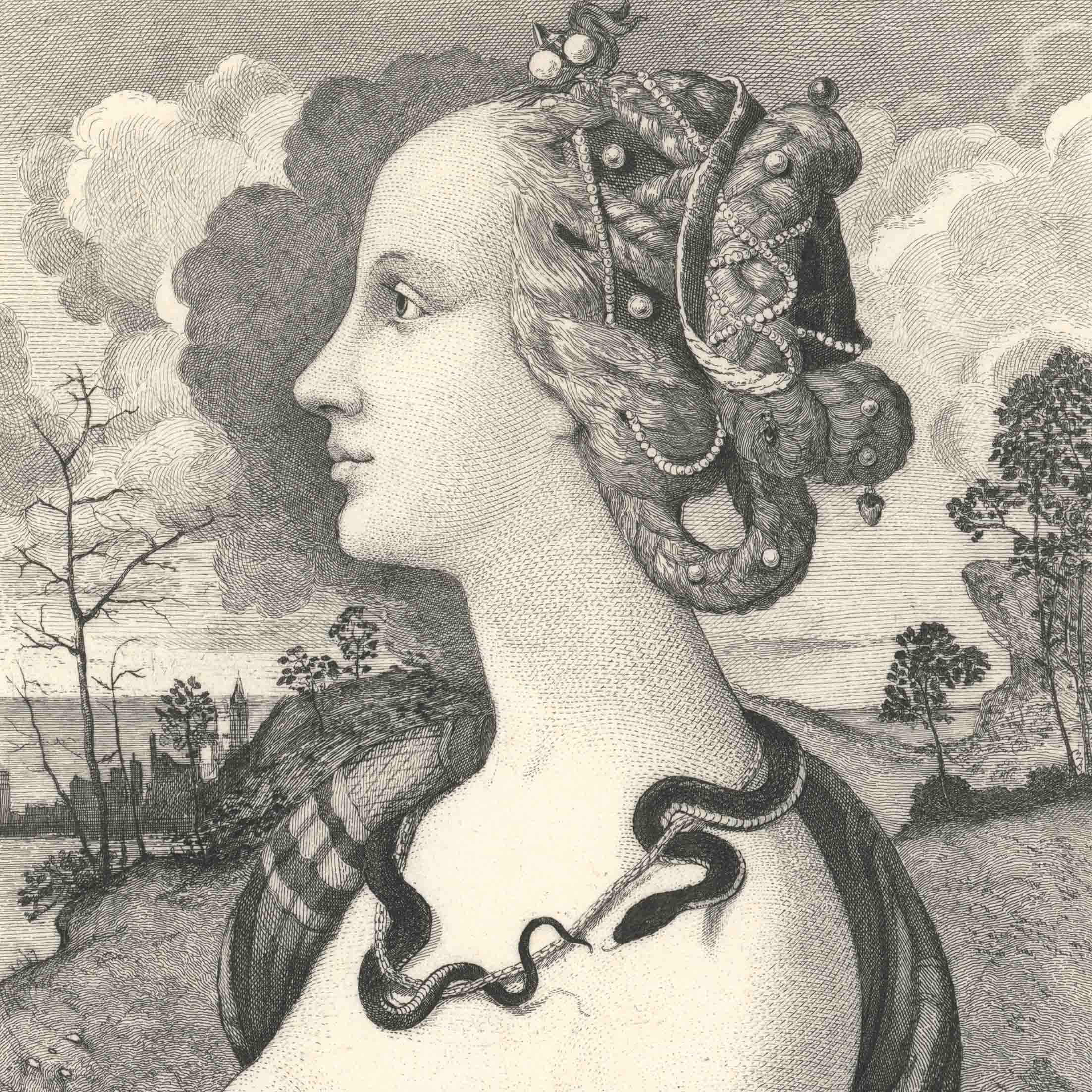
Tiburce de Mare’s etching with engraving, “Simonetta Vespucci”, 1880, after Piero di Cosimo

Tiburce de Mare (1840–1900)

“Simonetta Vespucci” (aka “Simonetta Ianvensis Vespvccia”)—Simonetta Vespucci (1453–1476) is the mistress of Guiliano de' Medici, portrayed in this portrait as Cleopatra and is purported to be the face of Venus in Sandro Botticelli’s “The Birth of Venus”—1880, after Piero di Cosimo’s (aka Pietro di Lorenzo di Chimenti; Piero di Lorenzo) (1461/2–1522) “Portrait de femme dit de Simonetta Vespucci”, 1490, in the Musée Condé, Chantilly (see https://en.wikipedia.org/wiki/Portrait_of_Simonetta_Vespucci), formerly attributed to Antonio Pollaiuolo (aka Antonio di Jacopo Benci) (1433–1498) (as inscribed in plate) (see https://www.musee-conde.fr/fr/notice/pe-13-portrait-de-femme-dit-de-simonetta-vespucci-2e175c26-93ad-4455-bdb4-a2aa2c260da3), printed by Charles Chardon aîné (fl. mid-1800s; Charles Chardon [1832–1896]) and published in Paris in the art periodical, “Gazette des Beaux Arts”, 1st December 1880, inserted between pages 482 and 483.

Etching with engraving on chine collé on wove paper, trimmed around (or slightly within) the platemark and backed with a support sheet.

Size: (sheet) 23.8 x 16.8 cm; (chine collé) 22 x 15.1 cm; (image borderline) 18 x 13.2 cm.

Inscribed in plate within the image borderline along the lower edge: “SIMONETTA IANVENSIS VESPVCCIA”.

Lettered in plate below the image borderline: (left) “A. Pollajuolo, pinxt./ Gazette des Beaux-Arts”; (centre) “SIMONETTA VESPUCCI/ ( GALERIE DE MGR LE DUC D’AUMALE. )”; (right) T. de Mare, sculpt./Imp. Ch. Chardon ainé.”

Beraldi [not described] (Henri Beraldi 1888, “Les Graveurs du Dix-Neuvième Siècle: Laemlein–Mécou”, vol. 9, Paris, Librairie L. Conquet, p. 216).

Condition: a strong and well-printed impression trimmed with a small margin around the chine collé and laid upon an archival support sheet of millennium quality washi paper providing wide margins. There are several dot marks/stains in the margin at upper-left, otherwise the sheet is in an excellent condition with no tears, holes, folds, abrasions, significant stains or foxing.

I am selling this jewel-like portrait of a famously beautiful Florentine woman who sadly passed away from Tuberculosis at the age of only twenty-three—shown here in guise of Cleopatra with the snake (possibly about to bite its tail) around her neck as an allegory for death (along with the dark cloud surrounding her head and the dead tree at left), mindful that this portrait was commissioned by her lover (Guiliano de' Medici) after the beautiful woman had passed away, for AU$188 (currently US$125.66/EUR113.70/GBP100.09 at the time of posting this print) including postage and handling to anywhere in the world (but not, of course, any import duties/taxes imposed by some countries).

If you are interested in purchasing this stunningly beautiful etching (with engraving) executed by a pupil of one of the most important (or at least one of my favourites) of the 19th century engravers, Ferdinand Gaillard (1834–1887), please contact me (oz_jim@printsandprinciples.com) and I will send you a PayPal invoice to make the payment easy.


Friday, 23 June 2023

Paul Borel’s etching, “Alpine Landscape Around Isère”, c1880

Paul Borel (aka André Marie Paul Borel) (1828–1913)

“Alpine Landscape Around Isère” (descriptive title only and forgive me if I am wrong about the location; the title proposed by the original dealer from whom I purchased this etching is “Paysage de Montagne” [Mountain Landscape]), c1880, a proof-state impression that is unsigned and before lettering with title and publication details, printed in cream chine collé on heavy wove paper.

Size: (sheet) 25.4 x 31.7 cm; (plate) 15.9 x 24 cm; (chine collé) 14.5 x 22.2 cm; (image borderline) 12.8 x 21.4 cm.

For those unfamiliar with this startlingly fine etcher (as exemplified in this wonderful etching), Paul Borel was introduced to etching by his cousin Jean Jacques de Boissieu (aka Jean Jacques de Boissieux) (1736–1810) and the outcome of this connection in terms of transferred skills is clear. Borel is also well-connected to the artists of the Barbizon School (notably Charles Daubigny [aka Charles François Daubigny] [1817–1878]) and the shared joy of working directly on the etching plate is also very apparent. What I find especially appealing about Borel’s etchings is the merging of informed observation of his chosen subject (e.g., his portrayed rocks look solid and “real” and the cascading of water is believable) with the added dimension of revealing a personal mindset—in this print, for instance, the formation of the rocks might be seen as nature’s claws and the pine trees on the right as expressions of upward moving transcendent energies. In lots of ways, this perfect merging of reality with personal response is the key that makes Borel a marvellous artist; an artist who (I think) compares well with Adolphe Appian (1818–1898).

Condition: a richly inked, strong, and near faultless impression in a near pristine condition.

I am selling this marvellous proof-state etching (unsigned and before lettering with title and publication details) that is so rare I have been unable to find another copy of it online, for the total cost of AU$269 (currently US$179.80/EUR162.68/GBP143.21 at the time of this listing) including postage and handling to anywhere in the world, but not (of course) any import duties/taxes imposed by some countries.

If you are interested in purchasing this remarkably fine and luminous etching, please contact me (oz_jim@printsandprinciples.com) and I will send you a PayPal invoice to make the payment easy.

This print has been sold


Thursday, 22 June 2023

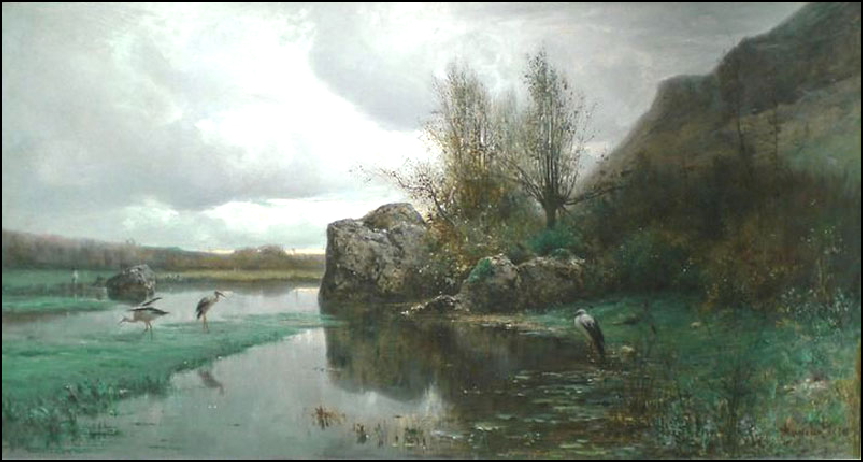
Adolphe Appian’s etching, “Marais de la Burbanche (Ain)”, 1868

Adolphe Appian (1818–1898)

Marais de la Burbanche (Ain)” (aka “Marsh of the Burbanche”), 1868, after Appian’s painting, “Temps gris, marais de la Burbanche” (Gray weather, marsh of the Burbanche) (see an image of this painting at henribidauld.com: http://www.henribidauld.com/wpimages/wp765ea859_06.png), shown in the 1869 Paris Salon, printed Auguste Delâtre (aka Auguste Marie Delâtre) (1822–1907) and published in Paris by Cadart et Luce (fl. 1867–1870/1) as plate 36 in “L'Illustration Nouvelle”, vol. 1, in 1868 (see https://gallica.bnf.fr/ark:/12148/btv1b8527596n/f52.item).

In Hamerton’s 1876 edition of “Etching and Etchers”, Hamerton offers the following interesting insights about Appian’s prints: “…his [Appian’s] work is that each plate, however large or however small it may be, is conceived from the first as a whole, and the first conception is never departed from for the disproportionate realisation of some obtrusive detail.” Going further, “…Appian sees always in masses, and gives quite as much detail as is consistent with the preservation of the mass” (pp. 202–03).

Etching with pale plate tone on fine laid paper with “ARCHES” watermark and full margins as published.

Size: (sheet) 31 x 48.5 cm; (plate) 13.7 x 23.7 cm; (image borderline) 10.4 x 19.5 cm.

Inscribed in plate within the image borderline: (upper left corner) “APPIAN 1868”.

Numbered in plate above the image borderline: (right) “36.”

Lettered in plate below the image borderline: (left) “A.Appian sc.”; (centre) “MARAIS DE LA BURBANCHE (AIN)/ CADART & LUCE Editeurs Rue Nve. des Mathurins, No.58.”; (right) “Imp.Delâtre,Paris.”

State ii (of iv) before the change of publication details.

Curtis & Prouté 26 ii (Atherton Cutiis & Paul Prouté 1968, “Adolphe Appian son Oeuvre Gravé et Lithographié”, Paris, Paul Prouté, [n.p.] cat. no. 26 ii); Jennings 23 (Herbert H Jennings 1925, Adolphe Appian (essay) in “Print Collector’s Quarterly,” vol. 12, no. 1, p. 115, cat. no. 23 [see https://digi.ub.uni-heidelberg.de/diglit/print_collectors_quarterly1925/0134/scroll]).

Condition: a richly inked, strong and near faultless impression with exceptionally generous full margins (as published). The sheet is in a remarkably fine condition for its large size with no tears, holes, folds, abrasions, significant stains or foxing.

I am selling this superb etching of marshlands before rain that to my eyes captures a melancholic mood with a heavy—almost oppressive—atmosphere, for the total cost of AU$315 (currently US$210.55/EUR190.50/GBP167.70 at the time of this listing) including postage and handling to anywhere in the world, but not (of course) any import duties/taxes imposed by some countries.

If you are interested in purchasing this superb etching executed by an artist with a strong personal vision and close connection with the Barbizon School, please contact me (oz_jim@printsandprinciples.com) and I will send you a PayPal invoice to make the payment easy.