Friday, 12 August 2016

Flameng’s etching, “Deliverance of the Captives of Carcassonne”


Léopold Flameng (aka Léopold Joseph Flameng) (1831–1911)
“Délivrance des Emmurés de Carcassonne”(Deliverance of the Captives of Carcassonne), 1879, after a painting by Jean Paul Laurens (1838–1921) exhibited in the Salon of 1879, printed by Alfred Salmon (fl. 1863–94),” first published in “L'Art, 1879. This impression is from the sumptuous double volumes of MK Halévys “L’Eau-Forte”, 1888.
Etching on heavy cream wove paper (Japan/Arches)
Size: (sheet) 40.1 x 28.5 cm; (image borderline) 28.6 x 22.7 cm
Numbered above image: “Planche XXXIV”
Beraldi 1885-92 207; IFF 248

The British Museum offers the following description of this print:
“Bernard Délicieux freeing prisoners from the Inquisition's jail in Carcassonne, after Laurens; the Franciscan friar stands on the left and addresses a crowd with both hands in the air while on the right a group of men is destroying the wall blocking the entrance of the jail; published in “L'Art, 1879” (http://www.britishmuseum.org/research/collection_online/collection_object_details.aspx?objectId=3496274&partId=1&searchText=flameng+Laurens&page=1)

Condition: strong, well-inked and well-printed impression in good condition (i.e. there are no significant stains, tears, folds or signs of foxing, but there is a band of age-toning verso).

I am selling this original etching (with engraving) by Flameng for a total cost of ... [deleted] including postage and handling to anywhere in the world.
If you are interested in purchasing this fine print by one of the leading reproductive printmakers of the 19th century, please contact me (oz_jim@printsandprinciples.com) and I will send you a PayPal invoice to make the payment easy.


MK Halévy, in the first volume of “L’Eau-Forte” (1888), offers a good account of what is illustrated in this etching by Léopold Flameng after Jean Paul Laurens’ painting of the same name (now in the Luxembourg museum):
“The people of Carcassonne have just attacked the wall of the inquisitorial dungeons to release the prisoners. In the centre, Jean de Picquigny, reformer of Languedoc, stands watching the invasion which he cannot prevent; the brother-miner, Bernard Délicieux, strives to pacify the mob” (p. xvi). (For those unfamiliar with this incident, the “storming” of the prison occurred in 1303 involving not only the local folk of Carcassonne, but also those of Albi.)

At the time of executing this print, Flameng was famous as a reproductive printmaker (i.e. an artist who translates paintings and other artworks into prints). His reputation was established by his very first etching: a copy of Rembrandt’s “Hundred Guilder Print” (see his graphic translation at https://www.artsy.net/artwork/leopold-flameng-after-rembrandt-van-rijn-the-hundred-guilder-print). This print was so good that Charles Blanc exclaimed: “He has imitated Rembrandt to a point that would deceive the master himself were he to return to this world” (FL Leipnik, 1924, p. 119).

Although this graphic translation is far from the incredibly sensitive rendering of Rembrandt’s masterpiece, I wish to draw attention to his treatment of the children portrayed in this print. Few artists have the skill to render the fine facial features of children when they are bathed in light. Note for example how Flemeng creates white lines to represent the children’s blonde hair, a feat that is not so straight forward when one is making an image only using black lines.


Thursday, 11 August 2016

Lépicié’s engraving “Le Bénédicité”, after Chardin


Bernard Lépicié (aka François Bernard Lépicié; Bernard L'Epicie; Bernard Lépicier) (1698–1755)
“Le Bénédicité” (The Grace), 1744, after a painting by Jean Baptiste Siméon Chardin (1699–1779), published by Louis Surugue (c.1686–1762)
Engraving (with etching), trimmed to the image borderline, on heavy laid paper.
Size: (sheet) 36.8 x 25.3 cm
Lettered with names of designer and etcher, date, title, four verses in French, inscription giving the provenance of the original painting, and publication addresses: “à Paris chez Lépicié (...) au coin de l'Abreuvoir du Quay des Orfevres” and “chez L. Surugue (...) ruë des Noyers vis à vis le mur de St. Yves”.

Bocher 1876 5.II (Bocher, Emmanuel, Jean-Baptiste Siméon Chardin: catalogue raisonné, Paris, 1876); IFF 70 (Inventaire du Fonds Français: Bibliothèque Nationale, Département des Estampes, Paris, 1930)

The British Museum offers the following description of this print:
“Saying grace, after Chardin; domestic interior with woman serving soup to her two children sitting at a table, the youngest saying the grace.” The curator of the British Museum also advises that this print is after “a painting by Chardin shown at the Salon in 1740, formerly in the collection of Louis XV, and now in the Musée du Louvre (Paris). A pair to 'La mère laborieuse'.”

Condition: rare impression, trimmed to the image borderline, with small surface abrasions and light staining. Beyond these issues, the sheet is clean and in good condition (i.e. there are no tears, folds or holes).

I am selling this rare 1744 original engraving of domestic bliss by Lépicié after Chardin for a total cost of [deleted] including postage and handling to anywhere in the world.
If you are interested in purchasing this charming and delicately executed print, please contact me (oz_jim@printsandprinciples.com) and I will send you a PayPal invoice to make the payment easy.

This print is no longer available


Beyond being famous for his translations of Chardin’s paintings into delicate etched and engraved lines—such as this superb example—Lépicié was also a poet. Like most poets struggling to find an audience, Lépicié clearly saw an opportunity to make the meaning of Chardin’s composition unambiguous with a few lines of poetry inscribed below the image:
“La Soeru, en tapinois, se rit du petit frere / Qui bégaie son oraison, / Lui, sans s’ínquiéter, dépêche sa priere, / Son apétit fait sa raison. Lépicié” (Google Translation: "Sister, stealthily, laughs at the little brother / Who stutters his prayer, / He, without worry, dispatches his prayer, / His frighten its raison. Lépicié ")

Although this print is the same as the copy in the British Museum with the attribution to Bernard Lépicié, the Hunterian Museum & Art Gallery has another copy with the name, “Rene Elizabeth Marie Lepicie” inscribed on the plate (lower right). Interestingly, the Hunterian Museum proposes: “Lépicié's interpretation of Saying Grace was one of the most popular prints of the century." (http://www.huntsearch.gla.ac.uk/cgi-bin/foxweb/huntsearch/DetailedResults.fwx?collection=all&searchTerm=933&mdaCode=GLAHA).

Regarding the popularity of this famous print, Archibald Younger (1913) in “French Engravers of the 18th Century” makes the bold assessment: “… difficult as it must have been to reproduce in black and white the life with which his [Chardin’s] pictures were imbued … in Lépicié’s beautiful plate of ‘Le Benedicite’ … the engraver’s art may be said to have now almost reached its zenith “(p. xiii).


Monday, 8 August 2016

Corot’s cliché verre print, “Souvenir of Ostia”


Jean-Baptiste Camille Corot (1796–1875)
“Souvenir of Ostia”, 1855, from the series of cliché verre prints, “Quarante Cliché-Glaces”, printed in the Le Garrec 1921 edition with Le Garrec’s ink stamp verso.
Point drawn cliché verre on fine light sensitive wove paper, signed by the artist in reverse (lower left)
Size: (sheet) 28.9 x 36.1 cm; (image borderline) 27.2 x 34.4 cm
Delteil 57; Melot 57

The British Museum offers the following description of this print:
“Plate 13: landscape (Ostia?) with church(?) building amongst trees, figure in foreground beside stream; first plate; from a portfolio of forty mounted cliché-verre prints by five artists.” (http://www.britishmuseum.org/research/collection_online/collection_object_details.aspx?objectId=1341285&partId=1&searchText=corot+Ostia&page=1)

Condition: superb impression in pristine condition by Le Garrec with verification stamp of authenticity (verso).

 I am selling this large original print by, Corot, one of the most famous artists of the 19th century, for a total cost of AU$986 (currently US$759.74/EUR678.07/GBP582.06 at the time of this listing) including postage and handling to anywhere in the world.
If you are interested in purchasing this exceedingly rare cliché verre print (i.e. a drawing inscribed through an opaque emulsion applied to a glass plate that is then placed over a sheet of light sensitive paper and exposed original glass print using a photographic process on light please contact me (oz_jim@printsandprinciples.com) and I will send you a PayPal invoice to make the payment easy.

This print has been sold


One of the seductive attributes of making cliché-verre prints (i.e. “a print made by placing photographic paper beneath a glass plate on which a design has been scratched through a coating of an opaque substance and then exposing it to light” [https://www.britannica.com/art/cliche-verre]) is the relative ease with which an inscribing instrument can glide over the glass plate. Corot is clearly liberated by the process, as his line work in this print is freely laid. Corot’s approach to achieving tonal variation using this process is the same that employed by pen-and-ink artists who only use full-strength ink: Corot compacts his line work in areas of shadow and varies the amount of white paper left between each stroke to represent different intensities of light.

Regarding the “Quarante Cliché-Glaces” series of cliché verre prints that this large and exceedingly rare print was extracted, the curator of the British Museum offers the following information:
“From a portfolio of forty individually mounted cliché-verre prints by Corot, Daubigny, Delacroix, Millet and Rousseau, printed from plates held in the collection of M. Cuvelier (Paris: Maurice Le Garrec, 1921); with title page, list of plates and 'avertissement', each mount and title page stamped with the series number in blue ink; edition 8/150. The verso of each print also bears a stamp, possibly that of the Edmond Sagot studio (the title page states that Le Garrec was the successor to Sagot). The department also holds a cliché-verre plate by Corot ( ) which was donated by M. Cuvelier after the printing of this series.” (http://www.britishmuseum.org/research/collection_online/collection_object_details.aspx?objectId=1341297&partId=1&searchText=1922,0410.213&page=1).


Sunday, 7 August 2016

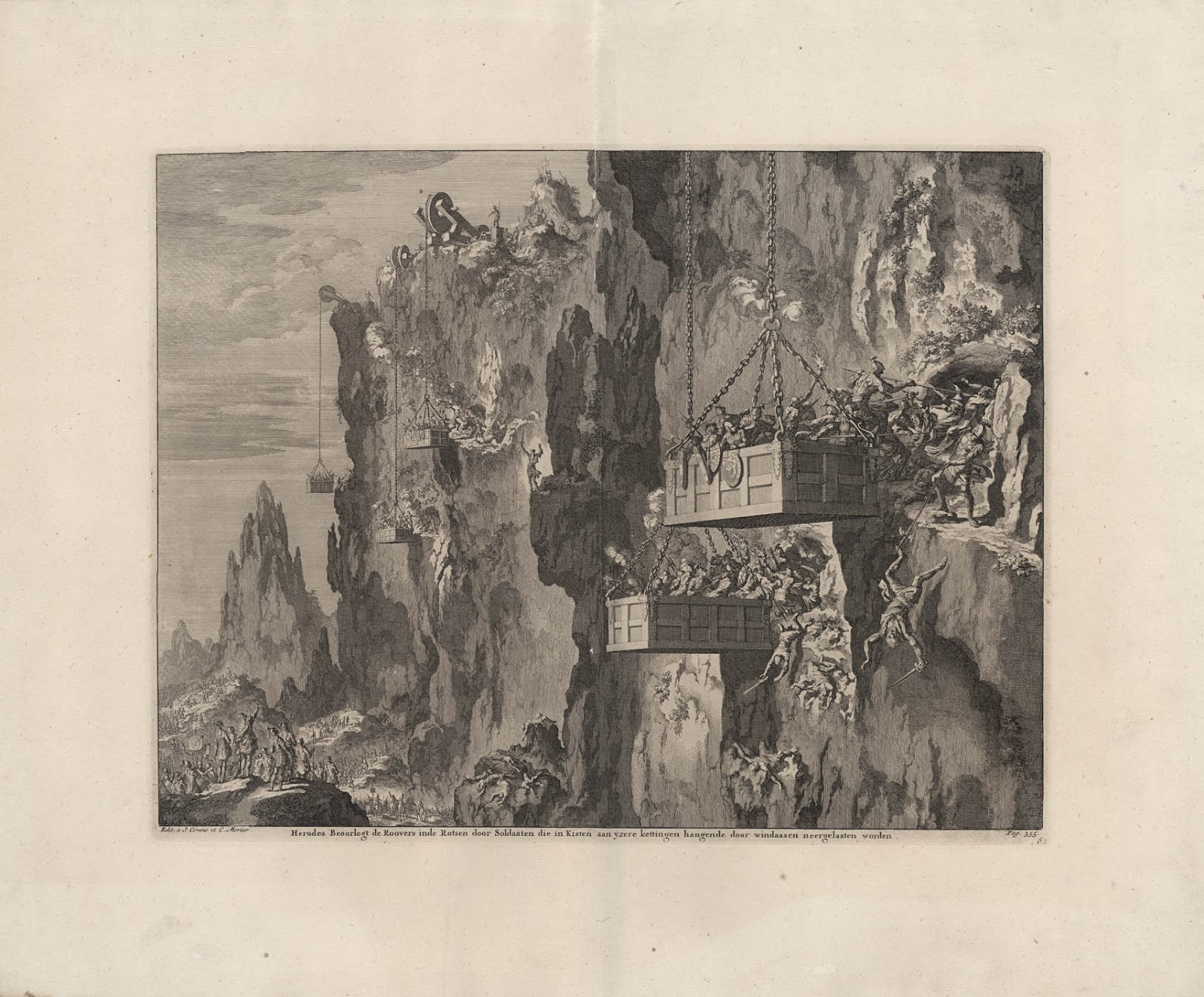
Luyken’s 1704 engraving of Herod’s army fighting robbers in their caves


Jan (Johannes) Luyken (1649–1712) and Caspar Luyken (1672–1708)

“Herodes Beoorlogt de Roovers inde Rotsen door Soldaaten die in Kisten aan yzere kettingen hangende door windaasen neergelaaten worden” [“Herod fights the robbers in their caves” or “Herod conquers Jerusalem” or “Herod waging war the (?) on the Rock Cliffs by the Soldiers hanging by boxes suspended by iron chains coming down on (?) the people below (?) (see: http://www.antiquarianbiblical.com/pages/prints/printot/luykeno/luykeno.htm], 1704, published by Jan Covens (1697–1774) and Corneille Mortier (1688 active) in “Josephus Flavius & Basnage, Alle de werken” in the 1729 edition. (Note the first edition was published by Pieter Mortier in 1704, the second edition was published by Covens and Mortier in 1729, and the third edition was by Frans Houttuyn in 1747.)

Copper engraving on heavy laid paper with wide margins and centre fold (as published)
Size: (sheet) 47.8 x 57.4 cm; (plate) 33 x 42.5 cm
Lettered in the plate below the image borderline: (left) “Edit. à J. Cóvens et C. Mortier.”; (centre) “Herodes Beoorlogt de Roovers inde Rotsen door Soldaaten die in Kisten aan yzere kettingen hangende door windaasen neergelaaten worden”; (right) “Pag. 355” / “62”
Hollstein (Jan Luyken)

Condition: crisp impression with wide margins and centrefold (as published) professionally conserved on a fine archival support sheet to preserve the centrefold. The sheet is in superb condition for its age (i.e. there is no foxing, noteworthy stains or folds).

I am selling this large original engraving from 1704 by Jan Luyken and his son for a total cost of [deleted] including postage and handling to anywhere in the world.
If you are interested in purchasing this visually arresting scene of Roman battle engineering, please contact me (oz_jim@printsandprinciples.com) and I will send you a PayPal invoice to make the payment easy.

This print has been sold


Not only is this print very large but the portrayed battle scene is equally grand in its conception and breadth of what is presented. Luyken really knew how to showcase a battle! I suspect that I am not alone in being transfixed by all the featured gore and the mechanics of the Roman strategy for eradicating robbers in mountainside caves. For instance, I love the Roman’s engineering feat shown here of using a gigantic pulley system for lowering soldiers in boxes. I am also fascinated that nearly each rock pinnacle has a figure standing on it with arms theatrically raised. Moreover, the dark forces within me shamefully marvel—with repugnant horror—at the grisly positions of the falling and fallen robbers.


Saturday, 6 August 2016

Théophile Chauvel’s etching of the Forest at Fontainebleau after Théodore Rousseau


Théophile Chauvel (aka Théophile Narcisse Chauvel; Théophile-Narcisse Chauvel) (1831–1909) after Théodore Rousseau (1812–67)

“Une mare—Forêt de Fontainebleau”, 1874, printed by François Liénard (1860s–1880s; fl. c.) and published in “L'Art”, 1876.
Etching on laid paper with 3.8 cm chainlines and trimmed at, or within, the platemark (as published in “L'Art”).
Size: (sheet) 28.4 x 39.8 cm; (image borderline) 24.6 x 29.6 cm
Lettered in the plate below the image borderline: (lower left) “Th. Rousseau, pinx.” / “L'Art.”; (lower centre) “UNE MARE - FORÉT DE FONTAINEBLEAU.” / “Collection de Mr. William T. Blodgett.”; (lower right) “Th. Chauvel, sc.” /  “F.çois Liénard, Imp. Paris.”
IFF 31 (Inventaire du Fonds Français: Bibliothèque Nationale, Département des Estampes, Paris, 1930)
The British Museum offers the following description of this print:
“A pond in a clearing of the forest at Fontainebleau; a figure standing by the pond, at centre, surrounded by trees; after Théodore Rousseau; published in 'L'Art', 1876. 1874” (http://www.britishmuseum.org/research/collection_online/collection_object_details.aspx?objectId=3350959&partId=1&searchText=Chauvel+Rousseau&page=1)
Condition: richly inked and well-printed impression in pristine condition.

Price & Shipping:

AU$238 (approximately US$170.40 / €144.70 / £126.02), including worldwide express shipping. Please note that import duties and taxes (if any) are the buyer’s responsibility.


Chauvel is one of my favourite nineteenth century etchers in term of his ability to display skill without resorting to impersonal formulaic approaches to representation.

Although Chauvel was a regular exhibitor at the Salon from 1858 to 1904 and was awarded the prestigious Legion of Honour in 1896, he is best known for his graphic interpretations of other artist’s paintings, such as this print after a painting by Théodore Rousseau, rather than for his own compositions. Regardless of his reputation as a reproductive etcher (i.e. an artist that “translates” paintings into etchings), Chauvel could draw like an angel—presuming angels can draw—and one only has to examine his line work in portraying the intricacies of Rousseau’s cloud formations to understand what I mean. For instance, in this etching he is able to illustrate the transparency of clouds rendered in oil paint and could do this in a way that a viewer could visualise the form of the cloud mass as well as subtle movements within the mass. Simply amazing!

Chauvel’s skill as an etcher is even acknowledged by FL Leipik—a writer who is not shy in offering unapologetic, blunt assessments of artists in his “A History of French Etching” (1924). Leipik saw in Chauvel an artist who, “though eclectic, does not convey the impression of slavish imitation” (p. 128). Leipik also insightfully proposes that if “sensitive adaptability prevented Chauvel from working in a fashion of his own, it fitted him eminently for the interpretation of others” (ibid). 


Friday, 5 August 2016

William Julian-Damazy’s etching, “Violetta”, after Jules Joseph Lefebvre


William Julian-Damazy (1865–c1920) after Jules Joseph Lefebvre (1836–1911)
“Violetta”, 1896, published by the Société des amis des arts
Etching and engraving on cream wove paper (Japon/Japanese vellum) with a remarque of a violet below the image, blind stamped (below the image lower right) with the seal of the Société des amis des arts
Size: (sheet) 44 x 31.1 cm; (plate mark [faint]) 33.7 x 23.8 cm; (image) 27.4 x 18.6 cm
Inscribed within the image (upper left) “Jules LeFebvre”
Condition: crisp impression in pristine condition.

I am selling this beautifully executed engraving in (rare) perfect condition, for a total cost of AU$97 (currently US$74.32/EUR66.61/GBP56.47 at the time of this listing) including postage and handling to anywhere in the world.
If you are interested in purchasing this masterwork of engraving, please contact me (oz_jim@printsandprinciples.com) and I will send you a PayPal invoice to make the payment easy.

This print has been sold


Among the many attributes of this fine print, there are two features in particular that amaze me.

The first is the stunning treatment of the girl’s hands arranged almost tangentially at the lower borderline. Beyond the visually arresting placement of the hands, they are also beautifully drawn. In fact, my eyes have great difficulty even seeing the fineness of the line work that renders them—even with my glasses focused on the hands only centimetres from the paper. For me, they are portrayed with such finely adjusted tonal nuance that the only words I can find to describe the treatment is: “breathtakingly delicate.”

The second feature that I find amazing is more of a formal technical nature: the evenness of the tonal gradation portraying the sweep of background tone from medium grey at the bottom to almost black at the top. On close examination, I can see how the artist has made the gradation using lightly laid diagonal strokes on top of a horizontal and vertical crosshatching, but the virtuosity to make the transition from light to dark is almost seamless. This reveals Julian-Damazy’s high order of technical skills just as much as the finely rendered features of the young woman.

I can understand how some viewers would dismiss prints like this as simply “nineteenth century romantic syrup.” From my standpoint, however, I can ignore the slight touch of saccharine and examine it without a moment of boredom.


Thursday, 4 August 2016

Claude Lorrain’s etchings of brigands


Claude Lorrain (aka Claude Gellée, Claude; Claude Le Lorrain; Claudio di Lorena) (1600–82)

(Upper image) “Etude d’une scène de brigands” [Study for a scene with brigands], 1633 (?)
Etching on wove paper (trimmed at the time of publication by McCreery in his 1816 edition of “200 Etchings” and printed from the original plate); (sheet) 2.8 x 6.7 cm
The British Museum has an impression of the full plate from which this impression has been trimmed, see: http://www.britishmuseum.org/research/collection_online/collection_object_details.aspx?objectId=1346423&partId=1&searchText=claude+lorrain+brigands&page=1
Mannocci 10; Blum 41; Robert-Dumesnil 39; Knab 113; Duplessis 41; Russell 16

(Lower image) “Scène de brigands” [Landscape with Brigands], 1633
Etching on wove paper published by McCreery in his 1816 edition of “200 Etchings” and printed from the original plate); (sheet) 13.7 x 20 cm; (plate) 13.1 x 19.8 cm
Signed and dated on plate in the right margin (very indistinctly but according to the BM): 'CLAUD I.V. ROMAE 1633', and in the lower margin to the right: 'Claudius in sup. P'.
The British Museum offers the following description of this print: “Landscape with two brigands; at the edge of a wood, two brigands attacking a man near a palm tree, while two others are taking his wife away, to the left.” (http://www.britishmuseum.org/research/collection_online/collection_object_details.aspx?objectId=1346417&partId=1&searchText=claude+lorrain+brigands&page=1)
Mannocci 11; Blum 7; Robert-Dumesnil 12; Knab 117; Duplessis 12; Russell 17

Condition: both etchings are of exceptional rarity and in very good condition, but trimmed as published by McCreedy (1816).
I am selling this pair of original etchings executed by the one of the most famous of the early landscape artists, Claude Lorrain, for a total cost of AU$533 (currently US$406.09/EUR365.16/GBP309.46 at the time of this listing) including postage and handling to anywhere in the world.
If you are interested in purchasing this pair of original etchings by one of the major old masters, please contact me (oz_jim@printsandprinciples.com) and I will send you a PayPal invoice to make the payment easy.

These prints have been sold


This rare pair of etchings were pulled from Claude Lorrain’s original plates in 1816 by McCreedy who published them in his now famous “200 Etchings” which included impressions by Rembrandt, Ruysdael, Dujardin and Della Bella (amongst others) which were also taken from the original plates. Sadly, I understand that all the plates were destroyed and so this was the final edition.

The two brigands attacking a traveller featured in upper impression is clearly a study/pensiero for the formally “finished” lower etching. As Russell in her catalogue for the 1983 exhibition of Lorrain’s work at the National Gallery of Art (Washington) points out, this subject of daylight robbery of travellers was popular in the late 16th and 17th centuries. Interesting, however, it was not a subject that Claude explored often and there seems to be only two paintings of the subject—sadly, one is now lost and the other is in a private collection. This pair of prints may have been made in preparation for one or both paintings.

Wednesday, 3 August 2016

Pennequin’s etching after Henner


Edmond-Jules Pennequin after a painting by Jean Jacques Henner (1829–1905)
“Portrait of a Young Girl”, late 19th century
Etching and engraving on chine-collé washi paper on heavy wove paper, signed by the artist with a hand-written dedication to his cousin.
Size: (sheet) 51.3 x 36.9 cm; (plate) 31.7 x 24.9 cm; (image) 26.7 x 21.3 cm
Inscribed in the plate below the image borderline: (left) "Peint par Henner"; (right) Grave par Pennequin"
Condition: richly inked impression in marvellous condition, hand-signed by the artist in pencil.

I am selling this beautifully executed etching for a total cost of AU$156 (currently US$118.48/EUR105.75/GBP88.75 at the time of this listing) including postage and handling to anywhere in the world.
If you are interested in purchasing this hauntingly strong etching, hand-signed by the artist, please contact me (oz_jim@printsandprinciples.com) and I will send you a PayPal invoice to make the payment easy.


There is so much theatre in this print in terms of a brooding seductress staring at the viewer with fully dilated pupils, dramatic lighting and latent energy in the line-work.

Surprisingly, the artist of this strong etching, Edmond-Jules Pennequin, is an almost forgotten nineteenth-century printmaker. I am astounded that an artist of his calibre of skill could fail to be documented in standard compendiums of printmakers (e.g. Arthur M Hind's “A History of Engraving & Etching”) or in major print collections (e.g. The British Museum). If there is anyone familiar with this artist and could share some biographical details (e.g. dates of his birth and death) I would be thankful.

What I love about this print is the overtones of the Pre-Raphaelites captured in treatment of the young woman with her haunting eyes and the rich texture of her simple dress. Regarding the treatment of the fabric, the line-work in this area shows an amazing high level of technical skill and discipline in representing the complexity of the woven material and its contouring to the curves of the woman’s body.