Sunday, 24 April 2022

Henry Valentin’s etching, “A Worker at Sèvres”, 1863


Henry Valentin (aka Henry Augustin Valentin) (1822–1886)

“A Worker at Sèvres” (aka “Un Ouvrier de Sèvres"), 1863, plate 70 from the second volume of prints produced by the Société des Aquafortistes, “Eaux-Fortes Modernes: Originales et Inédites”, published in Paris in monthly installments from September 1863 to August 1864 by Cadart & Luquet (aka Alfred Cadart & Jules Luquet) (fl.1863–1867) and printed by Auguste Delâtre (aka Auguste Marie Delâtre) (1822–1907). Note that the plate numbering for the second volume continues from the first volume (i.e., from plate 61 to plate 120).

Etching with masked plate tone on laid paper with full margins as published.

Size: (sheet) 48 x 32.2 cm; (plate) 31.5 x 23.4 cm; (image borderline) 26.7 x 19.5 cm.

Signed in plate within the image borderline: (lower right corner) “h. Valintin”.

Numbered and lettered in plate beyond the image borderline: (upper right corner) “70.”; (lower left) “H. Valentin sculpt.”; (lower centre) “UN OUVRIER DE SÈVRES./ Paris, Publié par A. CADART & LUQUET, Éditeurs, 79, Rue de Richelieu.”; (lower right) “Imp. Delâtre, Rue St. Jacques, 303, Paris.”

The British Museum and the Philadelphia Museum of Art offer descriptions of this print: https://www.britishmuseum.org/collection/object/P_1864-1008-280 & https://philamuseum.org/collection/object/7341.

See also the detailed description offered by Art of the Print: http://www.artoftheprint.com/artistpages/valentin_henry_aworkerfromsevres.htm.

Condition: a strong and well-printed impression with generously wide margins. Beyond minor handling marks and dustiness, the sheet is in an excellent condition with no tears, holes, folds, significant stains or foxing.

I am selling this revealing look at a potter at the world famous porcelain works at Sèvres—note the potter’s right leg propelling the “kick wheel”, the kneaded balls of clay prepared/deaired for throwing on the wheel, the large natural sponge beside his left hand used for soaking up excess water and his use of a wooden template form/”jigger” to refine/”turn” the footed bowl he is working on (my apologies for any mistakes with my interpretation of what he is doing)—for the total cost of AU$236 (currently US$169.58/EU157.23/GBP132.53 at the time of posting this listing) including Express Mail (EMS) postage and handling to anywhere in the world, but not (of course) any import duties/taxes imposed by some countries.

If you are interested in purchasing this rare and historically significant record of a potter at work in the 19th century, please contact me (oz_jim@printsandprinciples.com) and I will send you a PayPal invoice to make the payment easy.

This print has been sold


Adolphe Hervier’s etching, “Three Houses in a Norman Village with a Dilapidated Tower”, 1843


Adolphe Hervier (aka Louis Adolphe Hervier; Louis Henri Victor Jules François Adolphe Hervier) (1817–1879)

“Three Houses in a Norman Village with a Dilapidated Tower” (Rijksmuseum [transl.] title), 1843, plate 3 (second state impression of five states before the addition of the plate number), from the series of eight etchings, “Croquis du voyage de 1843”, published in Paris by Alexis Febvre (fl.1843)—possibly the art collector, Alexis Joseph Febvre (1810–1881).

Etching on chine collé printed in brown ink on wove paper with wide margins as published.

Size: (sheet) 36.2 x 27.5 cm; (plate) 21 x 15.5 cm; (image borderline) 12.4 x 7.9 cm.

Lettered in plate below the image borderline: (left) “Ad. Hervier”; (centre) “PARIS chez ALEXIS FEBVRE Rue de la Victoire 2.”

State ii (of v) before the addition of the plate number and the address of Auguste Delâtre (1822–1907) as the printer.

IFF 6-2(5) (Département des Estampes 1930–, “Inventaire du Fonds Français après 1800”, Paris, Bibliothèque Nationale, vol. 10, p. 361, cat. no. 6); Beraldi 1 (Henri Béraldi 1889, “Les Graveurs du XIXe Siècle: Guide de l'Amateur d'Estampes Modernes”, vol. 8, Paris, Conquet, p. 112).

The Rijksmuseum and the British Museum offer a descriptions of this print: http://hdl.handle.net/10934/RM0001.COLLECT.122623 & https://www.britishmuseum.org/collection/object/P_1925-1013-31).

Regarding Hervier’s extraordinary etchings, Henri Beraldi’s (1889) introductory commentary to Hervier’s printmaking oeuvre offers the following illuminating gem of nineteenth century appraisal: (transl.) “Apart from his paintings, he left beautiful watercolours, lithographs in crayon or wash which are not without interest; finally, rather curious plates nicely executed in etching, heightened with aquatint and roulette. He had talent: a little more and he would have become someone; but he could not cross this limit” (p. 111).

Condition: a well-printed early impression (before numbering) with generously wide margins in near pristine condition with no tears, holes, folds, abrasions, stains, foxing or signs of handling.

I am selling this somewhat moody scene of a crude village set beneath crumbling fortress towers with a figure attending to daily chores beside free roaming pigs, for the total cost of AU$238 (currently US$172.36/EU159.56/GBP134.30 at the time of posting this listing) including Express Mail (EMS) postage and handling to anywhere in the world, but not (of course) any import duties/taxes imposed by some countries.

If you are interested in purchasing this small and curiously wonderful etching of rural life in a Norman village, please contact me (oz_jim@printsandprinciples.com) and I will send you a PayPal invoice to make the payment easy.


Saturday, 23 April 2022

Benigno Bossi’s etchings, “Plate 6” & “Plate 9”, 1755


Benigno Bossi (1727–1792)

(left) “Plates 6” (aka “Head of a Boy, Profile Left”), 1755 (as dated in plate)

(right) “Plate 9” (aka “Head of a Boy Holding a Book”, c1755

Two etchings of the head of a youth facing left on laid paper from the series of forty-three numbered plates (including the title plate), “Raccolta di Teste” (Collection of Heads).

Size: (each sheet) 27 x 18.6 cm; (each plate) 9.4/9.6 x 7/7.5 cm.

“Plate 6” inscribed faintly in plate: (upper left) “Benigno Bossi f-.1755.”; (upper right) “6”.

“Plate 9” inscribed faintly in plate: (upper left) “Bossi In. f.”; (upper right) “9”.

The Harvard Art Museums offer a description of “Plate 6” in an earlier state before the plate was reduced in size and reworked: https://hvrd.art/o/275984.

The Rijksmuseum and The Harvard Art Museums offer descriptions of “Plate 9” in an earlier state when it was inscribed, “nō V”: http://hdl.handle.net/10934/RM0001.COLLECT.86262 & https://hvrd.art/o/275973.  

Interestingly, Benjamin Green (1739–1798)—purported to have been the first printmaker to make a soft-ground etching—copied Bossi’s “Plate 6” in the reverse direction as a soft-ground etching (see https://www.britishmuseum.org/collection/object/P_1861-1012-2390).

Condition: strong and well-printed impressions with generous margins and in an excellent condition with no tears, holes, folds, abrasions, losses, significant stains or foxing.

I am selling this pair of sensitive studies of a boy facing left, for the total cost of AU$428 for the pair (currently US$309.97/EU286.93/GBP241.51 at the time of posting this listing) including Express Mail (EMS) postage and handling to anywhere in the world, but not (of course) any import duties/taxes imposed by some countries.

If you are interested in purchasing this pair of small and very beautiful etchings, please contact me (oz_jim@printsandprinciples.com) and I will send you a PayPal invoice to make the payment easy.

Note that I have three other etchings by Benigno Bossi that are still available: https://www.printsandprinciples.com/2021/01/benigno-bossis-etchings-portrait-of-man.html & https://www.printsandprinciples.com/2019/12/benigno-bossis-etching-allegory-of-time.html.


Friday, 22 April 2022

Katsushika Hokusai’s woodblock diptych, “Morning Glory”, 1878


Katsushika Hokusai (葛飾 北斎) (1760–1849)

“Morning Glory” (descriptive title only), 1878, diptych of colour woodblock pints of pages 44 and 45 from volume 15 in the series of fifteen volumes of Hokusai’s “Manga Jūgohen” (北斎漫画, 十五編), compiled by Katano Tōshirō (片野東四郎編輯) and published in Nagoya by Eirakuya Tōshirō (永楽屋東四郎) (fl.1813–1842) (see https://pulverer.si.edu/node/774/title/1  & https://pulverer.si.edu/node/774/title/1/23).

Two individual colour woodblock panels abutted to create a diptych printed in black, grey and light vermilion ink on fine washi paper laid upon a support sheet.

Size: (2 abutted sheets) 22.7 x 25.5 cm.

The British Museum offers a description of the volume in which this print features (vol. 15) as well as a online view of all the prints on thirty folded sheets (cho): https://www.britishmuseum.org/collection/object/A_1979-0305-0-428-14.

Condition: delicate/pale impressions trimmed so that they may be abutted without a gap (but showing the superimposition of the left sheet over the right sheet), laid onto a support of archival (millennium quality) washi paper. Beyond a faint stain on the left panel, the diptych is in a good condition with no tears, holes, folds, abrasions, significant stains or foxing—note that some naturally occurring darker fibres in the paper are visible.

I am selling this diptych of original colour woodblock prints by Hokusai featuring the vine and flowers of the common and very beautiful Morning Glory (Ipomoea purpurea) for the total cost of AU$252 (currently US$184.37/EUR170.27/GBP142.21 at the time of this listing) including postage and handling to anywhere in the world, but not (of course) any import duties/taxes imposed by some countries.

If you are interested in purchasing this quietly beautiful woodblock print by the almost legendary Hokusai, please contact me (oz_jim@printsandprinciples.com) and I will send you a PayPal invoice to make the payment easy.


Thursday, 21 April 2022

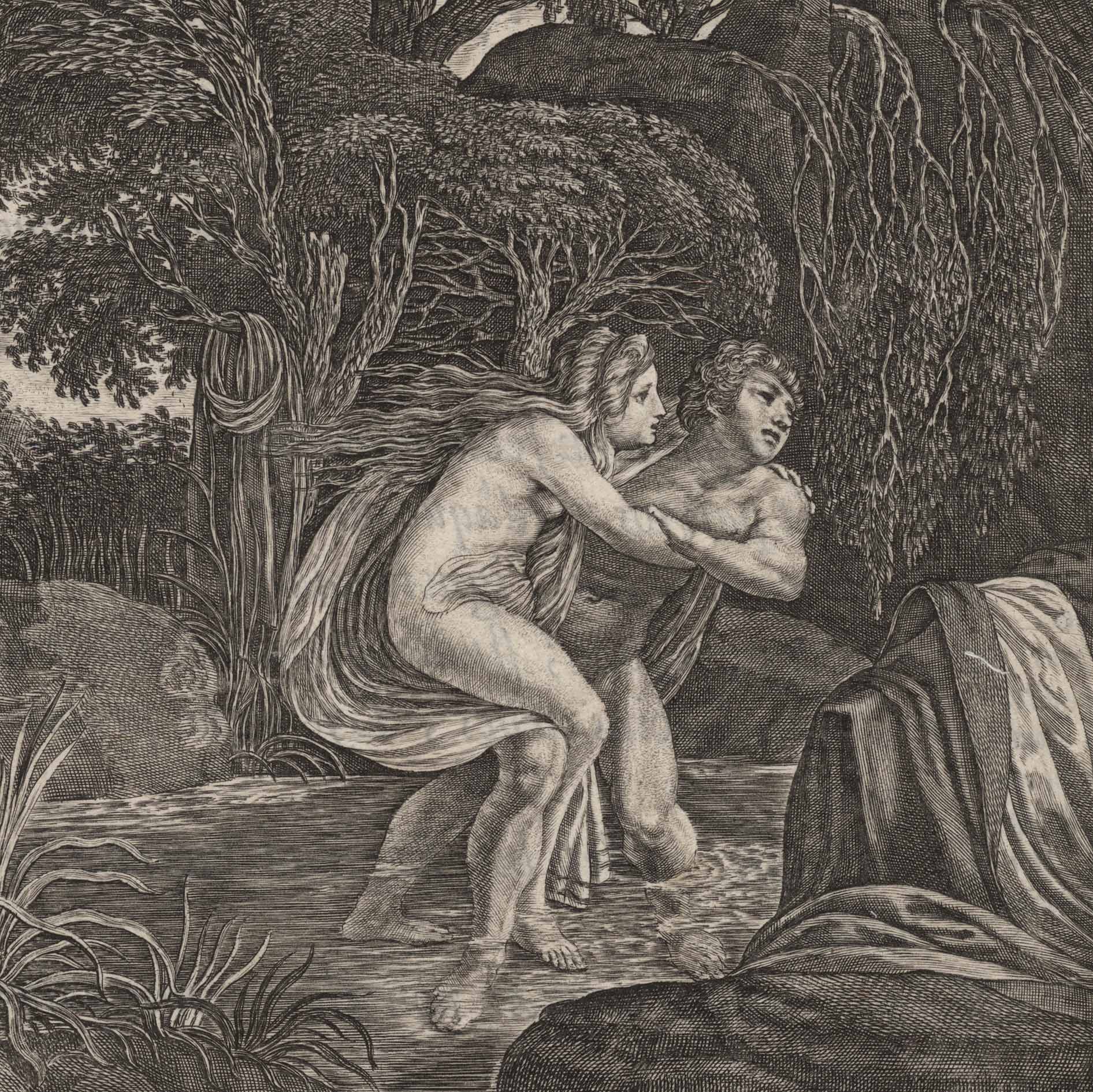
Magdalena de Passe’s engraving, “Salmacis and Hermaphroditus”, 1623


Magdalena de Passe (aka Magdalena van de Passe) (1596?–1638)

“Salmacis and Hermaphroditus”, 1623, after the design by either Jacob Pynas (aka  Jacob Pijnas; Jacob Symonsz. Pijnas; Jacob Pinas; Jacob Symonsz. Pinas) (1585–1648) (as proposed by the Rijksmuseum; see inv. no. RP-P-2014-34-34), or Jacob’s brother, Jan Simonsz Pynas (aka Jan Simonsz Pinas) (c1583–1631) (as proposed by the British Museum; see inv. no. Sheepshanks.7457), published in Brussels in 1677 by François Foppens I (fl.1656-1686) with letterpress text verso as an illustration to the translation by Pierre  du Ryer (1605–1658) of “Les Metamorphoses d'Ovide, en Latin et François, avec de nouvelles explications historiques, morales & politiques sur toutes les fables, chacune selon son sujetas”, as described by the Rijksmuseum: (transl.) “Hermaphroditus and Salmacis changed into a hermaphrodite: at the prayer of the fountain-nymph Salmacis, who holds the bathing Hermaphroditus closely embraced, their bodies fuse (Ovid, Metamorphoses IV 373) (inv.no. RP-P-OB-15.828).

Although there appears to be curatorial questions regarding which of the Pynas brothers was the source of the design for this marvellous engraving, there may also be a stylistic leaning in the design towards Hendrick Goudt (c1583–1648; for example, “Tobias and the Angel (small plate)”, 1608: https://www.metmuseum.org/art/collection/search/383883. See also the earlier post regarding another of Magdalena de Passe’s engravings, “Elijah at the Brook Cherith”, in which I engage with the idea that there may be female perspective—a way of looking that is exemplified in this print (see https://www.printsandprinciples.com/2016/10/magdalena-van-de-passes-engraving.html).

Engraving on laid paper with letterpress text verso, trimmed with a narrow margin around the image borderline (with loss of the text below the image), backed with a support sheet.

Size: (sheet) 16.9 x 23.6 cm; (image borderline) 16.1 x 22.6 cm.

Inscribed in plate: (upper centre) “Ovid: Met. lib. 4.”   

Franken 979 (Daniel Franken & Simon Laschitzer 1975, “L'Oeuvre Grave des Van de Passe”, Amsterdam, G. W. Hissink & Co., p. 186, 309-310, cat. no. 979 in 1379); Holstein Dutch 7 (Jan Verbeek & Ilja M. Veldman [comp.] 1974, “Dutch and Flemish Etchings, Engravings and Woodcuts ca. 1450-1700: De Passe [continued]”, Amsterdam, Van Gendt & Co, p. 67, 214, cat. no. 236ad in 7).

The Rijksmuseum offers the following description of this print: (transl.) “Hermaphroditus, the child of Hermes and Aphrodite (Mercury and Venus), wades through the lake in which the nymph Salmacis lives. Salmacis, one of Diana's nymphs, fell in love with Hermaphroditus. She clings to him so that their bodies will merge. Hermaphroditus tries to resist her hugs (https://www.rijksmuseum.nl/en/collection/RP-P-2014-34-34).

See also the descriptions offered by the British Museum and Bonhams Auctions (5 Jun 2013): https://www.britishmuseum.org/collection/object/P_Sheepshanks-7457 & https://www.bonhams.com/auctions/20738/lot/3/..

Condition: a strong and well-printed impression trimmed with a small margin around the image borderline and loss of the text lines below, laid onto a support sheet of archival (millennium quality) washi paper.  The sheet is in a very good condition for its considerable age with no tears, holes, folds or abrasions, significant stains or foxing.

I am selling this remarkable print executed by one of the few recorded female engravers from the Dutch Golden Age who may also be the first female artist to train another female artist—the incredible polymath, Anna Maria van Schurman (1607–1678)—for AU$302 (currently US$224.78/EUR207.16/GBP172.06 at the time of posting this print) including postage and handling to anywhere in the world (but not, of course, any import duties/taxes imposed by some countries).

If you are interested in purchasing this marvellous engraving showing the moment of embrace between Salmacis and Hermaphroditus before the Gods of Olympus fuse them together forever as a hermaphrodite whole, please contact me (oz_jim@printsandprinciples.com) and I will send you a PayPal invoice to make the payment easy.

This print has been sold