Showing posts with label Beatrizet (Nicolas). Show all posts

Friday, 25 August 2023

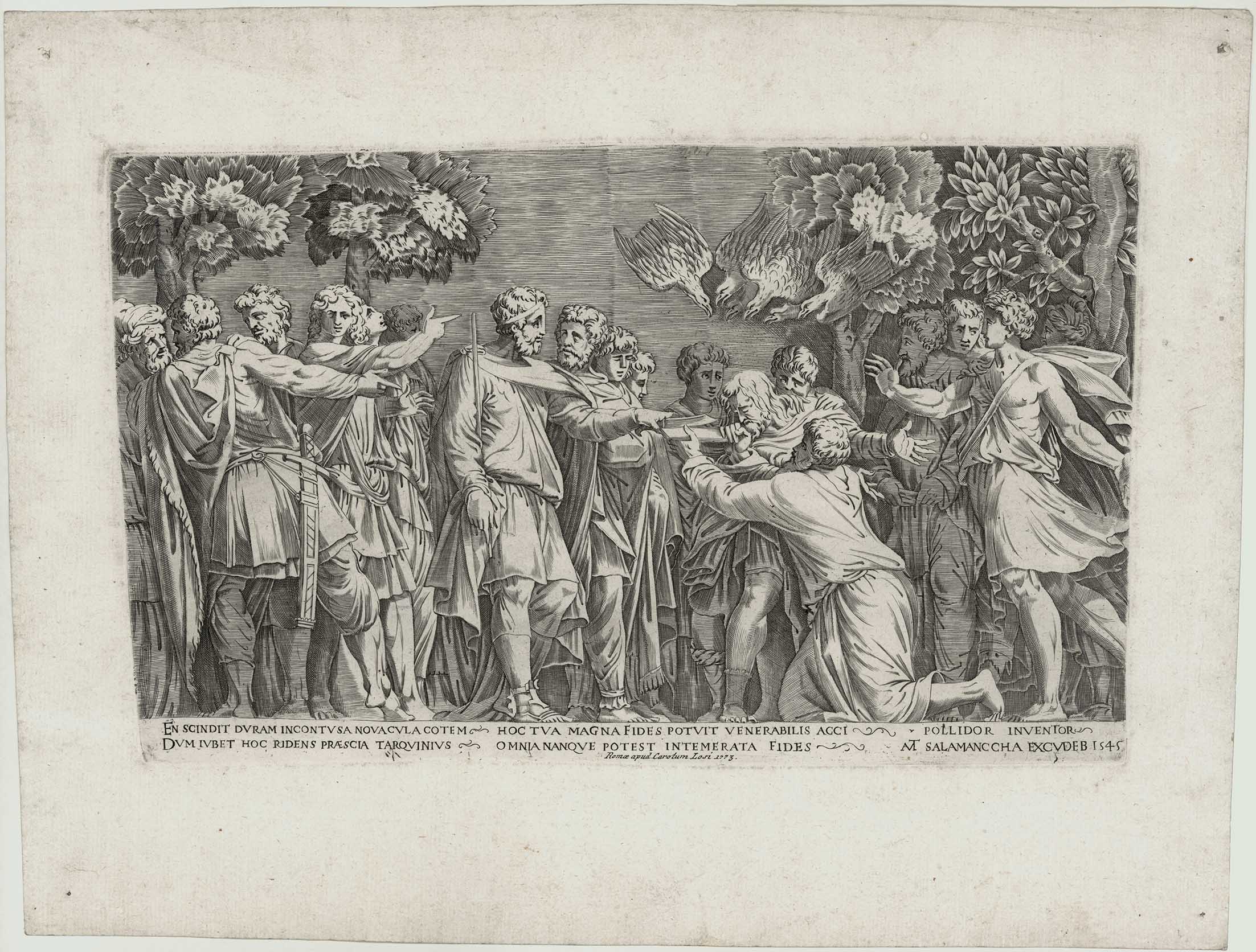
(Attrib.) Michele Lucchese’s engraving, “Tarquinius Priscus Cutting the Whetstone”, 1545, after Polidoro da Caravaggio

(Attrib.) Michele Lucchese (aka Michele Crecchi; Michele Grechi; Michele Greco) (fl.1534–1564), formerly attributed to Nicolas Beatrizet (aka Nicolas Beatricetto) (c.1507–c.1566)

“Tarquinius Priscus Cutting the Whetstone”, 1545, after Polidoro da Caravaggio (aka Polidoro Caldara; Polidoro da Caravagio) (c.1499–1543), possibly relating to a lost façade on Monte Citorio (see the Curator of the BM comment; inv. no. V,8.76), published in Rome by Antonio Salamanca (1478–1562) and later in 1773 (as is the case with this impression) by Carlo Losi (fl.Rome 1757–after 1805).

Engraving on heavy laid paper with wide margins.

Size: (sheet) 36.3 x 47.6 cm; (plate) 24.2 x 40.5 cm; (image borderline) 22.1 x 40.4 cm.

Lettered in plate below the image borderline: “EN SCINDIT DVRAM INCONTVSA NOVA CVLA COTEM ... POLLIDOR INVENTOR/ DVM IVBET HOC … [ANT] SALAMANCCHA EXCVDEB 1545/ Romæ apud Carolum Losi 1773.”

State ii (of ii) with the addition of the publication details for Carlo Losi.

Mariette I, p. 257 (as Caldara); Passavant 119 (as Beatrizet); Bianchi D 14 (attributed to Beatrizet).

See also the description of this print offered by the British Museum: https://www.britishmuseum.org/collection/object/P_1871-0429-615.

Condition: a strong and well-printed impression with wide margins. Beyond a pinhole in each corner of the margin and minor surface dustiness, the sheet is in an excellent condition with no tears, losses, abrasions, significant stains or foxing.

I am selling this rare engraving for AU$376 (currently US$251.32/EUR227.39/GBP200.17 at the time of posting this listing) including postage and handling to anywhere in the world (but not, of course, any import duties/taxes imposed by some countries).

If you are interested in purchasing this strong impression showing at left-of-centre, Tarquinius Priscus—by tradition, the fifth king of Rome (reigning between c.616–578 BC)—slicing through a whetstone (tool sharpener) with his knife to demonstrate his divine power, contact me (oz_jim@printsandprinciples.com) and I will send you a PayPal invoice to make the payment easy.

Note that I have previously listed another engraving by Michele Lucchese, “The Martyrdom of St. Lawrence” (c.1520), after Marcantonio Raimondi (and Baccio Bandinelli) that is currently still available: https://www.printsandprinciples.com/2017/02/luccheses-engraving-1539-after.html.

This print has been sold


Tuesday, 28 September 2021

Nicolas Beatrizet’s engraving, “St. Elizabeth of Hungary Visiting the Sick”, c1550

Nicolas Beatrizet (aka Nicolas Beatricetto) (c1507/15–1573/77)

“St. Elizabeth of Hungary Visiting the Sick” (TIB title), c1550 (1540–1566), after the design by Girolamo Muziano (aka Brescianino) (1528/32–1592). Initially published by Antoine Lafréry (aka Antonio Lafreri) (1512?–1577), this impression is from the later edition published in Rome by Carlo Losi (fl. late-1700s) in 1773 (as inscribed in plate).

Engraving with etching printed in a warm silvery-grey ink on laid paper.

Size: (sheet) 54.4 x 41.4 cm; (plate) 45.2 x 36.1 cm; (image borderline) 44.8 x 34.9 cm.

Lettered in plate: (upper left on wall) “SANCTA ELISABETH REGIS/ VNGARIE FILIA VAS VIRTV/ TVM ET MIRACVLORVM MA/ GNITVDINE CLARA QVÆ/ PARENTVM GENEROSITATE/ ET DIVITIARVM IACTANTIA/ CONTEMPTA PRO CORONA/ CINERE ET PRO PECTORALI/ FASCIA CILICIVM SVSCIPIENS/ MVNDO SE FECIT IGNOBILEM/ VT NOBILIS CVM CHRISTO/ EFFICERETVR IN COELIS”; (lower left corner) “HIERONVMO/ MVCIANO/ BRIXIANO/ INVENT”; (lower centre edge) “Presso Carlo Losi 1773”; (lower right corner) “NICOLAVS BEATRICIVS/ LO[TH]ARINGVS INCIDIT/ ET FORMIS SVIS EXC.”

State iii (of iii) with the erasure of the publication details added in state ii for Antoine Lafréry (“Romae Ant. Lafrerij”) and the addition of the publication details for Carlo Losi. Note that traces of the erased address of Lafréry may be seen between the second and third tile from the left.

TIB 31 (255) (Suzanne Boorsch [ed.] 1982, “The Illustrated Bartsch: Italian Masters of the Sixteenth Century”, vol. 29, New York, Abaris Books, p. 275, cat. no. 31 [255]); Bartsch XV.255.31.

The British Museum offers the following description of this print: ”St Elizabeth of Hungary visiting the sick, she blesses a woman who kneels before her. Engraving” (https://www.britishmuseum.org/collection/object/P_1874-0613-603).

See also the descriptions of this print at the Rijksmuseum and the Philadelphia Museum of Art: http://hdl.handle.net/10934/RM0001.COLLECT.76241; https://philamuseum.org/collection/object/144.

For those unfamiliar with Saint Elizabeth of Hungary (aka Elizabeth of Thuringia) (1207–1231), the block of Latin text at upper left in the engraving advises that Saint Elizabeth was the daughter of the King of Hungary (Ludwig IV) and “a vessel of virtue and miracles”. Although born to wealth and nobility, I understand that Elizabeth despised both and—again from my reading of the Latin text—famously wore “ashes” rather than (I assume) jewels when she engaged in charitable acts for the sick and poor as portrayed in the print. Elizabeth had three children and died at only 24.

Condition: a well-printed impression that shows very few signs of wear to the printing plate despite the silvery grey colour of the printing ink suggesting otherwise. The sheet has generous margins with tear fractures; otherwise, the sheet is in a good condition with no holes, significant stains or foxing. Verso has several numbers written in faded ink by an old hand.

I am selling this large and very beautiful engraving that to my eyes seems to delicately shimmer with the silvery grey ink in which it was printed, for the total cost of AU$312 (currently US$226.92/EUR194.31/GBP165.90 at the time of this listing) including postage and handling to anywhere in the world, but not (of course) any import duties/taxes imposed by some countries.

If you are interested in purchasing this engraving executed at the time of Michelangelo—mindful that the engraver worked under the direction of Michelangelo—please contact me (oz_jim@printsandprinciples.com) and I will send you a PayPal invoice to make the payment easy.


Sunday, 23 July 2017

Nicolas Beatrizet’s engraving, “Battle of the Amazons” (the right panel), 1559


Nicolas Beatrizet (aka Nicolas Beatricetto) (c1507/15–73 or after)
The right panel of the two-plate composite print, “Battle of the Amazons” (TIB title) or “Amazonum pugna adfabre efficta de sarcophago vetustissimo quod in Capitolio visitur ...” (The Amazon fight skillfully fashioned from ancient sarcophagus is seen at the Capitol …), 1559, from the series, “Speculum Romanae Magnificentiae” (The Mirror of Roman Magnificence), originally published by the artist and later published by Hendrik van Schoel (c1565–1622) as is the case with this impression. Interestingly, the name of Schoel that is inscribed on this impression is evidence that Bellini’s opinion expressed in “Print Collector” (1975, p. 34), that Schoel’s name is only found replacing that of G Orlandi is not correct.

Engraving on laid paper, trimmed along the plate mark and lined (by an early restorer) on an support sheet.
(sheet cut irregularly) 31.2 x 41.8 cm
Lettered below the image in two lines: “ATQVE IN EDIBVS SVIS SVA QVE IMPENSA NICOLAVS BEATRIVICS LOTHARINGVS IN LVCEM AD COMMVNEM OMNVM QVI REBVS ANTIVIS / EMISIT K . IAN . M . D . LIX. Henricus Van Schoel. excudit”
State either iii or iv (of iv) with the addition of the name of van Schoel as the publisher

TIB 1982 29.98 (267) (pp. 362–63); Bartsch XV.267.98; Robert-Dumesnil IX.171.98; Huelsen 1921 50.a; Quaritch Catalogue 233; Zorach 65.35

See also: Clay Dean, Theresa Fairbanks, Lisa Pon, Yale University Art Gallery “Changing Impressions: Marcantonio Raimondi and Sixteenth-Century Print Connoisseurship”. Exh. cat. Yale University Art Gallery, New Haven, December 14, 1999–February 13, 2000, cat. no. 28 & 29, pp. 78 & 79 and Peter Parshall 2006, "Antonio' Lafreri's 'Speculum Romanae Magnificentiae'" Print Quarterly. 1, London.

The British Museum offers the following description of this print:
“The Battle of the Amazons, with fighting men and women, many on horseback; after a Roman sarcophagus on the Capitol. 1559 Engraving printed from two plates joined down the centre” (Note that this impression is from the right plate) (http://www.britishmuseum.org/research/collection_online/collection_object_details.aspx?objectId=1605292&partId=1&searchText=Beatrizet+Speculum+Romanae+Magnificentiae&page=1)

The Metropolitan Museum of Art offers a description and image of the left panel of this composite print: http://www.metmuseum.org/art/collection/search/402938?sortBy=Relevance&who=Beatrizet%2c+Nicolas%24Nicolas+Beatrizet&ft=*&offset=60&rpp=20&pos=64  

Condition: crisp impression trimmed slightly unevenly along the platemark. The sheet shows light age-toning and is in good condition (i.e. there are no tears, stains or foxing) with only a few minor losses (see the lower-left corner). There is evidence that the print was once folded as it is a large print, but this issue has been addressed by the engraving having been laid onto a support sheet in what is clearly an old restoration.

I am selling this exceptionally rare and large engraving from 1559 featuring the fabled culture of Amazon women—the first feminists—fighting Roman warriors as published in “Speculum Romanae Magnificentiae” (The Mirror of Roman Magnificence) for AU$362 (currently US$286.36/EUR245.87/GBP220.53 at the time of this listing) including postage and handling to anywhere in the world.

If you are interested in purchasing this left panel of an engraved diptych celebrating the suppression of men by women where legend proposes that the captured men are held as temporary sex slaves until they are later executed, please contact me (oz_jim@printsandprinciples.com) and I will send you a PayPal invoice to make the payment easy.

This print has been sold


The Metropolitan Museum of Art offers the following insights about the “Speculum Romanae Magnificentiae” (The Mirror of Roman Magnificence) that this print features:

“The Speculum found its origin in the publishing endeavors of Antonio Salamanca and Antonio Lafreri. During their Roman publishing careers, the two foreign publishers - who worked together between 1553 and 1563 - initiated the production of prints recording art works, architecture and city views related to Antique and Modern Rome. The prints could be bought individually by tourists and collectors, but were also purchased in larger groups which were often bound together in an album. In 1573, Lafreri commissioned a title page for this purpose, which is where the title ‘Speculum Romanae Magnificentiae’ first appears. Lafreri envisioned an ideal arrangement of the prints in 7 different categories, but during his lifetime, never appears to have offered one standard, bound set of prints. Instead, clients composed their own selection from the corpus to be bound, or collected a group of prints over time.” (http://www.metmuseum.org/art/collection/search/402937