Showing posts with label Emblem Prints. Show all posts

Friday, 2 August 2024

Pierre Daret, “The Life of the Fields is the Life of Heroes”, 1646


Pierre Daret (aka Pierre Daret de Cazeneuve) (c1604–1678)

“The Life of the Fields is the Life of Heroes” (La Vie des Champs est la Vie des Heros), 1646, published and printed in Paris by Louys Sevestre (aka Louis Sevestre) (fl.1634–1690) as the full leaf of page 33 (and verso) to Marin Le Roy de Gomberville’s (1600–1674) “The Doctrine of Morals, Taken from the Philosophy of the Stoics, Represented in a Hundred Pictures and Explained in a Hundred Discourses for the Instruction of Youth” (La doctrine des murs, tiree de la philosophie des stoiques, representee en cent tableaux et expliquee en cent discours pour l'instruction de la ieunesse). Archive.org offers an online view of this leaf in its context in the publication: https://archive.org/details/ladoctrinedesmur00gomb/page/n99/mode/2up.

Interestingly, this publication also features an engraving in the reverse direction to Van Veen’s “Punishment Swiftly Follows Crime” that I listed a short while ago (see https://archive.org/details/ladoctrinedesmur00gomb/page/n73/mode/2up and my post https://www.printsandprinciples.com/2024/07/gijsbert-van-veens-engraving-punishment.html).

Engraving on laid paper, a double-sided with full margins and letterpress text recto and verso.

Size: (sheet) 35.3 x 23 cm; (plate) 18.3 x 14.4 cm; (image borderline) 18 x 14.1 cm.

Letterpress text: (above image) “LA DOCTRINE DES MOEVRS [THE DOCTRINE OF MORALITY]. 33/ LA VIE DES CHAMPS EST LA VIE DES HEROS. [THE LIFE OF THE FIELDS IS THE LIFE OF HEROES]; (below the image) “Vante qui voudra les Citez, [Praise who will Cite them,]/ Ou les mortels comme enchantez; [Or mortals as enchanted;]/ Tiennent pour des grandeurs, leur contraintes seruilles [Consider for greatness, their constraints (on liberty?)]/ Pour moy i’ayme les champs. Cari’y voy des beautez [For me I love the fields. Because there I see beauties]/ Que l’on ne voit point dans les Villes [That one does not see in the Cities].”

Condition: a strong and well-printed (near faultless) leaf. Beyond minor marks in the lower margin, the sheet is in an extraordinarily fine (almost pristine) condition for its considerable age with no tears, holes, folds or significant stains.

I am selling this superb leaf from a book of emblem engravings commissioned (from my understanding) by Cardinal Mazarin (aka Jules Mazarin; Giulio Raimondo Mazzarino) (1602–1661) to give moral guidance to the young Louis XIV—(transl.) ”…[to] throw into this Royal soul the foundations of a science which is the true science of Kings” (see https://archive.org/details/ladoctrinedesmur00gomb/page/n15/mode/2up)—for AU$257 in total (currently US$167.36/ EUR153.35/ GBP130.72 at the time of this listing) including Express Mail (EMS) postage and handling to anywhere in the world, but not (of course) any import duties/taxes imposed by some countries. Note that payment is in Australian dollars (AU$257) as this is my currency.

If you are interested in purchasing this superb leaf from 1646—a lifetime impression from the first edition—please contact me (oz_jim@printsandprinciples.com) and I will send you a PayPal invoice to make the payment easy.

This print has been sold


Thursday, 26 January 2023

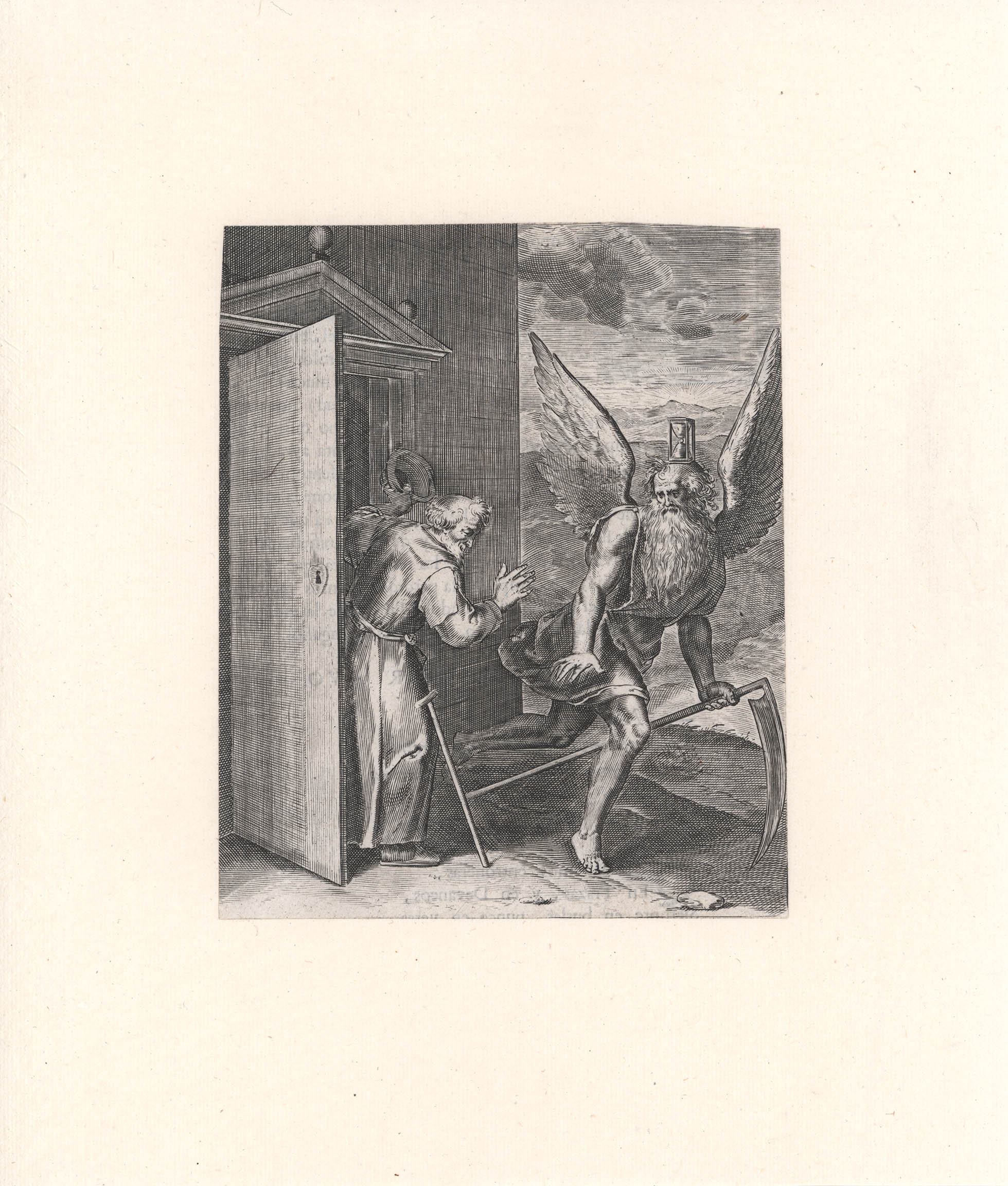
Gijsbert van Veen’s engraving, “Chronos Expelled”, c1607/12

Gijsbert van Veen (aka Gysbrecht van Veen; Gijsbert Vaenius; Gisbert Venius) (1558–1628), possibly designed in collaboration with his brother, Otto van Veen’s (aka Otho Venius; Octavio van Veen; Otho Vaenius) (1556–1629)—the teacher of Rubens

“Chronos Expelled” (aka “Tempus Rite Impensum Sapiens Non Revocat”; “The Wise Do Not Regret Time Expended Well”), c1607/12, published in Antwerp by Prostant apud Philippum Lisaert in 1612, as an illustration shown on the facing page to page 170 in Otto van Veen’s “Quinti Horatii Flacci Emblemata, Imaginibus in Æs Incisis, Notisque, Illustrata” (The emblems of Quintus Horatius Flaccus, illustrated with images engraved on them, and noted) with accompanying lines from Horace’s (aka Quintus Horatius Flaccus) (65–8 BCE) “Odes”, Book III, 29, lines 41–48: ("___ he who is powerful of his own,/ Lives happily, to whom it may be in the day/ To have said, I have lived …” (“___ ille potens sui,/ Laetusque deget, cui licet in diem/ Dixesse, vixi …”).

The following translation of the accompanying text for this illustration may help to give the flavour of the writing (my apologies for errors in the translation): “The wise man is not weighed down by the time well spent, because he goes out to say goodbye gratefully, and time consents to him, that he is paid for the good that has served him in his years; …” (p. 170).

Archive.org offers an online view of this print in its context in the publication: https://archive.org/details/quintihoratiifla00veen/page/171/mode/2up.

Note that this impression is from a Latin edition that is different from the publication showcased by Archive.org (based on looking at the layout when the print is held to the light).

Engraving on fine laid paper trimmed around the image borderline (or slightly within) and backed with a support sheet.

Size: (support sheet) 30.9 x 26.6 cm; (sheet) 17.9 x 14.8 cm.

Condition: a well-printed impression, trimmed slightly unevenly around the image borderline and laid onto a support of archival (millennium quality) washi paper providing wide margins. The sheet is in a very good condition for its age, with no tears, holes, folds, abrasions, stains or foxing.

I am selling this marvellous emblem print with Father Time (aka Chronos) wearing his attribute of an hourglass on his head and carrying his famous leveller of men—the scythe—being expelled from what appears to be a monastery, for the total cost of AU$237 (currently US$168.36/EUR154.25/GBP135.93 at the time of this listing) including Express Mail (EMS) postage and handling to anywhere in the world, but not (of course) any import duties/taxes imposed by some countries.

If you are interested in purchasing this visual reminder that time enjoyed may not be wasted time, please contact me (oz_jim@printsandprinciples.com) and I will send you a PayPal invoice to make the payment easy.

This print has been sold


Saturday, 9 October 2021

Jan Gerritsz Swelinck’s double-sided emblem engravings, “Plate XLIL” & “Plate XLIL”, 1627–59, after Adriaen van der Venne

Jan Gerritsz Swelinck (1601–c1649) (or from the circle of), after the designs by

Adriaen van der Venne (1589–1662)

Double sided engravings illustrating proverbs by Jacob Cats (1577–1660) (known with respect and affection as “Father Cats”), from the 1659 edition of “Alle de Wercken van den heere Jacob Cats …” (Complete Works of Jacob Cats), pages 140–150:

(Recto) “Plate XLIL: Haest is geen Spoet, Veerdigh Ryck niet goet” (Hurry is not important, quickly rich not good—if one grafts a fully mature plant onto an immature plant to speed up the growing process the result is unlikely to be successful), 1627–59;

(Verso) “Plate XLIII: Cupidinis Loculi Porro Vincti” (Cupid's Chests Now Bound—Cupid adds a log to a fire so that the warmth will open nut cases in the same way that love will open cold hearts), 1627–59.

Achive.org offers and online view of these engravings in their context in the 1712 edition: https://archive.org/details/JSH.31962001408628Images/page/n177/mode/1uphttps://archive.org/details/JSH.31962001408628Images/page/n179/mode/1up.

Double sided (recto and verso) engravings on laid paper trimmed with small margins and a letterpress printed plate number above each image.

Size: (sheet) 14.3 x 13.9 cm; (recto plate) 12.6 x 12.5 cm; (recto image borderline) 12.2 x 12 cm.

Condition: near faultless impressions in pristine condition.

I am selling these intriguing double-sided engravings of remarkable quality for the total cost of AU$174 (currently US$127.19/EUR109.96/GBP93.39 at the time of this listing) including postage and handling to anywhere in the world (but not, of course, any import duties/taxes imposed by some countries).

If you are interested in purchasing these double-sided engravings of the highest quality, please contact me (oz_jim@printsandprinciples.com) and I will send you a PayPal invoice to make the payment easy.

This print has been sold 


Saturday, 29 May 2021

Johann Christoph Böcklin’s engraving “Degustat Amara”, 1708, after Johann Andreas Thelott

Johann Christoph Böcklin (1657–1709)

“Degustat Amara” (Bitter Taste), 1708, plate 22 from the series of 26 emblem prints after the design by Johann Andreas Thelott (1654–1734), published in Augsburg in 1708 by Johann Christoph Kolb (1680-1743) and Andreas Maschenbauer (fl.early 1700s) in “Cor laetificans castrum doloris Christo redemtoris, oder, Hertz-erquickende Trauer-Bühne dem Erlöser menschlichen Beschlechtes Christo Jesu” (Gladdening the heart of the castle of pain Christ the redeemer), bound in the publication between pages 22 and 23 (see: https://books.google.com.au/books?id=06VjHlJmOWYC&printsec=frontcover#v=onepage&q&f=false).

Harvard Library (HOLLIS) offers a description of this publication:

http://id.lib.harvard.edu/alma/990042846950203941/catalog

Engraving on laid paper (with watermark).

Size: (sheet) 22 x 15 cm; (plate) 19.7 x 13 cm; (image borderline) 19 x 12.5 cm.

Inscribed on the plate: (above banderole) “Der Sterb/ Trancf Christi./ Matth. 27. [vers.] 46/ et 48” (Death of Christ. Matth 27 vers. 46 and 48); (on banderole) “DEGUSTAT AMARA” (Bitter taste); (below sill) “Da fich mein Haupt zur/ Ruhe sencft/ Berd ich mit saurem Strom/ getrancttt.” (Then my head fell to rest, I was soaked in acidic electricity.); I am unable to decipher the text on the face of the lower step except from this interesting verse: “When the sun communicates its splendour over the earth during the day must take is evening rest in the fallen sea.”; (lower right corner) “22”.

Note: there may be mistakes in my reading of the Frakture font and I have used Google for English translation of the German text.

Condition: a richly inked and well-printed impression—possibly a lifetime impression as there are no signs of wear to the printing plate. The sheet is in near pristine condition with no tears, holes, folds, abrasions, stains, foxing or signs of handling.

I am selling this small but graphically arresting emblem engraving that is rarely seen on the art market, for AU$328 (currently US$253.13/EUR207.59/GBP178.39 at the time of posting this listing) including postage and handling to anywhere in the world (but not, of course, any import duties/taxes imposed by some countries).

If you are interested in purchasing this intriguingly wonderful example of Baroque period symbolism about the inescapable truth of memento mori—“remember that you [have to] die”—please contact me (oz_jim@printsandprinciples.com) and I will send you a PayPal invoice to make the payment easy.

This print has been sold 


Tuesday, 26 May 2020

Swelinck’s engraving, “Sibe Nequam Cui Bonus?”, 1712


Jan Gerritsz Swelinck (1601–c.1649) after the design by Adriaen van der Venne (aka Adriaen Pietersz. van de Venne) (1589–1662)

“Sibe Nequam Cui Bonus?” (“Who is hurtful to himself, benefits no one”; “To whom is one good who is bad for himself?”; “He is a fool that forgets himself”—an old English proverb (c.1270) revived in Chaucer’s “Troylus”: “He is a fool that wol for-yete himselve” [1611]), 1712 (note that there are earlier versions of this design), plate XXXIV (34) in Jacob Cats’ (1577–1660)—known with respect and affection as “Father Cats”—1712 edition of “Alle de Wercken van den heere Jacob Cats …” (Complete Works of Jacob Cats) (aka “Alle de wercken van den Heere Jacob Cats. De laatste druck: war in het Twee-entachtig jaarig leeven des dichters, beneffens desselfs slaapeloose nachten, met printverbeeldingen sijn verrijkt”), published in Amsterdam by J. Ratelband, p. 68.

The publication (“Alle de Wercken van den heere Jacob Cats …”) in which this print features may be viewed online or downloaded free-of-charge from archive.org (this print features in the text on page 68 and online on page 98):

My understanding of this proverb (“Sibe Nequam Cui Bonus?”)—which may be far from the intended meaning—is that one should not place oneself in unnecessary danger as the outcome is not helpful to anyone, but rather one should enjoy life and let your pleasure spread to others. Regarding the image of the small bird within the jaws of a crocodile, the composition may be understood in terms of the following crude translation from a similar emblem print: “Do as the pretty bird that satisfies its fill on the banks of Nile without offering service to the Crocodile.” (My apologies to those who know the true meaning.)

Engraving on heavy laid paper with letterpress text recto and verso in Dutch, Latin and French and full margins as published.
Size: (sheet) 45.6 x 27.8 cm; (plate) 12.5 x 12.5 cm; (image borderline) 12.1 x 12.1 cm.
Numbered and lettered above the plate: (left) "68"; (centre) “SIBE NEQUAM CUI BONUS?/ XXXIV.”
Lettered in two columns below the plate (and verso) in lines of Dutch, Latin and French.

A brief description of this print is offered by the New York Public Library (digital collection):

Condition: full page (as published) in pristine condition apart from several printer’s creases created in the printing process.

I am selling this magnificent, museum-quality leaf for the total cost of AU$197 (currently US$131.06/EUR119.50/GBP106.35 at the time of this listing) including postage and handling to anywhere in the world.

If you are interested in purchasing this superb engraving of the highest quality on the huge, double-sided, lettered sheet as published, please contact me (oz_jim@printsandprinciples.com) and I will send you a PayPal invoice to make the payment easy.