Showing posts with label Meyer (Felix). Show all posts

Saturday, 18 September 2021

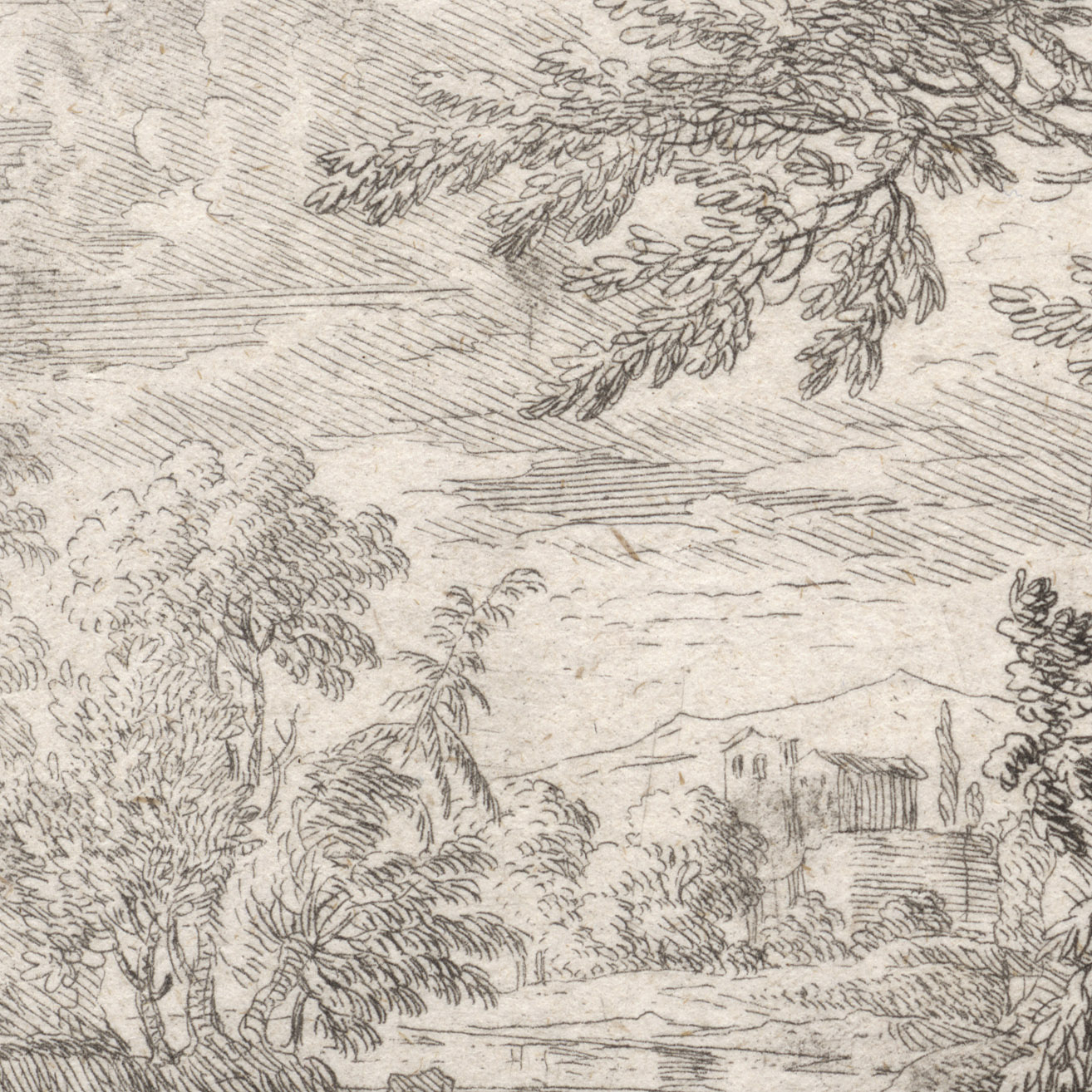
Felix Meyer’s etching, “Riverscape with Three Travellers”, 1675

Felix Meyer (1653–1713)

"Riverscape with Three Travellers" (aka “Paysage où sont trois personnages assis à g” [Landscape in which are three figures seated on the left] Le Blanc title; “Am Flußufer” [At the Riverbank]), 1675, plate number 73, published by Johann Christoph Weigel (1661­–1726).

Etching on fine laid paper ("Aescuiapian Staff" watermark) trimmed with a small margin around the image borderline.

Size: (unevenly trimmed sheet) 12.9 x 16.6 cm; (image borderline) 12.1 x 15.6 cm.

Inscribed in plate below the image borderline: (left) "I. C. Weigel exc."; (right) "No. 73."

Le Blanc 38 (Charles Le Blanc 1857, “Manuel de l'Amateur d'Estampes: Melchiori–Pencz”, Paris, P Jannet, p. 21, cat. no. 38; see https://archive.org/details/manueldelamateu00unkngoog/page/n27/mode/2up).

Meyer is one of the famous Swiss old masters, but rarely does one get a really good insight into such an artist's persona than the following account offered in Sholto and Reuben Percy's (1852) "The Percy Anecdotes", Vol. 4:

"An Abbot of St. Florian, Austria, being desirous to have two grand apartments painted in fresco ... applied to Felix Meyer, who was then on his travels, for his advice as to the manner in which he would have it executed. Meyer ... viewed the place for a few minutes; and then taking a long stick, to which he fastened a piece of charcoal, he immediately began to design, saying, 'Here I would have a tree:' which he marked out as quick as possible. 'At the remote distance I would represent a forest thus: here a fall of water, tumbling from great rocks,' and so on. As fast as he spoke, he designed, and deprived the Abbot of the power of expressing his approbation, so much he was lost in astonishment, to see a design with such elegance and taste, executed even without any time being allowed for reflection. At the Abbot's request, Meyer undertook to finish the design; which he completed in the course of the summer. This adventure spread the reputation of Meyer through all Germany; and was thenceforward continually employed by the princes and nobility in Europe" (pp. 136–37).

Condition: a strong impression showing no sign of wear to the printing plate, trimmed on, or slightly within, the plate mark. The sheet is in a near pristine condition with no tears, holes, folds, abrasions, stains, foxing or signs of handling.

I am selling this rare etching by Felix Meyer—so rare that I haven’t found another copy of it in any of the major museums! —for the total cost of AU$227 (currently US$164.99/EUR140.64/GBP120.11 at the time of this listing) including postage and handling to anywhere in the world (but not, of course, any import duties/taxes imposed by some countries).

If you are interested in purchasing this idyllic scene by a major Swiss old master showing resting travellers chatting beside a stream on the left and cascades on the right with a distant view of an Italianate styled building and cypress—please contact me (oz_jim@printsandprinciples.com) and I will send you a PayPal invoice to make the payment easy.


Thursday, 2 September 2021

Unidentified printmaker, “Mountaintop in the Clouds”, c1680, in reverse after Abraham Genoels

Unidentified printmaker from the circle of Abraham Genoels (aka [nickname] Archimedes) (1640–1723)—possibly Adriaen Fransz. Boudewijns (1644-1719) who is known to copy Genoels’ designs, but to my eyes in terms of style the artist is more likely to be Felix Meyer (1653–1713); see for example Meyer’s etching after Genoels: https://www.metmuseum.org/art/collection/search/415527.  

“Mountaintop in the Clouds” (TIB title) (aka “Arcadian Landscape with a Small Lake”), c1680, after the design and etching in reverse by Abraham Genoels (see http://hdl.handle.net/10934/RM0001.COLLECT.116290).

Etching on laid paper trimmed with a thread margin around the image borderlines on the top and sides and retaining the text lines, backed with a support sheet.

Size: (sheet) 19.6 x 14.3 cm; (image borderline) 19 x 14.2 cm.

Lettered in plate below the image borderline: (left) “A. Genoels inv. Romæ.”

(In reverse and after) TIB 5.13 (Walter L Strauss [gen. ed.] 1979, “The Illustrated Bartsch: Netherlandish Artists”, vol. 5, p. 304, cat. no. 13 [331]).

Condition: a strong impression trimmed close to the image borderline but retaining the text line and laid onto a sheet of archival (millennium quality) washi paper. Beyond a closed tear at lower left, the sheet in an excellent condition with no significant stains or foxing.

I am selling this beautiful etching in reverse to Abraham Genoels’ etching, for total cost of AU$306 (currently US$226.68/EUR190.78/GBP163.78 at the time of posting this listing) including postage and handling to anywhere in the world (but not, of course, any import duties/taxes imposed by some countries).

If you are interested in purchasing this sensitively executed etching in reverse to Genoels’ design, please contact me (oz_jim@printsandprinciples.com) and I will send you a PayPal invoice to make the payment easy.


Monday, 22 January 2018

Abraham Genoels’ etching, “Rest in Egypt”, c.1680


Abraham Genoels (aka Archimedes; Abraham Genoels II; Abraham Genoel; A. G.) (1640–1723)

“Rest in Egypt” (Le Repos en Egypte) (TIB title), 1675–91

Note that I have listed the pendent for this print executed by Felix Meyer (after Abraham Genoels) in the earlier post: http://www.printsandprinciples.com/2016/10/felix-meyers-etching-after-abraham.html

Etching on fine laid paper trimmed within the platemark and lined with a support sheet.
Size: (support-sheet) 30.7 x 33.4 cm; (sheet) 14.5 x19 cm

TIB 5 (4). 10 (328) (Walter L Strauss [Ed.] 1979, “The Illustrated Bartsch: Netherlandish Artists”, vol. 5, Abaris Books, New York, p. 301); Bartsch IV.328.10 (Adam Bartsch 1803, “Le Peintre graveur”, 21 vols, Vienna); Regnault-Delalande 1817 148.10 (F-L Regnault-Delalande 1817, “Catalogue Raisonné des Estampes du Cabinet de M le Comte Rigal”, Paris, chez l'auteur); Weigel 1843 undescribed (Rudolph Weigel 1843, “Suppléments au Peintre-Graveur de Adam Bartsch”, Vol.I, Leipzig, Rudolph Weigel);  Hollstein 10 (F W H Hollstein 1949, “Dutch and Flemish etchings, engravings and woodcuts c.1450-1700”, Amsterdam, p. 98)

The British Museum offers the following description of this print:
“The Rest on the Flight into Egypt. The Holy Family resting under a large tree in the centre, a sarcophagus next to a river to the left, two pyramids to the right, several architectural blocks and bushes in the foreground, palm trees and Egyptian temples in the background; in an oval” (http://www.britishmuseum.org/research/collection_online/collection_object_details.aspx?objectId=1667427&partId=1&searchText=egypt&people=123852&page=1); see also the description of this print at the Rijksmuseum: http://hdl.handle.net/10934/RM0001.COLLECT.116287

Condition: crisp and well-inked impression trimmed to the oval image borderline and re-margined on a support sheet. The sheet shows signs of use (i.e. it is slightly mottled in colouring and there is a spot on the upper left just within the borderline), but there are no tears, holes, folds or significant abrasions.

I am selling this luminous print for AU$208 (currently US$166.63/EUR135.98/GBP119.86 at the time of posting this listing). Postage for this print is extra and will be the actual/true cost.

If you are interested in purchasing this very rare etching by Genoels (mindful that all etchings by this highly sought after artist are rare), please contact me (oz_jim@printsandprinciples.com) and I will send you a PayPal invoice to make the payment easy.


In earlier posts focused on Genoels' etchings I proposed that his line work has the attribute of “openness” (i.e. he leaves quite large gaps between each line) and that he renders trees with rounded strokes resulting in the trees’ foliage having a rather “fluffy look.”

In this etching, I think my former proposals about his stylistic leanings are still valid—thank goodness! One feature of Genoels' style that I have not commented on previously is his choice to feature remnants of a classical past. Here, I am not only referring to the curiously very pointed pyramids in the far distance, but also to the tomb/sarcophagus in the centre of the composition and the rubble of architectural bits in the immediate foreground.

Of course the featured pyramids were necessary additions to the scene as they locate the flight of the holy family to Egypt to escape the edict of King Herod to kill the male infants. The featured tomb, however, has less to do with the biblical narrative and a lot to do with the 17th century landscape tradition of crafting scenes with architectural references to antiquity.


Tuesday, 21 March 2017

Felix Meyer’s etching of the Swiss landscape, c.1700


Felix Meyer (1653 - 1713)
"Path leading around a rocky outcrop with an overhanging tree and buildings in the distance" (descriptive title only), c.1670-1713, from the series, “Twelve Swiss landscapes.”

Etchings on fine laid paper with thread margins. Two early states taken from the same etching plate before it was lettered for publication.
Size: (plate) 10.4 x 12 cm
State i (of iii)
Hollstein 39 (F W H Hollstein 1954, “German engravings, etchings and woodcuts c.1400-1700”, Amsterdam); see also Holl. 36–47; resp. Le Blanc 10–21.

Condition: lifetime impressions trimmed close to the platemark. Both prints are in good condition (i.e. there are no tears, holes, folds, significant stains or foxing). The slightly lighter toned print is either an earlier state or the impression has been wiped too firmly resulting in some of the detail appearing faint.

I am selling this pair prints taken from the same etching plate for the total cost of AU$226 (i.e. the combined price of both prints) (currently US$174.76/EUR161.79/GBP140.17 at the time of posting this listing) including postage and handling to anywhere in the world.
If you are interested in purchasing these exceptional rare early impressions, please contact me (oz_jim@printsandprinciples.com) and I will send you a PayPal invoice to make the payment easy.

This pair of prints have been sold


Initially, I imagined that I would have no difficulty in finding information about this etching. After all, Meyer is one of the major Swiss landscape artists at the turn of the 17th century and why wouldn’t there be a plethora of information waiting “out there” for me to discover? I was wrong. Not only is the easily sourced information about Meyer fairly fundamental—in the sense of giving a broad timeline for his practice without much elaboration—but even the main institutions (The British Museum, Rijksmuseum and the Met) had only meagre collections of his prints.

What I did discover from reading between the lines was that he had a nodding acquaintance with Georg Philipp Rugendas and Johann Melchior Roos (I have discussed both of these artists in a previous posts). Indeed, according to Michael Bryan (1816) "A Biographical and Critical Dictionary of Painters and Engravers”: “In company with Roos and Rugendas, he [Meyer] was indefatigable in designing the most picturesque views of Switzerland …” (p. 62).

This insight about his association with these artists made me stop and think and I can now see hints of shared interests between the artists. For example, I view Meyer’s virtually untouched/line-free sky area as relating to his peers’ use of similar large slabs of untouched paper. Moreover, I would have little difficulty in arguing that Meyer shares a similar approach to orchestrating pattern of lights and darks in his compositions.

Although this is a Swiss landscape, the design elements—landscape features that suggest a timeless state and a distant ruin—are much the same as those found in any idealised Italianate landscape of the 17th century, whether it was executed in Italy or in far-flung reaches of the Netherlands. Indeed, so widely spread was the love of such timeless landscapes that their construction was even formalised by Gerard de Lairesse (the head of the Amsterdam Academy) in 1707—even though he had never actually been to Italy.

Like all artists wishing to express the concept that an ideal landscape is timeless (amongst a host of other notions driving artists at this time) the key design elements—viz. a winding road, a rocky outcrop, trees and a distant ruin—needed to be set in place before the less important, superficial details were added to a composition.

For me this approach of laying down the fundamental design elements first is like Stephen Covey’s practical advice about how to fill a bucket with rocks and sand—an analogy used by Covey to explain best practice of prioritisation in management: one can fill a bucket properly by putting the big rocks into the bucket first and then add the sand later, but never the converse of putting the sand in first and adding the rocks later.