Showing posts with label Ruisdael (Jacob van). Show all posts

Monday, 12 September 2022

Charles Daubigny’s etching, “The Ray of Sunlight”, 1860, after Jacob van Ruisdael

Charles Daubigny (aka Charles François Daubigny) (1817–1878)

“The Ray of Sunlight” (aka; “Le Coup de Soleil”; “The Burst of Sunshine”), 1860, after Jacob van Ruisdael 's (aka Jacob van Ruysdael; Jacob Isaaksz van Ruisdael; Jacob de Goyer) (1628/9–1682) 1665 painting in the Musée du Louvre, Paris (inv. no. 1820) (see https://commons.wikimedia.org/wiki/File:Jacob_Isaaksz._van_Ruisdael_003.jpg).

Etching and drypoint printed in brown ink on cream chine collé on heavy wove paper, trimmed slightly within the platemark and backed with a support sheet providing wide margins.

Size: (support sheet) 51.7 x 54.6 cm; (sheet) 39.3 x 42.8 cm; (image borderline) 33.3 x 39.9 cm.

Lettered in plate below the image borderline: (left) “RUISDAEL PINXT.”; (centre) “CHALCOGRAPHIE IMPÉRIALE DU LOUVRE./ LE COUP DE SOLEIL.”; (right) “DAIBIGNY SCULPT.”

State iv (of iv) with the addition of the title and publication details.

Melot D93 S4 (Michel Melot 1978, “Graphic Art of the Pre-Impressionists”, New York, Harry N. Abrams, p, 279, cat. no. D 93 [4]); Delteil 93 (“Le Peintre-Graveur Illustré (XIXe et XXe siècles”).

Michel Melot (1978) offers the following insights about the background events in Daubigny’s life leading up to the execution of this plate:

“The First Class Medal awarded Daubigny in the Salon of 1853 won him the privilege of figuring on the list of artists entitled to receive commissions from the Chalcographie. … In 1855 he won another medal, this one Second Class, and was given another task by that government agency for the arts, again to reproduce a Ruysdael, a task that seemed to call for his talents. … Ordered in 1855, the engraving was not complete and delivered to the Chalcographie until 1860, and the print was exhibited in the Salon of 1861 (as no. 3698)” (p. 279).

The British Museum offers the following description of this print:

“Elevated view over landscape with fortifications on rock lit by sun, overlooking river, with figures on path near bridge in foreground to left; after Jacob van Ruisdael” (https://www.britishmuseum.org/collection/object/P_1876-0510-288).

Note that Pierre Laurent (aka Pierre François Laurent) (1739–1809) also made a reproductive etching (with engraving) of Ruisdael’s painting (see https://www.britishmuseum.org/collection/object/P_1868-0612-368).

Condition: a strong and well-printed impression trimmed slightly within the platemark and laid upon an archival support sheet of millennium quality washi paper. The sheet is in a very good condition with no tears, holes, folds, abrasions or significant stains.

I am selling this large and magnificent etching executed by one of the luminaries of the Barbizon School that foreshadowed Impressionism, for the total cost of AU$289 (currently US$198.73/EUR196.14/GBP170.01 at the time of this listing) including postage and handling to anywhere in the world, but not (of course) any import duties/taxes imposed by some countries.

If you are interested in purchasing this warmly glowing etching which is one of Daubigny’s major commissioned works, please contact me (oz_jim@printsandprinciples.com) and I will send you a PayPal invoice to make the payment easy.

This print has been sold


Sunday, 28 August 2022

Charles Daubigny’s etching, “Le Buisson”, 1855, after Jacob van Ruisdael

Charles Daubigny (aka Charles François Daubigny) (1817–1878)

“Le Buisson” (aka “The Scrub”; “The Thicket”), 1855, after Jacob van Ruisdael 's (aka Jacob van Ruysdael; Jacob Isaaksz van Ruisdael; Jacob de Goyer) (1628/9–1682) painting, 1647/53, “Dune Landscape near Haarlem” (aka "Le Buisson ou Chemin dans les dunes harlemoises"), in the Musée du Louvre, Paris (inv. no. 1819) (see: https://en.wikipedia.org/wiki/Dune_Landscape_near_Haarlem), commissioned and published by the Chalcographie du Louvre.

Etching and drypoint printed in brown (bistre) ink on heavy cream wove paper, blind-stamped with the Chalcographie du Louvre seal.

Size: (sheet) 51 x 54.8 cm; (plate) 42.9 x 47.8 cm; (image borderline) 32.8 x 39.7 cm.

Lettered in plate below the image borderline: (left) “J.Ruisdael pinxit.”; (centre) “LE BUISSON.”; “C. Daubigny sculp 1855/ CHALCOGRAPHIE DU MUSÉE DU LOUVRE.”

Blind-stamped on lower margin with the seal of “Chalcographie du Louvre, Musées Nationaux”.

State v (of v) with the addition of the title and publication details of the Chalcographie.

Melot D87 S5 (Michel Melot 1978, “Graphic Art of the Pre-Impressionists”, New York, Harry N. Abrams, p, 278, cat. no. D 87 [5]); Delteil 87 (“Le Peintre-Graveur Illustré (XIXe et XXe siècles”).

Michel Melot (1978) offers the following insights about the background events in Daubigny’s life leading up to the execution of this plate:

“The Comte de Nieuwerkerke, Director-General of Museums, assigned Daubigny to translate the “Thicket” of Ruysdael, which no engraver had as yet taken on. Daubigny acquitted himself of this delicate task very honourably. He rendered the masterpiece of the Master of Haarlem not as a clever manipulator of cross-hatchings but as a painter interpreting another painter and penetrating directly into the feeling of the model. He attained the power of effect of the original and at the same time expressed its austere melancholy. Following the example of the masters of the great periods of engraving, Daubigny executed his plate with a great simplicity of means. He made use of scarcely anything more than etching and drypoint. He made little or no use of the burin. He rigorously ruled out the use of roulettes and other mechanical means. He made up for them by energetic and repeated [acid] baths; his work owes its frankness and vigour to those audacities in acid-biting, but the drawing was to some extent made heavier, and the plate lost by this a little of the spirit and finesse that distinguish the ‘first state’ of pure etching so sought after by print lovers” (p. 278; see also the original text written that Melot translated written by Comte de Nieuwerkerke’s secretary, Frédéric Henriet, in 1875 in “C. Daubigny et son oeuvre gravé, eaux fortes et bois inédits”, Paris, A. Lévy, pp. 60–61: https://archive.org/details/cdaubignyetsonu00henrgoog/page/n80/mode/2up).

The Metropolitan Museum of Art offers a description of this print: https://www.metmuseum.org/art/collection/search/336989.

Condition: a richly inked and well-printed impression with generous margins as published in near pristine condition.

I am selling this large and richly worked etching executed by one of the luminaries of the Barbizon School after a painting by one of the major landscape artists of the 1600s, for the total cost of AU$289 (currently US$199.21/EUR199.71/GBP169.82 at the time of this listing) including postage and handling to anywhere in the world, but not (of course) any import duties/taxes imposed by some countries.

If you are interested in superb etching which is one of Daubigny’s major commissioned works by the Louvre—interestingly, the print was commissioned by the director of the Louvre at a time when artists’ reproductive rights were being challenged by a proposed law in 1841 designed to prevent “the government of conducting itself like an owner and publisher with money taken from the Civil List” (see Frédéric Henriet [1875] p. 60)—please contact me (oz_jim@printsandprinciples.com) and I will send you a PayPal invoice to make the payment easy.

This print has been sold


Sunday, 9 February 2020

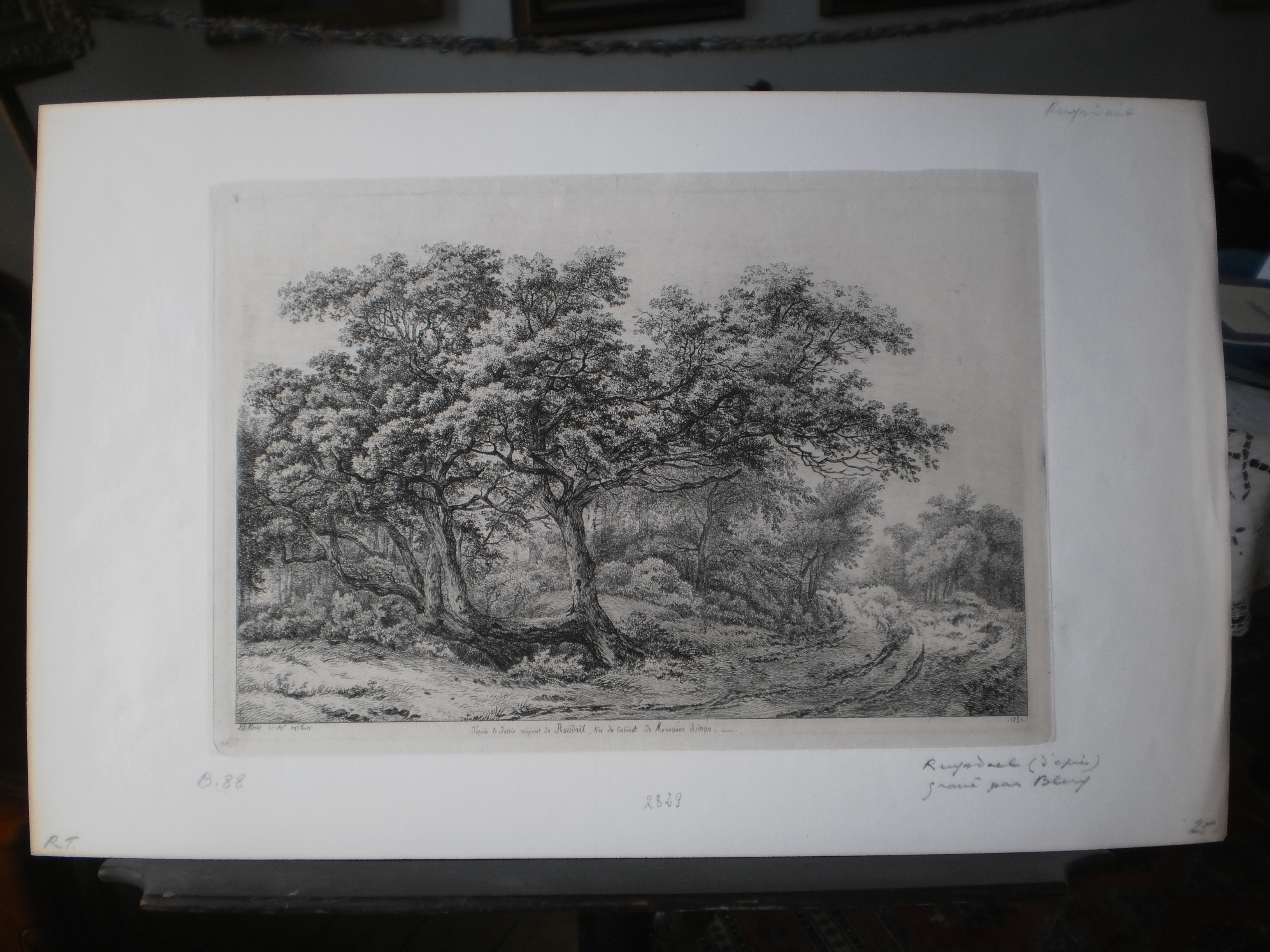
Eugène Bléry’s etching, “Le Chemin dans la Forêt”, 1851, after Van Ruisdael


Eugène Bléry (aka Alexandre Stanislas Eugène Bléry) (1805–1887)

“Le Chemin dans la Forêt” (The Path in the Forest) (aka “Le Ruysdaël” [Beraldi & BM title]), 1851, proof before lettering for publication, after the pencil and brushed ink drawing by Jacob Isaacksz van Ruisdael (aka Jacob van Ruysdael; Jacob van Ruisdael; Jacob de Goyer) (1628/9–1682) in the Petit Palais, Musée des Beaux-arts de la Ville de Paris (see http://parismuseescollections.paris.fr/de/node/219412#infos-principales).

Etching on light grey chine collé (China) on wove paper with small margins backed with a support sheet.
Size: (sheet) 25.4 x 36.6 cm; (plate) 23.4 x 34.1 cm; (chine collé) 23.1 x 33.8 cm.
Inscribed on plate below the image borderline: “(left) “EBlery Sculpt aq.a.forti”; (right) “.1851.”
Inscribed in ink by an old hand at lower below the image borderline: (right) “Ruisdaël invt.”

Note: I wish to propose that the hand-written ink note is inscribed by the artist as the writing style matches the inscribed style on the plate of the later states (cf. the style of writing the word, “Ruisdaël”, in states ii and iii).

State i (?) of iii (?) before lettering below the image borderline at centre: “d’après le dessin original de Ruisdaël, tire du Cabinet de Monsieur Simon. […]” (see https://upload.wikimedia.org/wikipedia/commons/1/13/E._BLERY%2C_Le_Ruysda%C3%ABl_%28Le_Chemin_dans_la_For%C3%AAt%29%2C_1851..jpg) and the later erasure of this lettering and the addition at lower left “- Ruisdaël delineavit” (see BM no. 1856,0712.324).

Beraldi 1885-92 88 (Henri Beraldi 1885, “Les graveurs du 19e siècle; guide de l'amateur d'estampes modernes”, vol. 2, Paris, L. Conquet, p. 115); IFF 109 (Département des Estampes 1930, “Inventaire du Fonds, Français: graveurs du XVIIe siècle”, Paris, Bibliothèque Nationale).

The British Museum offers the following description of this print:
“Landscape representing a forest; a path in the right foreground; two oaks in the left foreground”

Condition: richly inked and well-printed impression in excellent condition with small margins and laid upon a support sheet of archival (millennium quality) washi paper.

I am selling this elegantly simple and very beautiful etching after Ruisdael’s drawing, featuring a sweeping arc of a path leading into a forest, for AU$278 in total (currently US$185.67/EUR169.63/GBP144.11 at the time of posting this listing) including postage and handling to anywhere in the world (but not, of course, any import duties/taxes imposed by some countries).

If you are interested in purchasing this sensitively and insightfully executed etching—note how the artist has rendered the detail and darker tone of the foreground trees in a mimetic way, compared to the cross-hatched treatment of trees in the middle distance and the vertical and horizontal strokes suggesting the shapes of distant trees—please contact me (oz_jim@printsandprinciples.com) and I will send you a PayPal invoice to make the payment easy.

This print has been sold


Saturday, 23 March 2019

Jacob van Ruisdael's etching, “The Great Beech with Two Men and a Dog”, c1650


Jacob Isaaksz van Ruisdael (aka Jacob van Ruysdael; Jacob de Goyer) (1628/29–1682)

“The Great Beech with Two Men and a Dog” (aka “The Wooded Landscape with a Great Tree”), c1650, from the series of four etchings of similar format and dimensions, from McCreery’s 1816 edition of “200 Etchings” pulled from the original plates.

Etching on fine wove paper trimmed on or within the platemark (as published by McCreery) and lined onto a conservator’s support sheet.
Size: (sheet) 19.5 x 28 cm; (image borderline) 18.6 x 27.4 cm.
Inscribed on plate below the image borderline: (centre) "JVRuisdael f."
State ii (of ii)

Slive EII; Bartsch I.312.2; Hollstein 2.II
The British Museum offers the following description of this print:
“Two farmers with their dog; landscape with the farmers on a road in lower left, walking through a forest, a mature and gnarled tree in right foreground. c.1650” (http://www.britishmuseum.org/research/collection_online/collection_object_details.aspx?objectId=3097027&partId=1&searchText=ruisdael&page=3)

Clifford S Ackley (1981) in “Printmaking in the Age of Rembrandt” (Boston, Museum of Fine Arts) advises that in this second and final state of the print:
“… stiff, puffy cumulus clouds and parallel shading were added to the sky, crowding the space of the landscape and diminishing the sense of light and atmosphere. The clouds resemble those in some of the latter landscape painting of Ruisdael but are clumsily executed” (p. 227).

Needless, to say, these additions are not by the hand of Ruisdael and are probably by his son who wished to “improve” his father’s plate. Regarding the wriggly lines in the sky at the top right, these are not by Ruisdael’s son. Instead, they are accidents—arguably serendipitous—resulting from craquelure breaks in the etching ground. This fault is not uncommon and De Groot (1979) points out that this issue also occurs in Rembrandt’s “The Little Stink Mill”—a windmill (see Slive [2001], p. 604).

Condition: crisp, richly inked and well-printed impression slightly tanned with age toning and there is a little unevenness to the colour (water staining?) towards the upper edge. There are small tears and thin areas along the upper edge but these issues have been addressed by the sheet having been laid onto a conservator’s support sheet.

I am selling this very beautiful impression of one of Ruisdael’s most celebrated etchings for AU$400 in total (currently US$283.57/EUR250.82/GBP214.54 at the time of posting this print) including postage and handling to anywhere in the world (but not, of course, any import duties/taxes imposed by some countries).

If you are interested in purchasing this important masterwork by the almost legendary old master, Jacob van Ruisdael, please contact me (oz_jim@printsandprinciples.com) and I will send you a PayPal invoice to make the payment easy.

This print has been sold


Monday, 17 March 2014

Trees as Metaphors (Part 2)

There is a long history of trees symbolising attributes such as strength, resilience and the essence of nature, but how have trees been used metaphorically in images (i.e. used pictorially to “explain” ideas)?


In Part 1 of this discussion about artists’ use of trees as metaphors, I dwelt on the motif of the regenerating tree (i.e. a tree that has a dead stump or limb but also has fresh growth). For the present discussion I will shift the focus onto trees used as metaphors to visually “explain” romantic notions of mood (i.e. inner feelings such as awe, sublime elation and spiritual transcendence as well as negative feelings like melancholy, anxiety and fear).

Regarding artists who use trees to express mood, Adolphe Appian (1818­–­­­98) is an ideal exemplar. For instance, Appian portrays in his etching, Au Valromey (shown below), a meandering stream with a tree overhanging it as the central point of interest in the scene. This tree, however, is far from being a generic tree like the others depicted nearby. Instead, the tree has been crafted by Appian to be scary—in the sense of being spooky—with spindly branches that seem to reach out like feelers from a menacing monster. In short, when seen in this way the tree is a metaphor for eeriness and expresses the notion of sinister foreboding in a scene.

Adolphe Appian (1818­–­­­98)
Au Valromey, 1868
Published by Cadart et Luce (1868) in L'Illustration nouvelle par une société de peintres-graveurs à l'eau-forte (premier volume)
Etching and drypoint with light plate tone on fine laid paper with 2.7 cm chainlines
Inscribed: (lower-left) “Appian sculp. / CADART & LUCE, Editeurs. Rue Nve des Mathurins, 58.”; (lower-middle) “AU VALROMEY (AIN) / (Vallis Romana sous Jules César)”; (lower-right) Imp. Delâtre, Paris.”
(sheet) 29.7 x 46.5 cm; (plate) 13.9 x 24 cm; (image) 10 x 19.3 cm
State II (of II)
(see the related painting by Appian, In the Valromey Valley, near the Rhône River (1868), at the Minneapolis Institute of Arts: http://www.artsconnected.org/resource/5891/in-the-valromey-valley-near-the-rh-ne-river [viewed 5 March 2014])

Jennings 22; Prouté 25  

Condition: Superb, crisp, well-inked impression. The sheet is in good condition (i.e. there are no stains, handling marks or foxing) but there are remnants of three triangular hinge marks (recto) that are 2.5 cm from the plate mark. On the lower edge of the sheet (recto) are ink inscriptions by a former collector and (verso) has an ink stamp and an ink handwritten initial (?). I am selling this print for a total cost (including shipping to anywhere in the world) of [deleted]. Please contact me using the email link at the top of the page if you have any questions or click the “Buy Now” button below.
This print has been sold


In Bords Du Lac Du Bourget (shown below) Appian again uses the arresting shape of a tree to visually communicate his feeling of melancholy. Here, a solitary figure is portrayed seated in a small boat that is partly grounded on the shore of Lake Bourget. Rising above the boat in the near distance is another spindly tree favoured by Appian but this time it has a zigzag arrangement to its limbs and it position crowns a rocky outcrop leading into the water. To my eyes, the contrast of this tree’s sharp angularity set against the broad planes of the surrounding rocks and rows of horizontal lines representing the sky is an analogue (i.e. visual equivalent) of anxiety (see the discussion about analogues in the earlier post, Three Analogues: Brown & Kollwitz 
[http://www.printsandprinciples.com/search/label/analogue]). By this I mean that the tree is depicted like a nest of energy impacting upon the comparatively calm appearance of its immediate surroundings. Going further, in the context of this tree’s compositional placement—a placement that I see as both a threatening presence above the boat with its seated figure and as a core of busy excitement dissipating into the surroundings (see changes in the treatment of the sky show below)—this tree plays a vital role in articulating the gloom of melancholy permeating the scene. 

Adolphe Appian (1818­–­­­98)
Bords Du Lac Du Bourget [Shores of Lake Bourget], 1866
Published by Auguste Delâtre in Gazette des Beaux-Arts, Volume XXI. No. 8 (1 July 1866 to 1 December 1866). 
Etching on chine collé with light plate tone on fine laid paper with 2.7 cm chainlines
Inscribed: (upper-right within the image) signature and “1866”; (lower-left) “Gazette des Beaux-Arts.”; (lower-middle) “BORDS DU LAC DU BOURGET / Imp. Delâtre, Paris”; (lower-right) “A.Appian pinxt. et sculpt.”
(sheet) 19 x 28 cm; (plate) 15.8 x 23.7 cm; (image) 12.3 x 20.5 cm
State II (of II)
(see description of this print in the Bibliothèque municipale de Lyon: http://sged.bm-lyon.fr/Edip.BML/(ajm5t245yxd30k45z3czm045)/Pages/Redirector.aspx?Page=MainFrame
 [viewed 11 March 2014])
Jennings 22; Prouté 25

Condition: Strong and richly inked impression. The sheet is in good condition (i.e. there are no stains, handling marks or foxing) but there is a remnant of removed tape on the middle-left edge and a light fold on the top-right corner. I am selling this print for a total cost (including shipping to anywhere in the world) of [deleted]. Please contact me using the email link at the top of the page if you have any questions or click the “Buy Now” button below.

This print has been sold


Of course, trees do not have to be sinister forms in order to be metaphors signifying mood. Jacob Isaaksz van Ruisdael (sometimes spelt “Ruysdael”) (c.1629–82) employs a very different approach to using trees as metaphors. Ruisdael may have etched only thirteen plates, but these few prints illustrate very well how an artist can use trees to convey the romantic ideal of nature in its untamed state (i.e. wild and unmanicured by human intervention). For example, in The Great Beech, with Two Men and a Dog (shown below) Ruisdael uses the featured tree in a way that I think is almost visceral in conveying the idea of nature untamed. He does this by using his etched lines as visual equivalents for physically touching and handling the tree’s form as it twists and strains with the weight of its limbs. Ruisdael connotes this notion of organic energy in flux by minute changes in the direction and shape of the small marks rendering the tree. For example, note the changes of surface tensions captured by changes of mark attribute (i.e. the direction of the marks, their shape and their length) in the detail  of the tree's trunk shown further below.

Perhaps even more revealing, in terms of graphic expression of his passionate mindset and mood evoked by the drawing of the beech tree, is the contrast that Ruisdael’s haptic approach to drawing (for a discussion of the haptic approach, see the earlier post: Haptic and Visual: Rodin & Julien [http://www.printsandprinciples.com/2012/08/rodin-julien-haptic-visual.html]) differs from the perfunctory marks made by an unknown printmaker who aimed to improve upon Ruisdael’s plate by adding inexcusably horrid horizontal lines and cumulus clouds to the sky (to see the print before the “improvements,” one of the very few extant impressions of the first state is in the British Museum:
http://www.britishmuseum.org/research/collection_online/collection_object_details/collection_image_gallery.aspx?assetId=233096&objectId=1444713&partId=1 [viewed 17 March 2014]). Please be mindful, however, that not all of the sky was reworked with “improvements” by the unknown 17th century hand.  In the detail shown below of the sky on the right side of the print, there is a network of lines arising from craquelure in the etching ground—an accident that even Rembrandt succumbed to as seen in Little Stink Mill on the De Passeerde Bulwark in Amsterdam (see http://www.musicksmonument.nl/REMBRANT_VAN_RIJN_PROJECT/molen-3.html and 
http://www.britishmuseum.org/research/collection_online/collection_object_details/collection_image_gallery.aspx?assetId=26541&objectId=755860&partId=1 [viewed 17 March 2014]). 

Like all metaphors, the meaning projected by a portrayed tree may be read (i.e. interpreted) on multiple levels. This is certainly true of Ruisdael’s prints. Although in the present discussion I have categorised Ruisdael’s treatment of the beech tree as a graphic representation—perhaps even a passionate evocation—of untamed nature, his treatment of the tree may also be read as a metaphor for the precarious uncertainty of life, in much the same way as Weirotter often employed trees (see previous post, Trees as Metaphors [Part 1]). This additional level of reading became increasingly a part of Ruisdael’s mission when portraying trees in his latter years, as Seymour Slive (2001) insightfully points out in his catalogue raisonné on Ruisdael:
Ruisdael’s particular emphasis on the growth of powerful natural forms is keenly felt in this etching of a gigantic beech, and in the predominant tree in … Cottage on a Hill [shown below]. Here the ancient tree clings with its roots to the projection of a cliff; its broken top helps balance the weight of its heavily foliated branches. During the early 1650s Ruisdael showed a predilection in his paintings for variation on the theme of a monumental tree clawing into high ground or precariously balanced on a bank. (p. 605.)

Jacob Isaaksz van Ruisdael (also “Ruysdael”) (c.1629–82)
Cottage on a Hill, c.1660
Second state from McCreery’s 1816 edition of 200 Etchings taken from the original plates (of II)
Etching on thin wove paper
Inscribed with signature on lower margin: “JvRuisdael f.”
(sheet) 19.5 x 27.9 cm; (plate) cut on or within the plate mark; (image) 18.5 x 27 cm
State II (of II)
Slive EI2; Bartsch 1.3-1[2] (1.313.2); Hollstein 3.11

Condition: Crisp, richly inked and rare impression in virtually pristine condition (i.e. it is without foxing, stains, chips or tears) and the sheet is loose (i.e. it is not glued to a support sheet). 


This print has been sold


Regarding multiple readings of Ruisdael’s use of trees as metaphors, even the type of tree that Ruisdael chose to feature in his latter prints was important to him. For instance, Ruisdael chose a beech tree for the two prints discussed above, but, as the title of his attributed preliminary chalk study for these prints—Oak Trees on a River Bank (see Slive D54, p. 531)—suggests, Ruisdael envisaged that the beech was a more appropriate type of tree for his two prints. There may be little point in proposing reasons as to why he changed the type of tree from an oak to a beech, as any justifications can only be conjecture. In short, no one knows. Nevertheless, the fact that he did change tree types illustrates that he was seeking “something” in the tree he chose. Going further, and doing my best not to propose reasons that cannot be verified, he did have a leaning in his later paintings to the theme of what Clifford S Ackley (1981) in his excellent commentary in Printmaking in the Age of Rembrandt describes as the “heroic tree or group of isolated trees” (p. 227).


To offer an insight into this theme, the focus of the next instalment (Part 3) will shift to trees being used as metaphors for the noble hero.