Showing posts with label Panderen (Egbert van). Show all posts

Wednesday, 13 May 2020

Jaspar Isaac’s engraving, “The Descent from the Cross”, c.1631


Jaspar Isaac (aka Gasper Isac; Jaspar Isac; Gaspard Isac; Jaspar Isacsz; Jasper de Isaac) (fl.1585–1654), inscribed on plate as publisher.

“The Descent from the Cross” (La Descente de Croix), c.1631, plate 11 from “Biblia Sacra, Vulgatae Editionis” published by (widow) Claudius Rigaud and Claudius Obertand in 1631 in Lyon (see title page of this publication inscribed with “Jaspar Isac” as the engraver at the Rijksmuseum: http://hdl.handle.net/10934/RM0001.COLLECT.128102), possibly after Egbert van Panderen’s (c.1581–1637) engraving of the same design, “Kruisafneming” (http://hdl.handle.net/10934/RM0001.collect.160326)—alternatively, Van Panderen’s engraving may be after Isaac’s engraving—after the design by Luca Cambiaso (aka Luca Cambiasi; Luca Cangiage; Luca Cangiano; Luca Cangiasi; Lucas Cangiasus; Luchetto da Genova) (1527–1585)—possibly the pen and wash drawing, “Descent from the Cross”, c.1570 (https://www.artsy.net/artwork/luca-cambiaso-descent-from-the-cross) which is loosely similar in composition.

Note: this print is not documented or held in any of the major Museum repositories allowing me to verify that all the above details are correct. My apologies if there are errors.

Engraving on fine laid paper with watermark (portion) trimmed close to the image borderline.
Size: (sheet) 32.1 x 20.2 cm; (image borderline) 29.5 x 19.9 cm.
Inscribed on plate within the image borderline at lower left corner: “Jaspar Isac ex’”.
Numbered on plate below the image borderline: (centre) “11”.
Lettered on plate below the image borderline in two columns, with four lines of Latin at left and four lines of French at right: “Sancta quibus cordi est pietas gressum properate,/ …/…/… pharusque meis,// Sus sus tost hastéz uous, ames toutes fidelles/ …/…/ … de mes yeux,”.

Condition: a strong impression trimmed with a narrow margin around the image borderline and a centre-fold. The sheet is slightly darkened by its considerable age and there are numerous small areas of restoration along with the remnants of mounting verso.

I am selling this superb engraving, showing Christ being extracted from the cross by Nicodemus and Joseph of Arimathea and other assistants with Mary Magdalene seated and praying at the foot of the cross beside the crown of thorns in a basket, for AU$332 (currently US$213.59/EUR197.58/GBP174.98 at the time of this listing) including postage and handling to anywhere in the world (but not, of course, any import duties/taxes imposed by some countries).

If you are interested in purchasing this very rare engraving—I have been unable to find another copy of it in any museum repository—please contact me (oz_jim@printsandprinciples.com) and I will send you a PayPal invoice to make the payment easy.

This print has been sold


Tuesday, 3 April 2018

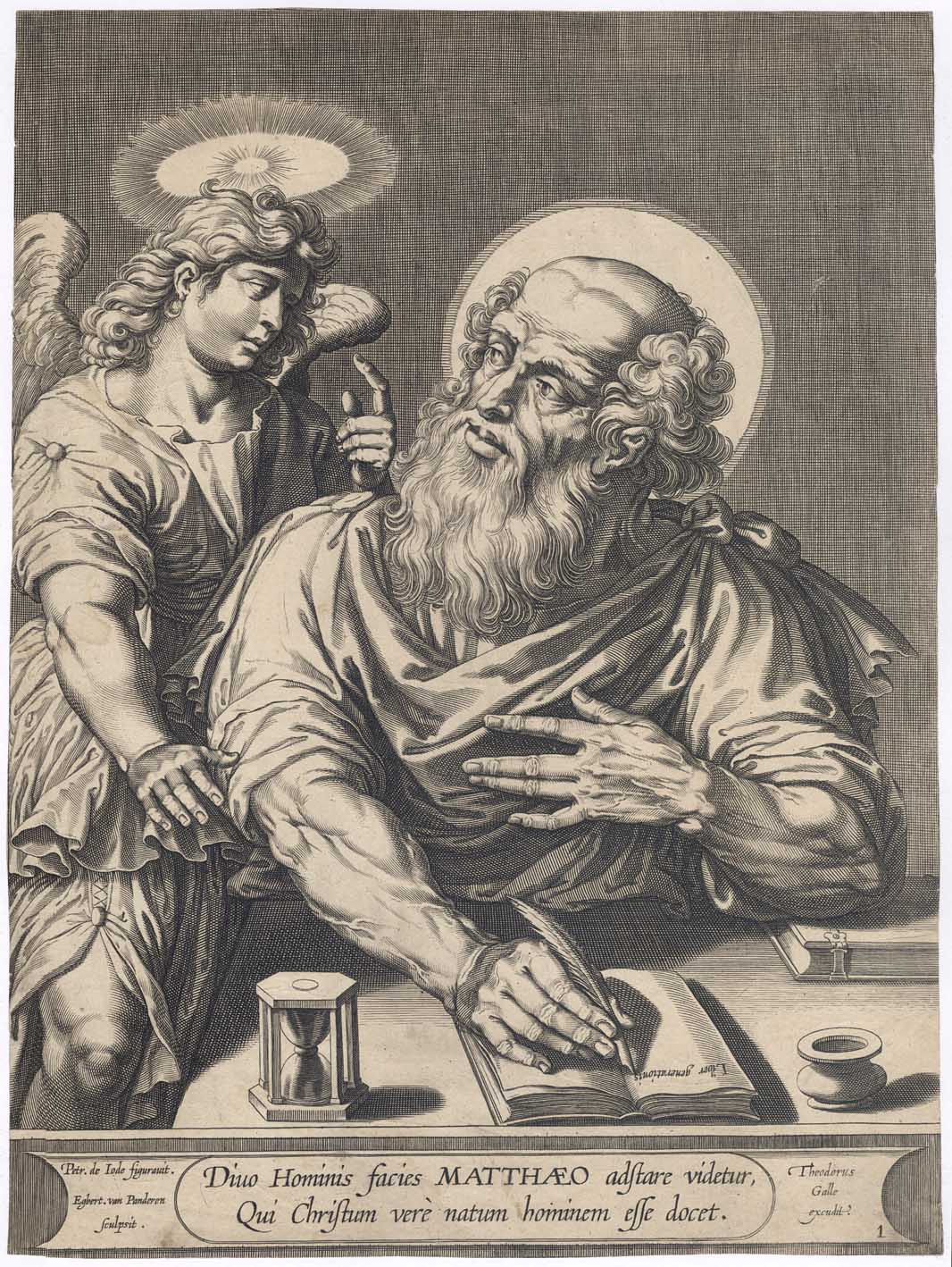
Egbert van Panderen’s engraving, “St Matthew”, c1605, after Pieter de Jode I


Egbert van Panderen (c1581–1637)

“St Matthew”, c1605 (1590–1637), after Pieter de Jode I (1570–1634), plate 1 from the series of four plates, “The Evangelists”, published in Antwerp by Theodoor Galle (1571–1633).
See a copy of this print with a few differences (e.g. St Matthew does not hold the quill in his right hand and the design of the haloes of St Matthew and the angel are different) by François van den Hoeye (1590­–1636), after Egbert van Panderen (Hollstein Dutch 1) at the Rijksmuseum: http://hdl.handle.net/10934/RM0001.COLLECT.123384.

Engraving on fine laid paper trimmed along the borderline and lined with a support sheet.
Size: (sheet) 28.8 x 21.3 cm
Lettered on the plate in a cartouche below the image borderline: (left) “Petr. de Iode figurauit. / Egbert. van Panderen / Sculpsit.”; (centre) "Diuo Hominis facies MATTHAEO adstare videtur, /Qui Christum verè natum hominem esse docet.” (Google transl. “MATTEO seems to be standing at the open air in the face of a man, / He who teaches that Christ is truly born to be a man.”); (right) “Theodorus / Galle / excudit. / 1.”

Hollstein IX.209.71 (F W H Hollstein 1949, “Dutch and Flemish Etchings, Engravings and Woodcuts c.1450–1700”, Amsterdam)
The Rijksmuseum offers the following description of this print:
“The evangelist Matthew, writing at a table. Beside him, his attribute is the angel. In a frame a two-line caption in Latin. First print from a series of four with the evangelists.” (http://hdl.handle.net/10934/RM0001.collect.160347)
See also the description at the Metropolitan Museum of Art: https://www.metmuseum.org/art/collection/search/644101

Condition: crisp, well-inked and well-printed impression (undoubtedly a lifetime impression) in near pristine, museum-quality condition (i.e. there are no tears, holes, folds, abrasions, stains or foxing) trimmed along the borderline and lined on a support sheet.

I am selling this strong engraving of the highest order of technical accomplishment for AU$186 in total (currently US$142.93/EUR116.28/GBP101.89 at the time of posting this listing) including postage and handling to anywhere in the world.

If you are interested in purchasing this impressive print exemplifying the Mannerist spirit at the time of its execution, please contact me (oz_jim@printsandprinciples.com) and I will send you a PayPal invoice to make the payment easy.

This print has been sold


In an earlier post in which I discuss Egbert van Panderen’s leaning to the exuberant energy of Northern Mannerism (e.g. his fascination with strong contrasts of light and dark, dramatic gestures, exaggeration of muscles and folds in drapery), I drew attention to the artist’s technical virtuosity in his amazing use of the burin to render “clothes as shimmery as satin” (see http://www.printsandprinciples.com/2016/09/egbert-van-panderens-engraving-after.html). Again, Van Panderen’s disciplined command of the burin is hard to ignore in this highly refined portrayal of the angel assisting St Matthew to write his gospel.

What I especially like about this print, however, is that the artist has not only captured a moment of spiritual engagement between the angel and the saint—as shown by their hand gestures to each other—but that the special moment of connection between the two figures is not one of an non-specific instant in time. Instead, what is captured is an endless moment of on-going transcendent engagement. What I mean by this comment is that Van Panderen has rendered the scene so that all the portrayed features have the same degree of focal clarity—a visual democracy if I may describe the consistency of focal resolution in this way. In this “visual democracy” of sameness, the background does not vary in texture or tone and the treatment of the figures also does not vary from foreground to background or from side to side. In short, what Van Panderen is portraying in this scene is a spiritual communion between the angel and the saint where the signified meanings of the figures’ gestures are frozen forever. 


Tuesday, 27 September 2016

Egbert van Panderen’s engraving after Abraham Janssens

'

Egbert van Panderen (c.1581–1637)
“Christ’s entombment”, c.1600, after Abraham Janssens (c.1575–1632), published by Pieter de Jode I (1573 - 1634)
Engraving on laid paper, trimmed on or within the plate mark and lined on a support sheet.
Size: (sheet) 40.5 x 26.8 cm
Inscribed within the image (lower left): “Abraham IanSSens invent. / Egbert van Panderen Sculp. / Pet. De Iode excud.”
Lettered below the image borderline in two lines of verse: (lower left) “Felicem tumulum Sacros qui condidit artus! / Non fuit in toto Sanctior orbe Specus” (Google translation: ”Felix, who founded the sacred tomb of the frame! / And there was no more holy than in the whole of the world of the Cave”); (lower right) “Huc amor, huc pietas, lacrymaru huc currite fontes: / ISta Sibi  fieri balSama Christus amat.” (Google translation: “To this love, I love, tears run hither springs / is meant to be the balm of Christ loves.”); (lower centre) “CL. V. ET DNO D. IOANNI DV BERON OMNIS ELEGANTLAE ADMIRATORI, / ABRAHANVS IANSONIVS VAN NUSSEN PICTOR L.M.D.D.

The Rijksmuseum offers the following description of this print (Google translated from Dutch):
“Christ is laid in the tomb by Joseph of Arimathea and Nicodemus. On the right a group of grieving women including Mary and Mary Magdalene. Left in the foreground lie Arma Christi in a basket. In the margin a four-line team, in two columns, in Latin. Underneath a two-line caption in Latin.” (https://www.rijksmuseum.nl/en/search/objects?q=Egbert+van+panderen&p=1&ps=12&st=OBJECTS&ii=6#/RP-P-H-M-76,9)

Hollstein Dutch 1 (Hollstein, F W H, Dutch and Flemish etchings, engravings and woodcuts c.1450-1700, Amsterdam, 1949); Nagler 6 (Nagler, G K, Die Monogrammisten, 5 vols, Munich, 1858)

Condition: strong impression trimmed at, or within, the platemark. The print is lined on the support sheet and is in good condition for its age (i.e. there are no evident tears, holes, losses, foxing, or abrasions but there is very light toning and a few marks).

I am selling this engraving of the highest order of technical accomplishment for AU$183 in total (currently US$140.22/EUR124.68/GBP108.08 at the time of posting this listing) including postage and handling to anywhere in the world. If you are interested in purchasing this impressive print exemplifying the Mannerist spirit at the time of its execution, please contact me (oz_jim@printsandprinciples.com) and I will send you a PayPal invoice to make the payment easy.

This print has been sold


At the time that this engraving was executed (circa 1600), Egbert van Panderen, like many of his fellow artists in Holland, was swayed towards the exuberant energy of Northern Mannerism. This leaning towards a theatricality of expression is seen in the spiralling compositional arrangement of this print—a sweeping movement that makes Christ appear almost weightless—along with the use of strong lighting and displays of technical virtuosity in the use of the burin that renders the portrayed clothes as shimmery as satin. This enthusiasm for a mannered mode of expression led some of his colleagues to even greater heights of exaggeration, such as the legendary Hendrick Goltzius (1558–1617) whose adoption of the Mannerist style of Bartholomeus Spranger (1546–1611) led to the term “Sprangerism” being coined for excessive exaggeration.