Showing posts with label Weigel (Christoph). Show all posts

Saturday, 18 September 2021

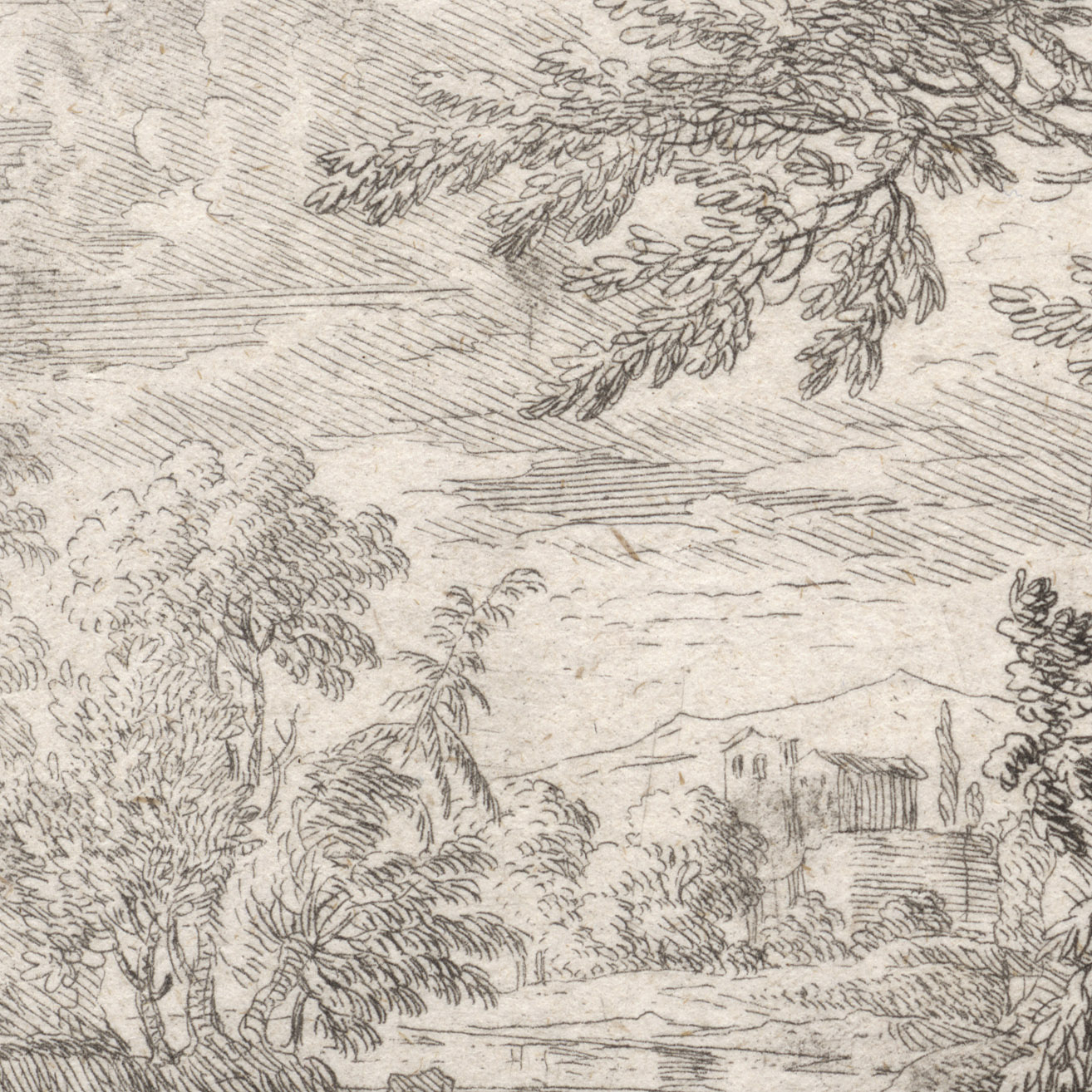
Felix Meyer’s etching, “Riverscape with Three Travellers”, 1675

Felix Meyer (1653–1713)

"Riverscape with Three Travellers" (aka “Paysage où sont trois personnages assis à g” [Landscape in which are three figures seated on the left] Le Blanc title; “Am Flußufer” [At the Riverbank]), 1675, plate number 73, published by Johann Christoph Weigel (1661­–1726).

Etching on fine laid paper ("Aescuiapian Staff" watermark) trimmed with a small margin around the image borderline.

Size: (unevenly trimmed sheet) 12.9 x 16.6 cm; (image borderline) 12.1 x 15.6 cm.

Inscribed in plate below the image borderline: (left) "I. C. Weigel exc."; (right) "No. 73."

Le Blanc 38 (Charles Le Blanc 1857, “Manuel de l'Amateur d'Estampes: Melchiori–Pencz”, Paris, P Jannet, p. 21, cat. no. 38; see https://archive.org/details/manueldelamateu00unkngoog/page/n27/mode/2up).

Meyer is one of the famous Swiss old masters, but rarely does one get a really good insight into such an artist's persona than the following account offered in Sholto and Reuben Percy's (1852) "The Percy Anecdotes", Vol. 4:

"An Abbot of St. Florian, Austria, being desirous to have two grand apartments painted in fresco ... applied to Felix Meyer, who was then on his travels, for his advice as to the manner in which he would have it executed. Meyer ... viewed the place for a few minutes; and then taking a long stick, to which he fastened a piece of charcoal, he immediately began to design, saying, 'Here I would have a tree:' which he marked out as quick as possible. 'At the remote distance I would represent a forest thus: here a fall of water, tumbling from great rocks,' and so on. As fast as he spoke, he designed, and deprived the Abbot of the power of expressing his approbation, so much he was lost in astonishment, to see a design with such elegance and taste, executed even without any time being allowed for reflection. At the Abbot's request, Meyer undertook to finish the design; which he completed in the course of the summer. This adventure spread the reputation of Meyer through all Germany; and was thenceforward continually employed by the princes and nobility in Europe" (pp. 136–37).

Condition: a strong impression showing no sign of wear to the printing plate, trimmed on, or slightly within, the plate mark. The sheet is in a near pristine condition with no tears, holes, folds, abrasions, stains, foxing or signs of handling.

I am selling this rare etching by Felix Meyer—so rare that I haven’t found another copy of it in any of the major museums! —for the total cost of AU$227 (currently US$164.99/EUR140.64/GBP120.11 at the time of this listing) including postage and handling to anywhere in the world (but not, of course, any import duties/taxes imposed by some countries).

If you are interested in purchasing this idyllic scene by a major Swiss old master showing resting travellers chatting beside a stream on the left and cascades on the right with a distant view of an Italianate styled building and cypress—please contact me (oz_jim@printsandprinciples.com) and I will send you a PayPal invoice to make the payment easy.


Thursday, 2 April 2020

Johann Kenckel’s mezzotint of Martin Luther’s wife, c.1715


Johann Kenckel (aka Johann Kenkel) (1688–1722)

“Portrait of Katharina of Bora”— wife of Martin Luther—(aka “Catharina aus dem Adelichen Geschlecht derer von Bore” [title on plate]), c.1715 (1708–22), after Lucas Cranach the Elder (c.1472–1553), published by Christoph Weigel (1654–1725) in Nuremberg.

Mezzotint with early hand-colouring trimmed with a small margin and backed with a support sheet.
Size: (sheet) 38.1 x 27.5 cm; (plate) 35.8 x 25.5 cm; (image borderline) 32.5 x 25.5 cm.

Lettered on plate below the image borderline:
(left) “Lucas Kranach pinx”;

(centre) “Catharina aus dem Adelichen Geschlecht derer von Bore,/ ward gebohren A.1499. rerließ mit Acht andern Gaistlichen Schwestern A:1523. das Gistercienser Closter Nimptsch beÿ Grimma, ward A. 1525./ den 13 Junu durch D. Foh. Bugenhagen , Pomeranum , Pfarrern in Wittenberg. D.Martin Luthern Professorn daselbst chelich angetrauct, zeugte mit ihm/ Sechs Kinder, als dreÿ Söhne und so viel Töchter, namentlich: A.1526.d.7. Jun. Johannem, A.1527.Elisabetham, A.1529. in rigil. Ascens. Magda =/ lenam, A.1531. d.7. Nov. Martinum, A. 1533. d.28. Jan. Paulum. und A. 1534. Margaretham, hielte ihrem Eheherrn allezeitals ein fromm treuc ehr =/ liches lGemahl liebund werth mard A.1546. d. 18. Fébr: zur Witme, und starb A.1552. d.20.Dacembr zu Torgan im 53, ten jahr ihres alters,woselbst sie auch in der Pfarr Kirche begraben/ Christ Weigel ex:” 

([Google transl.] Catharina from the Adelichen family of those of Bore, / was born A.1499. left with eight other Gaistliche sisters A: 1523. the Gistercienser Closter Nimptsch beÿ Grimma, A. 1525. / 13th June was by D. Foh. Bugenhagen, Pomeranum, pastors in Wittenberg. D.Martin Luthern professor there chelich, fathered with him / six children, as three sons and so many daughters, namely: A.1526.d.7. Jun. Johannem, A.1527. Elizabetham, A.1529. in rigorous. Ascens. Magda = / lenam, A.1531. d.7. Nov. Martinum, A. 1533. d.28. Jan Paulum. and A. 1534. Margaretham, always considered her husband to be a piously faithful honest husband Liebund werth mard A.1546. d. 18. Fébr: to Witme, and died A.1552. d.20.Dacembr zu Torgan in the 53rd year of their age, where they are also buried in the parish church / Christ Weigel ex:); 

(right) “Joh: Kenckel fecit”.

The British Museum offers a description of this print:

Condition: strong impression with delicate early hand-colouring and the initial guide lines for lettering of the artist’s name still clear—suggesting that this is possibly a lifetime impression—with small margins laid onto a support sheet of millennium quality washi paper. There are small restored chips to the edges and corners of the sheet and minor restorations of a few light abrasions to the delicate surface of the mezzotint, otherwise the sheet is in very good condition for its considerable age (i.e. there are no tears, holes, folds or significant stains).

I am selling this exceptionally rare mezzotint portrait of Martin Luther’s wife for the total cost of AU$300 (currently US$182.61/EUR166.80/GBP147.23 at the time of this listing) including postage and handling to anywhere in the world (but not, of course, any import duties/taxes imposed by some countries).

If you are interested in purchasing this  technically superb masterpeice of mezzotint showing Martin Luther’s wife gently smiling—to my eyes, an almost Mona Lisa-like enigmatic smile—please contact me (oz_jim@printsandprinciples.com) and I will send you a PayPal invoice to make the payment easy.


Monday, 16 March 2020

Christoph Weigel's etching, “Apocalypse XXI: Heavenly Jerusalem”, c.1684


Designed by Jan Luyken (aka Jan Luiken) (1649–1712) and/or Caspar Luyken (aka Caspar Luiken) (1672–1708)
Etched and published by Christoph Weigel (1654–1725)

“Apocalypse XXI: Heavenly Jerusalem”, c.1684, plate 108 (illustration) to “Biblia Sacra, Vulgatae Editiones”, etched and published by Christoph Weigel following the design of Jan Luyken and/or Caspar Luyken in Leiden in 1684 and reprinted later in 1708 and 1712 by Weigel in “Historiae Celebriores Veteris et Novi Testamenti” in Nuremberg. The plate was reissued again in 1751 in the first edition of the famous "Elizabethan Bible" (aka “Biblia, siriech knigi sviashchennago pisaniia vetkhago i novago zavieta” [Bible, or the books of the scriptures of the old and new testament]) on page 457, published during the reign of Empress Elisabeth Petrovna (1709–1761) with "corrected text" to the 1581 Slavonic character Bible published by Ivan Fedorov in Ostrog, (Volhynia).

Note that the “Elizabethan Bible” featuring this print is available for online viewing and may be downloaded free-of-charge from archive.org:

Etching on laid paper with wide margins.
Size: (sheet) 44.6 x 29.2 cm; (plate) 31.4 x 21 cm;(outer image boderline) 25 x 19.9 cm.
Lettered on plate below the image borderline in Latin and German: (centre) “APOC: XXI./ Coelestis Solyma mirandam conspicis urbem,/ Gemmea tota, vitro lucidiorque micat./ Qui pius est, non hic periturum defleat orbem./ Solumhabet e cæno terra lutosa domos./ Betracht von Salem dort des Himmels Freuden–Zimmer,/ die funkeln von Rubin von Demant und Sapphir./ Wo ist ein Frommer nun, der strebend sich bekümmer,/ daß er auf dieser Welt sein Leimen—Haus verliehr?”; (lower right corner) “108.”

The plate illustrates the following passage from Apocalypse 21:10–14 (extracted from the “New Revised Standard Version Bible”, 1989):
“And in the spirit he carried me away to a great, high mountain and showed me the holy city Jerusalem coming down out of heaven from God. It has the glory of God and a radiance like a very rare jewel, like jasper, clear as crystal. It has a great, high wall with twelve gates, and at the gates twelve angels, and on the gates are inscribed the names of the twelve tribes of the Israelites; on the east three gates, on the north three gates, on the south three gates, and on the west three gates. And the wall of the city has twelve foundations, and on them are the twelve names of the twelve apostles of the Lamb” (http://bible.oremus.org/?ql=137709508).

Condition: richly-inked and well-printed early impression with wide margins (as published). The sheet has a few faint marks in the margins otherwise it is in a very good condition (i.e. there are no tears, holes, losses, creases, abrasions, significant stains, foxing or signs of handling).

I am selling this superb impression of a visually arresting image showing “the holy city Jerusalem coming down out of heaven from God”, for AU$277 (currently US$170.97/EUR152.24/GBP138.76 at the time of this listing) including postage and handling to anywhere in the world (but not, of course, any import duties/taxes imposed by some countries).

If you are interested in purchasing this extraordinary etching blazing with light, please contact me (oz_jim@printsandprinciples.com) and I will send you a PayPal invoice to make the payment easy.

This print has been sold


Monday, 26 August 2019

Caspar Luyken's engraving, “The Plague of Hail and Fire”, 1708


Caspar Luyken (aka Caspar Luiken) (1672–1708)

“The Plague of Hail and Fire”, 1708, plate 41 (of 151 plates), illustration to the seventh plague in Egypt described in the second book of the Old Testament, “Exodus” (ch 9, verses 13–35), published in Nuremberg by Christoph Weigel (1654–1725) in “Historiae celebriores Veteris [-Novi] Testamenti iconibus repraesentatae et ad excitandas bonas meditationes selectis epigrammatibus exornatae”, p. 92.
Note: this publication is available for online viewing and may be downloaded free of charge from archive.org: https://archive.org/details/gri_33125014521914/page/n91

Engraving on laid paper.
Size: (sheet) 44 x 27 cm; (plate) 32.2 x 21.2 cm; (image borderline) 25.6 x 20.2 cm.
Lettered below the image borderline: (left) “Caspar Luÿken. fec.”; (centre, in five lines of Latin text and four lines of German text) “EXODI. IX/ Quidquid et in Silva …/ …/ …/ … nulla movent./ Blitz, Hagel …/ …/ …/ … bewegen kan.”; (right) Christ. Weigel.exc./ 41”.
Condition: richly inked, crisp and well-printed impression in near pristine condition for its considerable age (i.e. there are no tears, holes, folds, abrasions, stains or foxing).

I am selling this eye-catching engraving in museum quality condition for AU$154 (currently US$103.96/EUR93.47/GBP84.81 at the time of this listing) including postage and handling to anywhere in the world (but not, of course, any import duties/taxes imposed by some countries).

If you are interested in acquiring this highly detailed engraving showing a strong leaning to the dramatic gestures, action and swirling rhythms of the Baroque period, please contact me (oz_jim@printsandprinciples.com) and I will send you a PayPal invoice to make the payment easy.

This print has been sold


Friday, 13 July 2018

Christoph Weigel’s three engravings after Jan Luyken’s illustrations of different trades, c1700


Christoph Weigel (1654–1725)

Left image:
“Der Mahler” (The Painter), c1700, engraving after the etching, “De Schilder” by Caspar Luyken (1672–1708) after the intermediary design by Jan Luyken (1649–1712) as an illustration to a republished edition (in Nuremberg, c1700) of Jan and Caspar Luyken’s “HetMenselyk, Bedryf” (Human occupations), published in 1694, Amsterdam.

Centre image:
"Der Papierer" (The Papermaker), c1700

Right image:
"Der Schreiber" (The Scribe/Writer). c1700

Engravings on fine laid paper with letterpress text and margins as published.
Size (with slight variations): (sheet) 15.3 x 9.1 cm; (image borderline) 8.8 x 8 cm

Condition: strong lifetime impressions with minor age-toning, staining and signs of handling. Each print is backed with a support sheet of archival (millennium quality) washi paper.

I am selling all three engravings for the total cost of AU$268 (currently US$198.18 /EUR170.20/GBP150.46 at the time of listing these print) including postage and handling to anywhere in the world (but not, of course, any import duties/taxes imposed by some countries).

If you are interested in purchasing these fascinating and very revealing engravings of the practices of different trades at the end of the 1600s, please contact me (oz_jim@printsandprinciples.com) and I will send you a PayPal invoice to make the payment easy.

These prints have been sold


The series of 100 etchings featuring in Jan and Caspar Luyken’s “HetMenselyk, Bedryf” (Human Occupations), published in Amsterdam (1694), was popular as the prints gave a glimpse into the workshops of many different trades. Consequently, the designs were reprinted several times. These three engravings are Christoph Weigel’s versions of Jan Luyken’s compositions published in Nuremberg at around 1700. I am also aware of another set of the same designs by Anthonie de Winter (1652/3–c1707) whose series of engravings were published in Haarlem a year after Luyken’s etchings were published.

For comparison of the three series, see Caspar Luyken’s etching “De Schilder” (The Painter) held by the Rijksmuseum (http://hdl.handle.net/10934/RM0001.COLLECT.143904); De Winter’s engraving, “Shilder” (The Painter) held by the British Museum (http://www.britishmuseum.org/research/collection_online/collection_object_details.aspx?objectId=3435976&partId=1&searchText=Caspar+Luyken&page=1); and Weigel’s engraving, “Der Mahler” (The Painter) shown here.