Showing posts with label transfer lithograph. Show all posts

Wednesday, 30 November 2022

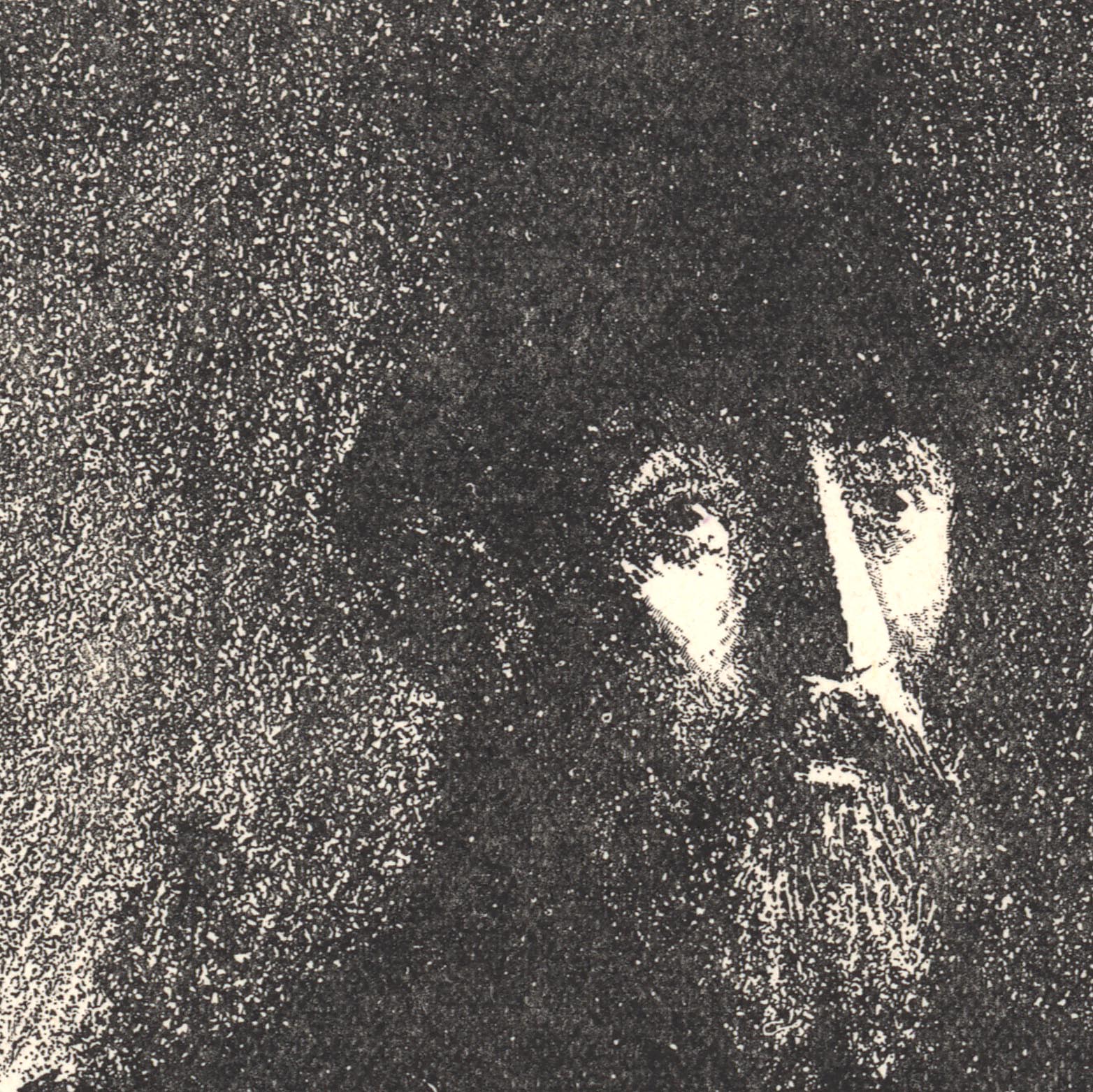
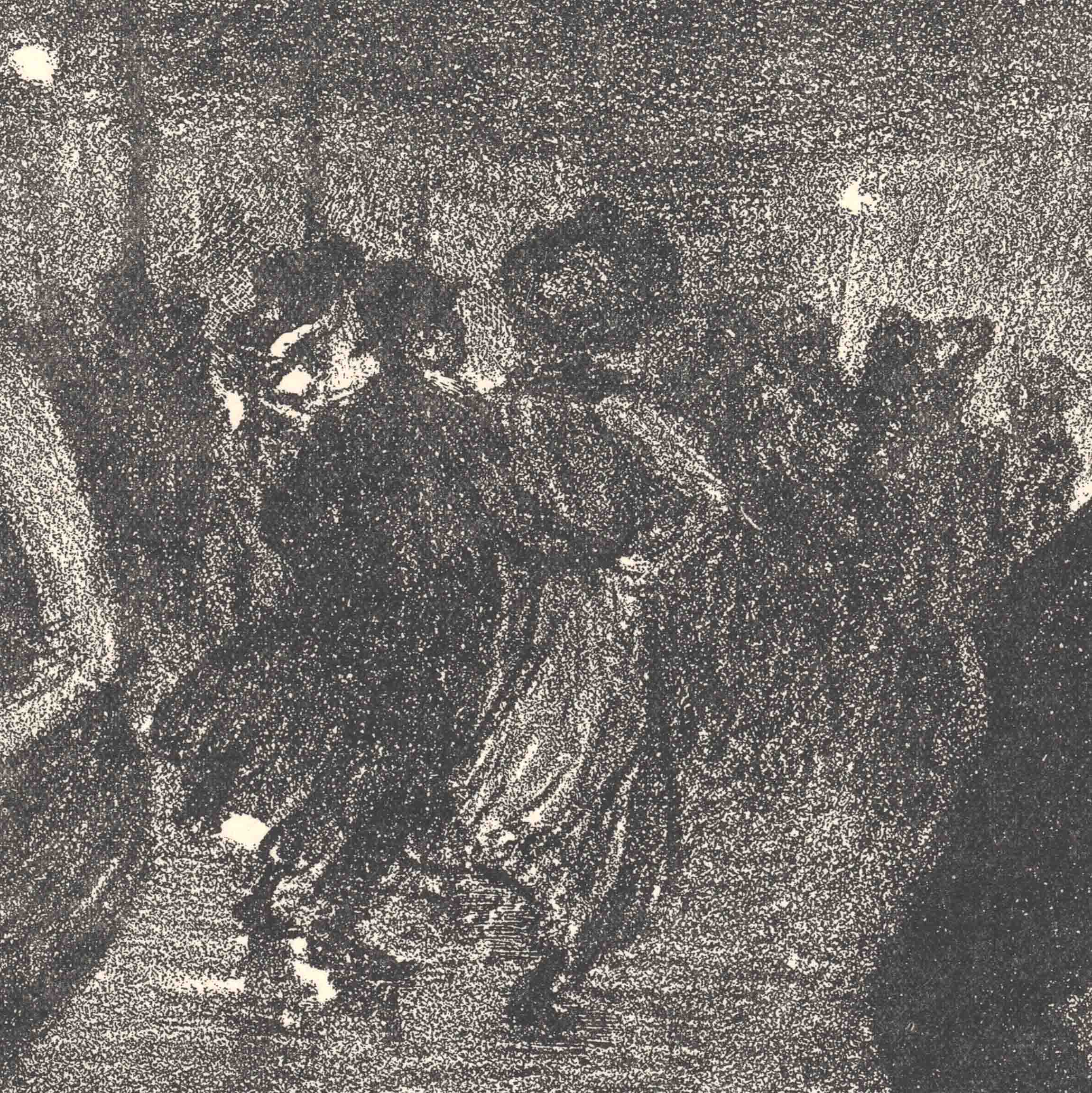
Théophile Alexandre Steinlen’s lithograph, “Les Soliloques du Pauvre”

Théophile Alexandre Steinlen (1859–1923)

Les Soliloques du Pauvre” (The Soliloquies of the Poor), 1895, proof impression of the cover to Jehan Rictus’ (aka Gabriel Randon) (1867–1933) poems, “Les Soliloques du Pauvre”, published by the Société du "Mercure de France" in Paris in 1897 (see https://catalogue.bnf.fr/ark:/12148/cb312150546).

I understand that the advancing figure on the right of the composition is the poet, Jenan Rictus—based on the Bibliothèque nationale’s advice that Rictus (transl.) “was a great friend of Steinlen who took inspiration from his silhouette to illustrate the most famous of his works: ‘The Soliloques of the Poor’” (see cat. no. 13: https://archive.org/details/bnf-bpt6k65340400/page/n22/mode/1up).

Éditions Gallimard offers the following insightful account of Jehan Rictus and this publication: (transl.) “Gabriel Randon, known as Jehan-Rictus … had a difficult and conflicted childhood, he left school around fourteen, lived in various small jobs and began to frequent the milieu of artists and anarchists in Montmartre. Leading a precarious life, homeless for a while, at twenty-two he frequented the world of tramps and vagabonds, a crucial experience that would inspire him with the best of his literary work. He was twenty-eight when he undertook to give voice to the little people of the streets and the declassed in poems entirely written in his language, Parisian slang. It will be The Soliloquies of the Poor which he made known by saying them himself in the Montmartre cabarets, notably at the Chat Noir. Unclassifiable book, without equivalent in the history of poetry, this collection which knows an immediate success because of its lyrical force, its oratorical power and its prosodic control is undoubtedly, after Villon and before Prévert or Queneau, one of rare examples of a poetry that uses popular language and in a certain way prefigures contemporary rap” (https://www.gallimard.fr/Catalogue/GALLIMARD/Poesie-Gallimard/Les-soliloques-du-pauvre-suivi-de-Le-coeur-populaire#).

Transfer lithograph printed in black on cream wove paper (see https://emuseum.mfah.org/objects/2826/les-soliloques-du-pauvre).

Size: (sheet) 28 x 38 cm; (image borderline) 20 x 32.3 cm.

Lettered in plate: “Jehan Rictus/ Les Soliloques/ DuPauvre/ Dessins De/ Steinlen”.

Crauzat 579 (Ernest de Crauzat 1913, “L'oeuvre gravé et lithographié de Steinlen”, Paris Société de propagation des livres d'art, p. 156, cat. no. 579 [see https://archive.org/details/loeuvregravetl00crauuoft/page/156/mode/1up]).

Condition: a strong and well-printed impression in a near pristine condition with no tears, holes, abrasions, stains or foxing.

I am selling this proof impression of Steinlen’s famous lithograph designed for the cover of his friend’s book of poems, for the total cost of AU$242 (currently US$164.68/EUR157.77/GBP136.20 at the time of this listing) including Express Mail (EMS) postage and handling to anywhere in the world, but not (of course) any import duties/taxes imposed by some countries.

If you are interested in purchasing this graphically strong original lithograph capturing a bleak view of Parisian life in Montmartre towards the end of the nineteenth century, please contact me (oz_jim@printsandprinciples.com) and I will send you a PayPal invoice to make the payment easy.

This print has been sold


Sunday, 18 April 2021

James McNeill Whistler’s lithograph, “Stéphane Mallarmé”, 1892

James McNeill Whistler (aka James Abbott McNeill Whistler) (1834–1903)

Stéphane Mallarmé”—French Symbolist poet (1842–1898), 1892, printed by Ch Wittmann (fl1891–1907) in Paris—(later 1894 impressions were printed by Henri Belfond (1834–1903) (see http://hdl.handle.net/10934/RM0001.COLLECT.42629)—signed in the stone with the artist’s butterfly monogram, published in "Vers et Prose" by Perrin et Cie (Imprimerie Deslis Frères) in Paris, 1893.

Maggs Bros. Ltd offers the following interesting exchanges between Mallarmé and Whistler regarding this print and an excellent description of it:

“Mallarmé writing to Whistler in November 1892, ’this portrait is a marvel, the best thing that’s ever been done of me, and I am delighted with it’ (5 Nov. 1892). The artist himself later wrote that ’it is very beautiful - and as a portrait of the poet extraordinary’ (Whistler’s letter to T. Way, 15 Oct. 1894)” (https://www.maggs.com/vers-et-prose-morceaux-choisis-avec-un-portrait-par-james-mn-whistler_228494.htm).

Transfer lithograph on cream chine collé on heavy wove paper backed with a support sheet.

Size: (sheet) 17.2 x 10.9 cm; (chine collé) 11.5 x 8.7 cm.

Inscribed on plate: (lower right) [artist’s butterfly monogram]; (lower edge at centre) “Imp Ch. Wittmann”.

State i (of i)

Levy 101 (“The Lithographs of James McNeill Whistler”, first published in 1998—note that this two-volume catalogue raisonné is available for online viewing at the Art Institute of Chicago: https://www.artic.edu/digital-publications/33/the-lithographs-of-james-mcneill-whistler-the-digital-edition).

The Art Institute of Chicago offers a description of this print and the following insight about Whistler and Stéphane Mallarmé:

“Introduced by Claude Monet, the poet Mallarmé and Whistler became friends in 1887 and remained close until Mallarmé’s death in 1898. Each man played a role in the other’s publishing projects; Mallarmé translated the “Ten O’Clock” lecture into French, and Whistler produced this lithographic portrait for Mallarmé’s 1893 book of poems, Vers et prose” (https://www.artic.edu/artworks/73797/stephane-mallarme).

See also the description of this print at the Metropolitan Museum of Art: https://www.metmuseum.org/art/collection/search/339426#.

Condition: a well-printed impression laid upon a support sheet of fine archival/millennium quality washi paper in a near pristine (museum quality) condition with no tears, holes, folds, abrasions, significant stains or foxing.

I am selling this small portrait study of the famous French Symbolist poet Mallarmé, who was a close friend of Whistler and of many other artists of the time like Gauguin—see Gauguin’s etched portrait of the poet:  https://www.britishmuseum.org/collection/object/P_1949-0411-2463—for AU$349 (currently US$270.12/EUR225.47/GBP195.17 at the time of posting this print) including Express Mail (EMS) postage and handling to anywhere in the world (but not, of course, any import duties/taxes imposed by some countries).

If you are interested in purchasing this acknowledged very close likeness to the poet—and a print that both artist and sitter exchanged correspondence that it was “a marvel” and “very beautiful”, please contact me (oz_jim@printsandprinciples.com) and I will send you a PayPal invoice to make the payment easy.

This print has been sold 


Saturday, 11 April 2020

Pierre-Victor Galland’s lithograph, “Gros Gromier du Cantal”, 1863–73


Pierre-Victor Galland (1822–1892).

“Gros Gromier du Cantal”, 1863–73, plate 12 to “Pomologie de la France: ou Histoire et description de tous les fruits cultivés en France et admis par le congrès pomologique”, vol. 8, page 68, published in Lyon in 1873 by J. Nigon for the Société Pomologique de France and printed by Jean-Marie Fugère (1818–82).

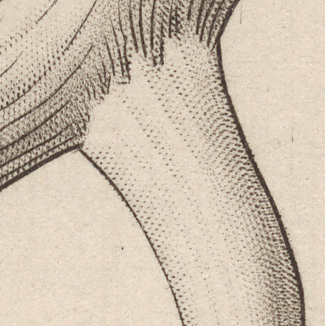
Transfer lithograph in the manner of a stipple engraving (i.e. not using the intaglio process but may have involved the transfer of the image from an intaglio plate onto the stone plate [anastatic printing] and this possibility helps to explain the coarse quality/blurring of the inscriptions [see Bamber Gascoigne 1986, 19g.20]), printed in bistre-coloured ink on wove paper with full margins as published.

Note that this lithographexemplifies two styles of stippling:
  • dot roulette stippling—shown by lines of dots outlining the leaf shapes—where a spiked roulette is rolled over an etching ground to produce intaglio stippling when etched;
  • punched engraved stippling—shown in the rendering of the grapes—where dent-like stippling is created by percussion spiking of an engraving plate with tools like the mattoir (mace head) producing what is termed “opus mallei” (mallet work).

Size: (sheet) 27.1 x 17.6 cm.
Numbered and lettered on plate: (upper right) “Pl. 12”; (lower left) “Galland sculpt.”; (lower centre) “GROS GROMIER DU CANTAL”; (lower right) “Imp. Fugère, Lyon.”

For those interested in these grapes, which are catalogued under the heading of “Raisins” in the publication in which this lithograph features, the following description by Robert Hogg (1860) on page 105 in “The Fruit Manual” (London, Cottage Gardener Office) may be helpful:

“GROMIER DU CANTAL (Barbaroux; De Candolle; Grec Rouge; Gros Gromier du Cantal; Malaga; Raisin du Pauvre; Raisin de Servie). - Bunches large, a foot long, broad, and shouldered.  Berries large and round.  Very fine, amber skin, speckled with light purplish brown.  Skin very thin, amber coloured, mottled with light purplish-brown. Flesh tender, juicy, and sweet, with a brisk vinous flavour.  Requires a warm vinery to ripen it; and it does not keep long after being ripe. In some vineyards of France, and particularly in those of Tarn-et-Garonne, it is called Alicante”

Condition: good impression with margins as published. The sheet has minor age-toning to the edges, otherwise the sheet is in excellent condition (i.e. there are no tears, holes, folds, abrasions, losses, significant stains or foxing).

I am selling this technically interesting and well executed study of grapes for AU$165 (currently US$104.82/EUR95.82/GBP84.18 at the time of this listing) including postage and handling to anywhere in the world (but not, of course, any import duties/taxes imposed by some countries).

If you are interested in purchasing this seemingly simple lithograph but an image created from an amalgam of techniques (see discussion above), please contact me (oz_jim@printsandprinciples.com) and I will send you a PayPal invoice to make the payment easy.