Showing posts with label Beham (Sebald). Show all posts

Wednesday, 1 February 2023

Sebald Beham’s engraving, “St. Anthony the Hermit”, 1521


Sebald Beham (aka Hans Sebald Beham; Sebald Peham) (1500–1550)

“St. Anthony the Hermit” (aka “S. Antoine l’Ermit”; “Saint Anthony the Great as Hermit”; “Heilige Antonius de Grote als kluizenaar”), 1521.

Engraving on laid paper, trimmed around the image borderline and backed with a support sheet.

Size: (support sheet) 22.9 x 19 cm; (sheet) 19.1 x 16.3 cm.

Inscribed in plate: (on tablet at lower left corner) “1521/ [artist’s monogram] IsP”.

State i (of i)

Pauli 68 (Gustav Pauli 1901, “Hans Sebald Beham: ein kritisches Verzeichniss seiner Kupferstiche, Radirungen und Holzschnitte”, Strassburg, p. 80, cat. no. 68); TIB 1(8).64(141) (Robert A Koch [ed.] 1978, “The Illustrated Bartsch: Early German Masters”, vol. 15, New York, Abaris Books, p. 60, cat no. 64 [141]); Holstein German 68.

The Rijksmuseum offers the following description of this print: (transl.) “Anthony the Great is depicted here as a young hermit in the desert writing in his book with his gaze fixed on a crucifix. He is accompanied by a pig and on the floor is another attribute, a bell. In general, in his role as a hermit, this saint was depicted as an old man with a beard. In this case, however, under the monk's habit at the bare knees, a powerful young body is visible.” (http://hdl.handle.net/10934/RM0001.COLLECT.31104)

See also the description of this print offered by the British Museum: https://www.britishmuseum.org/collection/object/P_1850-0612-261.

Condition: a well-printed impression with no significant stains or foxing, trimmed around the image borderline and laid onto archival (millennium quality) washi paper providing wide margins.

I am selling this exceptionally fine engraving executed with the utmost sensitivity, showing St Anthony as a muscly young man writing while he contemplates a crucifix mounted in a dead tree stump—possibly Beham’s choice of this base for the crucifix is symbolic of the cycle of death and rebirth/resurrection as dead trees were often shown beside regenerating ones at the time (but I could be wrong of course!)—for the total cost of AU$655 (currently US$467.98/EUR424.64/GBP377.76 at the time of this listing) including postage and handling to anywhere in the world, but not (of course) any import duties/taxes imposed by some countries.

If you are interested in purchasing this superb engraving of one of the earliest of the Desert Fathers and now celebrated as "the father of monasticism", please contact me (oz_jim@printsandprinciples.com) and I will send you a PayPal invoice to make the payment easy.

This print has been sold


Wednesday, 29 May 2019

Sebald Beham's woodcut, “The Betrayal”, 1535


Sebald Beham (aka Sebald Peham; Hans Sebald Beham) (1500–1550)

Note: there are inconsistencies signifying that this may be a deceptive copy (e.g. the complete framing edge to this impression rather than the breaks to the image borderline as shown in the BM copy [1853,0312.250] which could be infilled “improvements” made by a past restorer who filled in the gaps or simply that this is an early impression before the deterioration of the framing edge).

“The Betrayal”, 1535, from the series of eight plates, “The Passion”.

The Curator of the British Museum offers the following insight about the series:
“Beham initially produced six woodcuts for this series in 1521 and 1522. He added the remaining two (the Betrayal and Christ before Caiaphas) in 1535” (BM no. 1853,0709.87).

Woodcut on laid paper with narrow margins and backed with a support sheet.
Size: (sheet) 13.1 x 8.9 cm; (image borderline) 12.8 x 8.6 cm.
Signed with the artist's monogram and dated in the upper-right corner, “1535 / HSB”.

TIB 15(8).86(233) (Robert A Koch [ed.] 1978, “The Illustrated Bartsch: Early German Masters” vol. 15, New York, Abaris Books, p. 174);  Bartsch VIII.233.86; Pauli 1901-11 820 (Gustav Pauli 1901, “Hans Sebald Beham: Ein Kritisches Verzeichniss seiner Kupferstiche Radirungen und Holzschnitte”, 5 vols, Strasburg); Dodgson 1903, 1911 I.456.94 (Campbell Dodgson 1903, “Catalogue of Early German and Flemish Woodcuts in the Bristish Museum”, 2 vols, London, British Museum Trustees); Hollstein 820.

The British Museum offers the following description of this print:
“The Betrayal; Christ surrounded by a group of soldiers, in the foreground St Peter striking Malchus with a knife. 1535 Woodcut”

Condition: crisp impression printed with slightly grey ink (compared to the impressions in the BM and TIB) with narrow margins. The sheet is in excellent condition (i.e. there are no tears, holes, folds, abrasions or significant stains) and is laid on a support of archival (millennium quality) washi paper.

I am selling this exceptionally rare woodcut by one of the most famous of the early German masters for the total price of AU$480 (currently US$332.34/EUR298.21/GBP263.19 at the time of posting this print) including postage and handling to anywhere in the world (but not, of course, any import duties/taxes imposed by some countries).

If you are interested in purchasing this 16th century woodcut executed in the same year that Michelangelo started work on his fresco, “The Last Judgement”, please contact me (oz_jim@printsandprinciples.com) and I will send you a PayPal invoice to make the payment easy.


Sunday, 4 November 2018

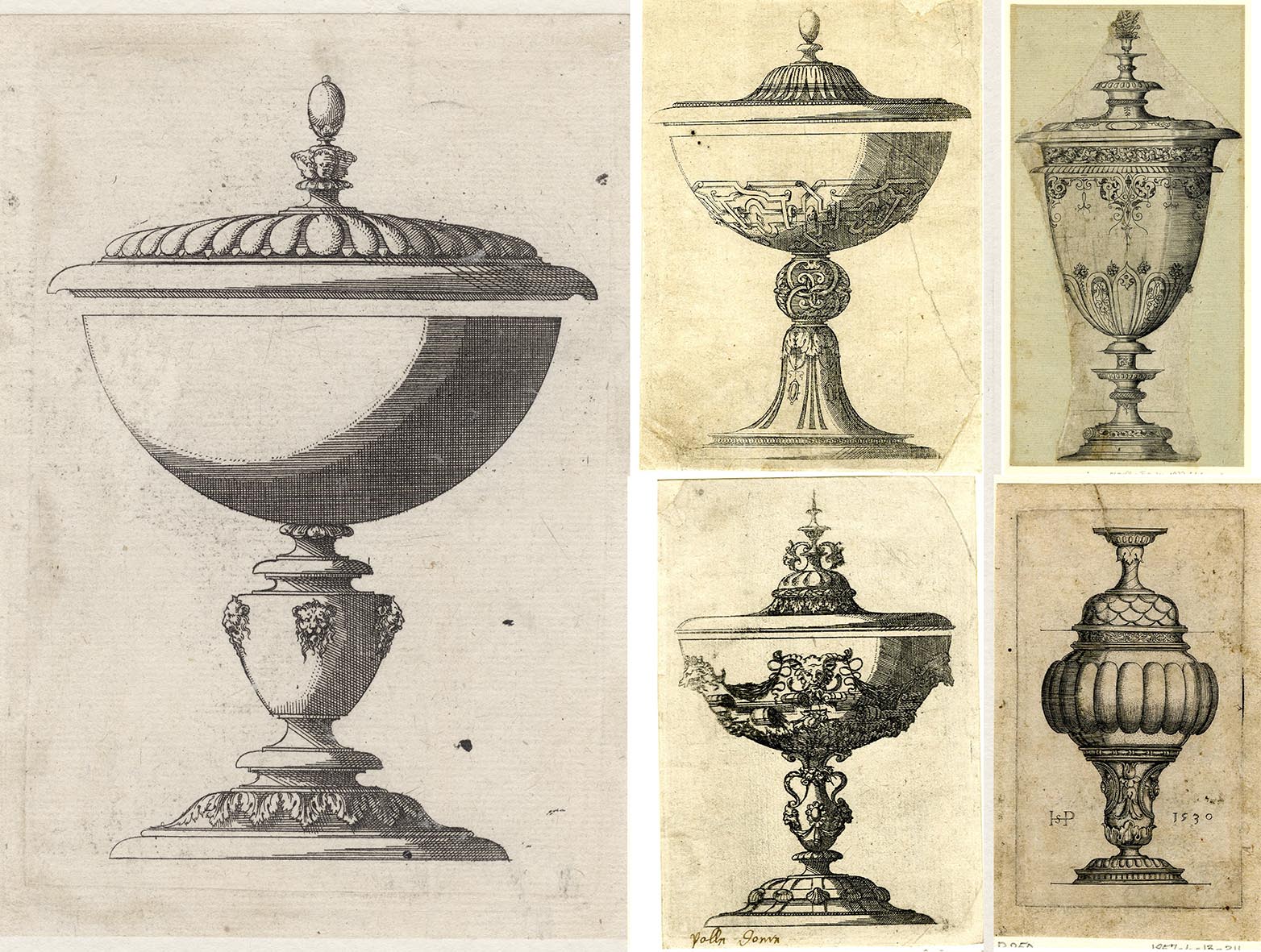
Etching by an unidentified artist from the circle of Jacques Androuet Ducerceau of a lidded goblet (c1560)


Unidentified artist from the circle of Jacques Androuet Ducerceau (aka Jacques Androuet Du Cerceau) (c1520–1586)

“Lidded goblet with lion head ornamentation” (note that the BM describe similar vessels as cups and other institutions describe them as goblets), c1560.

Etching on fine laid paper with small margins and backed with a support sheet.
Size: (sheet) 18.3 x 10.1 cm; (plate) 13.3 x 9 cm
Condition: crisp and well-printed early impression (based on the line quality showing no sign of deterioration to the printing plate) with small margins (approx. 5 mm) laid upon a support sheet of archival (millennium quality) washi paper. The sheet has light surface dustiness and there are small restorations of surface abrasions—now virtually invisible—and several ink dots on the lower right.

I am selling this Renaissance period etching of elegant beauty for AU$185 in total (currently US$133.26/EUR116.99/GBP102.71 at the time of posting this listing) including postage and handling to anywhere in the world (but not, of course, any import duties/taxes imposed by some countries).

If you are interested in purchasing this highly refined early etching of a goblet, please contact me (oz_jim@printsandprinciples.com) and I will send you a PayPal invoice to make the payment easy.

This print has been sold

(left) (circle of) Jacques Androuet Ducerceau’s etching (c1560)
(upper middle) Jacques Androuet Ducerceau’s etching (c1550/70) (British Museum, no. 1972,U.978)
(lower middle) Jacques Androuet Ducerceau’s etching (c1550/70) (British Museum, no. 1972,U.977)
(upper right) Virgil Solis’ etching with engraving (1530-62) (British Museum, no. 1972,U.1167)
(lower right) Sebald Beham’ engraving (1530) (British Museum, no. 1857,0613.311)

One of the inconvenient realities of attributing an artist's name to a print by an unidentified printmaker is that the attribution needs to be justified. Fortunately the task of setting the time period for this print to the mid-1500s is not that difficult as the style of the etching matches that of quite a few German printmakers of that era. For example Albrecht Altdorfer (1482/5­–1538) famously made twenty-two etchings of vessels very similar to this plate. Nevertheless, I know that this etching is not by Aldorfer as there are distinct stylistic differences. For example, with the exception of three of Aldorfer’s prints all of his etchings of vessels exhibit cross-hatched backgrounds (see https://www.britishmuseum.org/research/collection_online/collection_object_details.aspx?objectId=1421792&partId=1&searchText=Albrecht+Altdorfer+&page=1). Similarly, Sebald Beham (1500–1550) made three engravings of lidded goblets with the same formal arrangement and using a very similar rendering style, but this print is not by Beham as Beham nearly always signed/monogrammed his plates (see https://www.britishmuseum.org/research/collection_online/collection_object_details.aspx?objectId=1518559&partId=1&searchText=Beham++goblet&page=1). Virgil Solis (1514–1562) in his vast oeuvre of prints also made a series of intaglio plates featuring goblets, cups and pitchers that correlate well in terms of style with this print (see https://www.britishmuseum.org/research/collection_online/collection_object_details.aspx?people=107033&peoA=107033-2-60&ILINK|34484,|assetId=88785001&objectId=1488277&partId=1). Moreover, I have showcased previously an etching designed by Hans Holbein the Younger (1497/8–1543) of a goblet showing the same stylistic manner of the period… but admittedly the execution of the plate was completed much later in 1646 by Wenceslaus Hollar (see https://www.printsandprinciples.com/2018/02/wenceslaus-hollars-etching-wide-cup.html).
Mindful that there are many German printmakers who may well be the true artist who executed this elegantly simple etching, my attribution of this print to the circle of French printmakers around Jacques Androuet Ducerceau (c1520–1586) is all to do with the intimate details of how the goblet is rendered. Note, for example, how Ducerceau employs a row of dots to shade the lightest suggestion of shadow. He then uses right-handed angled hatched strokes to render the mid-tones (see the stem of the vessel) and finally applies a layer of vertical strokes on top of the angled strokes to achieve cross-hatched darkness.


Friday, 19 May 2017

Sebald Beham’s woodcuts from “The Apocalypse”, 1539


Sebald Beham (aka Hans Sebald Beham; Sebald Peham) (1500–50)
Two woodcut prints on the same leaf, 1539, from the series of twenty-six woodcuts showing subjects from “The Apocalypse” (Book of Revelation), book-illustrations printed together with Latin letterpress text, printed in Frankfurt by Christian Egenolph (1502–55).

(Recto) “An Angel Chains the Dragon” (TIB title), 1539
(Verso) “Destruction of the Beast” (TIB title), 1539

Woodcuts on laid paper with (partial) lines of accompanying Latin letterpress text and small margins.
Size: (sheet) 10.9 x 7.9 cm; (borderline of each plate) 6.8 x 7.12
TIB 15 (8). 116-[1] (233) (Walter L Strauss & Robert A Koch [Eds.] 1978, “The Illustrated Bartsch”, vol. 15, Abaris Books, New York, pp.187–88); Bartsch 92-120; Dodgson 1903, 1911 I.440.3; Pauli 1901-11 855 & 856 ((Apocalypse)); Paisey 2002 22; (David Paisey 2002, Catalogue of German printed books to 1900”, London, BMP); F W H Hollstein 1954, “German engravings, etchings and woodcuts c.1400-1700”, Amsterdam, p.189.

Condition: an extremely rare leaf with excellent impressions on both sides and small margins.

I am selling this small and superb double-sided leaf of woodcuts by one of the most famous of the German Little Masters for AU$332 (currently US$247.41/EUR221.05/GBP190.04 at the time of this listing) including postage and handling to anywhere in the world.
If you are interested in purchasing these stunning woodblock illustrations by the great master, Hans Sebald Beham, please contact me (oz_jim@printsandprinciples.com) and I will send you a PayPal invoice to make the payment easy.

These prints have been sold


In previous posts I have discussed Sebald Beham’s prints and so I will simply mention here that he is one of the most famous of the German printmakers in the early 1500s.

Presuming that I am not alone in having an extremely thin understanding about what is discussed in the “Book of Revelations” (aka, the “Revelation to John”; the “Apocalypse of John”; ”Apocalypse”; “The Revelation”; or simply, “Revelation”) for which these prints are illustrations, I have extracted some of the relevant text from the “World English Bible” (WEB) to give each illustration its context.

Regarding the print on the recto side, “An Angel Chains the Dragon”, this image illustrates the following verses from “Revelation: 20” (note that the first-person pronoun, “I”, refers to “John”):

“I saw an angel coming down out of heaven, having the key of the abyss and a great chain in his hand.
2 He seized the dragon, the old serpent, which is the devil and Satan, who deceives the whole inhabited earth, and bound him for a thousand years,
3 and cast him into the abyss, and shut it, and sealed it over him, that he should deceive the nations no more, until the thousand years were finished.”

Regarding the print on the verso side, “Destruction of the Beast”, this image illustrates the following verses from “Revelation: 19”:

11 “I saw the heaven opened, and behold, a white horse, and he who sat on it is called Faithful and True. …
13 He is clothed in a garment sprinkled with blood. His name is called ‘The Word of God.’
14 The armies which are in heaven followed him on white horses, clothed in white, pure, fine linen.
15 Out of his mouth proceeds a sharp, double-edged sword, that with it he should strike the nations. … [Note that this sword may be seen in the illustration protruding from the crowned figure on horseback on the left shown directly beneath the angel at the top of the image] …
19 I saw the beast, and the kings of the earth, and their armies, gathered together to make war against him who sat on the horse, and against his army.
20 The beast was taken, and with him the false prophet who worked the signs in his sight, with which he deceived those who had received the mark of the beast and those who worshipped his image. These two were thrown alive into the lake of fire that burns with sulphur.
21 The rest were killed with the sword of him who sat on the horse, the sword which came out of his mouth. All the birds were filled with their flesh … [Note the flesh eating birds shown to the right of the angel]”


Saturday, 8 April 2017

Sebald Beham’s engraving, “Christ as Salvator Mundi”, 1520


Sebald Beham (aka Hans Sebald Beham; Sebald Peham) (1500–50)
“Christ as Salvator Mundi” (aka “Christ the Saviour”; “Christ in Glory”), 1520, from the series of seven plates, “Christ and the Twelve Apostles”

Engraving on very fine laid paper with margins
Size: (sheet) 7.4 x 5.4 cm; (plate) 6.2 x 4.4 cm
Signed with monogram and dated at centre left.

Bartsch (1803) VIII.133.36; TIB (1978) 15 (8) 36 (133); Pauli 1901-11 38; Hollstein 38
The British Museum offers the following description of this print:
“Christ in glory; whole-length figure in frontal view, holding the orb in his left hand and blessing with his right hand; from a series of seven engravings. 1520 Engraving” (http://www.britishmuseum.org/research/collection_online/collection_object_details.aspx?objectId=1514988&partId=1&searchText=beham+christ&page=1)
See also the description of this print at the Rijksmuseum: http://hdl.handle.net/10934/RM0001.COLLECT.31069

Condition: superb impression with traces of ink residue above and below the plate mark and with small margins (approx. 5mm with slight variations) in near pristine condition. Very close inspection of the impression reveals tiny flecks of brown (far too small to measure in mms). These are fascinating as they are rust marks from the original iron plate from which this print was pulled.
I am selling this original early engraving by one of the leading members of the 16th century “Kleinmeister” (Little Masters) in Germany for AU$457 (currently US$342.82/EUR323.83/GBP277.08 at the time of posting this listing) including postage and handling to anywhere in the world.
If you are interested in purchasing this important engraving by one of the major Renaissance printmakers, please contact me (oz_jim@printsandprinciples.com) and I will send you a PayPal invoice to make the payment easy.

This print has been sold


For those unfamiliar with the iconography underlying “Salvator Mundi” (Latin for “Saviour of the World”) images, Christ is shown with his right hand raised in a blessing gesture while holding a globus cruciger (i.e. a cross-bearing orb symbolising Christ’s dominion over the world) in his other hand. Unlike Beham print, “The Bearing of the Cross”, that I have posted earlier dealing with a specific event in Christ’s passion, this postage-stamp sized image is a step beyond an illustration of earthly events. Instead, it is an image steeped in eschatological concerns (i.e. “a part of theology concerned with the final events of history, or the ultimate destiny of humanity” OED). From my way of looking at it, the print is like an icon helping a troubled soul—or perhaps an untroubled soul—to self-examine bigger spiritual issues than everyday problems and joys. In short, I suspect that the image was not created for a viewer to marvel at the artists’ skill or the beauty of the portrayed subject, but rather to “use” the image as a launching pad to spiritual transcendence.

Of course, the history behind even the most sublime image is often tainted by the less than holy world in which it was created. For example, only five years after this print was executed, Sebald and his brothers were brought before a board of inquiry in Nuremberg and banned from the city for their heretical views (amongst other issues like civil disobedience). They were dubbed with the title of “the three godless painters” and after reading the following extract from the hearing (argued by none less than the great George Penz) I can see that the spirit of sanctity with which this engraving appears to be made may be far from the truth:

“What does he [Sebald Beham] think of Christ?
He thinks nothing of Christ.
Does he believe in the Holy Scripture as the word of God?
He does not believe in Scripture.
What is his opinion of the Sacrament of the Altar?
He has no use for it.”
(Stephen H Goddard, ed. 1988, “The World in Miniature: Engraving by the German Little Masters: 1500–1550”, The Spencer Museum, University of Kansas, p.15) 


Monday, 6 February 2017

Sebald Beham’s woodcut of Christ bearing the cross


Sebald Beham (aka Hans Sebald Beham; Sebald Peham) (1500–50)
“The Bearing of the Cross” (Bartsch title), 1521, from the series of eight plates, “The Passion”
Woodcut on fine laid paper with the artist’s monogram “HSP” at the upper-right corner.
Size: (sheet) 13.4 x 10.2 cm; (plate) 12.5 x 8.5 cm
State ii (of ii) Note: the first state shows the date “1521” with the monogram at the upper right corner, whereas in the second state the date is erased (the reason is unknown).
Bartsch (1978) 15 (8) 89.II (233); Pauli 823 ii/ii

Condition: crisp impression from the second state showing very little wear. The sheet is in excellent condition (near pristine) and attached to a support sheet at the top edge. There is a small margin at the top of the sheet with larger margins on the other sides.

I am selling this original early woodcut by one of the leading members of the 16th century “Kleinmeister” (Little Masters) in Germany for AU$510 (currently US$391.07/EUR363/GBP313.24 at the time of posting this listing) including postage and handling to anywhere in the world.
If you are interested in purchasing this historically significant print by one of the major Renaissance era printmakers, please contact me (oz_jim@printsandprinciples.com) and I will send you a PayPal invoice to make the payment easy.

This print has been sold


This is a very early print by Beham executed while he was still under the spell of Dürer’s influence. In some ways the portrayed scene is the perfect subject for a young journeyman printmaker, in terms of portraying a subject that is very familiar and socially acceptable to the public—one of the stages of the cross in Christ’s passion. Nevertheless, to my eyes the scene represents more than Christ's agony: I see the gesturing and emotionally charged rebellious boy in the foreground as if his actions were a psychological self-portrait of the the artist himself.

The reason that I mention this curious perception is because Beham in his youth was a “bad boy.” Indeed so exciting was his early years (e.g. being put on trial and banished for blasphemy, heresy, civil disobedience and later charged with stealing/plagiarism of unpublished work by Dürer) that Joachim von Sandrart—an influential arts writer of the time—wrote that Sebald Beham “had a very bad reputation and led a dissipated life which caused his death” (see Giula Bartrum 1995, “German Renaissance Prints 1490–1550”, p 100). Absolute nonsense of course, as Bartrum (1995) points out: “ Beham was successful and found a flourishing market for his prints, which indicates that, despite the troubles of his youth, he must have tempered his early radical views and settled down in later life” (ibid.)

From a technical standpoint, I can see some of Dürer’s influence in this print, especially with regard to the spatial organisation of the composition. Nevertheless, by comparison to Dürer’s mature prints, this image is clearly the work of a developing artist. For instance, in Dürer’s mature prints each line serves a purpose, whereas here the line work (such as the hatched lines rendering the stone arches) leans more towards schematic and perfunctory. Beyond such criticism, however, the portrayed scene expresses a master's vision of space and volume. Note, for example, Beham’s choice to present the scene from a low vantage point—or to use a phrase that I love, “a worm’s eye view”—and to employ arches above the figures. Such visual devices project an aura of grandeur to the scene and hint at the developing genius of Beham's mature prints. 

Ultimately, Beham's insight into ways to subliminally express notions of expansive space, even when the image itself is small in physical size, earns him, along with his brother, Barthel, and his colleagues, Georg Pencz, Heinrich Aldegrever and Albrecht Altdorfer the famous title, “Kleinmeister”, for the ability to capture grand visions in miniature artworks.