Showing posts with label Rousseau (Théodore). Show all posts

Tuesday, 23 April 2024

Maxime Lalanne, “Le Matin”, 1882, after Théodore Rousseau


Maxime Lalanne (aka François Antoine Maxime Lalanne) (1827–1886)

“Le Matin” (title as inscribed in plate) (aka “Morning”; “La Mare” [Beraldi’s title]), 1882, after a painting by Théodore Rousseau (aka, Pierre Etienne Théodore Rousseau) (1812–1867), printed by Abraham Beillet (fl.1850–76/83) and published in the “Gazette des Beaux-Arts” in August 1883 as an insert between pages 118 and 119.

Interestingly, ten years before Lalanne executed “Le Matin”, Félix Bracquemond (aka Joseph Auguste Félix Bracquemond) (1833–1914) etched, “Bouquet d'Arbres près d'un cours d'Eau” (Bouquet of Trees near a Stream) (1872), that is also a translation of Rousseau's painting into line, but in the reverse direction to Lalanne's print: see https://www.britishmuseum.org/collection/object/P_1916-0411-23.

Etching on cream laid paper (watermarked “MBM” [Arches]) with a small margin around the platemark and backed with a support sheet providing wide margins.

Size: (sheet) 18.1 x 25.4 cm; (plate) 16 x 24 cm; (image borderline) 12.4 x 18.9 cm.

Lettered in plate above the image borderline: (centre) “EXPOSITION DES CEMT CHEFS – D’ŒUVRE.”

Inscribed in plate within the image borderline: (lower left) “TH ROUSSEAU”; (lower right) “[signature] M Lalanne”.

Lettered in plate below the image borderline: (left) Th. Rousseau pinx./ Gazette des Beaux-Arts.”; (centre) “LE MATIN./ (Collection de Mme la Baronne N. de Rothschild.}; (right) “M. Lalanne sc./ Beillet imp.”

State iii (of iii) final published state with height of plate reduced.

Villet 156 (Jeffrey M. Villet 2010, “The Complete Prints of Maxime Lalanne”, Washington, D.C., art@mone fine prints, n.p., cat. no. 156).

Condition: a strong and well-printed impression with a small margin around the platemark. Beyond a few surface marks, the sheet is in a very good condition and has been laid onto a support of archival (millennium quality) washi paper providing wide margins.

I am selling this marvellous etching that (to my eyes) sparkles with morning light, for AU$187 in total (currently US $120.62/EUR 112.96/GBP 97.46 at the time of this listing) including Express (EMS) postage and handling to anywhere in the world, but not (of course) any import duties/taxes imposed by some countries.

If you are interested in purchasing this very beautiful etching, please contact me (oz_jim@printsandprinciples.com) and I will send you a PayPal invoice to make the payment easy.


Sunday, 11 June 2023

Théophile Chauvel’s oil painting, “The Road to Arbonne, August 29, 1906”


Théophile Chauvel (aka Théophile Narcisse Chauvel) (1831–c1914)

“The Road to Arbonne, August 29, 1906” (or, as annotated verso on panel, “La Route d'Arbonne/ 29 Août 1906”), 1906, unsigned panel from a group of three panels purchased from a French dealer; see earlier listings (now sold): https://www.printsandprinciples.com/2022/09/theophile-chauvels-oil-painting-on.html; https://www.printsandprinciples.com/2022/11/theophile-chauvels-oil-painting.html.

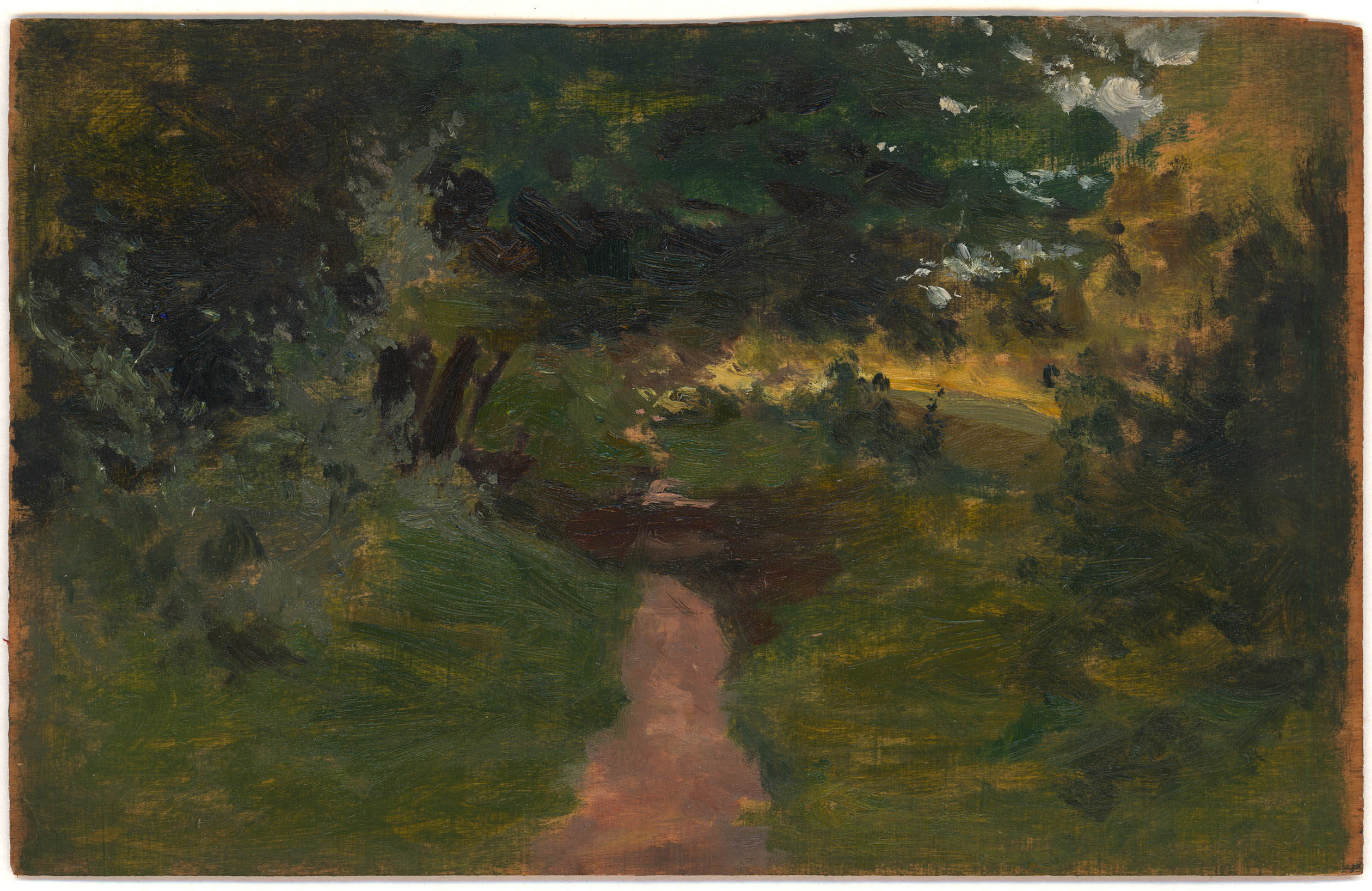
Interestingly, Théodore Rousseau (aka Étienne Pierre Théodore Rousseau) (1812–1867) painted, “Sunset near Arbonne” (c1860–65) close to where Chauvel executed this small oil sketch—an area that Asher Miller (2022) in the description of Rousseau’s painting held by the Metropolitan Museum of Art advises as being approximately “three miles” from the village of Barbizon at “the edge of Fontainebleau Forest” where “Romantic artists had long been attracted … [to its] rocky outcroppings, boulders, and strange, twisted trees” (https://www.metmuseum.org/art/collection/search/437520). See also Gustave Greux’s (aka Gustave Marie Greux) (1838–1919) etching held by the British Museum after Rousseau’s painting: https://www.britishmuseum.org/collection/object/P_1916-0411-25.  

Oil on wood panel (not signed).

Size: 15.5 x 24.5 cm.

Hand inscribed ink annotation verso: (upper right corner) “La Route d'Arbonne/ 29 Août 1906”.

Condition: the painting is in an excellent condition. The edges of the panel on the back are chamfered and there are remnants of glue possibly from the panel having once been framed.

I am selling this small oil study on wood panel—clearly executed on location rather than in the studio—by one of the better known of the French printmakers of the 19th century, for AU$593 (currently US$396.36/EUR258.63/GBP315.69 at the time of posting this listing) including postage and handling to anywhere in the world, but not (of course) any import duties/taxes imposed by some countries.

If you are interested in purchasing this small jewel of a painting, please contact me (oz_jim@printsandprinciples.com) and I will send you a PayPal invoice to make the payment easy.

This painting has been sold


Saturday, 31 October 2020

Charles Louis Kratke’s etching on vellum, “Evening”, c1883

Charles Louis Kratke (aka Charles Louis Kratké) (1848–1921)

“Evening”, c1883, proof-state impression on vellum (before the addition of title and publication details?) after Théodore Rousseau (aka Pierre-Étienne-Théodore Rousseau) (1812-1867).

Etching and drypoint on vellum, plate signed, with wide margins and backed with a support sheet (to help prevent the vellum from cockling).

Size: (sheet) 25.8 x 42.4 cm; (faint platemark) 23.7 x 28.4 cm; (image borderline) 14.6 x 22.5 cm.

Inscribed on plate: (within the image borderline at lower left) “TH. ROUSSEAU”; (below the image borderline at right) “L[?] KRATKÉ. SC”

Condition: richly inked and well-printed, near faultless impression printed on vellum with generously wide margins. There are naturally occurring imperfections in the vellum and minor distortions to the image, otherwise the sheet is in excellent condition.

I am selling this stunning proof-state etching on genuine vellum (i.e. calf skin), showing a twilight view across marshlands with a solitary seated fisherman in the middle distance and a figure crossing a bridge in the far distance, to a spectacularly glowing incandescent sky, for the total cost of AU$264 (currently US$185.61/EUR159.33/GBP143.32 at the time of this listing) including Express Mail (EMS) postage and handling to anywhere in the world, but not (of course) any import duties/taxes imposed by some countries.

If you are interested in purchasing this very beautiful etching capturing the sparkling effect of the last vestiges of sunlight illuminating the foliage of bushes—perhaps glinting on hoarfrost on gorse bushes (but I am probably wrong about this remembering that I live in the hot tropics of Australia and the reality of ever seeing something like frost on gorse bushes lives in my poetic dreams)—please contact me (oz_jim@printsandprinciples.com) and I will send you a PayPal invoice to make the payment easy.

This print has been sold


Thursday, 23 April 2020

Charles Louis Kratke’s etching with drypoint, “Le Matin”, c.1883, after Théodore Rousseau


Charles Louis Kratke (1848–1921)

“Le Matin” (Morning), c.1883, proof-state impression (before the addition of title and publication details) after Théodore Rousseau’s (aka Pierre-Étienne-Théodore Rousseau) (1812-1867) painting (c.1855–60) in the Musée d'Orsay, Paris.

Etching with drypoint on vellum, plate signed, with a wide margin.
Size: (sheet) 29 x 44.7 cm; (faint platemark) 19.5 x 26.5 cm; (image borderline) 14.4 x 22.2 cm.
Inscribed on plate below the image borderline: (right) “[L?] KRATKÉ S.C..”

Condition: faultless impression printed on vellum with a generously wide margin in pristine condition.

I am selling this stunning proof-state etching showing a panoramic scene of the environs of Fontainebleau glowing with morning light and featuring distant cows drinking from a marshland pond, for the total cost of AU$258 (currently US$164/EUR152.15/GBP132.63 at the time of this listing) including postage and handling to anywhere in the world (but not, of course, any import duties/taxes imposed by some countries).

If you are interested in purchasing this finely executed and very beautiful etching exemplifying the spirit of the Barbizon School, please contact me (oz_jim@printsandprinciples.com) and I will send you a PayPal invoice to make the payment easy.

This print has been sold


Saturday, 6 August 2016

Théophile Chauvel’s etching of the Forest at Fontainebleau after Théodore Rousseau


Théophile Chauvel (aka Théophile Narcisse Chauvel; Théophile-Narcisse Chauvel) (1831–1909) after Théodore Rousseau (1812–67)

“Une mare—Forêt de Fontainebleau”, 1874, printed by François Liénard (1860s–1880s; fl. c.) and published in “L'Art”, 1876.
Etching on laid paper with 3.8 cm chainlines and trimmed at, or within, the platemark (as published in “L'Art”).
Size: (sheet) 28.4 x 39.8 cm; (image borderline) 24.6 x 29.6 cm
Lettered in the plate below the image borderline: (lower left) “Th. Rousseau, pinx.” / “L'Art.”; (lower centre) “UNE MARE - FORÉT DE FONTAINEBLEAU.” / “Collection de Mr. William T. Blodgett.”; (lower right) “Th. Chauvel, sc.” /  “F.çois Liénard, Imp. Paris.”
IFF 31 (Inventaire du Fonds Français: Bibliothèque Nationale, Département des Estampes, Paris, 1930)
The British Museum offers the following description of this print:
“A pond in a clearing of the forest at Fontainebleau; a figure standing by the pond, at centre, surrounded by trees; after Théodore Rousseau; published in 'L'Art', 1876. 1874” (http://www.britishmuseum.org/research/collection_online/collection_object_details.aspx?objectId=3350959&partId=1&searchText=Chauvel+Rousseau&page=1)
Condition: richly inked and well-printed impression in pristine condition.

Price & Shipping:

AU$238 (approximately US$170.40 / €144.70 / £126.02), including worldwide express shipping. Please note that import duties and taxes (if any) are the buyer’s responsibility.


Chauvel is one of my favourite nineteenth century etchers in term of his ability to display skill without resorting to impersonal formulaic approaches to representation.

Although Chauvel was a regular exhibitor at the Salon from 1858 to 1904 and was awarded the prestigious Legion of Honour in 1896, he is best known for his graphic interpretations of other artist’s paintings, such as this print after a painting by Théodore Rousseau, rather than for his own compositions. Regardless of his reputation as a reproductive etcher (i.e. an artist that “translates” paintings into etchings), Chauvel could draw like an angel—presuming angels can draw—and one only has to examine his line work in portraying the intricacies of Rousseau’s cloud formations to understand what I mean. For instance, in this etching he is able to illustrate the transparency of clouds rendered in oil paint and could do this in a way that a viewer could visualise the form of the cloud mass as well as subtle movements within the mass. Simply amazing!

Chauvel’s skill as an etcher is even acknowledged by FL Leipik—a writer who is not shy in offering unapologetic, blunt assessments of artists in his “A History of French Etching” (1924). Leipik saw in Chauvel an artist who, “though eclectic, does not convey the impression of slavish imitation” (p. 128). Leipik also insightfully proposes that if “sensitive adaptability prevented Chauvel from working in a fashion of his own, it fitted him eminently for the interpretation of others” (ibid).