Showing posts with label Morghen (Raphael). Show all posts

Tuesday, 4 October 2022

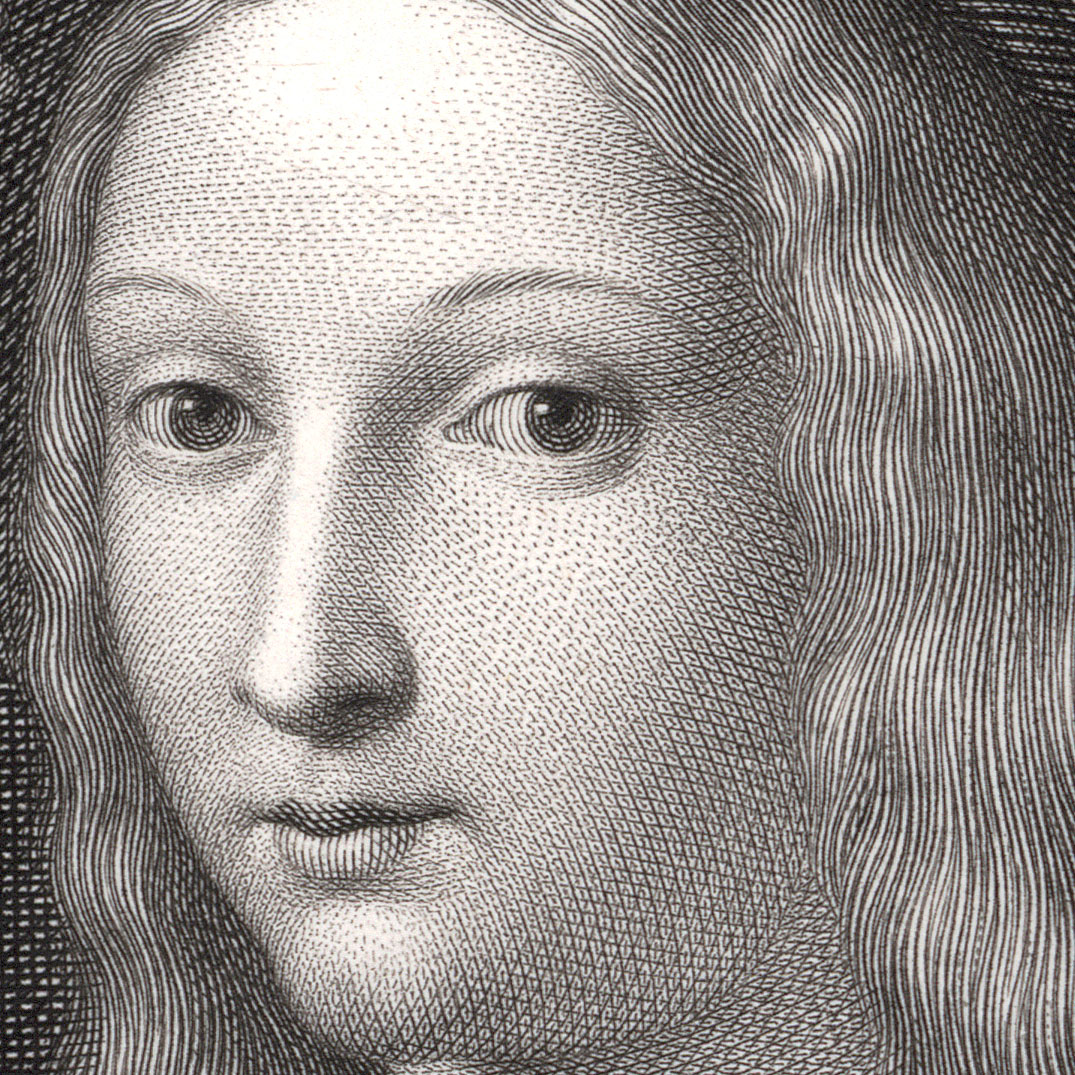
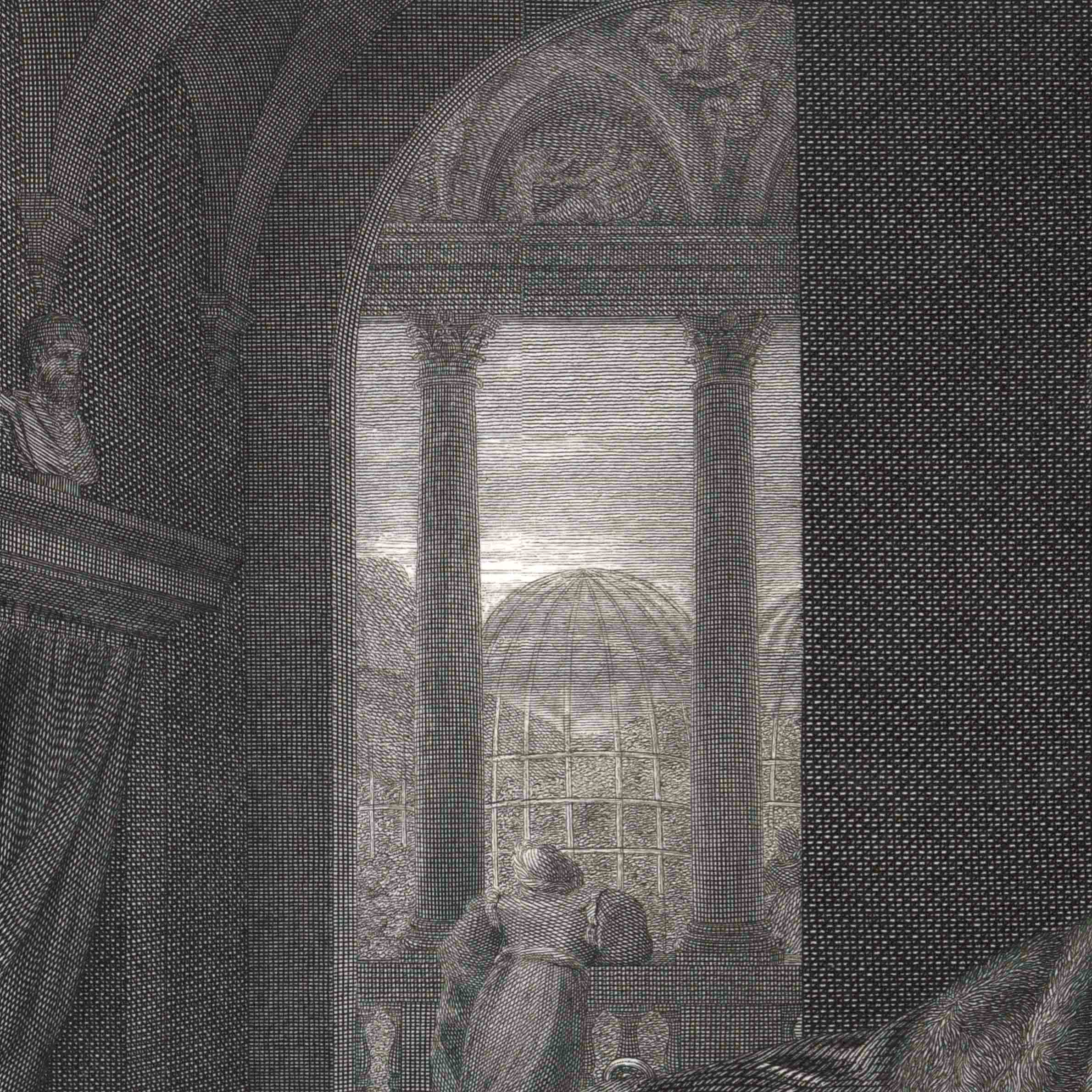
Raphael Morghen’s engraving, “Portrait de Jeanne d'Arragon”, 1821, after Raphael

Raphael Morghen (aka Raffaello Morghen) (1758–1833)

“Portrait de Jeanne d'Arragon” (as titled in plate), 1821, after Raffael (1483–1520) and Giulio Romano (1499–1546) following the intermediary design by Pierre Bouillon (1776–1831), from the series, “Musée Royal”.

Note that Frederic Robert Halsey (1885) in his catalogue raisonné for Morghen advises: “The etching was made by Angelo Emilio Lapi. The plate was then handed over to Giovanni Rivera, who engraved the rest of it, except the head and hands, which were executed by Morghen, who, besides, went over the entire plate, giving it its harmony and finish. The original drawing, by Bouillon, is in the possession of the author [Halsey]. It adds an interest to this plate to know that Raffaello himself only painted the hands and head of the original, i. e., those parts engraved by Morghen” (p.13; see https://archive.org/details/raphaelmorghense00hals/page/12/mode/2up).

The Curator of the British Museum offers the following insights about this print: “This print reproduces a portrait which is in the collection of the Musée du Louvre (Inv. 612). Vasari reports that the head of the sitter was painted by Raphael after a cartoon executed by Giulio Romano, who also painted the rest of the portrait. The sitter, traditionally identified as Joanna of Aragon, is now thought to be Dona Isabel de Requesens” (https://www.britishmuseum.org/collection/object/P_1843-0513-1034)
I understand that Dona Isabel de Requesens y Enriques de Cardona-Anglesola (1500–1577) was the vice-queen of Naples, whereas Joanna of Aragon (1454–1517) was the queen consort of Naples.

Engraving and etching on fine laid paper with wide margins as published.

Size: (sheet) 55.8 x 39.4 cm; (plate) 49.3 x 35.3 cm; (image borderline) 31.9 x 25.7 cm.

Lettered in plate below the image borderline: (left) “Peint par Raphaël.”; (centre) “Dessiné par Bouillon./ PORTRAIT DE JEANNE D'ARRAGON.”; (right) “Gravé par Raph: Morghen.”

State iii (of iv) showing shaded uncial capitals, before the addition of “Ecole Italienne …” of state iv.

Halsey 12iii (Frederic Robert Halsey, 1885, “Raphael Morghen's engraved works being a descriptive catalogue”, New York, G P Putnam’s Sons, pp. 13–14, cat. no. 12 iii); Palmerini 239 (Niccolo Palmerini 1824, “Opere d'intaglio del Cav. Raffaello Morghen”, Florence, Niccolo Pagni, cat. no. 239); Nagler 60.

The British Museum offers the following description of this print:

“Portrait of a woman, formerly identified as Joanna of Aragon, now known to be Doña Isabel de Requesens y Enrìques de Cardona-Anglesola; three-quarter length, turned to the left and looking to the viewer, with her left hand in her lap and her right touching her fur around her neck; she wears a hat with gems on the brim; in the background, at left, a woman leaning upon the edge of a loggia; after Raphael and Giulio Romano, final published state. 1821 Engraving” (https://www.britishmuseum.org/collection/object/P_1843-0513-1034).

Condition: a strong and well-printed (near faultless) impression with generous margins in near pristine condition for its large size and age with no tears, holes, folds, abrasions, stains, foxing or significant signs of handling

I am selling this very beautiful and finely crafted engraving for AU$277 (currently US$180.57/EUR182.78/GBP158.58 at the time of posting this listing) including Express Mail (EMS) postage and handling to anywhere in the world, but not (of course) any import duties/taxes imposed by some countries.

If you are interested in purchasing this remarkable engraving—a true masterwork of this very demanding medium—please contact me (oz_jim@printsandprinciples.com) and I will send you a PayPal invoice to make the payment easy.

This print has been sold


Saturday, 10 April 2021

Raphael Morghen’s engraving, “Head of Jupiter”, 1789

Raphael Morghen (aka Raffaello Morghen) (1758–1833)

“Head of Jupiter”—Portrait of Augustus [Octavian], 1789, following the intermediary design by Buenaventura Salesa (1756–1819) after an antique cameo found at Ephesus in 1793.

Frederic Robert Halsey (1885) in his catalogue raisonné for Raphael Morghen offers the following description of this print:

“Engraved at Rome, 1789, from an antique cameo, discovered at Ephesus, and in the possession of the Venetian Senator Giuliani. This cameo was carried off to Paris by Napoleon for the famous Museé Français, but was returned after Napoleon’s downfall in 1815. A head, full face, in a circular medallion, diameter 2⅝ in. The plate was said to have been destroyed; but this is a mistake, as it formed part of the Calcografia Morgheniana which passed into the possession of G. Snell, and it is now owned by Luigi Bardi, Florence. It was engraved for Osservazioni sopra un antico cammeo, rappresentante Giove Egioco, by the learned antiquary Ennio Quirino Visconti, Padova, 1793, 4to. There is an excellent copy by Rosaspina” (p. 66; see https://archive.org/details/raphaelmorghense00hals/page/66/mode/2up).

Engraving on heavy laid paper with wide margins as published.

Size: (sheet) 40.3 x 27.1 cm; (plate) 18.8 x 15.3 cm; (image borderline dia.) 6.8 cm.

Inscribed on plate around the image borderline: (lower left) “Bon. Salesa del.”; (lower right) “Raph. Morghen sculp.”

Lettered on plate in four lines of Latin below the image borderline: (centre) “Juppiter Aegiocus Ephesi nuper effosus/ Extat/ Apud Hieronymum Equitem Julianum/ Patricium Venetum”.

State iv (of iv) with correction of “Zulianum” to “Julianum” and “effosus” to “effossus” (see the first lettered state before changes at the British Museum: https://www.britishmuseum.org/collection/object/P_1843-0513-1116).

Halsey 81iv (Frederic Robert Halsey, 1885, “Raphael Morghen's engraved works being a descriptive catalogue”, New York, G P Putnam’s Sons, p. 66, cat. no. 81iv); Palmerini 142 (Niccolo Palmerini 1824, “Opere d'intaglio del Cav. Raffaello Morghen”, Florence, Niccolo Pagni, cat. no. 142); Nagler 151.

The British Museum offers a description of this print: https://www.britishmuseum.org/collection/object/P_1868-0822-93.

Condition: a strong and well-printed impression with generous margins. Beyond minor dustiness to the margins, the sheet is in excellent condition for its considerable age with no tears, holes, folds, abrasions, stains or foxing.

I am selling this jewel-like engraving of an antique cameo capturing not only its fine details but also the slight sheen of the cameo’s polished surface, for AU$267 (currently US$203.54/EUR170.97/GBP148.51 at the time of posting this listing) including Express Mail (EMS) postage and handling to anywhere in the world, but not (of course) any import duties/taxes imposed by some countries.

If you are interested in purchasing this remarkably fine engraving—a true masterwork of this very demanding medium—please contact me (oz_jim@printsandprinciples.com) and I will send you a PayPal invoice to make the payment easy.

This print has been sold


Saturday, 11 August 2018

Raphael Morghen’s engraving, “La Poesia”, 1827


Raphael Morghen (aka Raffaello Morghen) (1758–1833)

“La Poesia” (aka “Allegory of Poetry”), 1827, after the intermediary design by Pietro Ermini (1774–1850), after the painting in the Palazzo Corsini (Florence) by Carlo Dolci (1616–1686), printed by Luigi Bardi (fl.1814–1843).

Engraving with etching on heavy wove paper with wide margins as published in the final closed letter state.
Size: (sheet) 52.2 x 37.5 cm; (plate) 32.4 x 22.7 cm; (image borderline) 22.4 x 16.3 cm
Lettered on plate below the image borderline with title and dedication to Principe Tommaso Corsini by the engraver followed by two lines of Latin verse; with producer names “Carlo Dolci dipinse / Pietro Ermini dis. / Raffaello Morghen inc. 1827 / Luigi Bardi impresse”.
State v (of v [Halsey 1885]) or xi (of xi [Rijksmuseum])

Halsey 1885 147-5(5) (Frederic Robert Halsey 1885, “Raphael Morghen's engraved works being a descriptive catalogue, ... accompanied by biographical and other notes with a life of the engraver”, New York, p. 132, cat. nr. 147); Palmerini 1824 undescribed (Niccolo Palmerini 1824, “Opere d'intaglio del Cav. Raffaello Morghen”, Florence, Niccolo Pagni)

The British Museum offers the following description of this print:
“Half-length woman crowned with a laurel wreath, representing Poetry, after Carlo Dolci; final closed letter state. 1827 Engraving”
See also the description of this print at the Rijksmuseum:

Condition: crisp, well-inked and well-printed impression with wide margins (as published). The sheet is in near pristine condition with only light signs of handling and a faint stain in the margin at the lower-right corner.

I am selling this delicately beautiful neoclassical engraving of the allegorical figure, Poetry, wearing her usual wreath of laurel leaves and holding a book, for AU$147 in total (currently US$107.39/EUR94.07/GBP84.08 at the time of posting this listing) including postage and handling to anywhere in the world (but not, of course, any import duties/taxes imposed by some countries).

If you are interested in purchasing this masterpiece of engraving displaying extraordinary sensitivity in rendering transitions of tone, please contact me (oz_jim@printsandprinciples.com) and I will send you a PayPal invoice to make the payment easy.

This print has been sold


Thank goodness that the British Museum has nearly all of the early states for this masterpiece of neo-classical engraving (see the BM online collection: http://www.britishmuseum.org/research/collection_online/search.aspx?searchText=La+Poesia+morghen). After all, what the progressive stages reveal is that the engraver, Raphael Morghen, was as mythodical and as sensitive in “bulding” this image so that it glows sublimely as the original great Florentine master, Carlo Dolci, was in capturing the jewel like radiance of his paintings. Indeed, I have just read the introductory notes to the exhibition showcasing Doci’s painting at the Nasher Museum (August 24, 2017– January 14, 2018), “The Medici’s Painter: Carlo Dolci and 17th-Century Florence”, and discovered that “Dolci would recite the litany ‘Ora pro nobis (pray for us)’ between each brush stroke …” (https://nasher.duke.edu/exhibitions/the-medicis-painter-2/). Interestingly, the close-up detail of a painting shown on the cover of the catalogue for the Nasher Museum exhibition is the painting that this engraving reproduces.