Showing posts with label Galle. Show all posts

Saturday, 4 May 2019

Cornelis Galle’s engraving, “St Michael”, c1640


Cornelis Galle I (1576–1650 or Cornelis Galle II (c1615–1678)

Note: I have been unable to find precise attribution of this print inscribed, “C Galle”, to the younger or elder Cornelis Galle. Nevertheless, the somewhat perfunctory treatment of the archangel St Michael as he defeats the devil in the form of a dragon, along with the printmaker's choice to leave the space beyond the image borderline blank, suggest that the engraver is the younger Cornelis Galle … but, of course, I may be wrong.

“St Michael”, c1640
Engraving on laid paper with watermark, trimmed with small margins around the platemark and backed with a support sheet.
Size: (sheet) 10 x 7.4 cm; (plate) 9 x 6 cm; (oval image borderline) 7.6 x 5.7 cm.
Lettered on plate below the image borderline: (centre) “S. Michaël.”; (right) “C. Galle fecit et ex. c. Privilegio.”

Condition: well-printed, near faultless impression—note that the gap in the borderline on the upper right may be an intrinsic feature of the plate rather than a fault in the print—with small margins (approx. .5 cm) laid upon an archival support sheet of millennium quality washi paper. The sheet is in excellent condition (i.e. there are no tears, holes, folds, abrasions, stains, foxing or significant signs of use).

I am selling this very small engraving full of drama, for the total cost of AU$176 (currently US$123.66/EUR110.38/GBP93.90 at the time of this listing) including postage and handling to anywhere in the world (but not, of course, any import duties/taxes imposed by some countries).

If you are interested in purchasing this jewel-like engraving sparkling with light and action, please contact me (oz_jim@printsandprinciples.com) and I will send you a PayPal invoice to make the payment easy.


Tuesday, 3 April 2018

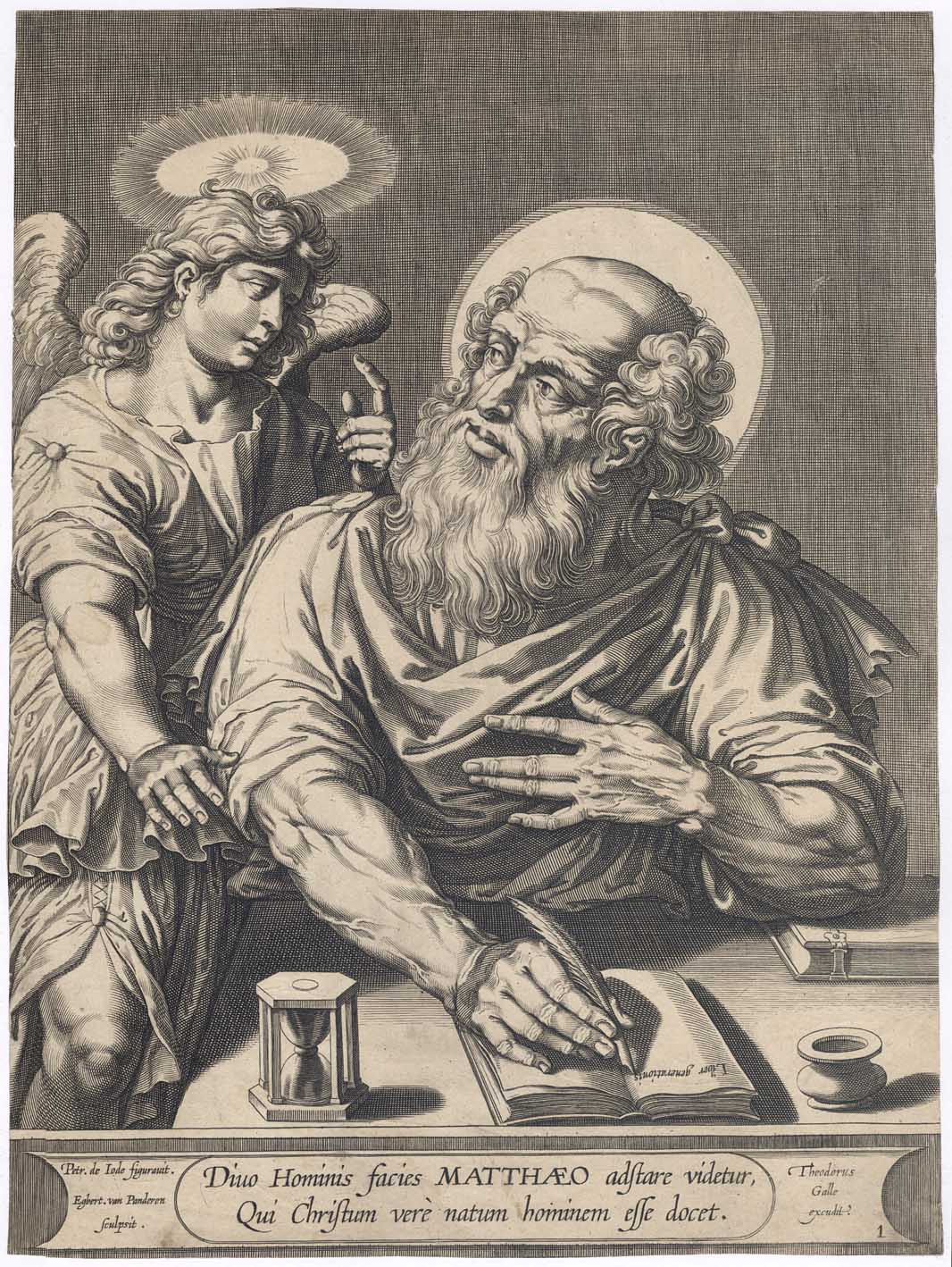
Egbert van Panderen’s engraving, “St Matthew”, c1605, after Pieter de Jode I


Egbert van Panderen (c1581–1637)

“St Matthew”, c1605 (1590–1637), after Pieter de Jode I (1570–1634), plate 1 from the series of four plates, “The Evangelists”, published in Antwerp by Theodoor Galle (1571–1633).
See a copy of this print with a few differences (e.g. St Matthew does not hold the quill in his right hand and the design of the haloes of St Matthew and the angel are different) by François van den Hoeye (1590­–1636), after Egbert van Panderen (Hollstein Dutch 1) at the Rijksmuseum: http://hdl.handle.net/10934/RM0001.COLLECT.123384.

Engraving on fine laid paper trimmed along the borderline and lined with a support sheet.
Size: (sheet) 28.8 x 21.3 cm
Lettered on the plate in a cartouche below the image borderline: (left) “Petr. de Iode figurauit. / Egbert. van Panderen / Sculpsit.”; (centre) "Diuo Hominis facies MATTHAEO adstare videtur, /Qui Christum verè natum hominem esse docet.” (Google transl. “MATTEO seems to be standing at the open air in the face of a man, / He who teaches that Christ is truly born to be a man.”); (right) “Theodorus / Galle / excudit. / 1.”

Hollstein IX.209.71 (F W H Hollstein 1949, “Dutch and Flemish Etchings, Engravings and Woodcuts c.1450–1700”, Amsterdam)
The Rijksmuseum offers the following description of this print:
“The evangelist Matthew, writing at a table. Beside him, his attribute is the angel. In a frame a two-line caption in Latin. First print from a series of four with the evangelists.” (http://hdl.handle.net/10934/RM0001.collect.160347)
See also the description at the Metropolitan Museum of Art: https://www.metmuseum.org/art/collection/search/644101

Condition: crisp, well-inked and well-printed impression (undoubtedly a lifetime impression) in near pristine, museum-quality condition (i.e. there are no tears, holes, folds, abrasions, stains or foxing) trimmed along the borderline and lined on a support sheet.

I am selling this strong engraving of the highest order of technical accomplishment for AU$186 in total (currently US$142.93/EUR116.28/GBP101.89 at the time of posting this listing) including postage and handling to anywhere in the world.

If you are interested in purchasing this impressive print exemplifying the Mannerist spirit at the time of its execution, please contact me (oz_jim@printsandprinciples.com) and I will send you a PayPal invoice to make the payment easy.

This print has been sold


In an earlier post in which I discuss Egbert van Panderen’s leaning to the exuberant energy of Northern Mannerism (e.g. his fascination with strong contrasts of light and dark, dramatic gestures, exaggeration of muscles and folds in drapery), I drew attention to the artist’s technical virtuosity in his amazing use of the burin to render “clothes as shimmery as satin” (see http://www.printsandprinciples.com/2016/09/egbert-van-panderens-engraving-after.html). Again, Van Panderen’s disciplined command of the burin is hard to ignore in this highly refined portrayal of the angel assisting St Matthew to write his gospel.

What I especially like about this print, however, is that the artist has not only captured a moment of spiritual engagement between the angel and the saint—as shown by their hand gestures to each other—but that the special moment of connection between the two figures is not one of an non-specific instant in time. Instead, what is captured is an endless moment of on-going transcendent engagement. What I mean by this comment is that Van Panderen has rendered the scene so that all the portrayed features have the same degree of focal clarity—a visual democracy if I may describe the consistency of focal resolution in this way. In this “visual democracy” of sameness, the background does not vary in texture or tone and the treatment of the figures also does not vary from foreground to background or from side to side. In short, what Van Panderen is portraying in this scene is a spiritual communion between the angel and the saint where the signified meanings of the figures’ gestures are frozen forever. 


Wednesday, 1 November 2017

Hieronymus Wierix’s engraving, “Portrait of Jan Cornelisz. Vermeyen”, c1572


Hieronymus Wierix (1553-1619) or Jan Wierix (aka Johannes Wierix) (1549–c1620)

“Portrait of Jan Cornelisz. Vermeyen”, c1572, plate 15 in the series of 23 engraved plates in “Pictorum aliquot celebrium Germaniae inferioris Effigies”, published by Theodoor Galle (1571–1633), 1572, in Antwerp. This impression is from the 1694 fourth edition published by D and T Browne (fl.1694) in London as illustrations to Sebastiano Resta's "The True Effigies Of The Most Eminent Painters And Other Famous Artists"

Engraving on fine laid paper with margins.
Size: (sheet) 27.5 x 18.6 cm; (plate) 20.4 x 12 cm
Lettered at top: "Obijt Bruxellis 1559. ætat 59. ad D. Gaugerici conditus. / 15.". Lettered with title in lower margin, followed by ten lines of Latin verse: "Quos homines, quæ ... / ... / ... ad vsque pedes.". Lettered with monogram within image in lower right corner: "IHW". Lettered with publisher's address in the lower left corner: "Th. Galle excud.". Numbered in pen and ink before title: "15".
State iv (of iv)

Mauquoy-Hendrickx 1979 1743; Hollstein 2027.IV (Wierix); Alvin 1866 2047; Riggs 1977 269; van Someren 1888 5774d

The British Museum offers the following description of this print:
“Plate 15: Portrait of Jan Cornelisz. Vermeyen, three-quarter length, turned to the left, head turned to face the viewer; with moustache and very long beard, seated and holding a book in his right hand while writing in it with his left hand, an exotic landscape seen behind him with a group of figures to right, a man menacing another figure with a sword; fourth state with an extra numbering of '15' before name; from the fourth edition of the series used as illustrations to Sebastiano Resta's 'The True Effigies Of The Most Eminent Painters And Other Famous Artists' (D. and T. Browne: London, 1694). c.1572"

Condition: crisp and near faultless, well-printed impression with wide margins in excellent condition for the age of the print (i.e. there are no tears, abrasions, holes, folds, significant stains—but there is a dot stain on the upper left and light handling marks on the right—or foxing). This print is in an extraordinary state of preservation.

I am selling this visually riveting portrait of an artist drawing in an exotic landscape with a murder occurring beyond his left shoulder for [deleted] at the time of this listing) including postage and handling to anywhere in the world.

If you are interested in purchasing this psychologically engaging portrait from the Baroque age, please contact me (oz_jim@printsandprinciples.com) and I will send you a PayPal invoice to make the payment easy.

This print has been sold


To be honest, when I first saw this portrait of Jan Cornelisz Vermeyen (aka Jan Mayo; Barbalonga) (c1500–1559), I knew nothing about the "sitter" other than that he must be Dutch based solely on his name.  I was curious to find out why he is shown he seated drawing with his sketch book resting on his knee in what is clearly not a Dutch countryside. Well, I now know … or I think that I have found an explanation for the exotic palm tree and sand dune setting: he was a companion of Emperor Charles V at the Conquest of Tunis. This also helps to explain the somewhat gruesome scene of murder/battle featured beyond the artist’s left shoulder. I guess wars are always horrible and so long as the grim details are behind your left shoulder all is well in the world when drawing out-of-doors.


Sunday, 22 October 2017

Alexander Voet II’s engraving, “Lucius Annaeus Seneca”, c1670, after Ruben’s painting, “The Death of Seneca”, c1615


Alexander Voet II (c1635–1695 or a little later)

“Lucius Annaeus Seneca”, c1670 (1650/62–1678/95), after Peter Paul Rubens’ (1577–1640) painting, “The Death of Seneca”, c1615, published by Cornelis Galle II (1615–1678)

Engraving on laid paper with small margins lined onto a conservator’s support sheet.
Size: (sheet) 43 x 30 cm; (plate) 40.9 x 27.5 cm; (image borderline) 39.5 x 26.9 cm
Lettered below the image borderline: (left) "Petr. Paul Rubbens pinxit"; (centre) “LVCIVS ANNÆUS SENECA.”; (right) "Corn. Galle excudit."

State ii (of ii) after the additional publication detail, "Corn. Galle excudit.", and the erasure of the details, "Alex. Voet iunior sculpsit et excudit".

Hollstein 11.II (under Voet); Schneevoogt 1873 140.39, Corpus Rubenianum XIII 54 (copy 6)

The British Museum offers the following description of this print:
“The Death of Seneca; the philosopher standing at centre with his feet in a basin of water, supported by a disciple at left while another takes down his last words at right, two others onlooking beyond at right; second state with address of Galle; after Peter Paul Rubens”

See also the Rijksmuseum’s description:
“Seneca commits suicide on Nero's order, opening his veins, standing in a [basin].”

Condition: excellent impression revealing very light wear to the plate with margins (varying in size but approximately 1 cm) and laid upon a support sheet. The sheet has minor nicks, abrasions mainly on the lower edge of the margin but these issues are addressed by the conservation of the sheet on a washi paper support and virtually invisible dot retouching.

I am selling this superbly executed, large and famous engraving for the total cost of AU$221 (currently US$172.95/EUR146.72/GBP131.17 at the time of this listing) including postage and handling to anywhere in the world.

If you are interested in purchasing this 17th century masterwork of engraving, please contact me (oz_jim@printsandprinciples.com) and I will send you a PayPal invoice to make the payment easy.

This print has been sold


This should be a dreadful scene in that it portrays Emperor Nero’s childhood tutor and friend, the philosopher Lucius Annaeus Seneca—known better by just his surname, Seneca—committing suicide by order of his former pupil … but it really isn’t. Instead I see the scene like a crucifixion image of Christ which is hideous in its depiction of an awful physical death but is in fact a celebration of atonement and love. In the case of Seneca, the sacrifice of his physical body is a celebratory exhibition of his free will against oppression—or as Mary Beard (2014) explains in “How Stoical Was Seneca?": Seneca offered this display of his death as “the only thing he had left, and the best: ‘the image of his own life,’ imago vitae suae.” (http://www.nybooks.com/articles/2014/10/09/how-stoical-was-seneca/)

Of course, like all martyr’s deaths, the “real” circumstances are far from spiritually transcendent. Seneca was an old man and when he slit his veins his blood flowed too slowly and so he tried taking hemlock to help in his plans for a glorious suicide. This too was ineffective and so he immersed himself in a hot bath so that his blood would flow freely. Sadly, this ploy was not successful either but the fumes from the hot bath did ultimately kill this magnificent stoic.

Regarding this famous engraving by Voet, it too is not an unproblematic illustration of Seneca’s suicide. As may be seen in the composite image shown above, Voet’s engraving reproduces Ruben’s painting now in the Alte Pinakothek, Munich, inv.no.305 (Rooses 812)—“with variations” as the BM curator points out (see BM no. 1841,0809.48). The origin of the image does not end with Rubens. Rubens also visually cannibalised the image from the pose of a Roman sculpture of an old fisherman (see the left image) which was in turn a copy of an ancient Greek (Hellenistic) sculpture. Note that the “bath” included in the Roman sculpture is a recent addition designed to give a contemporary meaningful context to the old fisherman; it has nothing to do with the original sculpture and its ancient context.


Thursday, 19 October 2017

Adriaen Collaert’s engraving, “Ox hunt”, 1582, after Hans Bol


(Attrib.) Adriaen Collaert (c1560–1618) or the studio of Philips Galle (1537–1612)

“Ox Hunt”, 1582, plate 2 from the series of forty-eight engravings (BM) or 54 engravings (Rijksmuseum), “Venationis, piscationis, et aucupii typi” (Hunting, Fishing and Fowling Scenes) after Hans Bol (1534–93), published by Philips Galle (according to the BM) and/or Theodoor Galle (1571–1633) (according to the Rijksmuseum)


Engraving on fine laid paper trimmed along the platemarks and lined onto a conservator’s support sheet
Size: (sheet) 8.3 x 21.8 cm
Inscribed below the image borderline: (from the left) “2”; "Sic passim spiculis, gladijs, leuibusq[ae] sagittis”;  “In foueas agitant armatos cornibus Vros." (advised trans. "Thus with darts, swords, and light arrows men everywhere drive the horned Aurochs into pits.")
State ii? (of ii?) After the addition of the plate number, “2”. My uncertainty about the number of other states is that I understand that there were alterations to the number sequences in later editions (e.g. plate 37 became plate 47). This impression is certainly an early one as there is very little wear to the plate.

Hollstein 110–163 (after Hans Bol); New Hollstein (Dutch & Flemish) 1532.I (The Collaert Dynasty)

The British Museum offers the following description of this print:
“A group of men, some on foot, some on horseback, and dogs, surround and attack an aurochs, at the centre of a wooded landscape; the animal has an arrow stuck in its back, and its heels are nipped at by some of the dogs; after Hans Bol”
See also the description of this print at the Rijksmuseum:

Condition: marvellous early impression showing no wear to the plate from the numbered publication state (state ii?). The sheet has been trimmed to the platemark and laid onto a support sheet. The sheet has the patina of light handling marks appropriate to the age of the print; otherwise the sheet is in excellent condition (i.e. there are no tears, holes, abrasions, folds, stains or foxing).

I am selling museum-quality early impression showing a hunt for the wild European ox—the anurochs—only 45 years before this species of animal became extinct, for the total cost of AU$280 (currently US$220/EUR186.54/GBP167.38 at the time of this listing) including postage and handling to anywhere in the world.

If you are interested in purchasing this panoramic illustration of the drama of a 16th century hunt, please contact me (oz_jim@printsandprinciples.com) and I will send you a PayPal invoice to make the payment easy.

This print has been sold


For those, like me, who may not be familiar with animal called an anurochs (the spelling of a herd of anurochs is the same as that of a single anurochs) being hunted here, according to www.merriam-webster.com/dictionary, it is “an extinct large long-horned wild ox (Bos primigenius) of Europe that is the ancestor of domestic cattle.” Interestingly—perhaps the adverb, “poignantly”, might be more appropriate—as the scene portrayed here in 1582 must be one of the last recorded hunts for an anurochs as the breed was exterminated in 1627 with the last one killed in Poland. So sad …


Monday, 9 October 2017

Philips Galle’s engraving, “Quail Hunt with Quail Pipe and net”, 1578


Philips Galle (aka Philippe Galle; Philippus Gallaeus) (1537–1612)

“Quail Hunt with Quail Pipe and net”, 1578, from the series, “Hunting Parties” (aka “Venationes Ferarum, Avium, Piscium” (transl. “With wild beasts, birds, fish”), after Jan van der Straet (aka Joannes Stradanus; Ioannes Stradanus) (1523–1605).

Note: according to the curator of the British Museum’s explanation about the series, this impression is from the first edition of 43 unnumbered plates that were all engraved by Philips Galle with a dedication page to Cosimo de Medici. After this edition the series was expanded to 104 plates engraved by A. Collaert, J. Collaert, C. Galle I and C. de Mallery with a dedication page to the jurist Henricus van Osthoorn en Sonnevelt (see http://www.britishmuseum.org/research/collection_online/collection_object_details.aspx?objectId=1619537&partId=1&people=93957&peoA=93957-2-70&page=1 and A. Baroni and M. Sellink, “Stradanus 1523-1605: Court artist of the Medici”, exh.cat. Groeningemuseum Brugge 2008-2009, Turnhout, 2012, pp.245–58, cat.nos.32–49.). In the later expanded edition of 104 plates, this plate was numbered “78” at the lower left.

Engraving on laid paper with margins as published in the first edition of 1578 (?) at the top and sides but trimmed unevenly and slightly within the platemark at lower edge.
Size: (sheet trimmed unevenly) 23.7 x 37cm; (image borderline) 20.2 x 29.5 cm
Lettered below the image borderline: (left) “Sic Autumnali capitur peregrina Coturnix”; (right) “Tempore, et excipulis effundit sibila linguis.”
State: ii (of iii?) before the addition of the plate number, “78”, as shown in the state iii copy held by the BM (no. 1957,0413.116)

The British Museum offers the following description of this print from the later edition when the plate was numbered:
“Plate numbered 78, Quail Hunt with Quail Pipe and Net; in the foreground, to left, a couple, holding quail pipes, and a child are seated behind a tree, beside a basket of quails; beyond, to the right, quails are caught under nets placed over the fields, where figures gather them into baskets; to far left, two classical villas and a domed building are seen; another domed building is visible in the distance to the right”

TIB 5601.104:35 (Walter L Strauss & Arno Dolders [Eds.] 1987, “The Illustrated Bartsch”, vol. 56, Supplement, p. 435); New Hollstein (Dutch & Flemish) 455.II (Johannes Stradanus) (Johannes Stradanus); New Hollstein (Dutch & Flemish) 455.II (Philips Galle); Baroni Vannucci 1997 693.78 (Alessandra Baroni Vannucci 1997, “Jan van der Straet, detto Giovanni Stradano, flandrus pictor et inventor”, Milan, Jandi Sapi Editori)

Condition: excellent lifetime impression (see explanation above). There is a tear (3.5 cm) in the lower margin right of centre which has been addressed and is now virtually invisible as the print is laid onto a support sheet of conservator’s fine archival/millennium quality washi paper.

I am selling this exceptionally rare, engraving from 1578 for a total cost of AU$244 (currently US$189.28/EUR161.36/GBP144.33 at the time of this listing) including postage and handling to anywhere in the world.

If you are interested in purchasing this fascinating print showing early techniques for catching quail, please contact me (oz_jim@printsandprinciples.com) and I will send you a PayPal invoice to make the payment easy.


This print has been sold


Following a query about my use of support sheets for early prints such as the one supporting this particular print, I thought I would share a few insights about the process and need for using such a sheet.

The photos on the left show the original state of the print with a tear that had been “fixed” with adhesive tape (“sticky tape”). Sadly, as is usually the case with tapes like this, the tape had deteriorated and no longer held the tear together. More disastrous, however, is that the adhesive had changed colour with time and had become an eye-catching honey yellow.

To remove the old tape, I used ethanol/alcohol with lots of swabbing with tissue paper to draw the adhesive out of the paper. The advantage of using alcohol for this purpose is that it evaporates out of the paper without leaving trace elements. Of course, the alcohol must be diluted to precise proportions (certainly no solution stronger that 75% ethanol) or the paper fibres will be embrittled.

After extracting the tape, the paper was soaked thoroughly in demineralised water to remove evidence of its past history of neglect. This is a part of the cleaning process that needs to be executed in the tropics as the paper is exposed to intense sunlight that ensures that everything organic (especially mould spores) rolls over and dies with its feet up. Essentially the UV of the sun lightly bleaches the paper without the need for any paper-damaging chemicals and without changing the colour of pigments like the carbon black used in printing ink.

In the next stage the thoroughly soaked and well-rinsed paper is laid onto a glued support sheet of fine (tissue thin) archival quality paper—I use the finest paper available that is supposed to last a millennium (hopefully two)—and rice powder glue designed for the archival purposes.

My interest in restoring this print and laying it onto a support sheet was prompted by two issues: the sheet had a tear that would inevitably become a larger tear without physical support, and the sheet had touches of foxing and surface grime that were distracting to the image and with no preventative action would become worse.


Monday, 2 October 2017

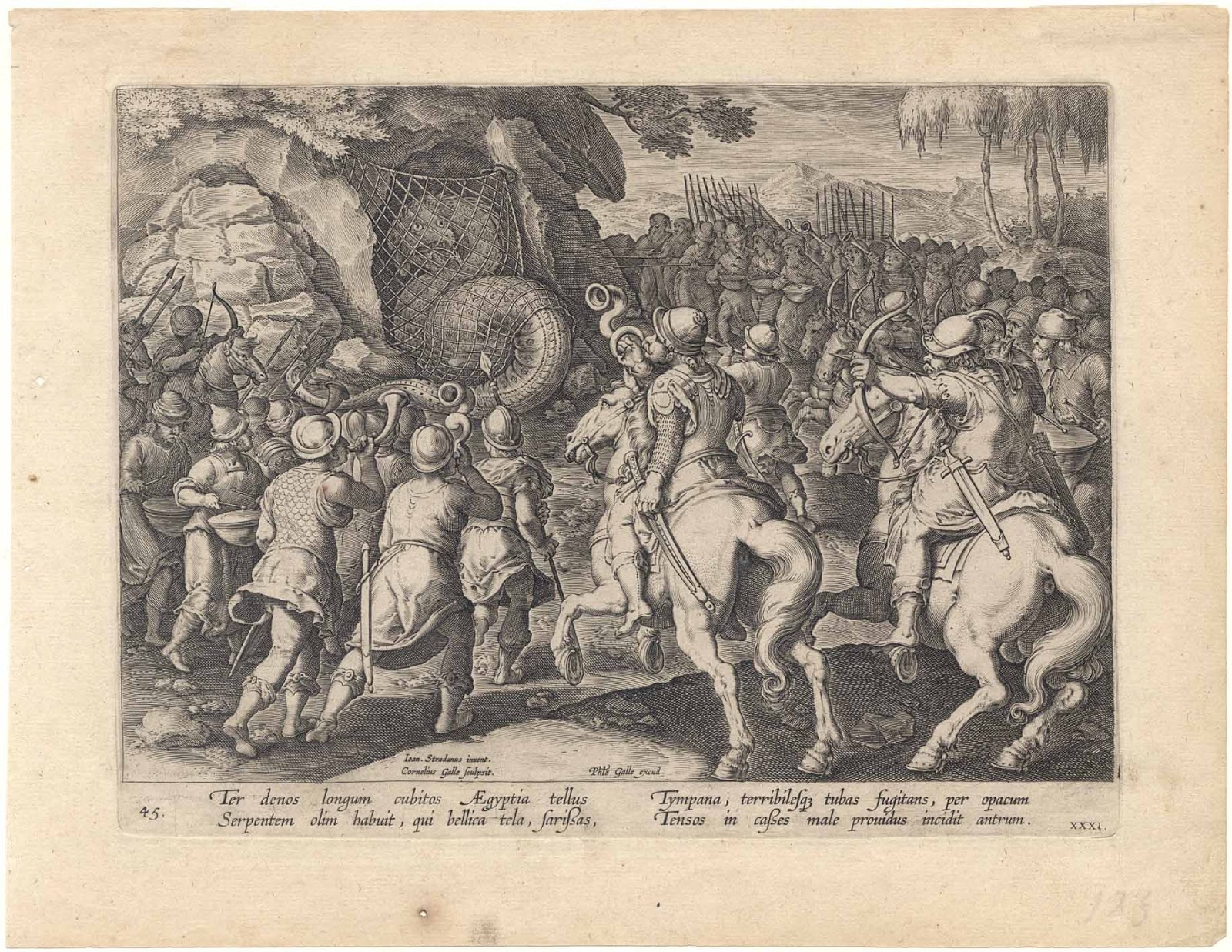
Cornelis Galle I’s engraving, “Catching a Giant Serpent with a Net”, 1596, after Jan van der Straet


Cornelis Galle I (1576–1650)
“Catching a Giant Serpent with a Net”, 1596 (or a little later), from the series, “Hunting Parties” (aka “Venationes Ferarum, Avium, Piscium” (transl. “With wild beasts, birds, fish”), after Jan van der Straet (aka Joannes Stradanus; Ioannes Stradanus) (1523–1605), published by Philips Galle (1537–1612).

Note: the first edition of “Venationes Ferarum, Avium, Piscium” published by Philips Galle comprised 43 unnumbered plates all engraved by Philips Galle with a dedication page to Cosimo de Medici. After this edition the series was expanded to 104 plates engraved by A. Collaert, J. Collaert, C. Galle I and C. de Mallery with a dedication page to the jurist Henricus van Osthoorn en Sonnevelt (see http://www.britishmuseum.org/research/collection_online/collection_object_details.aspx?objectId=1619537&partId=1&people=93957&peoA=93957-2-70&page=1  and A. Baroni and M. Sellink, “Stradanus 1523-1605: Court artist of the Medici”, exh. cat. Groeningemuseum Brugge 2008–09, Turnhout, 2012, pp. 245–58, cat. nos. 32–49).

Engraving on laid paper with full margins as published.
Size: (sheet) 24.8 x 32.2 cm; (plate) 20 x 26.4 cm; (image borderline) 18.4 x 26.1 cm
Inscribed within the image borderline at the lower edge: (left of centre) “Ioan. Stradanus invent. / Cornelius Galle Sculpsit.”; (centre) “Phls Galle excud.”
Lettered below the image borderline: (left) “45”; (two lines of Latin text arranged in two columns) “Ter denos...incidit antrum.”; (right) “XXXI.”
State: ii (with the added numerals, “45” and “XXXI”; see the BM’s impression of the first state: 1957,0413.62)

New Hollstein (Dutch & Flemish) 496.II (Johannes Stradanus); Baroni Vannucci 1997 693.45 (Alessandra Baroni Vannucci 1997, “Jan van der Straet, detto Giovanni Stradano, flandrus pictor et inventor”, Milan, Jandi Sapi Editori)

The British Museum offers the following description of this print from its first state before the plate number was changed from “31” to “45” and the Roman numerals “XXXI” were added:
“Plate 31 [“45”], Catching a Giant Serpent with a Net; in the left mid ground, a great serpent is trapped in a cave by a net that has been strung across the entrance; the cave is surrounded by troops, with several archers aiming towards the cave, while others blow horns and beat drums” (http://www.britishmuseum.org/research/collection_online/collection_object_details.aspx?objectId=1620347&partId=1&people=106252&peoA=106252-2-23&page=2)

Condition: crisp impression with generous margins. The sheet is in very good condition for its age, nevertheless, there are a few specks, faint handling marks and a few tiny holes in the margins.

I am selling this exceptionally rare, engraving of a late 1500’s fantasy of battling a dragon caught in its cave by a net, for a total cost of AU$320 (currently US$250.35/EUR212.84/GBP188.59 at the time of this listing) including postage and handling to anywhere in the world.

If you are interested in purchasing this exciting image showing the pending murder of the trumpeter on horseback who is clearly making far too much of a racket as he is about to be shot with an arrow by the chap on horseback beside him, please contact me (oz_jim@printsandprinciples.com) and I will send you a PayPal invoice to make the payment easy.


This print has been sold


Both the designer of this image, Jan van der Straet, and the engraver, Cornelis Galle I, are artists who followed the stylistic fashion of the time for compositions full of dynamic rhythms and tensions. This stylistic leaning, termed “Mannerism”, however, had an attribute that is seldom discussed and which is exemplified in this print: the representation of a “frozen” moment in time.

A century before, Renaissance artists also represented frozen moments (e.g. Michelangelo's “Creation of Adam” showing God investing Adam with the “spark” of life with the touch of fingers), but the notion of the frozen moment is very different. The Renaissance artists’ portrayal of a moment in time is all about showing a moment that was never intended to end: an endless moment. By contrast, Mannerists conceived of a moment in time as a very specific moment extracted from a sequence of events, as exemplified by this print. For instance, the foreground horses are represented mid-stride and the soldiers portrayed are all captured in animated movement.