Showing posts with label Haid (Johann Jakob). Show all posts

Friday, 12 July 2024

Johann Elias Haid’s mezzotint, “Voltaire”, 1783, after Barbié, Houdon and Gravelot

(Attributed to) Johann Elias Haid (17361809)—attribution by the Rijksmuseum (see http://hdl.handle.net/10934/RM0001.COLLECT.120687) and Ch. LeBlanc (cat. no. 108)

“Voltaire”—an influential French writer, wit and philosopher (aka François Marie Arouet) (1694-1778), 1783, mezzotint published in Augsburg by Johann Jakob Haid (1704-1767), after the etching in the reverse direction, “M. F. A. de Voltaire Mort à Paris...”, by Jacques Barbié (fl.c1755–1779) (see https://www.britishmuseum.org/collection/object/P_1868-0822-7757), after the sculpture of Voltaire by Jean Antoine Houdon (1741–1828) and after the battle scene drawing, “Il monte: il a déjà de ses mains triomphantes..”, by Gravelot (aka Hubert François Bourguignon Gravelot) (1699–1773) (see https://www.nga.gov/collection/art-object-page.58344.html). Note that Augustin de Saint-Aubin (1736–1807) made a similar print sixteen years after this mezzotint, but in the reverse direction and without the battle scene (see https://www.britishmuseum.org/collection/object/P_1900-1231-199).

Mezzotint with etching printed in a brown-black ink on laid paper trimmed with a narrow margin around the image borderline with loss of publication details and backed with a support sheet.

Size: (sheet) 21.5 x 13.4 cm.

Inscribed in plate below the battle scene: “Il monte, il a déj[à] de ses mains triomphantes,/ Arboré de ses lys les Enseignes Flotantes. Henriade Ch. VI” ([transl.] He ascends, he already has with his triumphant hands, / Emblazoned with his lilies the Floating Ensigns. Henriade Ch. VI).

LeBlanc 108 (Ch. Leblanc 1888, “Manuel de l'amateur d'estampes, contenant un dictionnaire des graveurs de toutes les nations: ouvrage destiné à faire suite au Manuel du libraire par J.Ch. Brunet”, vol. 2, Paris, p. 334, cat. no. 108).

The British Museum offers the following description of this print: “Portrait of Voltaire, head and shoulder in profile to left, nude, and wearing no wig, in oval frame surmounting a scene from ‘L'Henriade’ showing Henri IV victorious at the siege of Paris (canto VI). 1783/ Mezzotint” (https://www.britishmuseum.org/collection/object/P_1901-1022-939).

Condition: a strong impression trimmed around the image borderline with no tears, holes or folds or significant stains and laid upon a support sheet of archival (millennium quality) washi paper providing wide margins.

I am selling this visually eye-catching portrait of the great writer of the French Enlightenment accompanied by an illustration to a few lines from his epic poem “La Henriade” (see https://en.wikipedia.org/wiki/Henriade), for AU$257 in total (currently/approximately US$174.40/EUR159.86/GBP134.26 at the time of posting this listing) including Express Mail (EMS) postage and handling to anywhere in the world, but not (of course) any import duties/taxes imposed by some countries. Note that payment is in Australian dollars (AU$257) as this is my currency.

If you are interested in purchasing this very fine and beautiful mezzotint, please contact me (oz_jim@printsandprinciples.com) and I will send you a PayPal invoice to make the payment easy.

This print has been sold


Wednesday, 22 March 2023

Johann Jakob Haid’s mezzotint, “St Matthew”, early 1700s, after Hartmann

Johann Jakob Haid (aka Johann Jacob Haid, Johann Jacobus Haid) (1704–1767)

“St Matthew” (aka “St Matthew and the Angel”; “Saint Mathieu”; “S. Matthævs”), early 1700s, mezzotint after a painting by Hartmann (as inscribed in plate; possibly Johannes Jakob Hartmann (1680–1730) who is known for painting landscape with biblical figures) and published by the artist in Augsburg.

Mezzotint with etching on thick laid paper trimmed with a small margin around the platemark, with replenishment/restoration of wormholes at lower right and backed with a support sheet.

Size: (sheet) 42.7 x 29.2 cm; (plate) 41.3 x 28.4 cm; (image borderline) 37.7 x 28.1 cm.

Lettered in plate below the image borderline: (left) Hartmann. Pinx.”; (centre) “S. MATTHÆVS./ J. J. Haid et filius excudit Aug. V. [Augsburg]”; (right corner) “J.”

LeBlanc (not described) (Charles Le Blanc 1856, “Manuel de l'amateur d'estampes: contenant le dictionnaire des graveurs de toutes les nations”, vol. 2, Paris, P Jannet, pp. 333–34)

Interestingly, the Yale Center for British Art holds a series of ten saints executed in mezzotint by Johann Jakob Haid of which this print may belong; for example: “Saint Bartholomew” https://collections.britishart.yale.edu/catalog/tms:23301 and “Saint Philip” https://collections.britishart.yale.edu/catalog/tms:23296. Note, however, that Yale collection of these possibly related prints are all after Johann Kupezky (1667–1740) whereas this print is after the painter inscribed as “Hartmann”. Moreover, the Yale collection has a different image of St Matthew (see https://collections.britishart.yale.edu/catalog/tms:23294).

Condition: a strong impression laid onto a sheet of archival (millennium quality) washi paper. There are minor (partially restored) abrasions and replenished wormholes at lower right otherwise the sheet is in a good condition for its age with no significant tears, folds, stains or foxing.

I am selling this velvety and radiantly glowing mezzotint that seems to be so rare that I have been unable to find another copy—this is surprising for such a fine and large mezzotint—for the total cost of AU$268 (currently US$179.52/EUR166.34/GBP146.06 at the time of posting this listing) including postage and handling to anywhere in the world, but not (of course) any import duties/taxes imposed by some countries.

If you are interested in purchasing this marvellous and exceptionally rare mezzotint, please contact me (oz_jim@printsandprinciples.com) and I will send you a PayPal invoice to make the payment easy.


Monday, 29 November 2021

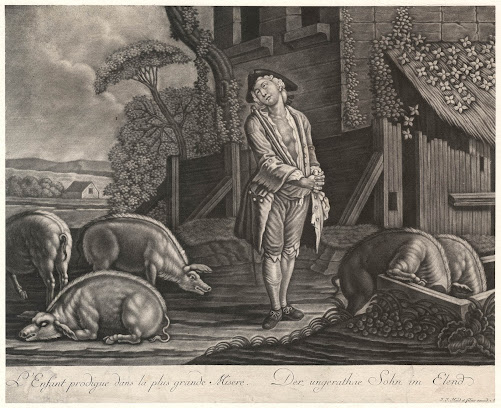
Johann Jakob Haid & Johann Elias Haid’s mezzotint, “The Prodigal Son in the Greatest Misery”, c1775


Johann Jakob Haid (aka Johann Jacob Haid, Johann Jacobus Haid) (1704–1767) and his son, Johann Elias Haid (1739–1809)

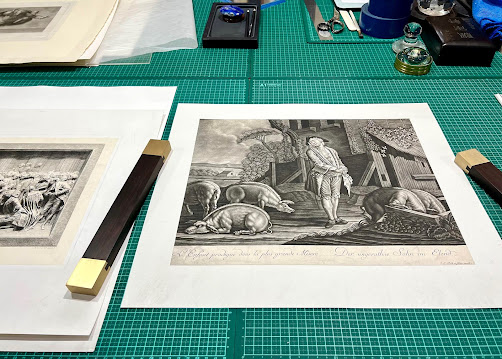
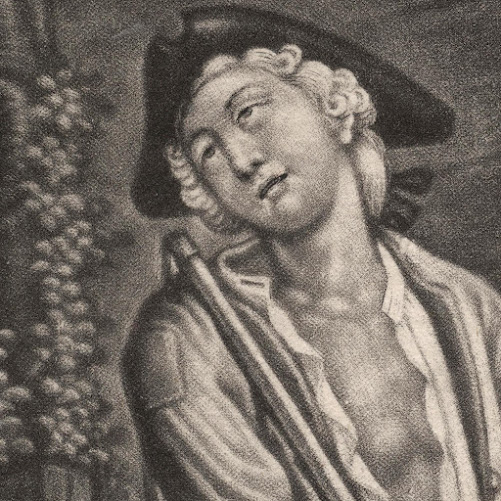
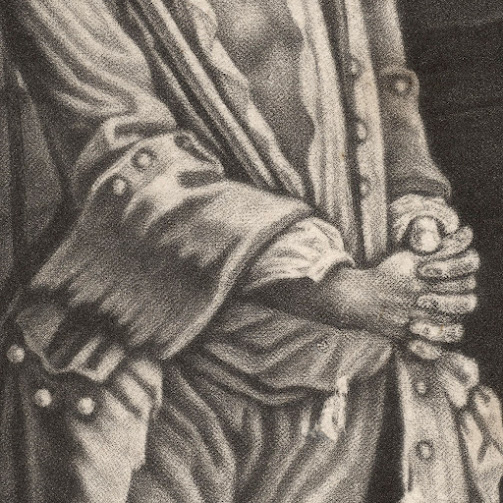
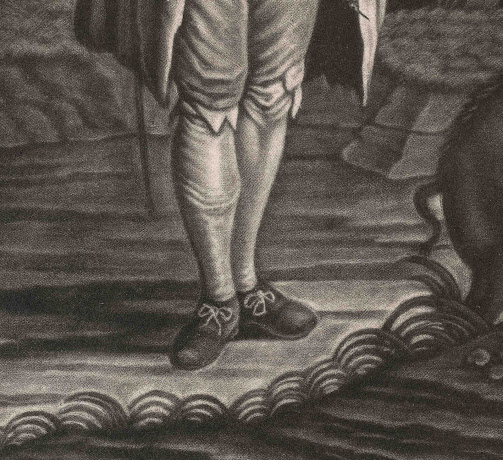
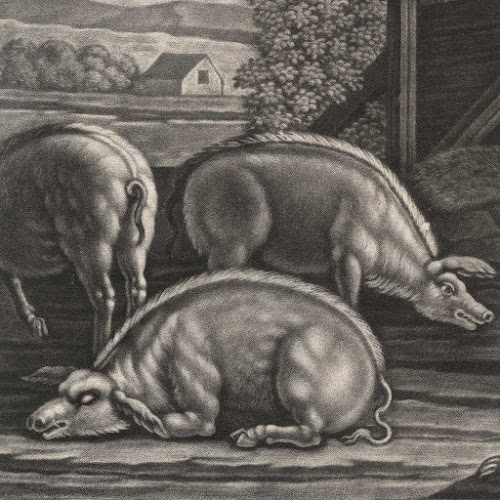
“The Prodigal Son in the Greatest Misery” (aka “L'Enfant Prodigue Dans la Plus Grande Misère”; “Der Ungerathne Sohn im Elend”; “The Unwary Son in Misery”), c1775, plate 4 from the series of 6 mezzotints, “The Prodigal Son”, based upon Sébastien Leclerc II's (1676–1763) series, "L'Histoire de l'Enfant Prodigue” (1751), published in Augsburg by Johann Jakob Haid and his son.

Mezzotint with etching on thick laid paper trimmed slightly within the image borderline and text, backed with a support sheet.

Size: (sheet) 32.4 x 39.8 cm; (image borderline) 29.2 x 39.8 cm.

Lettered in plate below the image borderline: (centre) "L'Enfant prodigue dans la plus grande Misere. Der ungerathne Sohn im Elend”; (right) “J. J. Haid et filius excud A. [V.]"

The Library Company of Philadelphia offers the following description of this print:

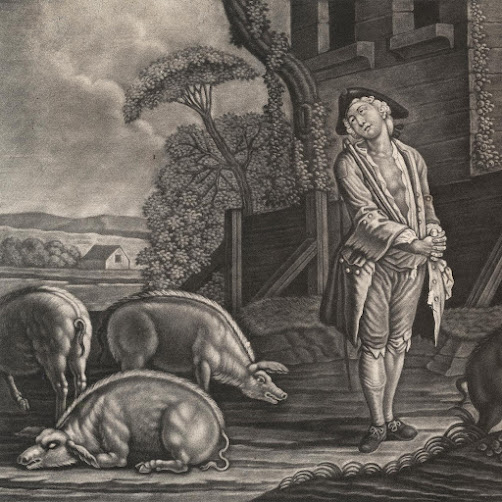
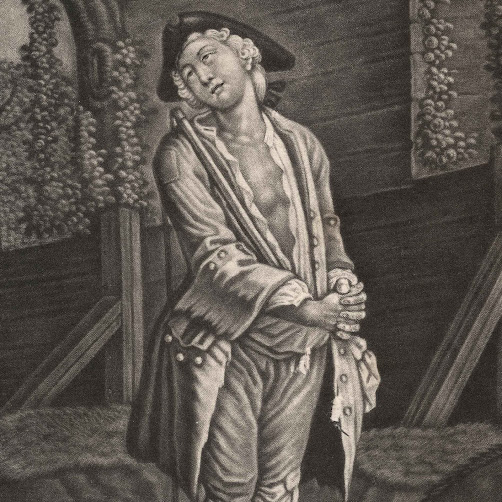
“Plate 4 from a circa 1775 Prodigal Son series of prints depicting the Prodigal Son in misery. Shows a young white man in the middle of a pen of pigs and in front of a barn. The man stands with his hands clasped, his head tilted to the right, and his eyes gazing up. He wears a tri-corn hat, an open shirt, breeches, a long coat, stockings, and slipper shoes. In the left, two pigs eat from a trough. In the right, two pigs stand and a third pig lies down. In the right background, countryscape is visible” (http://pacscl.exlibrisgroup.com:48992/F?func=direct&doc_number=000333698&solr).

See also the description of this print offered by the Yale Center for British Art: https://collections.britishart.yale.edu/catalog/tms:23259.

Condition: a strong impression with replenished losses in the sky and dots within the image, trimmed slightly within the platemark and laid onto a sheet of archival (millennium quality) washi paper.

I am selling this velvety and glowing mezzotint showing the key moment in the story of the prodigal son where his extravagantly careless lifestyle has led him living with swine—note the artists’ curiously comical interpretation of what a contrite young man might look like—for the total cost of AU$236 (currently US$168.50/EUR149.36/GBP126.37 at the time of posting this listing) including postage and handling to anywhere in the world, but not (of course) any import duties/taxes imposed by some countries.

If you are interested in purchasing this marvellous print exemplifying a lobulate approach to rendering forms (i.e., the clouds, trees, swine and even the chap’s chest are all portrayed as if they are constructed from lumps/lobes), please contact me (oz_jim@printsandprinciples.com) and I will send you a PayPal invoice to make the payment easy.

This print has been sold 


Tuesday, 26 December 2017

Johann Jakob Haid’s mezzotint, “Christian Ludwig von Löwenstern”, after Johann Christian Fiedler, 1719–67


Johann Jakob Haid (aka Johann Jacob Haid; Haid & Sohn) (1704–1767)

“Christian Ludwig von Löwenstern” or “Christianus Ludovicus Liber Baro a Loewenstern” (as inscribed on the plate), 1719–1767, after a painting by Johann Christian Fiedler (1697–1765), published by Johann Jakob Haid.

Mezzotint on laid paper trimmed unevenly at the image borderline and lined on a archival support sheet.
Size: (unevenly trimmed sheet) 40.2 x 26.9 cm
Lettered below with title, continuing: "Hasso-Darmstad nat IV. id Aug MDCCII. / alter Paris, inter trigam Sororum / artem poeticam, harmonicam et pictoriam / alteram litem dirimens, ultimam eruditione sua dignissimam / pronunciavit, / eamq Minerva pronuba in thalamum adscivit / ex qua / ut ut ab Apolline irato / valetudine minus recta mulctatus fuerit / liberorum loco tabulas sustulit / quarum vestigia praesens miratur aevum posteritas adorabit", and production details below: "Io Christian Fiedler pinx", "I Iac Haid scul. et exc. AV".

Singer 1930-36 55136 (Singer, Hans Wolfgang, Allgemeiner Bildniskatalog, 14 volumes, Leipzig, Verlag Karl W Hiersemann, 1930)

The British Museum offers the following description of this print:
“Portrait of Christian Ludwig von Lowenstern, half-length, turned to the right, looking at the viewer from behind a curtain that he holds open with his right hand, wearing soft cap and robe; an easel behind on the right; in window frame; below on the right, an open book with coat of arms, books and pens on the floor; after Fiedler. Mezzotint”

Condition: crisp impression with restored abrasions, faint stains and laid upon a support sheet of washi paper to stabilise thin areas in the paper.

I am selling this visually arresting mezzotint for the total cost of AU$156 (currently US$120.34/EUR101.44/GBP90.07 at the time of this listing) including postage and handling to anywhere in the world.

If you are interested in purchasing this intriguing and unforgettable print, please contact me (oz_jim@printsandprinciples.com) and I will send you a PayPal invoice to make the payment easy.

This print has been sold


There are a few portraits created through history that “stand out” in the long tradition of portraiture and this is one of them. The subject of the portrait, Christian Ludwig Löwenstern (1701–1754), was as artist as signified by the easel shown in the background and the brushes in the immediate foreground, but he was also a poet of substance and an author as signified by the quill and books in the foreground.

Arguably, the reason that this portrait is so arresting is because of the way that the composition is arranged to prompt a reflexive response in the viewer. For example, von Löwenstern is shown in the act of lightly pushing aside the large drape on the left and looking directly at the viewer with a faintly welcoming smile. Importantly—and I believe that this next visual device is used intentionally—von Löwenstern’s pupils are also portrayed as dilated to intuitively entice a warm response in the viewer.

Beyond exciting a reflexive response, I wish to propose that the trompe l'oeil depiction of von Löwenstern in the act of drawing the drape to one side is an orchestrated subliminal reference to the Greek legend of Parrhasius’ curtain. For those who may not be familiar with the story about this curtain, I will try to explain. The ancient Greek painter, Parrhasius, was engaged in an art contest with his artistic peer, Zeuxis. Zeuxis painted a bunch of grapes and was almost deemed the winner after birds flew down to eat his painted grapes, but lost the contest when he was invited to pull back the curtain which seemed to be in front of Parrhasius’ painting: the curtain was not real it was painted and was so well executed that it had fooled Zeuxis and so Parrhasius was judged the better painter.