Showing posts with label Schiaminossi (Raffaello). Show all posts

Tuesday, 9 April 2024

Raffaello Schiaminossi, “Plate 31: Rapier and Dagger Combat”, 1610

Raffaello Schiaminossi (aka Raffaello Schiaminossi) (1572–1622)

“Plate 31: Rapier and Dagger Combat”, 1610, from the series of forty-three plates illustrating Ridolfo Capo Ferro’s (aka Ridolfo Capoferro; Rodulphus Capoferrus) (1558–?) instructional manual on fencing (Italian rapier combat), “Gran simulacro dell'arte e dell'uso della scherma” (Grand Simulacrum of the Art and Use of Fencing), published in 1610 by Silvestro Marchetti (fl.1602–1619) in Siena (see https://www.britishmuseum.org/collection/object/P_1867-0309-75-119 and https://wiktenauer.com/wiki/Gran_Simulacro_dell%27Arte_e_dell%27Uso_della_Scherma_%28Ridolfo_Capo_Ferro_da_Cagli%29).

Etching on fine laid paper with full margins and letterpress text with woodcut border printed verso as published.

Size: (sheet) 20.5 x 27.4 cm; (plate) 14.5 x 22.9 cm: (image borderline) 14.3 x 22.8 cm.

Inscribed on plate: (upper left corner) “31”; (lower left corner) “F/[artist’s monogram] S/ RAF [ligature]. F.”; (lower right corner) “C”.

Letterpress Italian text verso: “FIGVRA CHE FERISCE/ DI QVARTA NELLA GOLA SOLO/ CON AFALSAR LA SPADA ET ABASSAR IL/ pugnale per parata mentre l'auersario caua di spada &/ cerca col pugnale per parare./ ROVANDOSI l'auersario in terza alta con il pugnale trauersato & vnito al comincia-/mento del suo sorte della sua spada alquanto obliqua, lo stringerai con la terza di fuora/ con il pugnale alto,e cauando egli di sotto, aiutandosi a parare con il pugnale per ferirti/ di quarta pararai col pugnale di su in giù verso le tue parti manche, e in un tempo caua-/ndo sotto al suo pugnale, lo ferirai di quarta nella faccia, o doue ti torna più comodo.”

([Transl.] “FIGURE THAT HITTS THE THROAT FROM THE FOURTH ONLY WITH SLASHING THE SWORD AND LOWING THE DAGGER TO PARRY while the opponent swings the sword & tries with the dagger to parry.

Having placed the opponent in the high third with the dagger crossed and having come to the beginning of his fate of his somewhat oblique sword, you will hold him with the third outside with the high dagger, and caundo [penetrate?] him from below, helping himself to parry with the dagger to wound you with the fourth you will parry with the dagger from up and down towards your left sides, and in a moment, falling under his dagger, you will wound him with the fourth in the face, or where it is most convenient for you.”)

Interestingly, this fencing manual was very influential in its time and the manual must still be influential and relevant as it has been republished by Greenhill Books/Stackpole Books in 2004. This recent reprint of the original plates and text (fortunately translated into English) is described with the following excellent account (of which this is an extract):

“The manual, illustrated with 43 striking illustrations, gives a very real flavour of the panache of this expert in swordsmanship and mastery of that most lethal of weapons—the rapier. Ferro examines different kinds of swords, their component parts and their suitability, before going on to discuss their actual use. There he expounds his theory as to the timing and direction of thrusts, the essential distances and the need for complete control. He also looks at defensive measures, guards, parries, the need for quick footwork. Capo Ferro's text is a practical guide to fighting and one which builds on the theory to show exactly how a superior form of swordsmanship could be learned by Europe's elite. His illustrations clearly show the best methods and also show how a rapier could be lethally effective when used with a dagger or with a cloak” (see https://www.amazon.com/Italian-Rapier-Combat-Ridolfo-Simulacro/dp/1853675806).

Condition: a strong and well-printed page (recto and verso) with full margins. The upper-left corner (recto) is chipped and there is a hole in the image at lower-left (above the artist’s monogram), otherwise the sheet is in a good condition for its age with no tears, folds, abrasions or significant stains.

I am selling this unforgettably graphic image of a “tough-love” rapier lesson, for AU$330 (currently US$218.69/EUR201.44/GBP172.53 at the time of this listing) including postage and handling to anywhere in the world, but not (of course) any import duties/taxes imposed by some countries.

If you are interested in acquiring this exceptionally rare etching from an important and unusual instructional manual—note that the advice given to opponents on the verso of this sheet is to wound him “in the face, or where it is most convenient for you” and clearly the throat seemed like a good idea to the illustrator of this image—please contact me (oz_jim@printsandprinciples.com) and I will send you a PayPal invoice to make the payment easy.


Sunday, 9 October 2022

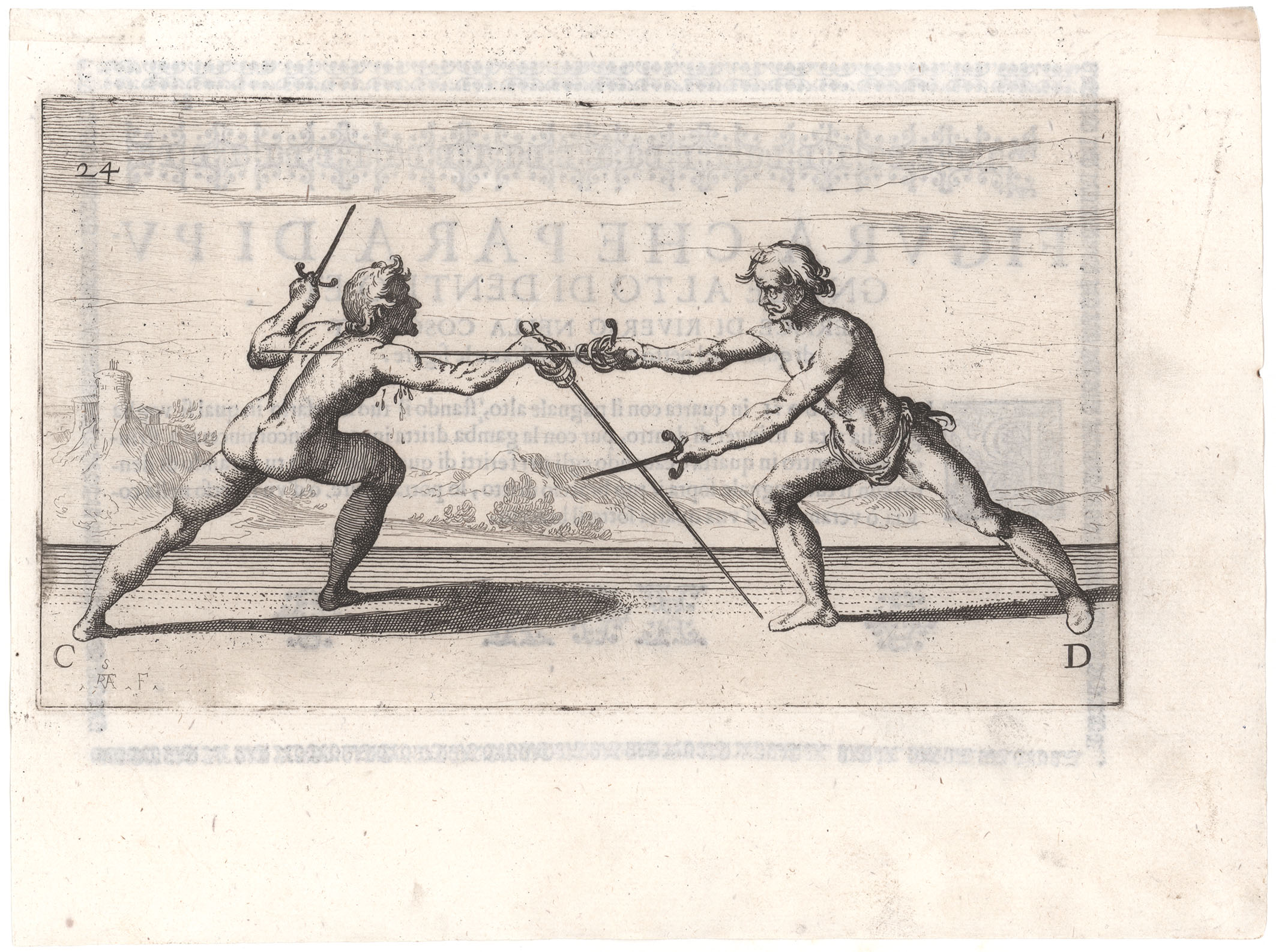
Raffaello Schiaminossi’s etching, “Plate 24: Rapier and Dagger Combat”, 1610


Raffaello Schiaminossi (aka Raffaello Schiaminossi) (1572–1622)

“Plate 24: Rapier and Dagger Combat, 1610, from the series of forty-three plates illustrating Ridolfo Capo Ferro’s (aka Ridolfo Capoferro; Rodulphus Capoferrus) (1558–?) instructional manual on fencing (Italian rapier combat), “Gran simulacro dell'arte e dell'uso della scherma” (Grand Simulacrum of the Art and Use of Fencing), published in 1610 by Silvestro Marchetti (fl. 1602–1619) in Siena (see https://www.britishmuseum.org/collection/object/P_1867-0309-75-119).

Etching on fine laid paper with full margins and letterpress text with woodcut border printed verso as published.

Size: (sheet) 20.4 x 27.5 cm; (plate) 13.3 x 23.8 cm.

Inscribed on plate: (upper left corner) “24”; (lower left corner) “C/ [artist’s monogram] S/ RAF [ligature]. F.”; (lower right corner) “D”.

Letterpress Italian text verso: “FIGVRA CHE PARA DI PV-/ GNALE ALTO DI DENTRO ET/ FERISCE DI RIVERSO NELLA COSCIA ET/ di quarta nel petto come dimostrano le figure./ RITROVANDOTI in quarta con il pugnale alto, stando il tuo auersario in qual si voglia/ guardia atta a stringer di dentro, pur con la gamba dritta innanzi, incomincerai a strin-/gerlo di dentro in quarta e cauando egli per ferirti di quarta in faccia tu parando di den-/ tro con il tuo pugnale sopra il tuo braccio dritto, lo potrai ferire, o d’vn riuerso nella co-/ scia, ò veramente d’vna quarta sotto il braccio.”

Interestingly, this fencing manual was very influential in its time and the manual must still be influential and relevant as it has been republished by Greenhill Books/Stackpole Books in 2004. This recent reprint of the original plates and text (fortunately translated into English) is described with the following excellent account (of which this is an extract):

“The manual, illustrated with 43 striking illustrations, gives a very real flavour of the panache of this expert in swordsmanship and mastery of that most lethal of weapons—the rapier. Ferro examines different kinds of swords, their component parts and their suitability, before going on to discuss their actual use. There he expounds his theory as to the timing and direction of thrusts, the essential distances and the need for complete control. He also looks at defensive measures, guards, parries, the need for quick footwork. Capo Ferro's text is a practical guide to fighting and one which builds on the theory to show exactly how a superior form of swordsmanship could be learned by Europe's elite. His illustrations clearly show the best methods and also show how a rapier could be lethally effective when used with a dagger or with a cloak” (see https://www.amazon.com/Italian-Rapier-Combat-Ridolfo-Simulacro/dp/1853675806).

Condition: a strong and well-printed page (recto and verso) with full margins. There are remnants of mounting on the upper corners, otherwise, the sheet is in an excellent condition with no tears, holes, folds, abrasions or significant stains.

I am selling this unforgettably graphic image of a “tough-love” rapier lesson set in an open field with naked muscly chaps, for AU$330 (currently US$210.24/EUR215.80/GBP189.45 at the time of this listing) including postage and handling to anywhere in the world, but not (of course) any import duties/taxes imposed by some countries.

If you are interested in acquiring this exceptionally rare etching from an important and unusual instructional manual, please contact me (oz_jim@printsandprinciples.com) and I will send you a PayPal invoice to make the payment easy.

This print has been sold


Tuesday, 1 October 2019

Raffaello Schiaminossi’s etching, “Plate 26” (Italian Rapier Combat), 1610


Raffaello Schiaminossi (aka Raffaello Schiaminossi) (1572–1622)

“Plate 26”, 1610, from the series of forty-three plates illustrating Ridolfo Capo Ferro’s instructional manual on fencing (Italian rapier combat), “Gran simulacro dell'arte e dell'uso della scherma”, published in Siena in 1610.

Etching on fine laid paper with full margins and letterpress text printed verso (visible recto) as published, backed with a support sheet.
Size: (sheet) 20.5 x 27.8 cm; (plate) 14.5 x 23.2 cm; (image borderline) 14.3 x 23 cm
Inscribed on plate: (upper left corner) “26”; (lower left corner) “D/ [artist’s monogram]. F.”; (lower right corner) “C”.

Although this particular lesson conducted in the nude may be perceived as leaning towards the “tough love” style of teaching, I understand that the artist, Raffaello Schiaminossi, had a sense of humour—albeit a rather macabre one—and this disposition to shameful humour may help to explain the grim lesson portrayed. Regarding the artist’s humour, an obituary written one of his best friends, Teofilo Torri advises: “homo molto spirituale et spiritoso tanto nel dipingere come nel intaglio d'acquaforte si come si vede de sue molte carte...” ([transl.] “he is very spiritual and witty both in painting and in etching, as we can see from his many prints…”. (See the British Museum’s biography for Schiaminossi:

Interestingly, this fencing manual was very influential in its time and the manual must still be influential as it has been republished by Greenhill Books/Stackpole Books in 2004. This recent reprint of the original plates and text (fortunately translated into English) is described with the following excellent account (of which this is an extract):
“The manual, illustrated with 43 striking illustrations, gives a very real flavour of the panache of this expert in swordsmanship and mastery of that most lethal of weapons—the rapier. Ferro examines different kinds of swords, their component parts and their suitability, before going on to discuss their actual use. There he expounds his theory as to the timing and direction of thrusts, the essential distances and the need for complete control. He also looks at defensive measures, guards, parries, the need for quick footwork. Capo Ferro's text is a practical guide to fighting and one which builds on the theory to show exactly how a superior form of swordsmanship could be learned by Europe's elite. His illustrations clearly show the best methods and also show how a rapier could be lethally effective when used with a dagger or with a cloak” (see

Condition: a well-printed, strong impression with full margins and letterpress text as published (verso), laid upon an archival support sheet of millennium quality washi paper. The text printed verso is visible recto in the image as the paper is fine—almost tissue thin. The upper corners of the margins are restored and there are signs of handling (light grubbiness) in the lower margin, otherwise the sheet is in good condition for its considerable age.

I am selling this unforgettably graphic image of a fencing/rapier lesson being conducted in the nude for AU$330 (currently US$221.12/EUR202.70/GBP179.70 at the time of this listing) including postage and handling to anywhere in the world (but not, of course, any import duties/taxes imposed by some countries).

If you are interested in acquiring this exceptionally rare etching from an important and unusual instructional manual, please contact me (oz_jim@printsandprinciples.com) and I will send you a PayPal invoice to make the payment easy.

This print has been sold


Saturday, 11 February 2017

Raffaello Schiaminossi’s etchings for Ridolfo Capo Ferro’s treatise on fencing


Raffaello Schiaminossi (aka Raffaello Schiaminossi) (1572–1622)
 “Frontpiece”, “Plate 13”, “Plate 14” and “Plate 18”, 1610, from the series of 43 plates illustrating Ridolfo Capo Ferro’s book on fencing (Italian rapier combat), 'Gran simulacro dell'arte e dell'uso della scherma' (published in Siena in 1610)

Etching in brown ink on fine laid paper with margins and text printed verso as published.
Size of the sheets based on Plate 18: 20.4 x 27.3 cm; (plate) 13.4 x 23.6 cm
Signed with the artist’s monogram, plate number and annotated with letters referencing the text.

Condition: apart from the front piece which is in very poor condition and laid onto a support sheet, the impressions are strong with full margins and text as published (verso). There are minor blemishes/stains and remnants of mounting.

This set of prints has been sold


Although these are illustrations from the 43 plates in Ridolfo Capo Ferro’s book on fencing (Italian rapier combat), 'Gran simulacro dell'arte e dell'uso della scherma' (published in Siena in 1610), I propose that they are not entirely designed as lessons in tough love when learning to fence. From what I have read about Schiaminossi, he had a sense of humour—albeit a rather macabre one. This understanding about his mindset is from an obituary written one of his best friends, Teofilo Torri: “homo molto spirituale et spiritoso tanto nel dipingere come nel intaglio d'acquaforte si come si vede de sue molte carte...” which my Google translation tells me that he was a spiritually witty chap. (See the British Museum’s biography for Schiaminossi: http://www.britishmuseum.org/research/search_the_collection_database/term_details.aspx?bioId=107994).

Interestingly, this fencing manual was very influential in its time and must still be influential as it has been republished by Greenhill Books/Stackpole Books in 2004. This recent reprint of the original plates and text (fortunately translated into English) is described with the following excellent account (of which this is an extract):

“The manual, illustrated with 43 striking illustrations, gives a very real flavour of the panache of this expert in swordsmanship and mastery of that most lethal of weapons—the rapier. Ferro examines different kinds of swords, their component parts and their suitability, before going on to discuss their actual use. There he expounds his theory as to the timing and direction of thrusts, the essential distances and the need for complete control. He also looks at defensive measures, guards, parries, the need for quick footwork. Capo Ferro's text is a practical guide to fighting and one which builds on the theory to show exactly how a superior form of swordsmanship could be learned by Europe's elite. His illustrations clearly show the best methods and also show how a rapier could be lethally effective when used with a dagger or with a cloak.” (see https://www.amazon.com/Italian-Rapier-Combat-Ridolfo-Simulacro/dp/1853675806

One thing that I have discovered from looking at these prints is the importance of learning to fence while being completely naked … but the reason eludes me.