Showing posts with label Veen (Gijsbert van). Show all posts

Saturday, 12 July 2025

Gijsbert van Veen, “In Flagrante Delicto”, c.1607/12

Gijsbert van Veen (aka Gysbrecht van Veen; Gijsbert Vaenius; Gisbert Venius) (1558–1628), possibly designed in collaboration with his brother, Otto van Veen’s (aka Otho Venius; Octavio van Veen; Otho Vaenius) (1556–1629)—the teacher of Rubens

“In Flagrante Delicto” (“In Blazing Offence”, with the colloquial meaning: “caught red-handed in the act of sexual activity”) (aka “Animi Servitus” [Servant of the Soul]), c1607/12, published in Antwerp by Prostant apud Philippum Lisaert in 1612, as an illustration to page 29 in Otto van Veen’s “Quinti Horatii Flacci Emblemata, Imaginibus in Æs Incisis, Notisque, Illustrata” (The emblems of Quintus Horatius Flaccus, illustrated with images engraved on them, and noted) with accompanying lines from Horace’s (aka Quintus Horatius Flaccus) (65–8 BCE) “Odes”, Book III.

Engraving on fine laid paper with Latin letterpress text verso, trimmed around the image borderline and backed with a support sheet providing wide margins.

Size: (sheet) 17.9 x 14.7 cm.

The following accompanying Latin verses by Horace on the facing page for this illustration may help to give the flavour of the writing (apologies for errors in translation): “Quid refert, uri virgis ferroque necari?” (What does it matter, being burned alive, or killed by a sword?)/ Auctoratus eas, an turpi clausus in arca,” (You are a slave, or shut up in a vile chest,)/ “Quo te demisit peccati conscia herilis,” (Where the master's sin-conscious servant has lowered you,)/ “Contractum genibus tangas caput?” (To touch your head with your knees [in the sense of a humiliating posture]) (p. 28).

Archive.org offers an online view of this print in its context in the publication: https://archive.org/details/quintihoratiifla00veen/page/28/mode/2up.

See also the images in the publication offered by Emblematica Online: http://emblematica.library.illinois.edu/detail/book/618513612/emblems.

Condition: a strong and well-printed (near faultless) impression, trimmed around the image borderline and laid onto a support of archival (millennium quality) washi paper providing wide margins. The sheet is in an excellent (near pristine) condition with no tears or significant stains.

This allegorical print, designed to ponder the agonizing choice between cruel punishment and degrading humiliation, is available for AU$237 (approx. US$155.99, EUR 133.42, or GBP 115.63). Express shipping is included worldwide. Import duties are the buyer's responsibility.

If you wish to acquire this dramatic depiction of a clandestine affair, please contact me at oz_jim@printsandprinciples.com. I will send you a PayPal invoice for your convenience. 

This print has been sold


Monday, 15 July 2024

Gijsbert van Veen’s engraving, “Punishment Swiftly Follows Crime”, c1607/12

Gijsbert van Veen (aka Gysbrecht van Veen; Gijsbert Vaenius; Gisbert Venius) (1558–1628), possibly designed in collaboration with his brother, Otto van Veen’s (aka Otho Venius; Octavio van Veen; Otho Vaenius) (1556–1629)—the teacher of Rubens

“Punishment Swiftly Follows Crime” (aka “Punishment Follows Close on Guilt”; “Culpam Poena Premit Comes”—note that this is the New South Wales Police Force [Australia] motto), c1607/12, published in Antwerp by Prostant apud Philippum Lisaert in 1612, as an illustration to page 181 in Otto van Veen’s “Quinti Horatii Flacci Emblemata, Imaginibus in Æs Incisis, Notisque, Illustrata” (The emblems of Quintus Horatius Flaccus, illustrated with images engraved on them, and noted) with accompanying lines from Horace’s (aka Quintus Horatius Flaccus) (65–8 BCE) “Odes”, Book III.

The following accompanying text for this illustration may help to give the flavour of the writing (my apologies for errors in translation): “— Often Death/ Negligence, incest added to the whole:/ Rarely did the previous criminal/ He left the punishment with a lame foot./ God follows the proud vulture behind.” (“—Sæpe Diespiter/ Neglectus, incesto addidit integrum:/ Rarò antecedentem scelestum/ Deseruit pede pœna claudo./ Sequitur superbos vltor à tergo Deus.”) (p. 180).

Archive.org offers an online view of this print in its context in the publication: https://archive.org/details/quintihoratiifla00veen/page/180/mode/2up.

I have not been successful in finding an online source that clarifies what is shown in this fascinating engraving, consequently, I’ve decided to propose my own reading (which may be very wrong) regarding this allegory about the consequences of criminal action: the sword-bearing man holding an armful of severed heads is the criminal in the allegory and his backwards glance at the beheaded figures in the foreground helps to clarify his feelings of guilt. Adding further grit to the unease of his conscience, he is shown walking hurriedly past a sacrificial altar for atonement and being followed by the personification of his guilt in the form of a winged lame figure holding a fist full of snakes and carrying the fasces—a Roman ceremonial axe bundled with rods that is symbolic of penal justice and power. The distant view of fire consuming a walled city on the left and gallows on the right may signify destruction of safe harbour and pending judicial outcome.

Engraving on fine laid paper with Latin letterpress text verso, trimmed around the image borderline and backed with a support sheet providing wide margins.

Size: (sheet) 17.8 x 14.5 cm.

Condition: a well-printed impression, trimmed around the image borderline and laid onto a support of archival (millennium quality) washi paper providing wide margins. The sheet is in a very good condition for its age, with no tears, holes, folds, abrasions or significant stains.

I am selling this marvellous allegorical print showing what I believe to be the consequences for criminal action, for the total cost of AU$237 (currently/approximately US$160.02/EUR146.87/GBP123.42 at the time of posting this listing) including Express Mail (EMS) postage and handling to anywhere in the world, but not (of course) any import duties/taxes imposed by some countries. Note that payment is in Australian dollars (AU$237) as this is my currency.

If you are interested in purchasing this visual affirmation that crime has consequences, please contact me (oz_jim@printsandprinciples.com) and I will send you a PayPal invoice to make the payment easy.

This print has been sold


Wednesday, 29 March 2023

Gijsbert van Veen’s engraving, “Times are Changing and We are Changing with Them”, c1607/12


Gijsbert van Veen (aka Gysbrecht van Veen; Gijsbert Vaenius; Gisbert Venius) (1558–1628), possibly designed in collaboration with his brother, Otto van Veen’s (aka Otho Venius; Octaviovan Veen; Otho Vaenius) (1556–1629)—the teacher of Rubens

“Times are Changing and We are Changing with Them” (aka “Tempora mutantur, et nos mutamur in illis”), c1607/12, published in Antwerp by Prostant apud Philippum Lisaert in 1612, as an illustration shown facing page 176 in Otto van Veen’s “Quinti Horatii Flacci Emblemata, Imaginibus in Æs Incisis, Notisque, Illustrata” (The emblems of Quintus Horatius Flaccus, illustrated with images engraved on them, and noted) with accompanying lines from Horace’s (aka Quintus Horatius Flaccus) (65–8 BCE) “Odes”, Book III.

Engraving on fine laid paper trimmed around the image borderline (or slightly within) and backed with a support sheet.

Size: (support sheet) 31.3 x 25.2 cm; (sheet) 18.1 x 14.8 cm.

The following translation of the accompanying text for this illustration may help to give the flavour of the writing (my apologies for errors in the translation): “Time makes everything worse, bringing new vices, emerging from the open wood of Pandora, with all evils. Our fathers passed their ancestors into malice, and we, worse than them, will leave nephews behind us, who owe us vice.” (p. 176).

Archive.org offers an online view of this print in its context in the publication: https://archive.org/details/quintihoratiifla00veen/page/177/mode/2up.

See also this engraving and accompanying text offered by De Digitale Bibliotheek voor de Nederlandse Letteren (DBNL): https://www.dbnl.org/tekst/vaen001quin01_01/vaen001quin01_01_0088.php.

Note that this impression is from a Latin edition that is different from the publication showcased by Archive.org (based on looking at the layout when the print is held to the light).

Condition: a well-printed impression, trimmed around the image borderline and laid onto a support of archival (millennium quality) washi paper providing wide margins. The sheet is in a very good condition for its age, with no tears, holes, folds, abrasions, stains or foxing.

I am selling this marvellous emblem print with Father Time (aka Chronos) carrying his scythe—his famous leveller of men—flying over ancient ruins bringing with him what I assume may be allegorical putti figures of the vices, for the total cost of AU$237 (currently US$158.24/EUR146.06/GBP128.37 at the time of this listing) including Express Mail (EMS) postage and handling to anywhere in the world, but not (of course) any import duties/taxes imposed by some countries.

If you are interested in purchasing this visual reminder of the constancy of vices with changing times, please contact me (oz_jim@printsandprinciples.com) and I will send you a PayPal invoice to make the payment easy.

This print has been sold


Thursday, 26 January 2023

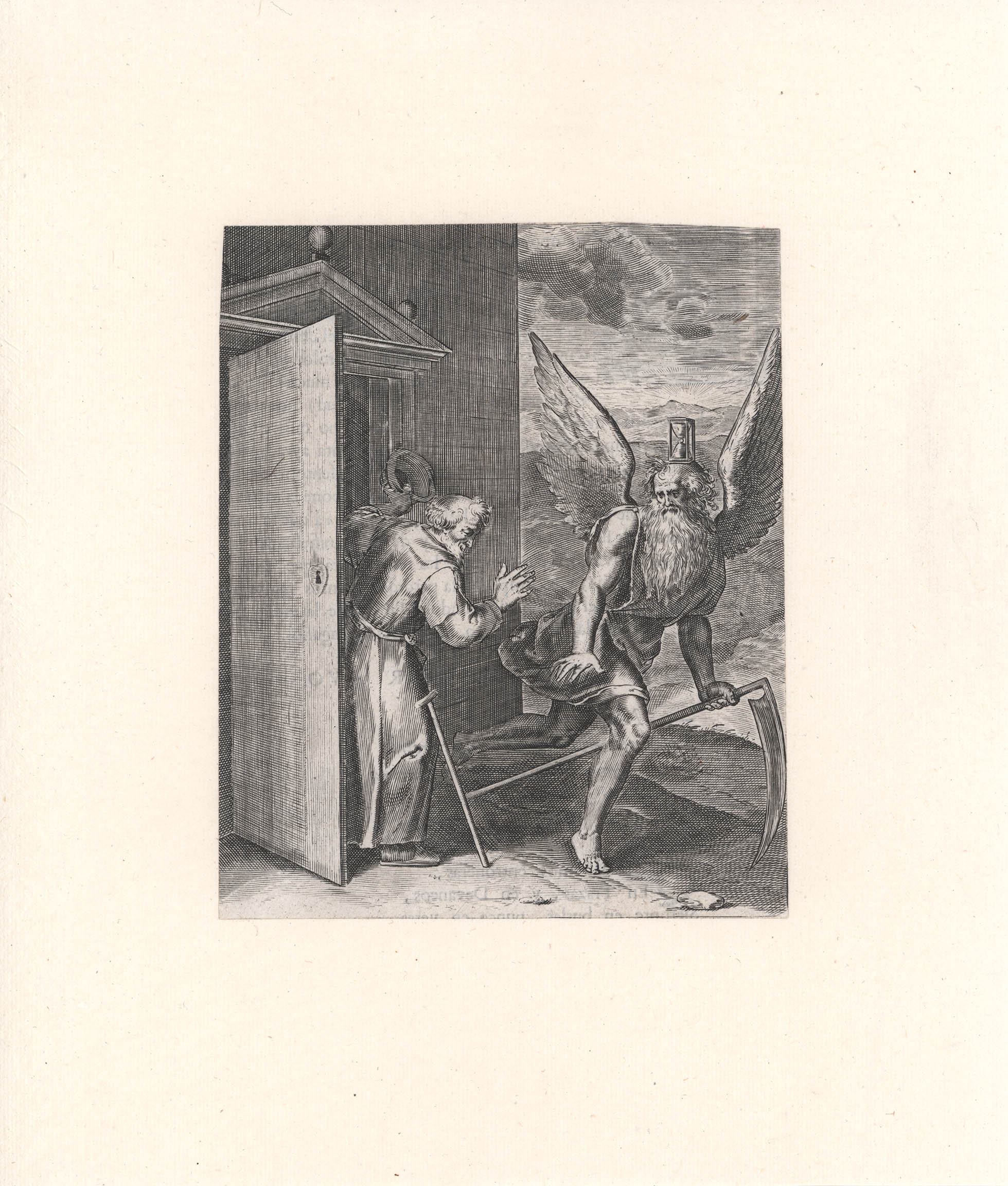
Gijsbert van Veen’s engraving, “Chronos Expelled”, c1607/12

Gijsbert van Veen (aka Gysbrecht van Veen; Gijsbert Vaenius; Gisbert Venius) (1558–1628), possibly designed in collaboration with his brother, Otto van Veen’s (aka Otho Venius; Octavio van Veen; Otho Vaenius) (1556–1629)—the teacher of Rubens

“Chronos Expelled” (aka “Tempus Rite Impensum Sapiens Non Revocat”; “The Wise Do Not Regret Time Expended Well”), c1607/12, published in Antwerp by Prostant apud Philippum Lisaert in 1612, as an illustration shown on the facing page to page 170 in Otto van Veen’s “Quinti Horatii Flacci Emblemata, Imaginibus in Æs Incisis, Notisque, Illustrata” (The emblems of Quintus Horatius Flaccus, illustrated with images engraved on them, and noted) with accompanying lines from Horace’s (aka Quintus Horatius Flaccus) (65–8 BCE) “Odes”, Book III, 29, lines 41–48: ("___ he who is powerful of his own,/ Lives happily, to whom it may be in the day/ To have said, I have lived …” (“___ ille potens sui,/ Laetusque deget, cui licet in diem/ Dixesse, vixi …”).

The following translation of the accompanying text for this illustration may help to give the flavour of the writing (my apologies for errors in the translation): “The wise man is not weighed down by the time well spent, because he goes out to say goodbye gratefully, and time consents to him, that he is paid for the good that has served him in his years; …” (p. 170).

Archive.org offers an online view of this print in its context in the publication: https://archive.org/details/quintihoratiifla00veen/page/171/mode/2up.

Note that this impression is from a Latin edition that is different from the publication showcased by Archive.org (based on looking at the layout when the print is held to the light).

Engraving on fine laid paper trimmed around the image borderline (or slightly within) and backed with a support sheet.

Size: (support sheet) 30.9 x 26.6 cm; (sheet) 17.9 x 14.8 cm.

Condition: a well-printed impression, trimmed slightly unevenly around the image borderline and laid onto a support of archival (millennium quality) washi paper providing wide margins. The sheet is in a very good condition for its age, with no tears, holes, folds, abrasions, stains or foxing.

I am selling this marvellous emblem print with Father Time (aka Chronos) wearing his attribute of an hourglass on his head and carrying his famous leveller of men—the scythe—being expelled from what appears to be a monastery, for the total cost of AU$237 (currently US$168.36/EUR154.25/GBP135.93 at the time of this listing) including Express Mail (EMS) postage and handling to anywhere in the world, but not (of course) any import duties/taxes imposed by some countries.

If you are interested in purchasing this visual reminder that time enjoyed may not be wasted time, please contact me (oz_jim@printsandprinciples.com) and I will send you a PayPal invoice to make the payment easy.

This print has been sold