Showing posts with label Goudt (Hendrick). Show all posts

Wednesday, 25 December 2024

Jan van de Velde II, “Dawn”, c.1628, after Hendrik Goudt

Jan van de Velde II (c.1593–1641)

“Dawn”, c.1628 (1615–1641), plate 2 from the series of four plates, “The Times of the Day”, after a print by Hendrik Goudt (aka Hendrick Goudt) (1583–1648).

Etching with engraving on fine laid paper, trimmed with a small margin around platemark and backed with a support sheet providing wide margins.

Size: (sheet) 10.8 x 17.9cm: (plate) 9.3 x 16.6cm; (image borderline) 9 x 16.3cm.

Numbered in plate at the lower right corner: “2”.

State ii (of ii) with the addition of the plate number.

Hollstein 76 (Ger Luijten & Christiaan Schuckman [comp.] 1989, “Dutch and Flemish Etchings, Engravings and Woodcuts c.1450–1700: Jan van de Velde II to Dirk Vellert”, vol. 33, Roosendaal, Koninklijke Van Poll, cat. no. 76); Franken & Van der Kellen 192 (Daniel Franken & Johan Philip van der Kellen 1883, “L'oeuvre gravé de Jan van de Velde II”, Amsterdam, p.90, cat. no. 192).

The Rijksmuseum offers the following description of this print: (transl.) “Hilly landscape with shepherds at a campfire in the foreground on the right. Dawn in the background. Print from a series of four” (https://id.rijksmuseum.nl/200392703).

See also the description of this print offered by The British Museum: https://www.britishmuseum.org/collection/object/P_Sheepshanks-5823.

Condition: a well-printed impression, but not rich in contrast, with small margins around the platemark and laid upon an archival support sheet of millennium quality washi paper providing wide margins. There is a replenished loss on the borderline at upper left and minor stains, otherwise, the sheet is in a good condition for its considerable age with no tears or significant stains.

I am selling this early morning scene showing the sun beginning to touch distant trees and the light of shepherds’ campfires illuminating the foreground darkness—an extraordinarily poetic etching (with engraving) by one of the most celebrated Dutch artists of the early 1600s—for AU $381 (currently US $238.21/ EUR 228.94/ GBP 189.84 at the time of posting this print) including Express Mail (EMS) postage and handling to anywhere in the world, but not (of course) any import duties/taxes imposed by some countries. Note that payment is in Australian dollars (AU $381) as this is my currency.

If you are interested in purchasing this sensitively executed etching from the Dutch Golden Age, please contact me (oz_jim@printsandprinciples.com) and I will send you a PayPal invoice to make the payment easy.

This print has been sold


Thursday, 21 April 2022

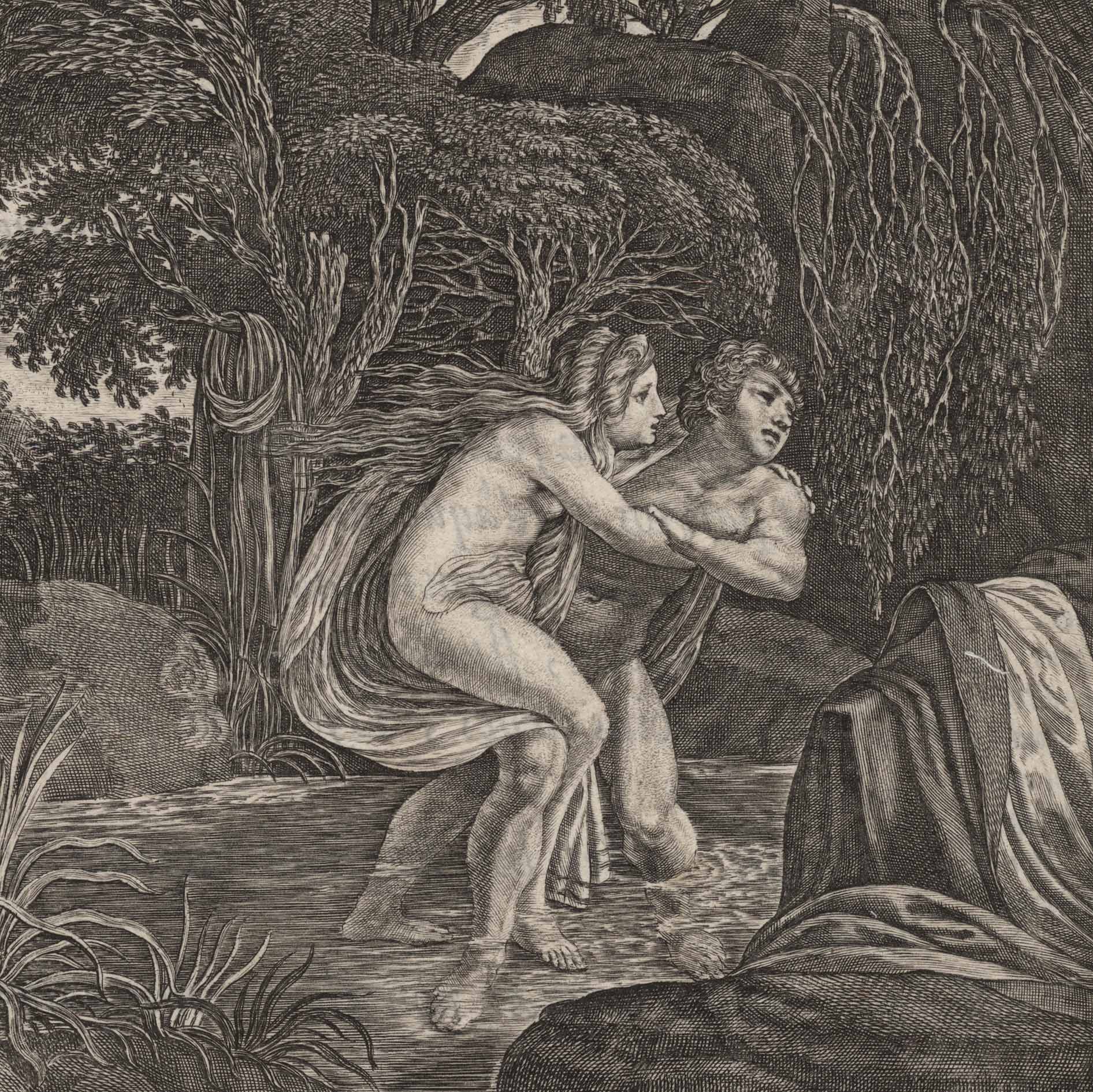
Magdalena de Passe’s engraving, “Salmacis and Hermaphroditus”, 1623


Magdalena de Passe (aka Magdalena van de Passe) (1596?–1638)

Salmacis and Hermaphroditus”, 1623, after the design by either Jacob Pynas (aka  Jacob Pijnas; Jacob Symonsz. Pijnas; Jacob Pinas; Jacob Symonsz. Pinas) (1585–1648) (as proposed by the Rijksmuseum; see inv. no. RP-P-2014-34-34), or Jacob’s brother, Jan Simonsz Pynas (aka Jan Simonsz Pinas) (c1583–1631) (as proposed by the British Museum; see inv. no. Sheepshanks.7457), published in Brussels in 1677 by François Foppens I (fl.1656-1686) with letterpress text verso as an illustration to the translation by Pierre  du Ryer (1605–1658) of “Les Metamorphoses d'Ovide, en Latin et François, avec de nouvelles explications historiques, morales & politiques sur toutes les fables, chacune selon son sujetas”, as described by the Rijksmuseum: (transl.) “Hermaphroditus and Salmacis changed into a hermaphrodite: at the prayer of the fountain-nymph Salmacis, who holds the bathing Hermaphroditus closely embraced, their bodies fuse (Ovid, Metamorphoses IV 373) (inv.no. RP-P-OB-15.828).

Although there appears to be curatorial questions regarding which of the Pynas brothers was the source of the design for this marvellous engraving, there may also be a stylistic leaning in the design towards Hendrick Goudt (c1583–1648; for example, “Tobias and the Angel (small plate)”, 1608: https://www.metmuseum.org/art/collection/search/383883. See also the earlier post regarding another of Magdalena de Passe’s engravings, “Elijah at the Brook Cherith”, in which I engage with the idea that there may be female perspective—a way of looking that is exemplified in this print (see https://www.printsandprinciples.com/2016/10/magdalena-van-de-passes-engraving.html).

Engraving on laid paper with letterpress text verso, trimmed with a narrow margin around the image borderline (with loss of the text below the image), backed with a support sheet.

Size: (sheet) 16.9 x 23.6 cm; (image borderline) 16.1 x 22.6 cm.

Inscribed in plate: (upper centre) “Ovid: Met. lib. 4.”   

Franken 979 (Daniel Franken & Simon Laschitzer 1975, “L'Oeuvre Grave des Van de Passe”, Amsterdam, G. W. Hissink & Co., p. 186, 309-310, cat. no. 979 in 1379); Holstein Dutch 7 (Jan Verbeek & Ilja M. Veldman [comp.] 1974, “Dutch and Flemish Etchings, Engravings and Woodcuts ca. 1450-1700: De Passe [continued]”, Amsterdam, Van Gendt & Co, p. 67, 214, cat. no. 236ad in 7).

The Rijksmuseum offers the following description of this print: (transl.) “Hermaphroditus, the child of Hermes and Aphrodite (Mercury and Venus), wades through the lake in which the nymph Salmacis lives. Salmacis, one of Diana's nymphs, fell in love with Hermaphroditus. She clings to him so that their bodies will merge. Hermaphroditus tries to resist her hugs (https://www.rijksmuseum.nl/en/collection/RP-P-2014-34-34).

See also the descriptions offered by the British Museum and Bonhams Auctions (5 Jun 2013): https://www.britishmuseum.org/collection/object/P_Sheepshanks-7457 & https://www.bonhams.com/auctions/20738/lot/3/..

Condition: a strong and well-printed impression trimmed with a small margin around the image borderline and loss of the text lines below, laid onto a support sheet of archival (millennium quality) washi paper.  The sheet is in a very good condition for its considerable age with no tears, holes, folds or abrasions, significant stains or foxing.

I am selling this remarkable print executed by one of the few recorded female engravers from the Dutch Golden Age who may also be the first female artist to train another female artist—the incredible polymath, Anna Maria van Schurman (1607–1678)—for AU$302 (currently US$224.78/EUR207.16/GBP172.06 at the time of posting this print) including postage and handling to anywhere in the world (but not, of course, any import duties/taxes imposed by some countries).

If you are interested in purchasing this marvellous engraving showing the moment of embrace between Salmacis and Hermaphroditus before the Gods of Olympus fuse them together forever as a hermaphrodite whole, please contact me (oz_jim@printsandprinciples.com) and I will send you a PayPal invoice to make the payment easy.

This print has been sold