Showing posts with label Visscher II (Nicolaes). Show all posts

Sunday, 31 August 2025

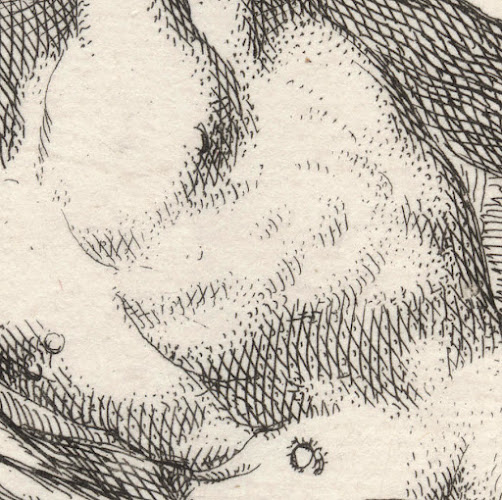
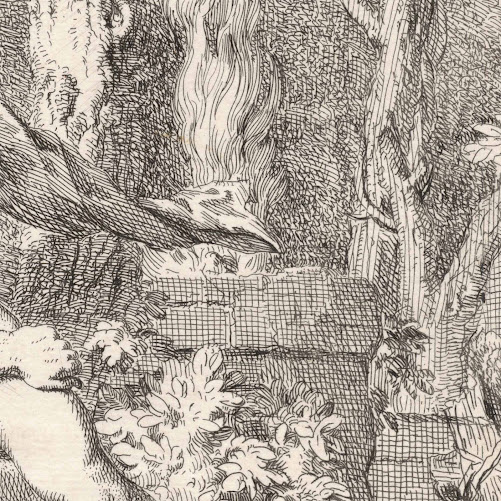
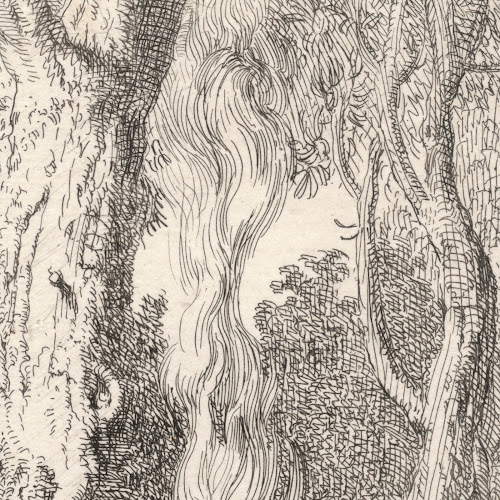
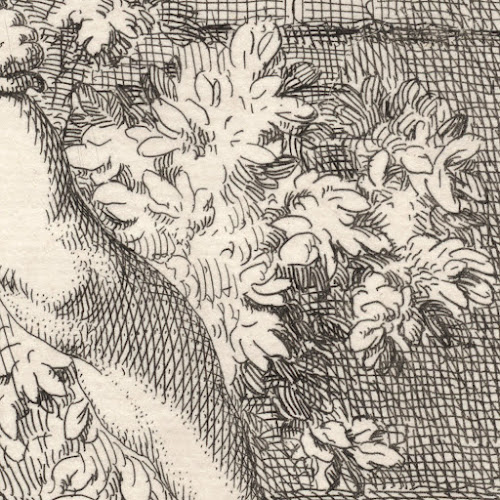
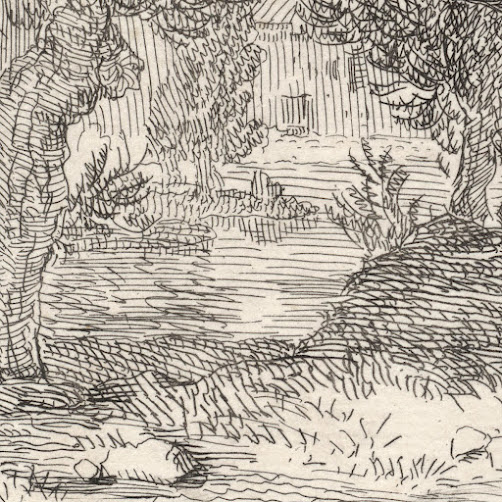
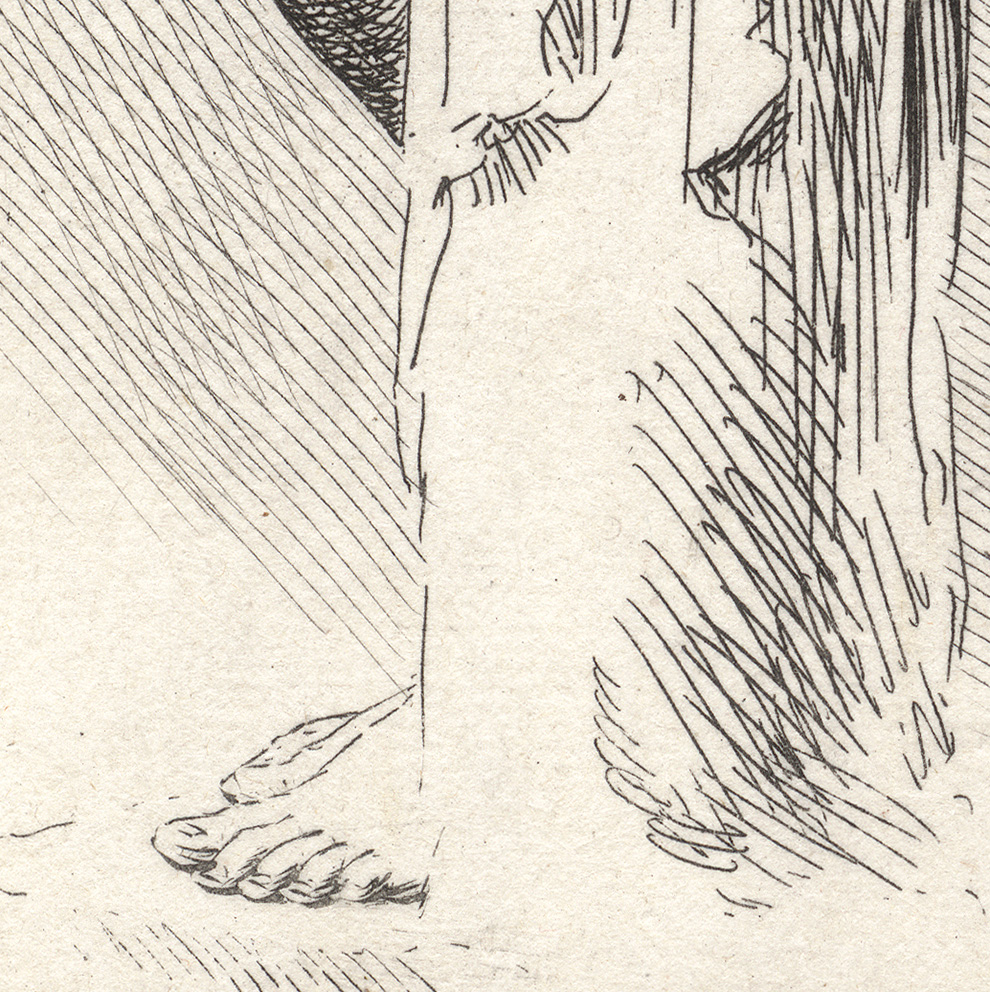
Gérard de Lairesse, “Venus Fills Cupid's Quiver”, c.1677–80

Gérard de Lairesse (1640–1711)

“Venus Fills Cupid's Quiver” (aka “Venus Replenishing Cupid's Quiver with Arrows”; “Venus and Cupid at the Forge of Vulcan”), c.1677–80, plate three from the series, of four plates, “The Life of Venus” (aka “Venus and Cupid”), published by Nicolaes Visscher II (aka Nicolai Vischer; Claes Claesz Visscher) (1649–1702). Based on the number inscribed at lower right (“56”), this impression is from the “Opus Elegantissimum” edition of 104 plates, published in Amsterdam by Gerard Valck (aka Gerard Valk) (1651/2–1726) (see the Curator of the British Museum’s comment about this edition regarding the title plate to the edition: https://www.britishmuseum.org/collection/object/P_1929-1112-2-1).

Etching on laid paper, trimmed along the platemark and backed by a support sheet.

Size: (sheet) 24.1 x 16.6cm; (plate) 21.4 x 17.2cm; (image borderline) 20.8 x 16.6cm.

Lettered in plate below the image borderline: (left) “3”; (centre) “Per Gerardum de Lairesse inv: et sculp: et per Nicolaum Visscher edit: cum Privil: Ord: General: Belgii Fæderati.”; (right) “56”.

Hollstein Dutch 29; Timmers 29

The British Museum offers the following description of this print (not reproduced): “Venus filling the quiver of Cupid with arrows which are being forged behind her; a plate from a series of four on Venus and Cupid. c.1677/80” (https://www.britishmuseum.org/collection/object/P_1929-1112-2-52).

See also the descriptions of this print offered by the Rijksmuseum and Harvard Art Museums: https://id.rijksmuseum.nl/200528267; https://hvrd.art/o/339704.

Condition: a well-printed impression with narrow margins around the image borderline and laid onto archival (millennium-quality) washi paper that provides generous margins. The sheet is in an excellent condition with no tears, holes, folds, abrasions or stains.

I am selling this very beautiful etching that to my eyes seems sculpted by light, for the total cost of AU$333 (approximately US$217.87, EUR 186.35, or GBP 161.37), this includes worldwide express postage and handling. Please note that any applicable import duties or taxes imposed by the destination country are the responsibility of the buyer.

If you are interested in purchasing this sensitively executed etching, please contact me (oz_jim@printsandprinciples.com) and I will send you a PayPal invoice to make the payment easy.

This print has been sold


Monday, 29 November 2021

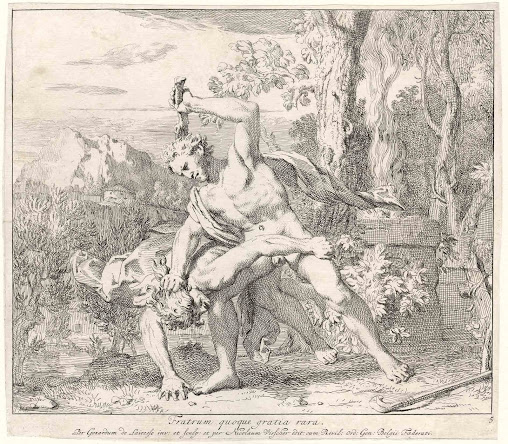
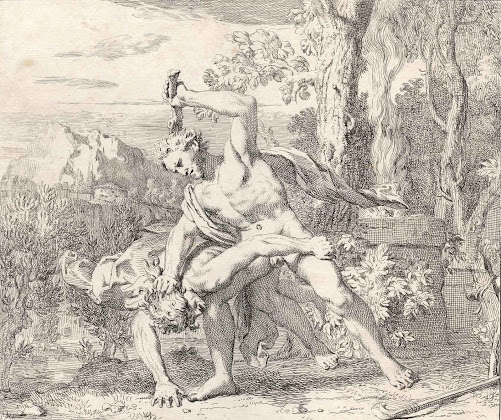
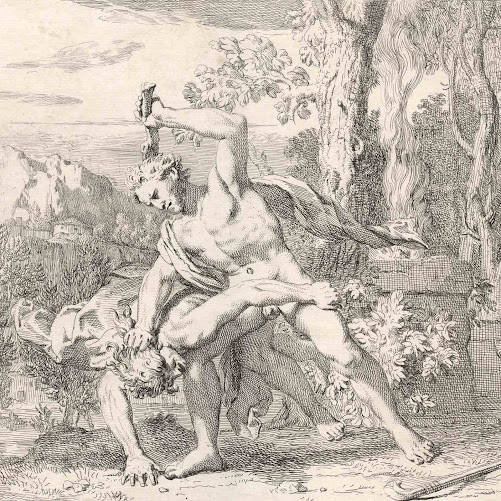
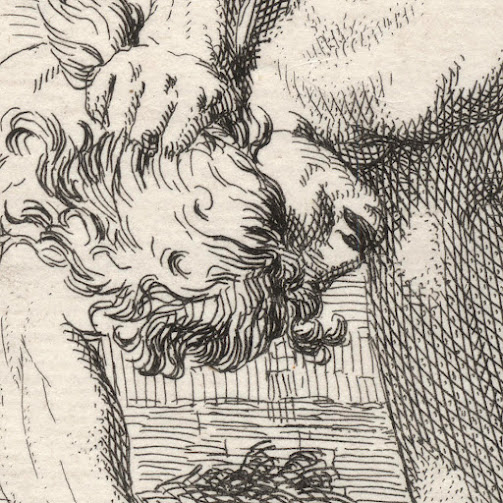
Gérard de Lairesse’s etching, “Cain Killing Abel with the Jawbone of an Ass”, c1680

Gérard de Lairesse (aka Gerardi de Lairesse; Gerardum de Lairesse) (1640–1711)

“Cain Killing Abel with the Jawbone of an Ass”, c1680, plate 5 from a series of etchings illustrating the Old Testament (Timmers 1 to 7), published by Nicolaes Visscher II (aka Nicolai Vischer; Claes Claesz Visscher) (1649–1702) in c1675 as an illustration to “Opus Elegantissimum” (see folios 65v-66r in the online scroll of this publication offered by the Yale Center for British Art: https://collections.britishart.yale.edu/catalog/orbis:4190566). The etching was later published by Gerard Valck (aka Gerard Valk) (1651/1652–1726) in Valck’s edition (c1702) of “Opus Elegantissimum” with the publication details, “nunc apud Ger.Valk” and “49”. This is a lifetime impression before the Valck edition.

The Curator of the British Museum offers the following insight regarding the publication of this print: “Timmers (p.83) records four editions of the plates: 1. with Visscher's address, 2. with Valck's added, 3. with the plates numbered, 4. with Schenk's address. He also notes that almost all copies show differences in content and order” (https://www.britishmuseum.org/collection/object/P_1929-1112-2-1).

Etching on laid paper trimmed around the platemark and backed with a support sheet.

Size: (sheet) 22.1 x 25.3 cm; (image borderline) 20.5 x 24.3 cm.

Numbered and lettered in plate below the image borderline: (centre) “Fratrum quoque gratia rara./ Per Gerardum de Lairesse inv: et sculp: et per Nicolaum Visscher edit: cum Privil: Ord: Gen: Belgii Fæderati.”; (right) “5”.

State i (of iv) (?) before the three alterations with publication details (see Timmers, p. 83).

Timmers 5 (J.J.M. Timmers 1942, “Gérard Lairesse”, Amsterdam, H J Paris, pp. 83 & 127, cat. no. 5).

Condition: a strong and well-printed lifetime impression showing no sign of wear to the printing plate, trimmed irregularly around the platemark and laid onto a sheet of archival (millennium quality) washi paper. Beyond a pale mark in the sky at upper left, the sheet is in a very good condition with no tears, holes, folds, abrasions, significant stains or foxing.

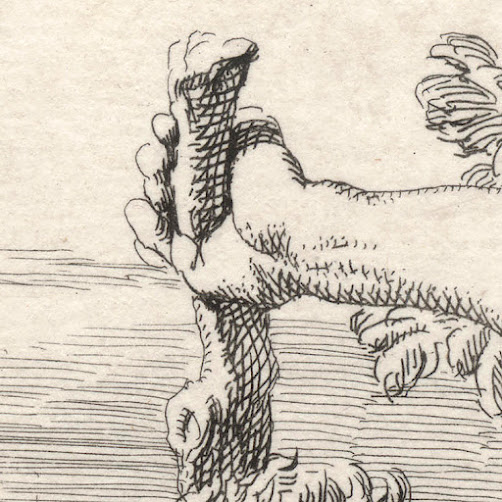
I am selling this superb etching showing the two sons of Adam and Eve fighting—note the crook that the shepherd, Abel, has dropped as the farmer, Cain, is about to kill him in a jealous rage with the jawbone of an ass after discovering that God favoured his brother—for the total cost of AU$368 (currently US$261.51/EUR231.10/GBP196.36 at the time of posting this listing) including postage and handling to anywhere in the world, but not (of course) any import duties/taxes imposed by some countries.

If you are interested in purchasing this rare lifetime impression (based on the publication details), please contact me (oz_jim@printsandprinciples.com) and I will send you a PayPal invoice to make the payment easy.

This print has been sold 


Wednesday, 8 September 2021

Jan de Bisschop’s etching, “Statue of Aphrodite”, 1668/9

Jan de Bisschop (aka Johannes Episcopius) (1628–71)

“Statue of Aphrodite”, 1668/9 (pub. 1672), plate 81 from the series, “Signorum Veterum Icones,” published by Jan de Bisschop and in the case with this impression (based on the margins) in 1672 by Nicolaes Visscher II (1649–1702) in Amsterdam.

Archive.org offers an online view of this etching in its context in the publication: https://archive.org/details/signorvmvetervmi00biss/page/81/mode/2up.

Etching with engraving on fine laid paper watermarked with the Arms of Amsterdam.

Size: (sheet) 29.9 x 18 cm; (plate) 21.1 x 13.5 cm.

Inscribed in plate: (upper right corner) “81”; (lower right) “[De Bisschop's ligature monogram]. f."

Hollstein 6; Van Gelder I.166.81

The British Museum offers the following description of this print: “Statue of an Aphrodite in a pudica pose with a cloth lying on a rock beside her left leg; front view and side view directed to left shown side by side” (https://www.britishmuseum.org/collection/object/P_1901-1022-2531-82).

The Curator of the British Museum offers the following insights regarding the portrayed sculpture:

“The statue was lost during the fire of 1762 in the Uffizi in Florence. This type belongs to the Venus pudica type, which may have been a Hellenistic repetition. Its base and support may have been modern. The draughtsman's name is not mentioned. In his list of contents and locations de Bisschop says that the statue is "in aedibus Mediceis", a location which he otherwise used for statues inside the Villa Medici in Rome. He obviously had a drawing with the inscription 'Medici' at his disposal and did not know that the statue was actually in Florence. He further says that it is not very different from the Greek Venus "in the same palace" and that according to Cavalieri, III.IV,67, it seems it was previously in the Farnese collection (which was not the case); Cavalieri's plate in fact shows another version.” (op.cit.)

Condition: a strong impression with substantial margins in near pristine condition with no tears, holes, folds, abrasions, losses, stains, foxing or signs of handling.

I am selling this amazing double view of an antique sculpture that was destroyed in a fire a century after this etching was published, for AU$247 in total (currently US$182.06/EUR153.79/GBP132.29 at the time of posting this listing) including postage and handling to anywhere in the world.

If you are interested in purchasing this dual viewpoint of a classically arranged Aphrodite/Venus in the famous pudica pose—a pose that in one sense gives modesty to the nude figure, while (arguably) also drawing attention to her pudenda and her partially successful covering of her breasts—please contact me (oz_jim@printsandprinciples.com) and I will send you a PayPal invoice to make the payment easy.

This print has been sold


Tuesday, 11 August 2020

Jan de Bisschop’s etching, “Dying Christ Supported by Angels,” c1670

Jan de Bisschop (aka Johannes Episcopius) (1628–1671)

“Dying Christ Supported by Angels,” c1670 (1668–1671 [Rijksmuseum dating]), after a red chalk drawing in the Albertina, Vienna (inv. no. 2128; see https://sammlungenonline.albertina.at/#/query/5a3b14ca-fc54-4ac9-ab84-d57b64007f86) formerly attributed to Annibale Carracci (1560–1609), plate 1 (after the title plate) in the series of 157 etchings by Jan de Bisschop, initially published at the Hague in 1671/72 by Nicolaas Visscher II (1649–1702) and later by Hendrik de Leth (1703–1766) in “Paradigmata Graphices Variorum Artificum”, with a title plate by Gerard de Lairesse (1640–1711) (see https://research.britishmuseum.org/research/collection_online/collection_object_details.aspx?objectId=3296238&partId=1). This impression is from the numbered and lettered Hendrik de Leth edition (c.1731–41).

See this publication and the context of this print online at archive.org:

https://archive.org/details/paradigmatagraph00biss_0/page/n3/mode/2up.

Etching on laid paper with wide margins.

Size: (sheet) 31.9 x 22.4 cm; (plate) 22.3 x 13.4 cm.

Inscribed on plate: (upper right corner) “1”; (lower left) “Ann.Caratus inv.del.”; (lower right) “Ann.Caratius inv.del.”; (lower right) “[De Bisschop's monogram] JE. f.” 

State iii (of iii) with the addition of the artist’s Latin monogram, the name of the designer and the plate number.

Hollstein Dutch 6 (F W H Hollstein 1950, “Dutch and Flemish Etchings, Engravings and Woodcuts ca. 1450–1700: Berckheyde–Bodding”, vol. 2, Amsterdam, Menno Hertzberger, p. 44, cat. no. 6); Gelder & Jost 1-3 (3) (Jan G van Gelder & Ingrid Jost 1985, “Jan de Bisschop and his Icones and Paradigmata: Classical Antiquities and Italian Drawings for Artistic Instrumentation in Seveneenth Century Holland”, Doornspijk, Davaco, p. 231, cat. no. 1).

See also the description of this print at the British Museum and the Rijksmuseum:

https://www.britishmuseum.org/collection/object/P_1850-0810-754;

http://hdl.handle.net/10934/RM0001.COLLECT.466643.

Condition: richly inked and well-printed impression in near faultless condition (i.e. there are no tears, holes, folds, losses, abrasions, stains, foxing or signs of handling).

I am selling this exceptionally beautiful translation (in reverse) of Carracci’s red chalk drawing in the Albertina of Christ as “The Man of Sorrows”, for AU$302 in total (currently US$216.58/EUR184.46/GBP165.72 at the time of posting this listing) including postage and handling to anywhere in the world (but not, of course, any import duties/taxes imposed by some countries).

If you are interested in purchasing what I see as a magnificent rendering of Christ’s musculature with convincingly drawn foreshortened legs and stretched torso (following his crucifixion), please contact me (oz_jim@printsandprinciples.com) and I will send you a PayPal invoice to make the payment easy.

This print has been sold


Tuesday, 7 July 2020

Hendrik Bary’s engraving, “Spring and Autumn”, c1670, after Anthony van Dyck


Hendrik Bary (aka Hendrick Barij) (1640–1707)

“Spring and Autumn” (aka “Two Children Playing: Spring and Autumn” [Twee Spelende Kinderen: Lente en Herfst]; “Personification of Spring and Autumn”), c1670 (1657–1677), after a painting by Anthony van Dyck (aka Anthony van Dijck; Antoon van Dijk; Anton van Dyck) (1599–1641), published by Nicolaes Visscher II (aka Nicolai Vischer; Claes Claesz Visscher; Nicolaas Visscher) (1649–1702) and Gerard Valck (aka Gerard Valk) (1651/52-1726) in Amsterdam.

Engraving on laid paper with a small margin around the platemark, backed with a support sheet.
Size: (sheet) 29.9 x 24.5 cm; (plate) 28.9 x 24 cm; (image borderline) 25.4 x 23.5 cm.
Lettered on plate below the image borderline: (left) “A. van Dyck pinxit”; (centre) "De lieve Lente wil ons Schoone bloemen geven./ De Oegst schenkt nutter vrucht. men kan van reuk niet leven./ ex Formis Nicolai Visscher/ Cum Privelegio Ordinum Hollandiæ & West-Frisiæ. Nunc apud Ger. Valk."; (left) HBary Sculp.”
State iii (of iii) with the addresses of the publishers.

Hollstein 7 (Bary); New Hollstein 627 (van Dyck)

The Rijksmuseum offers the following description of this print:
(Transl.) “Two children playing, left Autumn with a fruit and corn, right Spring with a wreath of flowers [in his hair]. Under the image a verse of two lines in Dutch”

See also the description of this print by the British Museum:

Condition: near faultless, richly inked impression with a small margin around the platemark and laid onto a support sheet of millennium quality washi paper. The sheet is in an excellent/museum-quality condition (i.e. there are no tears, holes, folds, losses, abrasions, stains or foxing).

I am selling this very beautiful engraving featuring children playing in an allegory of the seasons in which “Sweet Spring wants to give us beautiful flowers. The harvest … more fruit”, for AU$356 (currently US$247.24/EUR218.95/GBP198.07 at the time of posting this print) including postage and handling to anywhere in the world (but not, of course, any import duties/taxes imposed by some countries).

If you are interested in purchasing this very fine engraving—it is such a strong impression that the lines show no sign of wear to the printing plate suggesting that it must be an early impression!—please contact me (oz_jim@printsandprinciples.com) and I will send you a PayPal invoice to make the payment easy.