Showing posts with label Peeters I (Jan). Show all posts

Tuesday, 17 October 2017

Lucas Vorsterman II’s etching, “Porta Suda Paleo in Candia” (the second version), c1665


Lucas Vorsterman II (1624– fl.1666)

Note: this print is VERY similar to the one shown in the previous post but close examination reveals distinct differences. In short, this impression is from a different plate.

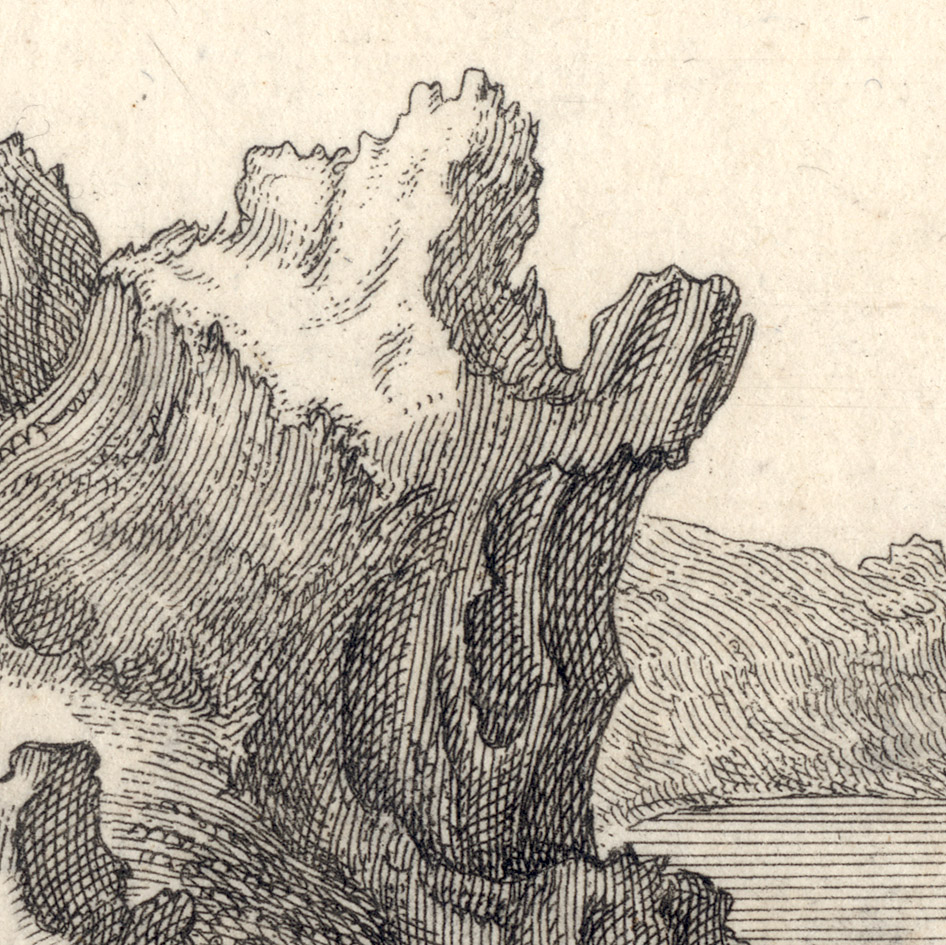
“Porta Suda Paleo in Candia” (second version), c1665, after the design by Jan Peeters I (aka Johannes Peters) (1624–c1677), from the series of ten plates featuring Mediterranean islands, “Insula di Candia del Mare Mediteranea”, published by Jan Peeters I. This is a first state impression before lettering with the publication details.

Note: The BM advises that the publisher was the same as the designer of the composition (Jan Peeters I). This information may be incorrect and the publisher may be Jacobus Peeters (1637–95) instead who published the series in the third edition.

Etching on laid paper lined onto a support sheet of fine washi paper.
Size: (sheet) 19.5 x 29.1 cm; (plate) 11.5 x 27.7; (image borderline) 10.5 x 26.8 cm

Inscribed within the image borderline: (above the third mountain from the left) “Canca”; (right of centre) “Suda”.
Monogrammed within the image borderline at lower right corner: “VL”.
Lettered below the image borderline: (left) “Ioannes Peeters delineavit"; (centre) “Porta Suda Paleo in Candia.”; (right) "Lucas Vorstermans fecit."

State i (of iii?) My attribution of this print to the first state is based on the lettered details that match the first state impression held by the BM (no. F,1.121). I assume that as the previous print that I have listed was from the same series and it had three states that this print also has three states commensurate with the lettering of the different publishers.

Hollstein 44-53 (under Conrad Lauwers) (F W H Hollstein 1949, “Dutch and Flemish etchings, engravings and woodcuts c.1450-1700”, Amsterdam); Hollstein 56.I

The British Museum offers the following description of this print:
“View of the harbour of Souda; battle scene with soldiers in a fort in left foreground firing cannons at the fleet of ships advancing rightwards, the Souda island in centre middleground, a row of ships seen at left, mountainous landscape in the background. c.1665” (http://www.britishmuseum.org/research/collection_online/collection_object_details.aspx?objectId=3086844&partId=1&people=103947&peoA=103947-2-60&page=1)

Condition: richly inked and crisp impression in near pristine condition (but there is a tear in the margin on the left). The sheet has generous margins (possibly as published) and has been laid onto a conservator’s support sheet. There is a collector’s ink stamp at the lower right corner.

I am selling this spectacularly fine, pre-publication, lifetime impression of Vorsterman II’s etching from the mid-1600s of a battle scene in Crete for the total cost of AU$179 (currently US$140.91/EUR119.28/GBP106.18 at the time of this listing) including postage and handling to anywhere in the world.

If you are interested in purchasing this marvellously detailed depiction of the naval battle in the harbour of Heraklion (Crete), please contact me (oz_jim@printsandprinciples.com) and I will send you a PayPal invoice to make the payment easy.

This print has been sold


In the previous discussion I mentioned that I thought (but wasn’t certain) that I had another version of Vorsterman’s naval battle at the port of Heraklion in Crete in the 17th century, well I did as can be seen here. Both prints are surprisingly similar but they are not prints from different states of the same printing plate. Close examination shows that they are offer different angles of view of the harbour and the features of the battle portrayed.


Monday, 16 October 2017

Lucas Vorsterman II’s etching, “Porta Suda Paleo in Candia”, c1665


Lucas Vorsterman II (1624– fl.1666)

“Porta Suda Paleo in Candia”, c1665, after the design by Jan Peeters I (aka Johannes Peters) (1624–c1677), from the series of ten plates featuring Mediterranean islands, “Insula di Candia del Mare Mediteranea”, published by Gaspar Huberti (aka Gaspar Huybrechts) (fl. 1685–1724) and later by Jacobus Peeters (1637–95). This impression is from the first state of the print before the published editions by Huberti and Peeters.

Etching on laid paper trimmed along the platemark and lined onto a support sheet of fine washi paper.
Size: (sheet) 11.7 x 27.4 cm; (image borderline) 10.5 x 26.8 cm
Inscribed within the image borderline: (centre of the left side) “Paleo”; (left of centre) “Canca” and “Suda”.
Monogrammed within the image borderline at lower left corner: “VL”.
Lettered below the image borderline: (left) “Ioannes Peeters delineavit"; (centre) “Porta Suda Paleo in Candia.”; (right) "Lucas Vorstermans fecit."

State i (of iii?) My attribution of this print to the first state is based on the lettered details that match the first state impression held by the BM (no. F,1.120) before the lettered production details of Gaspar Huberti (see BM no. 2AA+,a.43.82) and Jacobus Peeters (see BM no. 2AA+,a.43.80).

Hollstein 44-53 (Conrad Lauwers) (F W H Hollstein 1949, “Dutch and Flemish etchings, engravings and woodcuts c.1450-1700”, Amsterdam); Hollstein 55.I; Landwehr 1970 82 (J Landwehr 1970, “Romeyn de Hooghe as book illustrator”, Amsterdam)

The British Museum offers the following description of this print:
“View of the harbour of Souda; a row of ships in foreground, the Souda island with the harbour at centre, a town ('Paleo') on a hill at left; mountainous landscape in the background.” (http://www.britishmuseum.org/research/collection_online/collection_object_details.aspx?objectId=3086845&partId=1&searchText=vorsterman+porta+suda&page=1)

Condition: richly inked and crisp impression in near pristine condition. The sheet is trimmed along the platemark and has been laid onto a conservator’s support sheet.

I am selling this spectacularly fine, pre-publication, lifetime impression of Vorsterman II’s etching from the mid-1600s of a battle scene in Crete for the total cost of AU$179 (currently US$140.91/EUR119.28/GBP106.18 at the time of this listing) including postage and handling to anywhere in the world.

If you are interested in purchasing this marvellously detailed depiction of the naval battle in the harbour of Heraklion (Crete) and, interestingly, shows cannon fire from the fortress of Paleo Castro—a place that I understand is now only in ruins—please contact me (oz_jim@printsandprinciples.com) and I will send you a PayPal invoice to make the payment easy.


This print has been sold


I’m presently experiencing one of those moments when my brain tells me one thing but reality tells me another. The issue for me right now is that I know—or rather I think that I know—that I have another variation of this same scene. Hopefully I can find it and feature it tomorrow night.

Regarding this image, what is missing in the BM’s account of what is featured here is far more than “a row of ships in foreground, the Souda island with harbour at centre” (see BM no. F,1.120). What is REALLY going on here is a battle in the harbour of Heraklion in Crete. On the left, the fortifications at Paleo Castro (inscribed, “Paleo”) are enlivened with puffs of smoke from the cannons firing on the attacking ships which are clearly responding with their own puffs of cannon smoke. From what I understand (based on information gleaned from http://www.cretanbeaches.com), the Fort of Paleo Castro was originally built by the Venetians to protect the harbour. Interesting the fort was soon abandoned and was in ruins well before 1668, according to the Turkish traveller Evliya Celebi (1611–82). This means that Vorsterman II’s etching which was executed circa 1665 shows the final days of the old fort.