Monday, 5 November 2018

Martin Hermann Faber’s etching, “Landscape with Christ healing the Centurion’s Servant”, c1620


Martin Hermann Faber (aka Marten Herman Faber; Marten Harmens Faber; Martinus Hermannus Faber) (1587–1648)

“Landscape with Christ healing the Centurion’s Servant”, c1620
Etching on laid paper trimmed with thread margins around the image borderline and backed with a support sheet.
Size: (sheet) 40 x 51.8 cm; (image borderline) 39 x 51.6 cm
Lettered below the image borderline: (left) “Martin: Faber Embd: Inuentor"

Andresen/Hollstein/Wurzbach 1

Condition: richly inked and well-printed lifetime impression (based on the crisp linework showing no sign of wear to the plate) trimmed close to the image borderline with restored tears, nicks and replenished small losses including the lower left corner. The print is laid upon a support sheet.

I am selling this huge etching of the utmost rarity—it is so rare that I have been unable to find this print in the collection of any major institution—for AU$615 in total (currently US$442.26/EUR388.92/GBP340.29 at the time of posting this listing) including postage and handling to anywhere in the world (but not, of course, any import duties/taxes imposed by some countries).

If you are interested in purchasing this stunning masterwork of early landscape etching with a biblical narrative, please contact me (oz_jim@printsandprinciples.com) and I will send you a PayPal invoice to make the payment easy.

This print has been sold


This is one of those prints that I suspect very few people will have seen as it is not held by any major museum or any other institution listing their collection online. Despite its rarity, the print is also historically important (at least in my way of looking at the development of the landscape tradition in art). The reason that I wish to propose this idea is simply because it fits neatly as a transitional landscape separating the “Weltlandschaft” (World Landscape) of the early Netherlandish painters, such as Joachim Patinir (c1480–1524) (see https://en.wikipedia.org/wiki/Joachim_Patinir#/media/File:Paisaje_con_san_Jer%C3%B3nimo,_Joachim_Patinir,_Museo_del_Prado.jpg), and the late Mannerist landscapes of artists like Paul Bril (1554–1626) (see https://www.wikidata.org/wiki/Q27964568#/media/File:Paul_Bril_001.jpg). What marks it as a historically seminal image for me is that it captures a compression of spatial depth from the expansively vast— almost cosmic—aerial viewpoint of the earlier landscapes to a more intimate connection with nature.  


Sunday, 4 November 2018

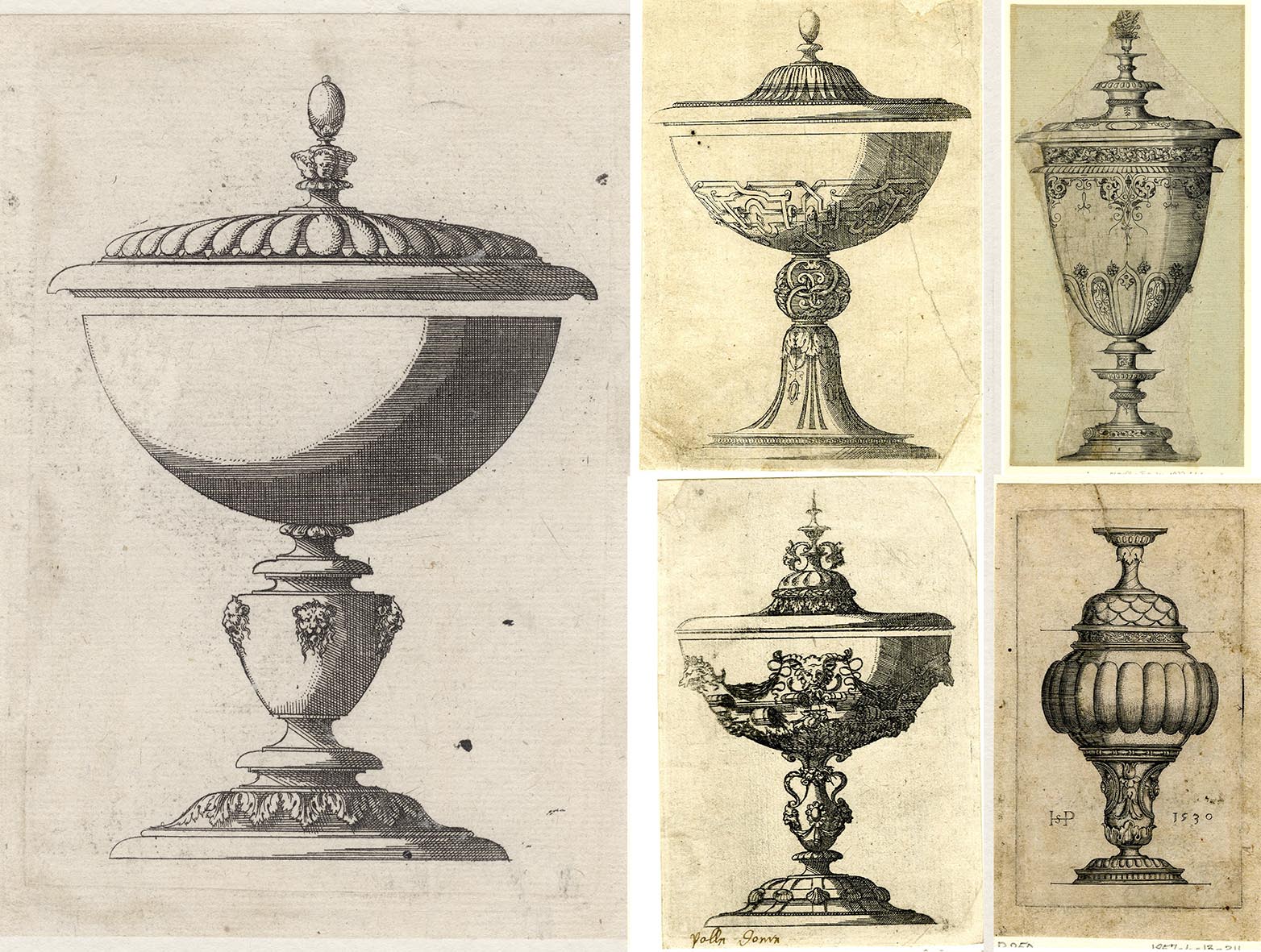
Etching by an unidentified artist from the circle of Jacques Androuet Ducerceau of a lidded goblet (c1560)


Unidentified artist from the circle of Jacques Androuet Ducerceau (aka Jacques Androuet Du Cerceau) (c1520–1586)

“Lidded goblet with lion head ornamentation” (note that the BM describe similar vessels as cups and other institutions describe them as goblets), c1560.

Etching on fine laid paper with small margins and backed with a support sheet.
Size: (sheet) 18.3 x 10.1 cm; (plate) 13.3 x 9 cm
Condition: crisp and well-printed early impression (based on the line quality showing no sign of deterioration to the printing plate) with small margins (approx. 5 mm) laid upon a support sheet of archival (millennium quality) washi paper. The sheet has light surface dustiness and there are small restorations of surface abrasions—now virtually invisible—and several ink dots on the lower right.

I am selling this Renaissance period etching of elegant beauty for AU$185 in total (currently US$133.26/EUR116.99/GBP102.71 at the time of posting this listing) including postage and handling to anywhere in the world (but not, of course, any import duties/taxes imposed by some countries).

If you are interested in purchasing this highly refined early etching of a goblet, please contact me (oz_jim@printsandprinciples.com) and I will send you a PayPal invoice to make the payment easy.

This print has been sold

(left) (circle of) Jacques Androuet Ducerceau’s etching (c1560)
(upper middle) Jacques Androuet Ducerceau’s etching (c1550/70) (British Museum, no. 1972,U.978)
(lower middle) Jacques Androuet Ducerceau’s etching (c1550/70) (British Museum, no. 1972,U.977)
(upper right) Virgil Solis’ etching with engraving (1530-62) (British Museum, no. 1972,U.1167)
(lower right) Sebald Beham’ engraving (1530) (British Museum, no. 1857,0613.311)

One of the inconvenient realities of attributing an artist's name to a print by an unidentified printmaker is that the attribution needs to be justified. Fortunately the task of setting the time period for this print to the mid-1500s is not that difficult as the style of the etching matches that of quite a few German printmakers of that era. For example Albrecht Altdorfer (1482/5­–1538) famously made twenty-two etchings of vessels very similar to this plate. Nevertheless, I know that this etching is not by Aldorfer as there are distinct stylistic differences. For example, with the exception of three of Aldorfer’s prints all of his etchings of vessels exhibit cross-hatched backgrounds (see https://www.britishmuseum.org/research/collection_online/collection_object_details.aspx?objectId=1421792&partId=1&searchText=Albrecht+Altdorfer+&page=1). Similarly, Sebald Beham (1500–1550) made three engravings of lidded goblets with the same formal arrangement and using a very similar rendering style, but this print is not by Beham as Beham nearly always signed/monogrammed his plates (see https://www.britishmuseum.org/research/collection_online/collection_object_details.aspx?objectId=1518559&partId=1&searchText=Beham++goblet&page=1). Virgil Solis (1514–1562) in his vast oeuvre of prints also made a series of intaglio plates featuring goblets, cups and pitchers that correlate well in terms of style with this print (see https://www.britishmuseum.org/research/collection_online/collection_object_details.aspx?people=107033&peoA=107033-2-60&ILINK|34484,|assetId=88785001&objectId=1488277&partId=1). Moreover, I have showcased previously an etching designed by Hans Holbein the Younger (1497/8–1543) of a goblet showing the same stylistic manner of the period… but admittedly the execution of the plate was completed much later in 1646 by Wenceslaus Hollar (see https://www.printsandprinciples.com/2018/02/wenceslaus-hollars-etching-wide-cup.html).
Mindful that there are many German printmakers who may well be the true artist who executed this elegantly simple etching, my attribution of this print to the circle of French printmakers around Jacques Androuet Ducerceau (c1520–1586) is all to do with the intimate details of how the goblet is rendered. Note, for example, how Ducerceau employs a row of dots to shade the lightest suggestion of shadow. He then uses right-handed angled hatched strokes to render the mid-tones (see the stem of the vessel) and finally applies a layer of vertical strokes on top of the angled strokes to achieve cross-hatched darkness.


Wednesday, 24 October 2018

Philips Galle’s engraving, “Ops”, 1574


Philips Galle (aka Philippe Galle; Philippus Gallaeus) (1537–1612)

“Ops” (as inscribed on plate) (aka “Agriculture” (TIB title), 1574, plate 1 from the series of 8 engravings, “The Human Labours” (BM title) (aka “Personifications of Industrial and Professional Life” [TIB title]), after Marten van Cleve I (aka Marten van Cleef; Maerten van Cleve) (1527–1581) or Frans Floris (aka Frans Floris van/de Vriendt, 1519/1520–1570), with descriptive text by Hugo Favolius (1523–1585), published initially by Philips Galle (see the impression held by the Rijksmuseum, RP-P-1952-531), later by Johannes Boel (1592–1640) (see the impression held by the British Museum, 1950,0520.434), and finally published by Joannes Galle (1600–1676) in Antwerp. This impression is from the Joannes Galle edition (as inscribed on plate on the lower image borderline).

Engraving on fine laid paper with margins.
Size: (sheet) 24.9 x 30.6 cm; (plate) 20.5 x 24.6 cm; (image borderline) 20.5 x 20.2 cm
Lettered on plate within the image borderline: (upper left) “f.”; (upper centre) “ARTES PRACTICÆ, MAN VALES ET HONESTÆ./ OPS.”
Inscribed on plate within the image borderline: (on barrel at lower left) “F.Floris inuent.”; (left of centre at lower edge) “Ioan. Galle excud.”
Lettered in Latin on plate below the image borderline in two columns of two lines: Magna Deûm …/ … // …/ …auras./ Hugo Fauolius caneb.”
Numbered on plate below the image borderline: (centre) “1”.
State: iii (of iii) with the addition of the line of text above the allegorical figure, “Ops”, and the publication details of Joannes Galle.

TIB 5601.084:1 (Walter L Strauss & Arno Dolders [eds.] 1987, “The Illustrated Bartsch”, vol. 56, Supplement, p. 315); New Hollstein (Dutch & Flemish) 148.II (Frans Floris); New Hollstein (Dutch & Flemish) 382.II (Philips Galle).

Condition: crisp, richly inked and near faultless impression with margins in museum-quality/excellent condition (i.e. there are no tears, holes, folds, abrasions, significant stains or foxing).

I am selling this rare engraving from 1574 for a total cost of AU$270 (currently US$191.37/EUR167.89/GBP148.14 at the time of this listing) including postage and handling to anywhere in the world.

If you are interested in purchasing this important and very beautiful print showcasing the agricultural aspirations of the 16th century, please contact me (oz_jim@printsandprinciples.com) and I will send you a PayPal invoice to make the payment easy.

This print has been sold


The Rijksmuseum offers the following description of this print in its first state published by Philips Galle (who is also the engraver of the print):
(transl.) “In the foreground the Roman goddess of Agriculture Ops. She is surrounded by all kinds of agricultural and horticultural products and tools. In the background a plowing and sowing farmer. The print has a Latin caption and is part of a series of prints about human activities.”

See also the description of this print in its second state at the British Museum:
“Ops personifying agriculture; she sits holding a sickle besides a wheatsheaf bound with grape vine and is surrounded by the abundance of agriculture, barrels and tools etc; in the distance a field is ploughed and a man sows seeds”

Regarding the third state (shown here) published by Joannes Galle, the meaning of the print is now made unambiguously clear with the Latin text inscribed at the top of the image: “ARTES PRACTICÆ, MAN VALES ET HONESTÆ” (Google transl. “Practical art MAN is valid and honesty”) which I understand to mean the virtues of honest work.

There is one change over the course of the various states that catches my eye more than any other and it is the erasure of date of the engraving’s execution (1574) on the barrel and its substitution with the name of the artist who (arguably) designed the composition: Frans Floris. This may not seem at first to be extraordinary change to the print, but when a viewer is reminded that one of the greatest feats of fame of this Flemish artist was his propensity to drink copious amounts alcohol then his name written across the barrel seems shockingly appropriate.


Tuesday, 23 October 2018

Raphael Sadeler I’s engraving, “View of a Harbour with Large Waves”, c1590


Raphael Sadeler I (1560/61–1628/32)

“View of a Harbour with Large Waves” (TIB title), c1590, after a lost drawing by Pieter Stevens II (c1567–after 1624), published by Raphael Sadeler I (as inscribed on plate).

Etching with engraving on fine laid paper backed with a support sheet.
Size: (sheet) 21.4 x 28.3 cm; (plate) 21 x 27.9 cm; (image borderline) 20.1 x 27.7 cm
Inscribed on plate within the image borderline: (lower right) “P. Stephan. In:/ Raph. Sadeler ex.”
Lettered in Latin on plate below the image borderline in four columns of two lines: “Fluctiuago …/ …// …/ …// …/ …// …/ …aquas.”
State i (of i) Note: the crisp linework with no sign of wear to the plate suggests that this is a lifetime or an early impression.

TIB 7102.06 (Isabelle de Ramaix [ed.] 2007, “The Illustrated Bartsch: Raphael Sadeler I”, vol. 71, Part 2 [Supplement], Abaris Books, p. 215); Wurzbach, no. 127, 2; Hollstein 1980, vol. 21, no. 55 (Raphael Sadeler II); Edquist, p. 312, no. 40b.

Condition: richly inked, faultless impression in excellent condition (i.e. there are no tears, holes, folds, abrasions, stains or foxing) trimmed close to the platemark. The sheet has been laid onto a support sheet of archival (millennium quality) washi paper.

I am selling this museum quality impression—shimmering with strong contrasts of light and dark—that is so rare that it is neither in the collection of the British Museum nor the Rijksmuseum, for AU$345 in total (currently US$243.76/EUR212.68/GBP188.04 at the time of posting this listing) including postage and handling to anywhere in the world (but not, of course, any import duties/taxes imposed by some countries).

If you are interested in purchasing arguably one of the best examples of a harbour scene rendered with theatrical drama of the period style known as Mannerism, please contact me (oz_jim@printsandprinciples.com) and I will send you a PayPal invoice to make the payment easy.

This print has been sold


Research for this print was a tad difficult as it is so rare that reliable information is limited to the catalogue raisonnés rather than online repositories at major museums like the British Museum and the Rijksmuseum (neither of which possess a copy of this print). Making the task even more problematic is that “The Illustrated Bartsch” attributes the print to Raphael Sadeler I (TIB 7102.06) whereas Holstein assigns it to Raphael Sadeler II (Hollstein 1980, vol. 21, no. 55 [Raphael Sadeler II]). Not that even these august authorities are always spot on as TIB (vol. 71, Part 2 [Supplement], p. 215) describes this print as an engraving, but close examination reveals that many of the richer black lines are etched.

Interestingly, the proportional amount of engraving to etching may be a guide to determining who the true printmaker may be, as when I was reading Isabelle de Ramaix’s introduction to the TIB volume on Raphael Sadeler I, I discovered the following riveting piece of information:
“Like Johan Sadeler I, Raphael I always first etched his plates, but he engraved less with the burin than his elder brother, so that the etched lines remain clearly visible” (TIB, vol. 71, Part 2 [Supplement], p. 1). I also discovered in the same introductory essay by Isabelle de Ramaix that “Raphael II usually signed himself as Raphael Junior“ (ibid) and this helps to clarify that the true printmaker is indeed Raphael Sadeler I.


Monday, 22 October 2018

David Kandel’s woodcut, “Rhinoceros”, 1550, after Albrecht Dürer


David Kandel (1520/25–1592/96)

“Rhinoceros”, 1550, after Albrecht Dürer (1471–1528) (Meder 273), printed by Heinrich Petri (fl.c.1527–1577), published in a German edition of Sebastian Münster’s (1488–1552), “Cosmographia”, published in German from 1550 to 1628.

Woodcut with letterpress text printed recto and verso on fine laid paper (as published).
Size: (sheet) 30.7 x 19.9 cm; (Rhinoceros recto) 10 x 14.6 cm; (woodcut verso) 2.8 x 5.7 cm
With the monogram of David Kandel (entwined letters): “DK”

Hollstein 10p; Nagler 1858-79 II.1173.5; Bartsch IX.394.17
Note that the British Museum’s leaf featuring Kandel’s rhinoceros (see BM no. 1850,1014.988) is from the Latin edition of “Cosmographia” and features on the verso side a woodcut of “an elephant carrying various figures on a large saddle to right, by an anonymous printmaker”.

Condition: well-printed impression with full margins as published in near pristine condition (i.e. there are no tears, holes, folds, abrasions, stains or foxing).

I am selling this extremely rare woodcut for AU$350 (currently US$248.63/EUR216.46/GBP191.49 at the time of this listing) including postage and handling to anywhere in the world (but not, of course, any import duties/taxes imposed by some countries).

If you are interested in purchasing this superb woodcut in museum quality condition after Dürer’s famous “Rhinoceros”, please contact me (oz_jim@printsandprinciples.com) and I will send you a PayPal invoice to make the payment easy.

This print has been sold


This woodcut by Kandel after Dürer’s famous “Rhinoceros” (1514) was a plate in a series of 22 illustrations for the enlarged edition of “Cosmographia”—the first publication offering descriptions of the world and, interestingly, the first to feature a map of the Americas—initially published in Basle in 1550 and republished another 15 times with German text with the last printing in 1628. The Curator of the British Museum advises that this enlarged edition “contained around 900 illustrations and 40 maps” (see BM no. 1850,1014.972).

For those who may not be familiar with Dürer’s depiction of a rhinoceros—an Indian rhinoceros I understand—the design of the woodcut is based on a sketch made by an unidentified artist when the portrayed rhino was in Lisbon. Essentially, Dürer never had the chance to see this particular animal as the rhino drowned when the ship that was transporting it from Lisbon to Rome became shipwrecked. What Kandel/Dürer have depicted in their illustration of a rhino is consequently a concoction of rhino details and understandably, some are not quite right, such as an “extra” horn on the neck of the animal and the marvellous patterning of spots on its hide.


Saturday, 20 October 2018

Jean Pierre Norblin de la Gourdaine’s etching (with drypoint), “The Large Bagpiper”, 1787


Jean Pierre Norblin de la Gourdaine (aka Jean Pierre Norblin de la Gordaine) (1745–1830)


“The Large Bagpiper”, 1787. Note that the word “large” in the title is in reference to the plate size as there is a second etching by Norblin that is is slightly smaller featuring a bagpiper (see BM no. 1853,0312.290: http://www.britishmuseum.org/research/collection_online/collection_object_details.aspx?objectId=1533605&partId=1&searchText=norblin+&page=1)
Etching and drypoint on ivory Japanese (wove) paper with small margins and backed with a support sheet.
Size: (sheet) 9.1 x 6.3 cm; (plate) 8.1 x 5.5 cm
Inscribed on plate in reverse: (upper right) “Norblin fecit Varsovie 1787'.
State ii with added drypoint outline

Hillemacher 1848 27.II
The British Museum offers the following description of this print:
“Standing man playing bagpipes; on white ground; second state, with right arm outlined with drypoint.”

Condition: richly inked and well-printed impression with small margins (approximately 4 mms) laid onto a support sheet of archival (millennium quality) washi paper. The sheet has light staining in the upper left and lower right corners from old glue on the verso otherwise the print is in excellent condition (i.e. there are no tears, holes, folds, abrasions or foxing).

I am selling this seemingly simple and freely inscribed etching by one of the most important artists of the Enlightenment in Poland for AU$256 (currently US$182.30/EUR158.05/GBP139.69 at the time of posting this print) including postage and handling to anywhere in the world (but not, of course, any import duties/taxes imposed by some countries).

If you are interested in purchasing this small masterwork from the 1700s following in the tradition of Rembrandt, please contact me (oz_jim@printsandprinciples.com) and I will send you a PayPal invoice to make the payment easy.

This print has been sold


To be honest, I do not know why Norblin chose to portray a chap playing bagpipes, but I doubt that the reason was simply because he liked bagpipe players. From my standpoint, mindful that Norblin’s prints often reference the old masters, I believe that this bagpipe player in his peasant dress addresses the recurrent theme in the 17th century of showing bagpipers as figures connected with bawdy reveling. If I may go further with this proposal, the fact that the piper looks backwards instead of forwards may also add to this idea of him being more than JUST a music maker. After all, the more common way of portraying folk of dubious character is to show them looking sneakily over their shoulder at the mayhem that they have caused.