Wednesday, 12 February 2020

Lucien Gautier's etching, “Intérieur du Vieux Port à Marseille”, 1882


Lucien Marcelin Gautier (1850–1925)

“Intérieur du Vieux Port à Marseille”, 1882, from the suite of fifteen etchings, “Vues de Marseille” (Beraldi 17–31), printed by Eudes (aka L Eudes) (fl.1876–1888), published in “L'Art”, vol. XXXI, 1882.

According to the Musée national de la Marine, this print features in a series of ten large etchings by Gautier sponsored and published between 1880 and 1883 by “L'Art” to illustrate "Paris Picturesque" by A. de Campeaux and FE Adam (http://mnm.webmuseo.com/ws/musee-national-marine/app/collection/record/27753).
Note that Gautier’s panoramic views were more extensive than the ten plates published by “L’Art.” According to Beraldi's catalogue raisonné (1887, vol. 6, pp. 250–51), Gautier executed in total, sixteen views of Paris, fifteen views of Marseille and twenty views of other localities within and beyond France.

Etching with retroussage on beige laid paper with full margins as published.
Size: (sheet) 30.6 x 44.3 cm; (plate) 25.4 x 40.6 cm; (image borderline) 20 x 38 cm.
Lettered on plate above the image borderline: (centre) “SALON DE 1882”.
Lettered on plate below the image borderline: (left) “Lucien Gautier del. & sc. / L[']Art”; (centre) “INTÉRIEUR DU VIEUX PORT À MARSEILLE”; (right) “Imp. Eudes”.

Beraldi 1885–92 18 (Henri Beraldi 1887, “Les graveurs du 19e siècle; guide de l'amateur d'estampes modernes”, vol. 6, Paris, L Conquet, p. 251, cat. no. 18); IFF 8 (Département des Estampes 1930, “Inventaire du Fonds, Français: graveurs du XVIIe siècle”, Paris, Bibliothèque Nationale).

The Musée national de la Marine (National Navy Museum, Paris) offers the following description of this print:
(transl.) “The print represents an interior view of the old port of Marseille and highlights, on the right, the forest of masts of many sailing ships. Until the middle of the 19th century, the old port was the economic centre of Marseille, from which merchant ships left for the various points in the Mediterranean basin and the French colonial Empire. From 1844, the decision was made to extend the commercial port further north, by developing the Joliette basin” (op. cit).

See also the description of the print offered by the British Museum:
“The old harbour in Marseille, looking across the sea towards the city at left; group of rowing boats in the centre foreground, and beyond many ships”

Condition: richly inked and well-printed impression with full margins as published. There are significant dark toned areas and a closed tear (9 mm) on the left margin and pale toning to the right margin, otherwise the sheet is in good condition (i.e. there are no holes, folds, abrasions, losses or significant stains within the image area).

I am selling this spectacular panorama of the old port of Marseille featuring a virtual forest of masts for AU$260 in total (currently US$174.64/EUR160.60/GBP134.88 at the time of posting this listing) including postage and handling to anywhere in the world (but not, of course, any import duties/taxes imposed by some countries).

If you are interested in purchasing this darkly glowing image of the harbour at Marseille with throngs of circling seagulls adding a spark of life to an otherwise quiet scene please contact me (oz_jim@printsandprinciples.com) and I will send you a PayPal invoice to make the payment easy.

This print has been sold


Seven alphabet woodcuts designed by Hans Holbein the Younger, 1522


Hans Holbein the Younger (1497–1543)

Seven woodcut majuscule letters featuring animals, 1522, printed and possibly cut by Curio Valentine (fl.1522–34) in Basel according to the designs of Hans Holbein II (see the collection of these alphabet letters in the Victoria & Albert Museum: https://collections.vam.ac.uk/name/valentine-curio/AUTH339050/).

Woodcuts on laid paper with letterpress Latin text verso trimmed close to the image borderline and backed with separate support sheets.
Size of letter “T”: (image borderline) 2.7 x 2.7 cm

Reference: Oscar Jennings 1908, “Early woodcut initials; containing over thirteen hundred reproductions of ornamental letters of the fifteenth and sixteenth centuries, selected and annotated by Oscar Jennings”, London, Methuen & Co., p.140.

Condition: well-printed impressions with a few abrasions, trimmed with thread margins and laid upon separate support sheets of archival (millennium quality) washi paper.

I am selling this set of seven woodcut impressions executed in Michelangelo’s lifetime for AU$252 (i.e. AU$36 each) (currently US$169.85/EUR155.52/GBP131 at the time of posting this listing) including postage and handling to anywhere in the world (but not, of course, any import duties/taxes imposed by some countries).

If you are interested in purchasing these amazing alphabet letters designed by one of the most famous portrait painters of the 16th century, please contact me (oz_jim@printsandprinciples.com) and I will send you a PayPal invoice to make the payment easy.

This set of prints has been sold


Tuesday, 11 February 2020

Francesco Brizio's engraving, “St Mary Magdalene in Penitence”, c.1600


Francesco Brizio (aka Francesco Briccio) (1574–1623)

“St Mary Magdalene in Penitence” (aka “Mary Magdalen”; “Maria Magdalena”), c.1600, possibly after Lodovico Carracci (1555–1619) (according to Carlo Cesare Malvasia [1961] in “Le Pitture di Bologna”, p. 74) or more likely Titian (1489/90–1576) because of the close view of Mary seen in supplication (according to DeGrazia Bohlin [1979] in her catalogue raisonné for the Carracci family, p. 396), published by Nicolas van Aelst (1550s–1613).

Engraving on laid paper trimmed with a thread margin around the image borderline and backed with a support sheet.
Size: (sheet) 23.1 x 18.2 cm; (inner image borderline) 21.2 x 18 cm.
Lettered below the image borderline: “SPECVLVM PENITENTIÆ”.

State i (of ii) lifetime impression before the addition of the publisher’s address.

TIB 4003.004 S1 (Veronika Birke 1987, “The Illustrated Bartsch: Italian Masters of the Sixteenth and Seventeenth Centuries”, vol. 40 [Commentary Part 1], New York, Abaris Books, p. 185, cat.no. .004 S1); DeGrazia Bohlin R29 (Diane DeGrazia Bohlin 1979, “Prints and Related Drawings by the Carracci Family: A Catalogue Raisonné”, Washington, National Gallery of Art, p. 396, cat.no. R 29); Bartsch XVIII.80.83 (under Agostino Carracci) (Adam Bartsch 1803, “Le Peintre Graveur”, vol. 18, Vienna, p. 80, cat.no. 83).

The Rijksmuseum offers the following description of this print:
(transl.) “Maria Magdalena in a landscape. In the background on the right is an ointment jar”

See also the description of this print offered by the British Museum:

Regarding the pose of a figure portrayed resting their head on their hand, by tradition this pose signifies a state of melancholy and because the figure shown here is the biblical figure, Mary Magdalen—note her symbolic attribute: the jar of ointment used to anoint the crucified Christ—her pose is likely to signify repentant sorrow for her former life as a promiscuous woman.

Condition: Evenly and well-printed lifetime impression showing no sign of wear to the printing plate, trimmed with a narrow margin around the borderline and laid upon a support sheet of archival (millennium quality) washi paper. The sheet is in excellent condition for its age (i.e. there are no tears, folds, holes, losses, abrasions, stains or foxing).

I am selling this exceptionally rare lifetime impression (before the addition of the publisher’s name) in museum quality condition for AU$432 in total (currently US$289.76/EUR265.33/GBP224.22 at the time of posting this listing) including postage and handling to anywhere in the world (but not, of course, any import duties/taxes imposed by some countries).

If you are interested in purchasing this beautifully executed engraving exemplifying the Baroque period style of heightened drama and exuberant rhythms, please contact me (oz_jim@printsandprinciples.com) and I will send you a PayPal invoice to make the payment easy.

This print has been sold


Monday, 10 February 2020

Paul Ponce Antoine Robert de Séri & Nicolas Le Sueur's, "Assumption of the Virgin", 1729, after Giuseppe Passer


Paul Ponce Antoine Robert de Séri (aka Paul-Ponce-Antoine Robert) (1686–1733) and Nicolas Le Sueur (aka Nicolas Lesueur) (1690-1764)

“Assumption of the Virgin” (aka “L'Assomption de la Ste. Vierge” [as inscribed on plate]), 1729–64, after the drawing by Giuseppe Passeri (1654–1714), plate 131 from the series, “Recueil d'estampes d'après les plus beaux tableaux et d'après les plus beaux desseins qui sont en France” (aka “Recueil Crozat”; “Cabinet Crozat”), published by Basan in 1764.

Etching with aquatint in the style of a chiaroscuro woodcut on laid paper (with a watermark) with the collection stamp of Johann Balthasar Bullinger the Elder (1713–1793) (Lugt 3292). Note that the earlier states of this print (c.1729) show use of etching with a woodcut plate rather than the later state of the Basan edition (1764) where etching is employed with an aquatint plate.

Size: (sheet) 42.6 x 28.5 cm; (plate) 29.7 x 23.7 cm; (image borderline) 25.3 x 22.5 cm.

Lettered on plate below the image borderline: (centre) “L'Assomption de la Ste. Vierge. / D’après le dessein de Joseph Passari, qui est dans le le Cabinet de Mr Croza[t] / Gravé à l'eau forte par P. P. A. Robert, et en bois sous sa conduite par Nicolas le Sueur”; (lower right corner) “131”.

Robert-Dumesnil 1835-71 I.283.12 (Robert-Dumesnil, A P F, “Le Peintre-Graveur Français”, 11 vols.); Le Blanc II.543.10 (Charles Le Blanc 1854–1888, “Manuel de l'amateur d'estampes: contenant le dictionnaire des graveurs de toutes les nations”, 4 vols., Paris, cat. no. 10, p. 543).

The British Museum offers the following description of this print from the same state:
“Assumption of the Virgin, carried into heavens by angels; within oval; after a drawing by Giuseppe Passeri. c.1729/64 Aquatint imitating a chiaroscuro woodcut, printed in one shade of brown over etched lines” (https://research.britishmuseum.org/research/collection_online/collection_object_details.aspx?objectId=3170590&page=5&partId=1&peoA=112170-2-23&people=112170&view=list).

See variations in the colours employed in this print at the Metropolitan Museum of Art (https://www.metmuseum.org/art/collection/search/698371) and in the earlier state of this print at Harvard Art Museums (https://www.harvardartmuseums.org/collections/object/54405?position=5).

The curator of the BM offers the following insights into the series known as 'Recueil Crozat” of which this print is number 79:
“… a series of plates commissioned by Crozat and reproducing famous paintings and drawings of the era; 140 plates were published in 1729. A second volume formed by 42 prints (instead of the 110 plates initially planned) was issued in 1740.
After Crozat's death, the plates were sold to a company of booksellers who commissioned Mariette to reorganize the 'Recueil'; Mariette divided the plates into two volumes, added some missing descriptions, and advertised the set to the public in 1742.
In 1764, Basan bought the plates and the text, and republished the 'Recueil', but replaced the woodcuts by intaglio prints. ... where an attempt to imitate the effect of a chiaroscuro woodcut is made by using aquatint instead; some of the plates from this edition bear the signature of F. P. Charpentier, who invented a method akin to aquatint ... Basan also published the 45 plates reproducing the Italian paintings from the collection of the Duc d'Orléans in a volume entitled 'Recueil d'après la gallerie du palais royal' (see Heinecken, 'Idée générale d'une collection d'estampes', Paris 1771, p.76)” (http://www.britishmuseum.org/research/collection_online/collection_object_details.aspx?objectId=1430522&partId=1&museumno=1907%2C1121.14&page=2).

Condition: near faultless impression with margins. The sheet is in excellent condition for its age (i.e. there are no tears, holes, losses, abrasions, foxing or significant stains). There are previous collectors’ notes in ink and pencil verso and a collector’s ink stamp: “Bullinger” (Lugt 3292)—the stamp most likely belongs to the Swiss artist and collector, Johann Balthasar Bullinger the Elder (1713–1793); otherwise it is the stamp of his grandson, Johann Balthasar Bullinger the Younger (1777–1844).

I am selling this museum quality, early intaglio print replicating the illusion of a chiaroscuro woodcut print for the total price of AU$284 (currently US$190.07/EUR173.49/GBP147.38 at the time of posting this listing) including postage and handling to anywhere in the world.

If you are interested in purchasing this strong print and a marvellous example of 18th century technical excellence in the subtle art of trompe l'oeil, please contact me (oz_jim@printsandprinciples.com) and I will send you a PayPal invoice to make the payment easy.

This print has been sold

Collector's stamp verso


Sunday, 9 February 2020

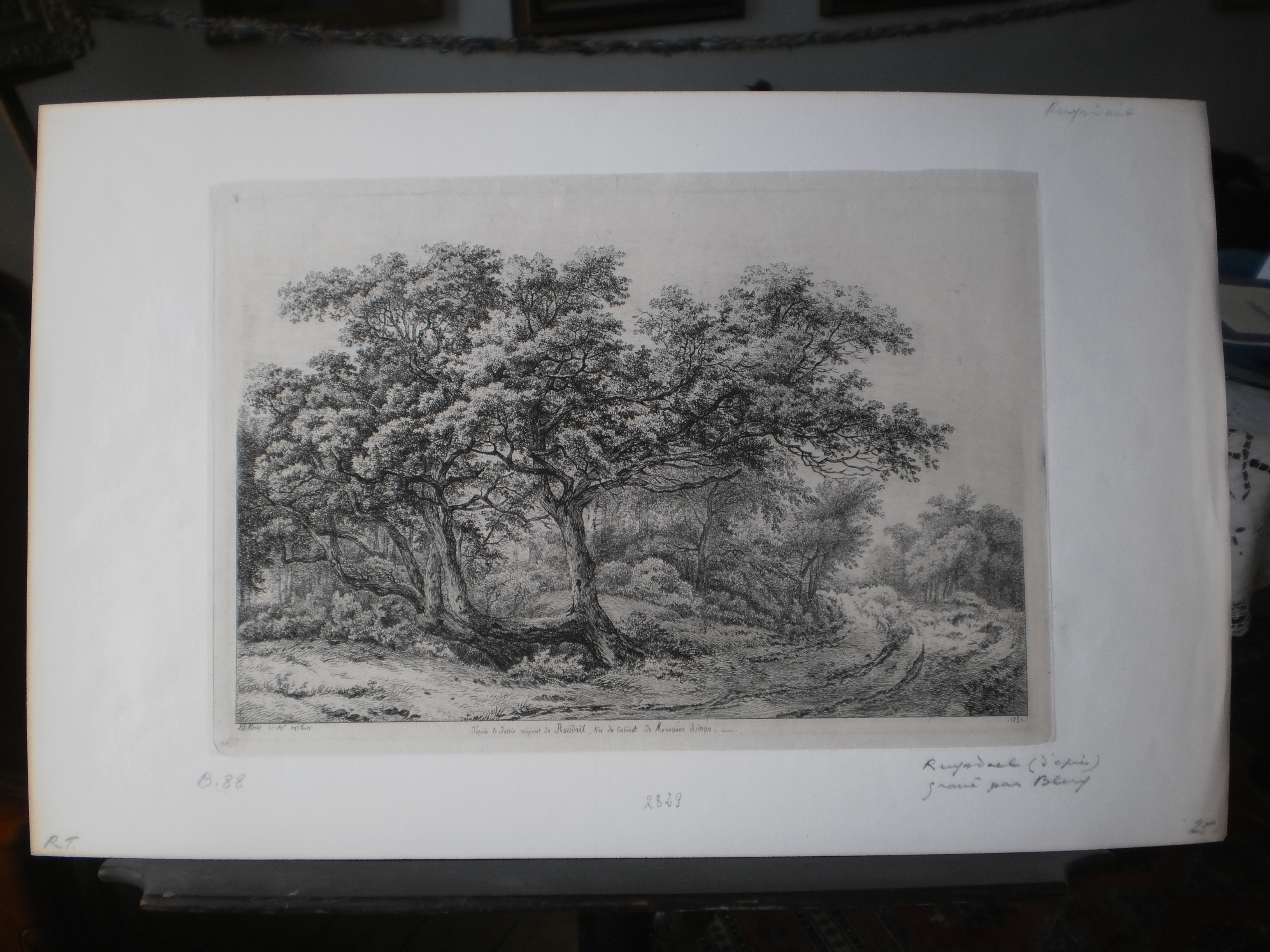
Eugène Bléry’s etching, “Le Chemin dans la Forêt”, 1851, after Van Ruisdael


Eugène Bléry (aka Alexandre Stanislas Eugène Bléry) (1805–1887)

“Le Chemin dans la Forêt” (The Path in the Forest) (aka “Le Ruysdaël” [Beraldi & BM title]), 1851, proof before lettering for publication, after the pencil and brushed ink drawing by Jacob Isaacksz van Ruisdael (aka Jacob van Ruysdael; Jacob van Ruisdael; Jacob de Goyer) (1628/9–1682) in the Petit Palais, Musée des Beaux-arts de la Ville de Paris (see http://parismuseescollections.paris.fr/de/node/219412#infos-principales).

Etching on light grey chine collé (China) on wove paper with small margins backed with a support sheet.
Size: (sheet) 25.4 x 36.6 cm; (plate) 23.4 x 34.1 cm; (chine collé) 23.1 x 33.8 cm.
Inscribed on plate below the image borderline: “(left) “EBlery Sculpt aq.a.forti”; (right) “.1851.”
Inscribed in ink by an old hand at lower below the image borderline: (right) “Ruisdaël invt.”

Note: I wish to propose that the hand-written ink note is inscribed by the artist as the writing style matches the inscribed style on the plate of the later states (cf. the style of writing the word, “Ruisdaël”, in states ii and iii).

State i (?) of iii (?) before lettering below the image borderline at centre: “d’après le dessin original de Ruisdaël, tire du Cabinet de Monsieur Simon. […]” (see https://upload.wikimedia.org/wikipedia/commons/1/13/E._BLERY%2C_Le_Ruysda%C3%ABl_%28Le_Chemin_dans_la_For%C3%AAt%29%2C_1851..jpg) and the later erasure of this lettering and the addition at lower left “- Ruisdaël delineavit” (see BM no. 1856,0712.324).

Beraldi 1885-92 88 (Henri Beraldi 1885, “Les graveurs du 19e siècle; guide de l'amateur d'estampes modernes”, vol. 2, Paris, L. Conquet, p. 115); IFF 109 (Département des Estampes 1930, “Inventaire du Fonds, Français: graveurs du XVIIe siècle”, Paris, Bibliothèque Nationale).

The British Museum offers the following description of this print:
“Landscape representing a forest; a path in the right foreground; two oaks in the left foreground”

Condition: richly inked and well-printed impression in excellent condition with small margins and laid upon a support sheet of archival (millennium quality) washi paper.

I am selling this elegantly simple and very beautiful etching after Ruisdael’s drawing, featuring a sweeping arc of a path leading into a forest, for AU$278 in total (currently US$185.67/EUR169.63/GBP144.11 at the time of posting this listing) including postage and handling to anywhere in the world (but not, of course, any import duties/taxes imposed by some countries).

If you are interested in purchasing this sensitively and insightfully executed etching—note how the artist has rendered the detail and darker tone of the foreground trees in a mimetic way, compared to the cross-hatched treatment of trees in the middle distance and the vertical and horizontal strokes suggesting the shapes of distant trees—please contact me (oz_jim@printsandprinciples.com) and I will send you a PayPal invoice to make the payment easy.

This print has been sold