Sunday, 18 September 2016

Roger Favier’s engraving of Velázquez’s “The Rokeby Venus”


Roger Favier (1881–1925)
“The Rokeby Venus” (aka “The Toilet of Venus”, “Venus at her Mirror”, “Venus and Cupid”, “La Venus del espejo”), c.1907, after Diego Velázquez (1599–1660). This is an early unlettered proof state before publication in “La Revue de l’art ancien et moderne”, December 1907, T. 129, bw p. 114–15.
Engraving on wove (Japan) paper, avant la letre (proof before letters), signed by the artist in pencil.
Size: (sheet) 22.9 x 31.4 cm; (plate) 19 x 24.7 cm; (image borderline) 15 x 22.1 cm
Note that Idburyprints offers a fine description of this engraving in its lettered state that gives the printer’s name (Chardon-Wittmann [1884 - 1890; fl. c.]): http://idburyprints.com/index.php?page=print_style_view.php&pid=6681&s_name=Nudes,%20female&s_table=subject&s_title=subject&sp_id=4&page1=52

Condition: superb, richly inked and well-printed proof impression (i.e. before lettering with publication details) in pristine condition with generous margins and signed by the artist in pencil.

I am selling this rare, pencil signed engraving in faultless condition after the famous painting by Velázquez for AU$92 in total (currently US$68.90/EUR61.84/GBP53.034 at the time of posting this listing) including postage and handling to anywhere in the world.
If you are interested in purchasing historically significant, and highly influential image, please contact me (oz_jim@printsandprinciples.com) and I will send you a PayPal invoice to make the payment easy.

This print has been sold


This image of the goddess, Venus, reclining on a bed while gazing at a mirror held by her son, the Roman god of physical love, Cupid, is one of the most famous paintings in the National Gallery, London. Beyond its sad plight after being badly damaged in 1914 by the suffragette, Mary Richardson—fortunately it is now fully restored—it is for many artists and historians a key milestone in the evolution of how nudes are portrayed.

Rather than discuss its historical significance in terms of paintings that may be viewed as its precedents (e.g. Giorgione’s “Sleeping Venus” [c.1510] and Titian’s “Venus of Urbino” [1538]) and paintings that it may have inspired (e.g. Manet’s “Olympia” [1863] and Baudry's “The Wave and the Pearl [1862]), I’ve decided to focus on the single element that I find the most interesting: Venus’ reflection in the mirror.

Although the scientific impossibility of the portrayed reflection has been well documented, what is seldom discussed is the psychological challenge of wanting to look upon the goddess’ divine body when she is looking straight at us. For me, this “challenge” to ignore her reflected gaze so that I may admire her body and the rest of the image creates a reflexive response. This response may be all about constrained desire, but, in terms of wanting to look at this image directly and in its entirety, the reflected gaze of Venus is disconcerting. Of course, the psychological challenge that I experience to ignore Venus’ direct gaze is a personal constraint that may not be shared by all viewers. Nevertheless, without this constraint I imagine that the image may not be so transfixing.


Saturday, 17 September 2016

Jan de Bisschop’s etching of six old master studies


Jan de Bisschop (aka Johannes Episcopius) (1628–71) after drawings by: Angelo Bronzino (1503–72) (?); Annibale Carracci (1560–1609); Domenichino (1581–1641) (?); Michelangelo (1475–1564); Jacopo da Pontormo (1494–1557) (?); Raphael (1483–1520).

“Plate 28”, from the first edition of “Paradigmata Graphices Variorum Artificum” printed in The Hague in 1671.
Etching on fine laid paper with margins and binding crease (as published).
Size: (sheet) 20 x 31.2 cm; (plate) 14.5 x 23.3 cm
Inscribed below the images:  "Annib. Carats. inv.''; "Mich. Ang. inv."; "Rafael"; “JE” (monogram of the artist) “F.”; "28".

The British Museum offers the following description of this print:
“Five male figures, nude or partly nude, in different attitudes and of different scales; the figures are described below in the following order: top row left, top row centre, followed by the bottom row from left to right; (a) male nude, bowed over his right bent knee, turning away from the spectator; (b) male nude, lying face downward and forward, only the upper part of the body is shown; (c) labouring slave, holding a piece of wood at right with both hands, facing right; (d) male nude seen from the back and turned away from the spectator, kneeling on his right knee and holding both hands before his face; (e) male nude, the upper part of the body turned away from the spectator, one arm raised ;after Carracci, Michelangelo and Raphael” (http://www.britishmuseum.org/research/collection_online/collection_object_details.aspx?objectId=3374911&partId=1&searchText=Bisschop+28&page=1?bibId=4603)

Hollstein 6 (Hollstein, F W H, Dutch and Flemish etchings, engravings and woodcuts c.1450-1700, Amsterdam, 1949); Van Gelder 1985 I.249.2 (Van Gelder, Jan; Jost, Ingrid, Jan de Bisschop and his Icones & Paradigmata, 2, Doornspijk, Davaco, 1985).

Condition: a marvellous first edition impression with margins and binding crease (as published). There is light yellowing to the centre of the binding crease and towards the edges of the sheet, as to be expected in such an early print.

I am selling this highly desirable and historically significant, 17th century, first edition print for AU$176 in total (currently US$131.81/EUR118.31/GBP101.46 at the time of posting this listing) including postage and handling to anywhere in the world.
If you are interested in purchasing major etching by Bisschop, please contact me (oz_jim@printsandprinciples.com) and I will send you a PayPal invoice to make the payment easy.

This print has been sold


This engraving from the first edition of “Paradigmata Graphices Variorum Artificum” printed in 1671 is one of the more complex engravings by Bisschop involving graphic translations of drawings by old masters.

The curator of the British Museum offers the following insights about the six figure studies featured in this print:
“These examples were chosen after different drawings and arranged according De Bisschop's own ideas. The figures are described below in the following order: top row left, top row centre, followed by the bottom row from left to right.
(a) This figure is similar to the youth in the bottom left corner of Annibale Carracci's fresco 'Romulus marking the boundaries of Rome' in the Palazzo Magnani in Bologna, and, to a lesser extent to Annibale's drawing of a 'Kneeling Youth with Books' in the Uffizi (inv. no. 12 413 F).
(b) This is probably a detail of the lost 'Deluge' by Pontormo and Bronzino in the choir of the S. Lorenzo in Florence. The inscription of Michelangelo's name might be intended for this figure, as other parts of the same fresco reproduces by De Bisschop in plates 12 (1850,0810.765) and 13 (1896,0528.766) are also inscribed with his name.
(c) De Bisschop's etching is a reduced reproduction in reverse of a drawing by Annibale Carracci called 'Galley Slave labouring at the Oar' in red chalk, inscribed "Annibale Carracci", now in the Claude Aubry collection in Paris.
(d) Close to this figure is the inscription "Rafael". In the Rutgers collection however, De Bisschop's model was regarded as a Domenichino drawing. Neither this, nor any intermediary drawing by de Bisschop has been traced.
(e) Van Gelder states that this is in all likelihood a detail, reproduced in reverse, from Pontormo's 'Ascension of Souls', formerly on the rear wall on either side of the window in the choir of S. Lorenzo in Florence.
No intermediary drawings by De Bisschop have come to light. The image was rotated 90º to right to fit page.” (http://www.britishmuseum.org/research/collection_online/collection_object_details.aspx?objectId=3374911&partId=1&searchText=Bisschop+28&page=1?bibId=4603


Friday, 16 September 2016

Giorgio Ghisi’s engraving of “Neptune with Two Marine Horses”


Giorgio Ghisi (aka Giorgio Mantovano) (1520–82)
“Neptune with Two Marine Horses”, c.1560, after Perino del Vaga (1501–47).
Engraving on laid paper with a watermark, trimmed to the image borderline. 
Size: (sheet) 23.7 x 15.1 cm

The British Museum offers the following description of this print:
“Neptune standing naked holding a fork, his cape billowing behind, below are two sea horses, after Perino del Vaga” and the BM’s curator advises that this print “is thought to be after Perino del Vaga, from a series of four (two feature Neptune, two feature Thetis).” (http://www.britishmuseum.org/research/collection_online/collection_object_details.aspx?objectId=1613650&partId=1&searchText=Giorgio+ghisi&page=1)
Note that the BM’s impression is in a damaged condition whereas this impression is perfect.
Bellini 1998 F.20 (Bellini, Paolo, “L'Opera incisa di Giorgio Ghisi”, 1998); Lewis 1985 R.2.I/II (Boorsch, S.; Lewis, R. E., “The Engravings of Giorgio Ghisi”, 1985; Bartsch XV.397.31 (Bartsch, Adam, “Le Peintre graveur”, 21 vols, Vienna, 1803)

Condition: a superb lifetime impression from the 16th century of the utmost rarity, trimmed at the image borderline, with a watermark and in exceptional condition for its age with remnants of corner mounts (verso).

I am selling this engraving of exceptional rarity (this print has not been listed in an International auction for 25 years!) for AU$573 in total (currently US$429.86/EUR383.05/GBP326.21 at the time of posting this print) including postage and handling to anywhere in the world.
If you are interested in purchasing this museum-quality engraving that is so rare that even the most important texts on Renaissance prints fail to feature a quality illustration of it (see, for example, the poor impression held by the British Museum even “The Illustrated Bartsch” [(1986) 31-1 (398), p. 83] only shows a copy by an unidentified artist made after it), please contact me (oz_jim@printsandprinciples.com) and I will send you a PayPal invoice to make the payment easy.

This print has been sold


Giorgio Ghisi is one of the more important 16th century printmakers and the reason is not simply that his use of the burin (i.e. the engraver’s tool) is delicately sympathetic to the subjects he portrays, but that he was able to craft images that moved beyond a formulaic approach to rendering. What I mean by this—and I apologise in advance to those that may not agree with me—is that many of his fellow engravers at the time, especially those in Italy, tended to use an almost perfunctory/arbitrary code of mark-making for their prints. By contrast, Ghisi ensured that his use of line and dot was critically important to the subject portrayed.

Evelyn Lincoln’s (1999) in “The Invention of the Italian Renaissance Printmaker” offers the following insight into Ghisi’s approach: “Giorgio Ghisi avoided … mechanical shading combinations and difficult-to-read images by working the surfaces of his plates until they were so covered with tone that he could pick out the brightest lights by judiciously opening the net of marks” (p. 125).


Thursday, 15 September 2016

Charbonnel's etching, “La Cigale”


Jean Louis Charbonnel (1854–85)
“La Cigale”, 1873, printed by Auguste Delâtre (1822–1907)
Etching on laid paper
Size: (sheet) 27.5 x 19 cm; (plate) 15.6 x 11.1 cm

Note that Idburyprints offers a fine description of this etching and where it was published:

Condition: superb impression with generous margins in near pristine condition (there are a few marks verso).

I am selling this very desirable etching of a figure in an Ingres-like pose for AU$93 in total (currently US$69.64/EUR61.83/GBP52.76 at the time of posting this print) including postage and handling to anywhere in the world.
If you are interested in purchasing this etching, please contact me (oz_jim@printsandprinciples.com) and I will send you a PayPal invoice to make the payment easy.

This print has been sold


The subject of this print fascinates me. My interest is not so much about the nude lady with her broken lute, nor am I particularly intrigued by the circumstances that have arisen leading to her predicament of being unclothed with a broken lute looking at a distant house with smoke coming out of its chimney. Instead, I am baffled about the title of the etching: “La Cigale” (the cricket/cicada/grasshopper). All I can think of, in terms of proposing a meaning, is the fable of La Fontaine, "La Cigale et la Fourmi” (the cricket and the ant). At this point I struggle with finding a meaningful connection, but, as an attempt, I guess the moral overtone is that this lady has been neglecting her household duties and has been ostracised by the town folk. I realise that I am hopelessly out of my depth in reading literary meanings into artworks and so any help is welcome as my concocted meaning is so dreadful.


________________________

I had a stroke of good fortune today in that I received information about this print from a major blog on prints—“The Linosaurus” (http://gerrie-thefriendlyghost.blogspot.com/):

“This is probably Chloe watching lovesick at Daphnis' cottage (last chapter of the play). Depicted the pastoral way (nude)

The broken lute to indicate she stopped singing (making music). Plato tells in his ‘Pheadrus’ of a mythe, cicades being the remnants of a first generation of humans that learned to sing and were so engaged they stopped eating and drinking totally devoted to art. (The ancients believed cicadas did not eat). Cicadas acted as go-betweens between humans and the gods.

The message or sub-title being: although (wo)man feeling low, the crickets keep tsjirping, also meaning the arts will always ‘survive’.
Something like this, along these lines......”

My sincere thanks to “The Linosaurus” blog

Friday, 2 September 2016

Alphonse Legro’s etching, “Les bords de la Liane”


-->
Alphonse Legros (1837–1911)
“Les bords de la Liane” (Banks of the Liane), 1877–84
Etching and drypoint in brown ink on cream laid paper, pencil signed (lower right margin)
Size: (sheet) 21.5 x 26.5 cm; (plate) 15.1 x 20.1 cm
Bliss 1923, no. 240; Legros 240
The British Museum offers the following description of this print:
“River landscape with figure wading in water at r [sic], fishing. 1877-84 (?)Etching and drypoint with some surface tone, printed in brown ink” (http://www.britishmuseum.org/research/collection_online/collection_object_details.aspx?objectId=1436332&partId=1&searchText=Legros+&page=1)
Condition: crisp impression, signed in pencil by the artist in excellent condition. There are pencil notation by previous collectors in the lower margin (recto) and numbers (verso). There is also a very faint stain in the margin (lower-right).

I am selling this pencil signed etching by Legros for AU$238 in total (currently US$179.14/EUR160.84/GBP136.28 at the time of posting this listing) including postage and handling to anywhere in the world.
If you are interested in purchasing this etching, please contact me (oz_jim@printsandprinciples.com) and I will send you a PayPal invoice to make the payment easy.


Legros is seldom linked with the Impressionist movement, nevertheless, to my eyes this print exemplifies the Impressionists' quest to create images that capture the effects of shimmering light on surfaces. Going further, Legros’ crosshatched treatment of the portrayed scene not only expresses the idea of sparkling light bouncing off the river bank and the screen of trees beyond, the crosshatching may even lend the suggestion of an intangible and non-visual sensation of crisp, fresh air that Legros may have experienced when drawing the scene.


Wednesday, 31 August 2016

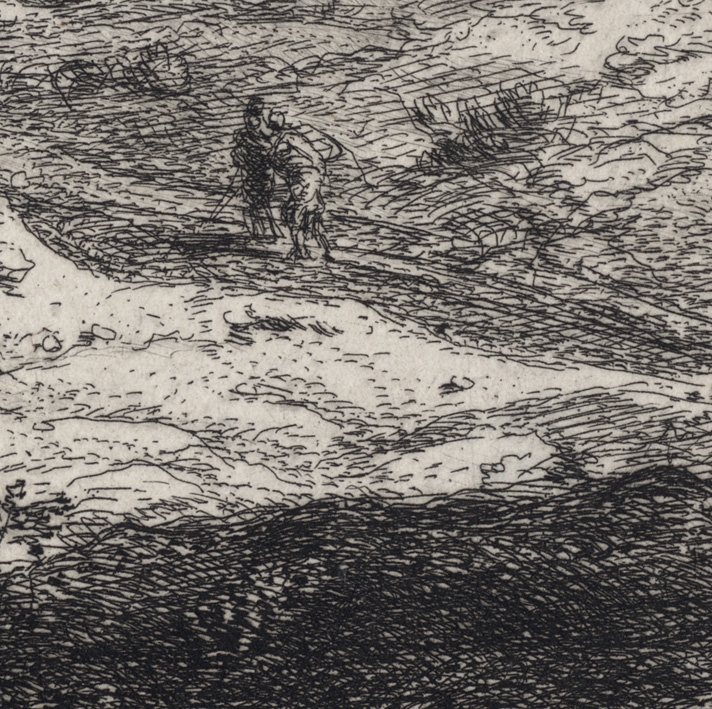
Theodore Fourmois’ etching, “Près d'Ardenne”


Theodore Fourmois (1814–71)
“Près d'Ardenne”, 1850
Etching chine collé trimmed near the platemark at the top and right sides.
Size: (sheet) 20.3 x 26.2 cm; (plate) 18.1 x 25.6 cm
Lettered below the image borderline (lower right): "T. Fourmois"
Hippert & Linnig 1874-9 I (Hippert, T & Linnig, J N, Le Peintre-Graveur Hollandais et Belge du dix-neuvième siècle, 3 vols, Brussels, 1809)
The British Museum offers the following description of this etching:
“Landscape of a hill with rocks, a path in the centre descending from left to right, two figures walking up along the path, a farmhouse in the centre with trees behind it, a village in the right background; plate 23 of the catalogue 'Album de la fête artistique à Bruxelles' (1850)” (http://www.britishmuseum.org/research/collection_online/collection_object_details.aspx?objectId=3338423&partId=1&searchText=Landscape+in+the+Ardennes&page=1).

Condition: marvellously crisp impression with printer’s creases/unevenness (?) in the chine collé. The verso is lined with a fine washi support sheet. The sheet is in excellent condition (i.e. there are no tears, holes, stains or foxing).

I am selling this loosely drawn landscape for AU$78 in total (currently US$58.53/EUR52.56/GBP44.66 at the time of posting this listing) including postage and handling to anywhere in the world.
If you are interested in purchasing this landscape etching by a leading 19th century Belgium printmaker, please contact me (oz_jim@printsandprinciples.com) and I will send you a PayPal invoice to make the payment easy.


Fourmois is best known for his landscapes of the Ardennes and Campine—although he did venture into countryside of Dauphiné (south eastern France) and Switzerland. This view of the rugged terrain for which the Ardennes is famous is captured beautifully with Fourmois’ signature-style of building up an image with a layering of tiny curved marks. 

What I especially like about this print is the way that Fourmois spotlights an almost diamond-shaped area in the near foreground. For a moment, when I was gazing at this spot-lit area, I had difficultly rationalising how he achieved this effect—as if a shaft of light had illuminated the ground. But then I realised that the artist has left a faint trace of plate tone (i.e. grey) over the plate and had thoroughly wiped clean the plate tone from this particular area until it gleamed.


Tuesday, 30 August 2016

Henriquel-Dupont’s engraving after Raphael


Louis Pierre Henriquel-Dupont (1797–1892)
“La Vierge et l'enfant Jésus” after Raphael, 1854, printed and published by Goupil (active 1827–1919)
The curator of the British Museum advises that this print is “after a drawing which is now in the Cabinet des Dessins, Louvre and which is believed to be a study for a lost painting known as the ‘Madonna Sergardi’.” (http://www.britishmuseum.org/research/collection_online/collection_object_details.aspx?objectId=3192972&partId=1&searchText=Henriquel+Dupont+La+Vierge&page=1)
Etching and engraving on chine collé trimmed within the platemark.
Size: (sheet) 32.1 x 22.7 cm; (image borderline) 25.6 x 18.9 cm
Lettered below the image’s borderline (lower centre): “Gravé par Henriquel Dupont, 1854 / LA VIERGE & L'ENFANT JÉSUS / D’ápres Le Defsin original, de Raphael appartenent au Museé Imperial”
Beraldi 1885-92 86 (Beraldi, Henri, “Les Graveurs du dix-neuvième siècle”, 12 vols plus supplement, Paris, 1885); IFF 87 (Inventaire du Fonds Français: Bibliothèque Nationale, Département des Estampes, Paris, 1930)

Condition: beautiful impression but in poor condition with restorations to the chine collé, trimmed within the platemark and with slight wrinkling. There glue residue at the outer edges (recto) and the back of the sheet is unevenly discoloured with oxidation/age-toning.

I am selling this amazingly delicate and finely executed engraving for AU$61 in total (currently US$45.91/EUR41.14/GBP35.01at the time of posting this listing) including postage and handling to anywhere in the world. (Note that this print has condition issues, as outlined above, and the low price reflects these issues.)
If you are interested in purchasing this exquisite print, please contact me (oz_jim@printsandprinciples.com) and I will send you a PayPal invoice to make the payment easy.

This print has been sold


Although this may not be the finest copy on the market of this very beautiful print, the delicacy and loving attention to detail that the master engraver is able to give to this translation of Raphael’s study of the now lost painting, “Madonna Sergardi”, is very evident.

What is remarkable about engravings by Henriquel-Dupont is the care and conspicuous amount of time that he took to make his prints. For example, his most famous engraving, which reproduces Delaroche's decoration for the Hémicycle of the École des Beaux-Arts, took ten years to execute. Such dedication …


Daubigny's etching, "Lever de Lune"


Charles-François Daubigny (1817–78)
"Lever de Lune" [Moonrise], 1871
Originally published in "Gazette des Beaux -Arts", 1871. (Vol. IV, pp. 446-47)
Etching with drypoint printed on chine-collé mounted on white wove paper with full margins
Size: (sheet) 21.1 x 29.9 cm; (plate) 14.8 x 21 cm; (image) 9.5 x 16.6 cm
Inscribed with signature under the image borderline (lower-left) and at plate edge (lower-left) "Les chefs -d'oeuvre _ 47"; the title (lower-centre); and the printer’s name (lower-right) "Imp. Chardon-Wittman."
Melot 98
(See description of same edition not listed by Melot: http://quod.lib.umich.edu/m/musart/x-1973-sl-1.755/1973_1.755___jpg)
Condition: Rich impression with full margins as published. There is light foxing, age-darkening at the edges and an area of lightening of the paper margin at the top-right; otherwise the print is in good condition.

I am selling this beautiful etching by Daubigny which epitomises the Barbizon School that changed the course of printmaking for a total cost of  [deleted] at the time of posting this listing including postage and handling to anywhere in the world. If you are interested in purchasing this etching please send me an email and I will email you a PayPal invoice.

This print has been sold


Prints like this very romantic image of the evening settling upon the rural landscape as a farmer attends to his cows followed by a woman carrying a child and holding another by the hand (no doubt his family) exemplifies the famous Barbizon School of artists. Although the print is small in size it is (without wishing to sound too pompous) epic in scale in terms of the layering of meanings it projects. What I mean by this grand statement is that at the time the print was executed there was an exodus of country folk heading out of the rural pastures to the greater fortunes of the newly industrialised cities. Essentially, this print is like a bucolic icon created to stand as an image evoking a fading era. How sad and deeply significant this print must have been for Daubigny as he drew what may well have been the last true souls of the rural landscape before industry changed everything.


Daubigny’s etching, "Le Berger et la Bergerer”


Charles-François Daubigny (1817–78)
"Le Berger et la Bergerer” [The Shepherd and Shepherdess], 1874
Published in "L'Art", vol. LXIII, 1904, p. 560, to illustrate an article by Henriet about Daubigny.
Etching on laid paper
Size: (sheet) 43.2 x 29.6 cm; (plate) 28.9 x 21.9 cm; (image) 25.4 x 19.5 cm
State v (of viii)
Inscribed with signature under the image borderline (lower-left); the title (lower-centre); and the printer’s name (lower-right)
Melot 122v (of viii), Delteil 122v (of viii)
Condition: Superb impression in pristine condition with full margins (and remnants of tissue-guard) as published.

I am selling this rare, original and arguably Daubigny's most famous etching for a total cost of [deleted] at the time of posting this listing) including postage and handling to anywhere in the world.
If you are interested in purchasing this etching in top condition please send me an email and I will email you a PayPal invoice.

This print has been sold


This is one of the last prints made by Daubigny. In the previous six years Daubigny had dedicated himself, almost exclusively, to painting as (according to Melot in "Graphic Art of the Pre-Impressionists") he was "much in demand as a painter" (p. 282). Beyond the visual poetry that Daubigny captures in this print of light filtering through trees and the romance of embracing lovers, what is especially beautiful is the lively line work that he employs. Interestingly, Melot proposes that this and the other five of Daubigny's final plates "were increasingly close to the style of the Impressionists in their use of delicate and vibrating small strokes" (p. 282). Indeed, etchings like this earn Daubigny the title of a "Pre-Impressionist."