Thursday, 27 June 2019

Conrad Faber von Kreuznach's woodcut illustration to Titus Livius’ “Romische Historie ...", c1505


(Attrib.) Conrad Faber von Kreuznach (aka Konrad Faber von Creuznach; [formerly] “Master of the Holzhausen Portraits”) (1495–1558)


“Marcus Danlius Confronts Lucium Wanlium” (descriptive title only), illustration to page 358 (CCCLVIII) of Titus Livius’ (59 BC–17 AD) “Romische Historie usz Tito livio gezogen” from the German edition published 1505–1530 by Johannes Schoeffer (c1475–1531) in Mainz, translated from Latin by Bernhard Schöfferlin (c1436–1501) and Ivo Wittich (1456–1507).

WorthPoint offers the following marvellous insight into Conrad Faber von Kreunach’s compositions:
“To depict scenes for the book, Conrad Faber used sketches which he had made during his travels along the Rhine. Thus identifiable towns on the Rhine were used to illustrate sieges and 16th century German dukes represented Roman leaders.”

Woodcut on fine early laid paper with letterpress fraktur text (recto and verso) backed with a support sheet.
Size: (sheet) 26.8 x 17 cm; (image borderline) 17.5 x 16.5 cm.
Lettered above the image borderline: (centre) “Der Römischen Historien.” (The Roman Histories); (right) “CCCLVIII” (358).
Lettered with six lines of German text below the image borderline:
“Marcus Danlius der Römischbirgermepster sog/ …/ …/ …/ …/ …/ …fole er da wider nichr fechres odes”
(Google translation with apologies for errors) “Marcus Danlius of the Roman-Bohemian monasteries, with his dewy-eyed finery, called upon the mountain to the end of the day, and called his brother Lucium Wanlium of midnight values (who favors the suffering and suffering of the dark) / and if, in the eventuality, he would be able to grasp the isolated place, he did not oppose it”.

Condition: richly inked, crisp impression without signs of wear to the printing plate. The sheet is in near pristine condition for its considerable age (i.e. there are no tears, holes, folds, abrasions, stains, foxing or signs of use) and is laid upon a support sheet of fine archival/millennium quality washi paper.

I am selling this superb woodcut masterpiece from 1505 for AU$388 (currently US$271.40/EUR238.62/GBP213.88 at the time of this listing) including postage and handling to anywhere in the world (but not, of course, any import duties/taxes imposed by some countries).

If you are interested in purchasing this woodcut of extraordinary quality in museum quality condition, please contact me (oz_jim@printsandprinciples.com) and I will send you a PayPal invoice to make the payment easy.

This print has been sold


Wednesday, 26 June 2019

Franz von Stuck's etching and drypoint, “Kämpfende Faune”, 1889


Franz von Stuck (1863–1928)

“Kämpfende Faune” (Fighting Fauns), 1889, published by Wien in 1892 in “Die vervielfältigende Kunst der Gegenwart” (The Duplicating Art of the Present), Heft XXVI (Radirung 5), in Vienna.

The Curator of the British Musuem offers the following insights about this print:
“Stuck created numerous paintings with similar subject matter, which are closely related to this print. The closest version is in the Bayerischen Staatsgemäldesammlungen (Pinakothek) in Munich, painted in 1889. For more information, see Heinrich Voss: 'Franz von Stuck 1863-1928, Werkkatalog der Gemälde', 1973, p. 99 and 259, and 'FvS und die Photographie' ed. Birgit Jooss, Munich 1996 (for photographs used in making the paintings).” (BM No. 1980,0628.19)

Etching and drypoint on wove paper trimmed close to the plate-mark (perhaps slightly within the plate-mark at the lower edge) and backed with a card support sheet.
Size: (sheet) 9.8 x 15.8 cm; (image borderline) 8.2 x 13.3 cm.
Inscribed on plate within the image borderline: (lower right) “FRANZ STUCK”.
Lettered on plate below the image borderline: (centre) “KÄMPFENDE FAVNE”.

The British Museum offers the following description of this print:
“Two fauns fighting, pressing their heads against each other; in the background, two more are sitting on a wall, watching the scene.”

Condition: well-printed impression with a small margin around the image borderline. The sheet is in excellent condition (i.e. there are no tears, holes, folds, abrasions, stains or foxing) and is laid onto an archival quality card and backed with a heavy support sheet to give the print margins.

I am selling this mythological fantasy of two young fauns literally butting heads for AU$252 in total (currently US$175.99/EUR154.78/GBP138.76 at the time of posting this listing) including postage and handling to anywhere in the world (but not, of course, any import duties/taxes imposed by some countries).

If you are interested in purchasing this sensitively executed small etching of great pictorial strength, please contact me (oz_jim@printsandprinciples.com) and I will send you a PayPal invoice to make the payment easy.
This print has been sold


Tuesday, 25 June 2019

Abraham Blooteling & Pieter Stevens van Gunst's anatomical engravings of male genitals, 1685


Abraham Blooteling (aka Abraham Bloteling; Abraham Blotelingh; Abraham Blootelingh) (1640–1690) and Pieter Stevens van Gunst (aka Pieter van Gunst) (1658/ 59–c1731)

(left) “Plate 46: Testicles”, 1685
(right) “Plate 44: Male Genitals“, 1685

Both engravings are after drawings in the Ecole de Médicine (Paris) by Gerard de Lairesse (1640/41–1711) as illustration plates to Govard Bidloo’s (1649–1713) famous anatomical atlas, “Anatomia humani corporis / Ontleding des menschelyken lichaams", first published by the widow (de Weduwe van Joannes van Someren) (fl. after 1679) of Johan van Someren (1622–1676) in 1685 in Amsterdam.

In previous listings I showcased an impression (now sold) from the 1734 edition published by Jacob van Poolsum (1701–1762) in Utrecht that had 2.5 cm chainlines (rather than the 3 cm chainlines of these prints) and on a sheet that is slightly smaller leading me to propose that these impressions are from the first edition.

Note that William Cowper (c1666–1709) also published an edition of the prints in 1739; see the description of the controversy about the Cowper edition offered by The Print Collector: http://www.theprintscollector.com/Article/Antique-Medical-Print-FOETUS-ABDOMEN-Cowper-Bidloo-1739.

Engravings on laid paper (3 cm chain-lines) with full margins as published.
Size (with small variations between the sheets: (sheet) 50.7 x 35.5 cm; (plate) 44 x 27.8 cm.
Numbered on plate at upper right corner on both sheets (“T. 46.”; “T. 44.”) and indexed with figures and letters.

For information about the Bidloo’s anatomical atlas in which these illustrations feature, see:
Christie’s Auction: Anatomy As Art: The Dean Edell Collection
Rare Prints Gallery
This publication is available to view online or to download free of charge from archive.org

Condition: well-printed and near faultless impressions with minor spots appropriate to the age of the prints, otherwise the sheets are in excellent condition (i.e. there are no tears, holes, folds, abrasions, significant stains—again, there are a few spots—or foxing).

I am selling this pair of large masterpieces of engraving from one of the most famous series of anatomical illustrations created, for AU$550 in total for the pair (currently US$383.38/EUR336.55/GBP300.44 at the time of posting this listing) including postage and handling to anywhere in the world (but not, of course, any import duties/taxes imposed by some countries).

If you are interested in purchasing this extraordinary and technically magnificent pair of engravings—the ideal gift for a man who loves his jewels—please contact me (oz_jim@printsandprinciples.com) and I will send you a PayPal invoice to make the payment easy.


Monday, 24 June 2019

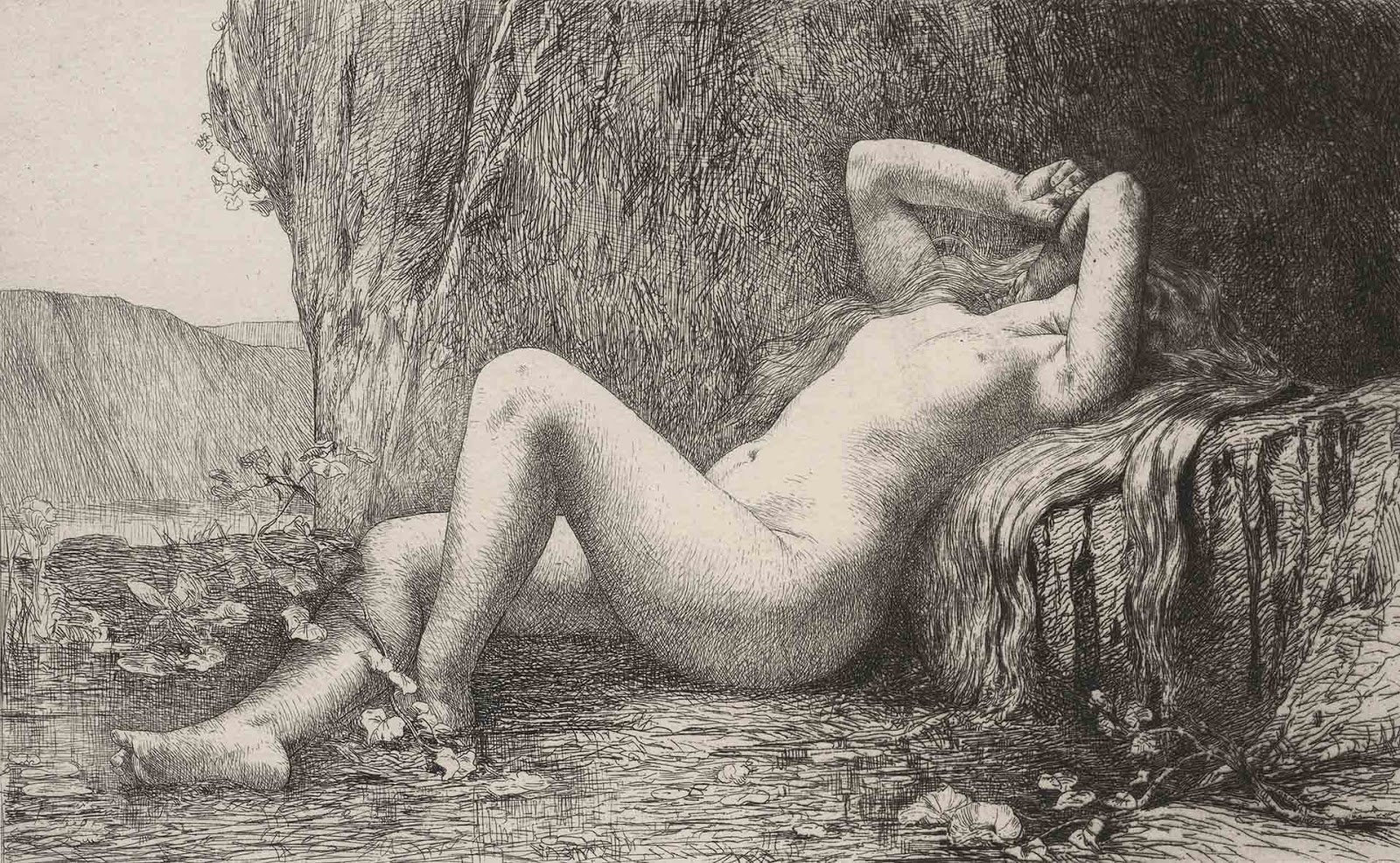
Jules Joseph Lefebvre's etching, “Madeleine”, c1876


Jules Joseph Lefebvre (aka Jules Joseph Lefevre; Jules Lefebvre) (1836–1911)

“Madeleine”, c1876, after the painting by the artist, “Mary Magdalene In the Cave”, 1876, exhibited in the Salon of 1876 and now in the collection of the Hermitage Museum (Saint Petersburg). This etching was published in “'La Gazette des Beaux-Arts” and printed by Alfred Salmon (aka Alfred Fortuné Salmon) (fl.1863–94) in Paris.

Etching on laid paper with small margins and backed with a support sheet.
Size: (sheet) 18 x 24.6 cm; (plate) 15.1 x 22.3 cm; (image borderline) 12.4 x 20.1 cm.
Lettered on plate below the image borderline: (left) “JULES LEFEVRE PINX & SCULP. / Gazette des Beaux-Arts.”; (centre) “MADELEINE”; (right) “SALON DE 1876 / Imp. A. Salmon, Paris.”

Beraldi 1885-92 6 (Henri Beraldi 1885, “Les Graveurs du dix-neuvième siècle”, 12 vols plus supplement, Paris); IFF undescribed (Département des Estampes 1930, “Inventaire du Fonds, Français: graveurs du XVIIe siècle”, Paris, Bibliothèque Nationale).

The British Museum offers the following description of this print:
“St Mary Magdalene, lying naked in landscape”

For those unfamiliar with the portrayed subject, legend proposes that after Christ’s crucifixion, Saint Marie Madeleine (Mary Magdalene) travelled by a rudder-less boat to the coast of Provence and “spent the last 30 years of her life in prayer and meditation in a mountain cave in the sacred forest of La Saint Baume. As the story goes, her only sustenance was the Holy Eucharist, which she received on a daily basis from angels.” (http://www.marymagdalenewisdom.com/the-cave-of-magdalene)

Condition: near faultless impression backed with a support sheet of fine archival/millennium quality washi paper. There are flattened creases in the lower margin otherwise the sheet is in excellent condition (i.e. there are no tears, holes, abrasions, stains, foxing or significant signs of use).

I am selling this sensitive and very sensual depiction of Mary Magdalene resting outside her cave—the Sainte-Baume grotto—for AU$220 (currently US$152.95/EUR134.23/GBP120.04 at the time of this listing) including postage and handling to anywhere in the world (but not, of course, any import duties/taxes imposed by some countries).

If you are interested in purchasing this beautifully rendered nude showing finely tuned contrasts between the pale tones and softness of the saint’s skin set against the darker tones and coarse textures of her surroundings, please contact me (oz_jim@printsandprinciples.com) and I will send you a PayPal invoice to make the payment easy.

This print has been sold


Sunday, 23 June 2019

Niccolo Guidetti's engraving, “Mater Amabilis”, c1815, after Raphael


Niccolo Guidetti (aka Nicola Guidetti) (fl.1800–50)

“Mater Amabilis” (Loving Mother), c1815, after Raphael’s (aka Raffaello Santi) (1483–1520) painting, “The Virgin and Child” (aka “The Bridgewater Madonna”), c1507, in the collection of the Scottish National Gallery, published by Ignazio Pavon (fl.1810–1850) in Rome, with dedication from Pietro Fontana.

Regarding Raphael’s painting shown in reverse in this engraving, the Scottish National Gallery offers the following insight:
“Raphael made many drawings and paintings of the Virgin and Child, in part inspired by the work of Leonardo da Vinci in Florence. Here he achieved a particularly graceful combination of poses, with an elegant twist (contrapposto) in both. The exchange of glances further emphasises the tender relationship between the beautiful mother and child. Technical analysis has revealed that the artist originally painted a landscape background. Raphael may have decided that a dark setting was a better foil for the subtle modelling of his figures in light and shadow. The painting was probably made as a devotional image for a private chamber.”

Engraving with etching on wove paper backed with a support sheet.
Size: (sheet) 41 x 29.4 cm; (plate) 38.5 x 27 cm; (image borderline) 28.8 x 22.3 cm.
 Lettered on plate below the image borderline: (right) “Raffaello Sanzio inv. e dip.”; (centre) “MATER AMABILIS / A Sua Eccellenza / La Signora Contessa de Westmorland […] / Pietro Rontana D. D. D. / Si vende in Roma presso Ignazio Pavon in Via del Babuino N° 124.”; (right) “Nicola Guidetti inc. in Roma.”

Nagler 397 (Raphael)

Condition: well-printed near faultless impression with small margins in museum-quality/near pristine condition backed with a support sheet of fine archival/millennium quality washi paper.

I am selling this exceptionally sensitive engraving of Raphael’s “The Bridgewater Madonna” for AU$220 (currently US$152.46/EUR134.07/GBP119.66 at the time of this listing) including postage and handling to anywhere in the world (but not, of course, any import duties/taxes imposed by some countries).

If you are interested in purchasing this beautiful engraving from the early 1800s in near perfect condition, please contact me (oz_jim@printsandprinciples.com) and I will send you a PayPal invoice to make the payment easy.

This print has been sold