Monday, 14 January 2019

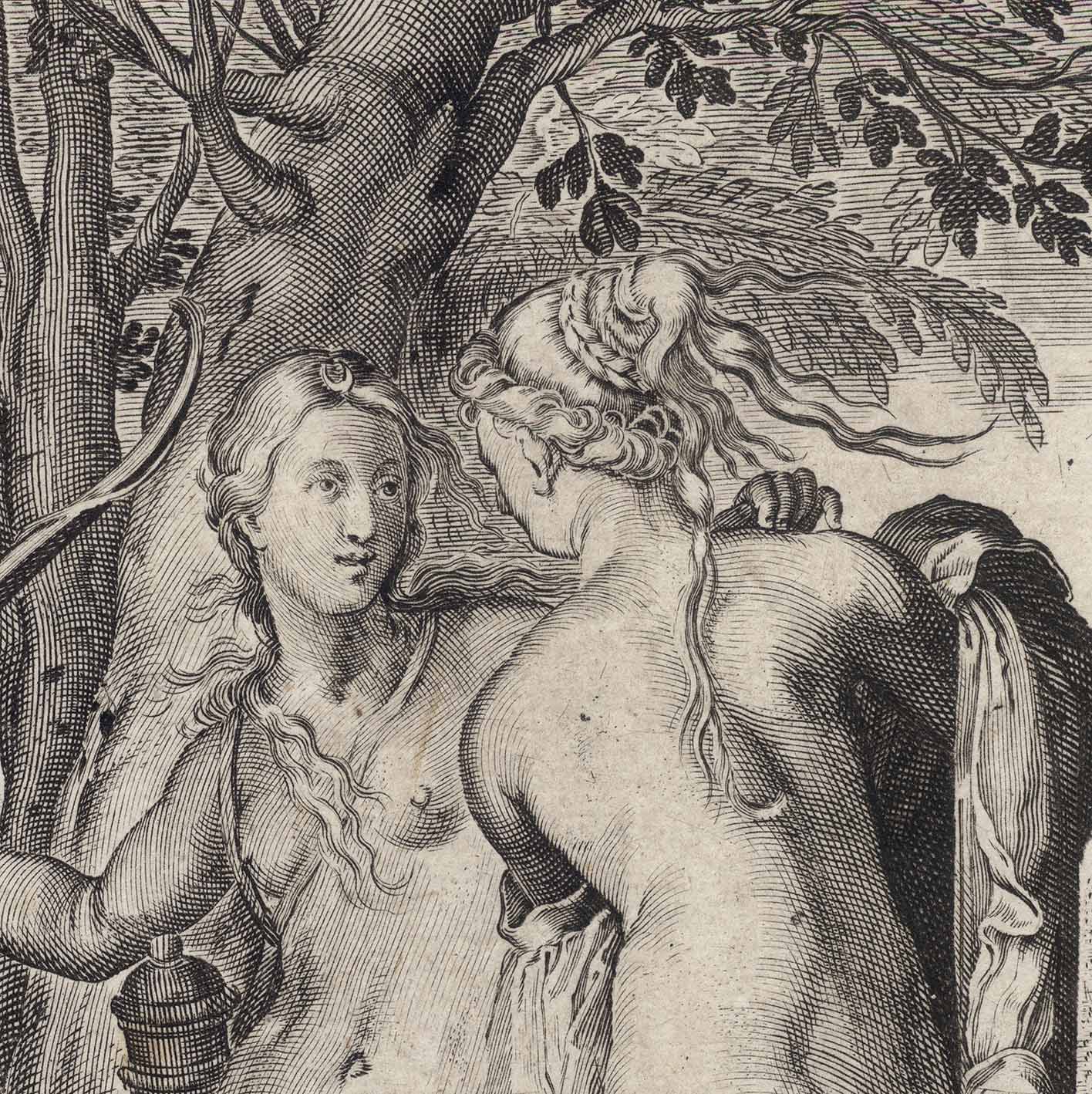
Engraving from the circle of Jan Saenredam (in reverse of Saenredam’s composition), “Diana and a Wood Nymph”, c1650


(From the circle of) Jan Saenredam (aka Jan Pietersz Saenredam) (c1565–1607)

“Diana and a Wood Nymph” (Rijksmuseum title) (aka “Two Nymphs, One seen from the Rear, the Other Holding a Bow” [TIB title]) (Deux nymphes don’t l’une, placée à gauche …), c1650, copy in reverse after Jan Saenredam, after Hendrik Goltzius (aka Hendrick Goltzius) (1558–1617), first plate from the series of three plates with Latin captions, “Diana’s Nymphs” (TIB title).

Engraving on laid paper trimmed with thread margins around the platemark, backed with a support sheet
Size: (sheet/plate) 22 x 16 cm; (mage borderline) 20.8 x 15.7 cm.
Inscribed on plate within the image borderline: (lower right of centre) “HG. inu. I. Saenredam / sculp.”
Lettered below the image borderline: (left) “1’S’2” [?]; (centre) "Felices sÿlvæ nymphas spectare Dianæ".

Copy in reverse after Saenredam’s engraving: TIB Bartsch 4 (3). 59 (240) (Walter L Strauss [ed.] 1980, “The Illustrated Bartsch: Netherlandish Artists”, Abaris Books, New York, vol. 4, p. 37); Hollstein Dutch 80-3 (8) (GS Keyes & KG Boon [eds.] 1980, “Dutch and Flemish etchings, engravings and woodcuts ca. 1450–1700: Jan Saenredam to Roelandt Savery”, vol. 23, Amsterdam, Van Gendt & Co, p. 62, cat.no. 80).

Condition: crisp, well-inked and well-printed impression trimmed along the platemark and backed with a support sheet of archival (millennium quality) washi paper. The sheet is in excellent condition (i.e. there are no tears, holes, creases, abrasions or significant stains—but there are a few spots).

I am selling this engraving in reverse of Saenredam’s print (which in turn was a copy of Goltzius’ composition) for the total cost of AU$230 (currently US$165.30/EUR143.94/GBP128.74 at the time of posting this print) including postage and handling to anywhere in the world (but not, of course, any import duties/taxes imposed by some countries).

If you are interested in purchasing this finely rendered engraving (note in particular the subtle curving “flow” of vertical lines describing Diana’s body and the variety of marks used to portray the foliage), please contact me (oz_jim@printsandprinciples.com) and I will send you a PayPal invoice to make the payment easy.

This print has been sold


Sunday, 13 January 2019

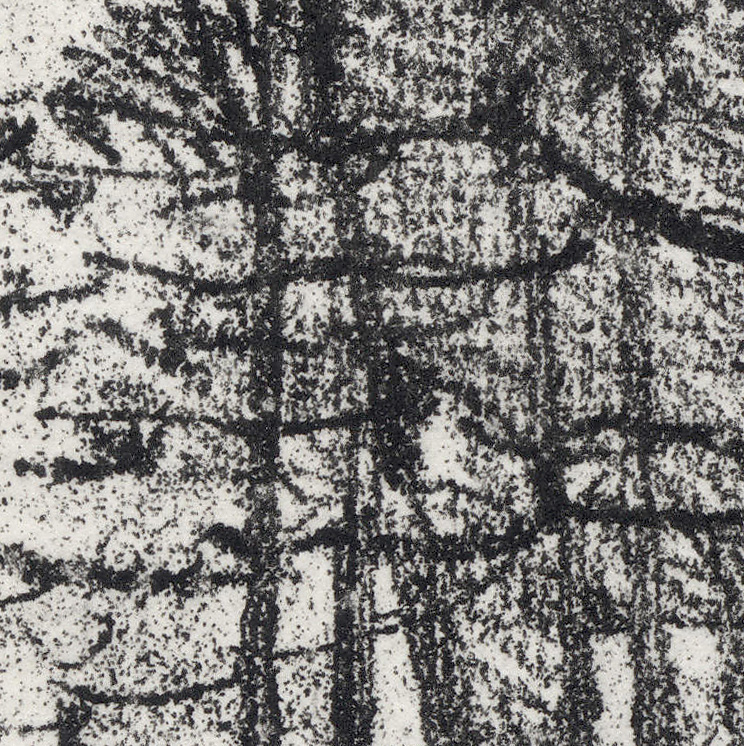
John Crome's soft-ground etching, "Hoveton St. Peter", 1811–12


John Crome (1768–1821)

"Hoveton St. Peter", 1811–12, from the series of 31 etchings, “Etchings of Views in Norfolk” (aka “Norfolk Picturesque Scenery” [MMA title]), published before (or after?) the chine collê posthumous edition of 1834 (“to benefit his widow”, see MMA No. 26.72.223[26]) and/or 1838 (see BM No. 1868,0612.1823).

Soft-ground etching on wove paper with margins backed with a support sheet.
Size: (sheet) 23.4 × 30.3 cm; (plate) 16.8 × 24 cm
Signed on plate with etcher's initials in lower right corner: “JC”
State i (of i)

Goldberg 1978 240 (Norman L Goldberg 1978, “John Crome the Elder”, [2 vols.], New York, New York University Press, p. 285 [vol. 1], p. 164 [vol. 2]); Theobald 1906 30 (Henry Studdy Theobald 1906, “Crome's Etchings”, London, Macmilian); Goldberg 1978 242 (Norman L Goldberg 1978, “John Crome the Elder”, New York, New York University Press).

The British Museum offers the following description of this print:
“End of wood, with tall trees on r, fields and clouds beyond fence on l.”
See also the description of this print at the Metropolitan Museum of Art:

Condition: richly inked and well-printed crisp impression with generous margins backed with a support sheet of archival (millennium quality) washi paper. There are signs of handling in the margins (i.e. a flattened fold and tear at upper left corner and the platemark shows minor abrasions/staining), otherwise the sheet is in a very good condition.

I am selling this extremely rare and very beautiful etching, for AU$390 in total (currently US$281.53/EUR245.41/GBP219.30 at the time of posting this listing) including postage and handling to anywhere in the world (but not, of course, any import duties/taxes imposed by some countries).

If you are interested in purchasing this major print in the oeuvre of one of the first English artists to value etching as a significant medium for portraying landscape and helped to pave the way for the Etching Revival, please contact me (oz_jim@printsandprinciples.com) and I will send you a PayPal invoice to make the payment easy.

This print has been sold


Saturday, 12 January 2019

Stefano della Bella’s etching, “Stag Hunt”, c1643


Stefano della Bella (1610–1664)

“Stag Hunt”, c1643 (1640–45), plate 5 from the series of 12 plates, “Diverses Paisages” (“not to be confused with a series of the same name containing four plates, produced c.1641” as advised by the Curator of the BM [1871,0513.709]), published by Israël Henriet (c1590–1661) in Paris.

Etching on fine laid paper trimmed close to the image borderline and backed with a support sheet.
Size: (sheet) 11.3 x 26 cm; (image borderline not including the text box) 10.4 x 25.8 cm
Inscribed on plate below the image borderline: (right) "Israel excud. Cum privilegio Regis. 5"

De Vesme/Massar 1971 761.II (A de Vesme 1971, revised by Phyllis D.Massar, “Stefano della Bella”, New York)

The British Museum offers the following description of this print:
“Plate 5; stag hunt; the stag to right, fleeing towards left through a river and pursued by several hounds and riders on horseback, with a man holding a hunting spear and with a dog standing to left to stop them; with trees behind and to left.”

Condition: crisp and well-printed impression on fine laid paper trimmed close to the image borderline and backed with a support sheet of archival (millennium quality) washi paper. There is a small loss in the sky at the upper left (almost invisible) otherwise the sheet is very good condition.

I am selling this interesting landscape where the treatment of the trees helps to explain the portrayed narrative of a hunt—note for example how the trees shown above the running stag are rendered with horizontal strokes whereas the trees on the left to which the poor animal is making its escape are rendered in a turmoil of waving rhythms—for the total price of AU$170 (currently US$122.72/EUR106.97/GBP95.59 at the time of posting this listing) including postage and handling to anywhere in the world (but not, of course, any import duties/taxes imposed by some countries).

If you are interested in purchasing this remarkable landscape, please contact me (oz_jim@printsandprinciples.com) and I will send you a PayPal invoice to make the payment easy.

This print has been sold


Stefano della Bella’s etching, “Landscape with Windmill”, c1643


Stefano della Bella (1610–1664)

“Landscape with Windmill” (descriptive title only), c1643 (1640–45), plate 10 from the series of 12 plates, “Diverses Paisages” (“not to be confused with a series of the same name containing four plates, produced c.1641” as advised by the Curator of the BM [1871,0513.709]), published by Israël Henriet (c1590–1661) in Paris.

Etching on fine laid paper trimmed close to the image borderline and backed with a support sheet.
Size: (sheet) 12 x 26 cm; (image borderline not including the text box) 10.6 x 25.8 cm
Inscribed on plate below the image borderline: (right) "Israel excud. Cum privil. Regis / 10."

De Vesme/Massar 1971 766.II (A de Vesme 1971, revised by Phyllis D.Massar, “Stefano della Bella”, New York)

The British Museum offers the following description of this print:
“Plate 10; windmill at centre; to left, a couple with a child seated on the ground under a tree, and to right, two people riding a horse towards left followed by a man on foot; with other figures and animals near the windmill.”

Condition: crisp and well-printed impression on fine laid paper trimmed close to the image borderline and backed with a support sheet of archival (millennium quality) washi paper. There is a small tear in the text box at lower left otherwise the sheet is very good condition.

I am selling this eye-catching and large(ish) landscape etching showing Della Bella’s skill in employing meaningful variation to the etched depth of his lines to create the illusion of spatial distance and, importantly, a landscape suffused in light, for the total price of AU$170 (currently US$122.72/EUR106.97/GBP95.59 at the time of posting this listing) including postage and handling to anywhere in the world (but not, of course, any import duties/taxes imposed by some countries).

If you are interested in purchasing this sensitively etched landscape, please contact me (oz_jim@printsandprinciples.com) and I will send you a PayPal invoice to make the payment easy.

This print has been sold


Friday, 11 January 2019

Antonio Tempesta’s etching, “Civilis Floods the Land by Defensively Breaking the Dikes”, 1611


Antonio Tempesta (1555?–1630)

“Civilis Floods the Land by Defensively Breaking the Dikes” (TIB’s title) (aka “Civilis leaves the country under water” [Rijkesmuseum’s transl. title]), 1611, possibly after Otto van Veen (1556–1629) (according to the Rijksmuseum [see RP-P-OB-37,681]), plate 29 from the series of 37 plates (including the frontispiece/titlepage), “The War of the Romans against the Batavians” (Romanorvm et Batavorvm societas), published in the first edition without Latin text verso in 1612 in Antwerp.

Etching on laid paper trimmed along the platemark (or close to the image borderline) and backed with a support sheet.
Size: (sheet) 16.9 x 21.4 cm; (image borderline) 14.7 x 20.9 cm.

Monogrammed on plate at lower left corner: “AT” (in ligature).
Lettered on plate below the image borderline: (in four lines of Dutch text at left): “Civilis maeckt hem sterck by het Oudt legher, ende maeckt eenen / dyck, die den Ryn over t'landt doet loopen daer Cerialis lagh / men vecht in’t verdroncken landł, daer de Duytschen lanck van / persoon synde, ende den grondt kennende, de Romeynen doen wycken.”; (center within a circle) “29”; (in four lines of Latin text at right) “Civilis reparato per Germaniam exercitu apud Vetera con: / sedit, molem Rheno iniecit, ut aqua circumquaque stagnaret, / et Romani nandi ignari in aquis pugnarent. Germani / aquis exstantes et vadi gnari Romanos in fiugam pellunt.”

State i (of ii) Note: TIB lists this impression without Latin text verso as “SI I2” and the impressions with the text verso as “SI I1”. In the second state the plate is “heavily retouched” and with “PLANCHE XXIX. / BATAILLE DU PREMIER JOUR.” (among other changes). There is also a copy in the same direction executed by Joseph Mulder and inscribed, “I. Mulder fecit."  (see http://hdl.handle.net/10934/RM0001.collect.156913

TIB 35. 525 S1 12 (Eckhard Leuschner 2007, “The Illustrated Bartsch: Antonio Tempesta, vol. 35. Commentary, Part 2, New York, Abaris Books, p. 145); Bartsch 588 i/ii (Adam von Bartsch 1803, “Le Peintre graveur,” Vienna); FMH 65-b (29) (Frederik Muller 1863–82, “The Dutch history in plates: reasoned description of Dutch history records …”, [4 vols], Amsterdam, dl. I [years 100 to 1702], p. 8, No. 65b [29]); Nagler XVIII.179.560-.595 (G K Nagler 1835–52, “Neus allgemeines Künstler-Lexicon” [22 vols.]).

The Rijksmuseum offers a description of this print:

See also the description at the Metropolitan Museum of Art:

Condition: superb lifetime impression from the first state that is richly inked, crisp and well-printed without Latin letterpress text verso. The sheet is in excellent condition (i.e. there are no tears, holes, folds, abrasions, stains or foxing), trimmed along the platemark (or close to the image borderline) and backed with a support sheet of archival (millennium quality) washi paper.

I am selling this superb first state/lifetime etching for the total cost of AU$207 (currently US$149.64/EUR129.71/GBP1116.73 at the time of posting this print) including postage and handling to anywhere in the world (but not, of course, any import duties/taxes imposed by some countries).

If you are interested in purchasing this graphically strong image full of swirling action, but without the extreme use of distortions typifying the earlier period style of Mannerism, and executed when Rembrandt was only a five-year-old boy, please contact me (oz_jim@printsandprinciples.com) and I will send you a PayPal invoice to make the payment easy.

This print has been sold