Monday, 6 August 2018

Jan van Londerseel’s engraving, “Judah and Tamar”, c1600


Jan van Londerseel (aka Johannes van Londerseel) (1578–c1625) (according to the BM or an anonymous printmaker according to the Rijksmuseum)

“Judah and Tamar”, 1590–1625, after a print by Nicolaas de Bruyn (aka Nicolaas de Bruin; Nicolaes de Bruyn) (1571–1656), after the design by Maarten de Vos (aka Marten de Vos; Maerten de Vos) (1532–1603), after Gillis van Coninxloo (aka Egidius Coninxlogensis; Gillis van Coningsloo) (1544–1607), plate 23 from the series of 131 engraved illustrations (including the title page) to the “Royal-Size Bible” (aka Historiae Sacrae Veteris et Novi Testamenti; Biblische figuren, Darinen die fürnembste historien, in heiliger Schrifft begriffen, geschichtmässig entworffen; Figures de la Bible, demonstrans les principales histoires de la Saincte Escriture; Bybelsche figuren, vertonende de voornaemste historien der Heylige Schrifture; Figures of the Bible, in wich almost every history of the Holy Scriptures is described), published by Nicolaes Visscher I (aka Nicolaas Visscher; Claes Claesz Visscher) (1618–1679) and Claes Jansz. Visscher (aka Piscator; Nicolaes Jansz Visscher) (1587–1652) in Amsterdam.

Engraving on laid paper with red ink lines marking upper and lower borders and a centerfold (as published), trimmed near the image borderline and backed with a support sheet.
Size: (sheet) 39 x 52.5 cm; (image borderline) 36.6 x 52.3 cm
Inscribed on plate within the image borderline: (lower left) "Egidius Coningsloo inven. CIViβcher Excu."
Lettered in Latin text on plate below the image borderline:  "IUDAS ET THAMAR COEUNT PROMITTITUR HOEDUS   ANNULUS, ARMILLÆ, ATQUE PEDUM PRO PIGNORE DANTUR. Genesis 38.6."

Hollstein 10 (Londerseel); Hollstein 21 (after Gilles van Coninxloo); Hollstein undescribed (Visscher)

The British Museum offers the following description of this print:
“Judah and Tamar [Genesis 38:6]; woody landscape with an elderly man embracing a younger woman in lower left, the woman holding a ring and looking at it, a castle surrounded by a moat at centre, mountains and a cascading river in background; after Gillis van Coninxloo; from a series of 130 engravings (plus title-page) forming a Picture Bible”
See also the description of this print at the Rijksmuseum:

Condition: a near faultless early impression (based on the crisp lines and lack of wear to the plate), richly inked and well-printed, trimmed close to the image borderline and backed with a support sheet of archival (millennium quality) washi paper. There are ruled red ink lines bordering the image at the top and lower edges. Otherwise the sheet is in near pristine condition (i.e. there are no tears, holes, folds—apart from the flattened centrefold of publication—abrasions, stains, foxing or signs of use).

I am selling this huge engraving showing not only the shocking liaison between a father-in-law and his daughter-in-law who he has mistaken for a whore, but also a sublime landscape designed by the brother-in-law of Pieter Brueghel the Younger, for AU$405 in total (currently US$299.05/EUR259.01/GBP231.37 at the time of posting this listing) including postage and handling to anywhere in the world (but not, of course, any import duties/taxes imposed by some countries).

If you are interested in purchasing this masterpiece from the late 1500s/early 1600s, please contact me (oz_jim@printsandprinciples.com) and I will send you a PayPal invoice to make the payment easy.

This print has been sold


I have previously listed an illustration of the story for Judah and Tamar executed by Harmen Jansz. Muller, but for those who may have missed the account of what is portrayed in this scene I will give a VERY brief explanation: the chap in the foreground is Tamar and he has mistaken his daughter-in-law, Judah, for a prostitute. He is shown here engaged in the act of purchasing her services by offering her his signet ring which she examining along with his staff which she holds. These items along with bracelets (which the artist has failed to portray) are collateral for a goat which she is later to receive as advised in the Latin text beneath the image: (transl.) “… rings, bracelets, and crook given as collateral. Genesis 38.6”

The publication of this engraving in the “Royal-Size Bible” is rather complicated and so I will leave the explanation to the account offered by the British Museum:

“… a series of 130 engravings known as the 'Royal-Size Bible'. It contains 65 biblical scenes from the Old Testament and 65 biblical scenes from the New Testament; the project was originally started by Claes Jansz Visscher and published by his son Nicolaes after his father's death in 1652. Some prints have the address of Claes Jansz Visscher and others have the address of Nicolaes Visscher, meaning the elder Visscher might have published some plates separately before. The prints are printed on royal size paper (roughly 400 mm by 500 mm), folded vertically and inserted on tabs, bound together in a blindstamped vellum cover. The prints are made by and after various artists. Most of the prints were taken from earlier print series and selected by Visscher to make up a new set and create this Picture Bible, others seem specially made for Visschers' Picture Bible by an unidentified printmaker. Some of the plates were engraved by Pieter Nolpe and Johannes van Londerseel. Many compositions from the 'Theatrum Biblicum' (another Picture Bible published by Claes Jansz Visscher) were copied, transferred to the royal format, as were inventions of artists such as David Vinckboons, Maerten de Vos, Gillis van Coninxloo, Melchior d'Hondecoeter, Peter Paul Rubens, Abraham van Diepenbeeck and Nicolaas de Bruyn.”

The Rijksmuseum also gives an account of the publication details:


Sunday, 5 August 2018

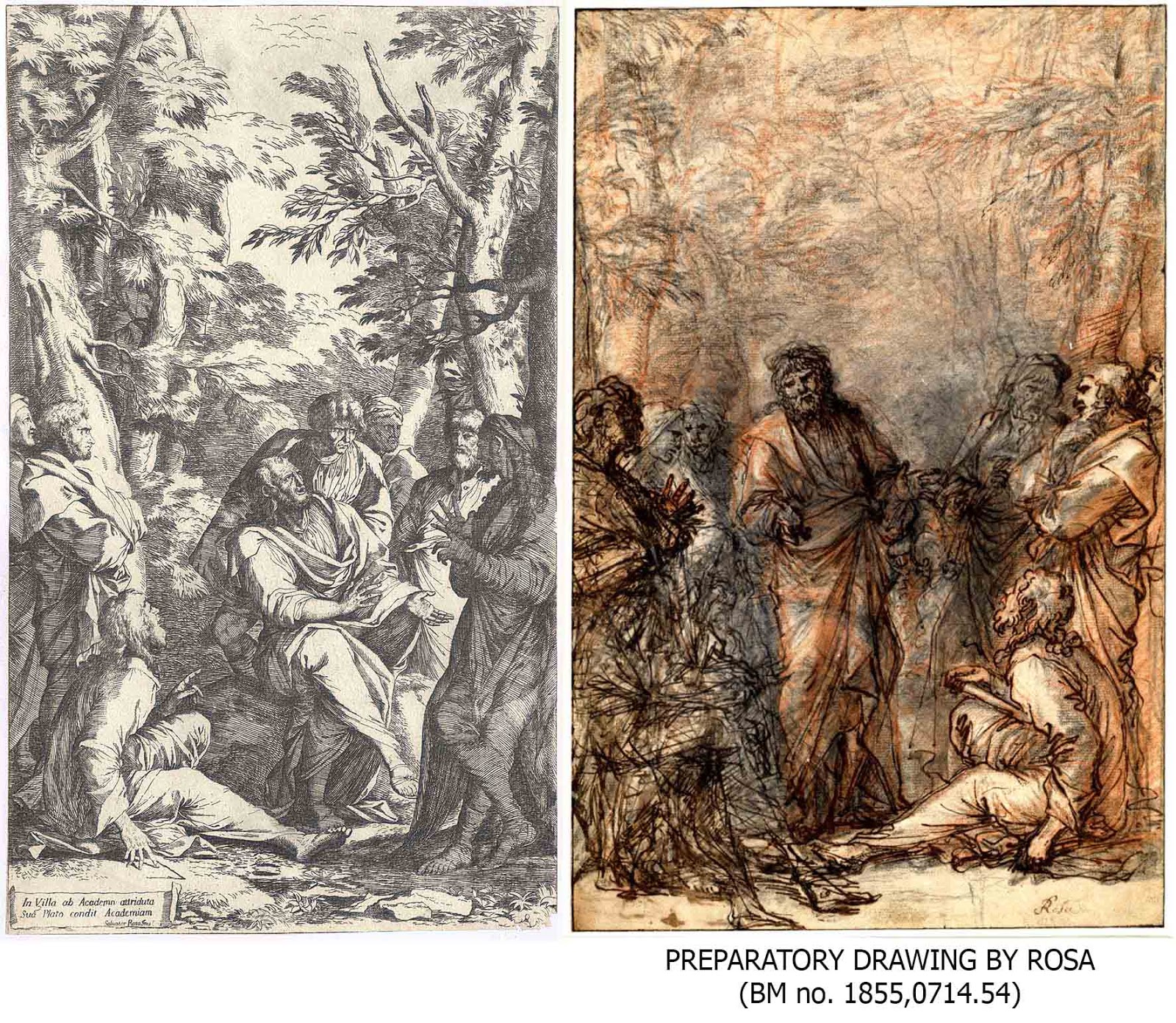
Salvator Rosa’s etching with drypoint, “The Academy of Plato”, 1662


Salvator Rosa (1615–1673)

“The Academy of Plato”, 1662, based on a preparatory study executed in black and red chalk with pen and brown ink held by the British Museum: http://www.britishmuseum.org/research/collection_online/collection_object_details.aspx?objectId=714207&partId=1&searchText=+1855,0714.54&page=1

Etching and drypoint on heavy laid paper trimmed along the image borderline.
Size: (sheet) 44.9 x 26.5 cm
Inscribed on plate: (Latin text on scroll at lower left) "In Villa ab Academo attributa / Sua Plato condit Academiam / Salvator Rosa Inv. scul." (transl. “In the villa given by Academus Plato founds his Academy.)

State ii (of ii)
This attribution is based on Richard W Wallace’s (1979) description of the plate in the second state:
“The ear of the figure seated in the left foreground removed by being burnished out. His hair worked over with light drypoint. Light drypoint shading added to the tree trunk behind his head. Small amount of light drypoint shading added to Plato’s drapery at his right shoulder, to the cap and drapery of the figure farthest in depth at the right, and to the drapery of the figure in the foreground at the extreme right. Light drypoint added to several portions of the background foliage especially near Plato. Some additional burnishing of the ground and background foliage.” (Wallace, p. 273)

TIB 4512. 003 S2 [B. 3 (269)] (Paolo Bellini & Richard W Wallace [eds.] 1990, “The Illustrated Bartsch: Italian Masters of the Seventeenth Century”, vol. 45, Commentary, Abaris Books, pp. 337–39); Wallace 1979 109.II (Richard W Wallace 1979, “The Etchings of Salvator Rosa”, Princeton University Press, Princeton, pp. 272–74); Bartsch XX.269.3

The British Museum offers the following description of this print:
“The academy of Plato; in centre, Plato seated talking to his students in the gardens of his academy.”
See also the description of this print at the Rijksmuseum:

Condition: richly inked, well-printed, crisp impression trimmed along the image borderline. The sheet is in near faultless condition but the lower right corner has a few nibbles/losses.

I am selling this large etching by Rosa—one of his largest prints!—for AU$410 in total (currently US$303.48/EUR262.27/GBP233.45 at the time of posting this listing) including postage and handling to anywhere in the world (but not, of course, any import duties/taxes imposed by some countries).

If you are interested in purchasing this masterwork by Rosa, please contact me (oz_jim@printsandprinciples.com) and I will send you a PayPal invoice to make the payment easy.

This print has been sold


To make this very large print by Rosa extra interesting to contemplate, the British Museum holds a preparatory study for it executed in black and red chalk with pen and brown ink.

At first glance the preliminary drawing and the etching may seem very different, but close examination shows that the seated figure at the lower right in the drawing is a mirror image of the same figure on the left in the etching (as one would expect through the printing process). Going further the almost silhouetted hands of the standing figure in the near foreground of the drawing have been retained in the design of the etching.

For me, Rosa’s retention of these hands, caught in a momentary gesture of communication with Plato, is pivotal to the expressed meaning of the composition. After all what is portrayed in the scene is a discourse between Plato and his followers.

Beyond the compositional connections linking the drawing and print there are some significant differences that I find surprising. For example, Rosa has changed the arrangement of the two standing men behind the seated chap on the right of the drawing. From my standpoint in comparing the two compositions, I believe that the intimate interaction of these figures in the drawing is lost in the changes to the same figures in the etching.

Rosa’s portrayal of Plato is another major departure in the designs of the two compositions. Again from a personal standpoint, I find that the etching’s arrangement which shows the great philosopher in a seated position makes Plato seem diminutive and almost lost in the composition compared to the standing pose in the study. Going further, I also find that the leg of the seated man in the immediate foreground of the drawing pictorially “pushes” Plato back into the centre of the ring of his followers, whereas in the etching showing the seated figure’s leg less in front of Plato adds a note of spatial confusion to the composition.

(Of course, these observations are strictly personal responses and everyone will have different readings when comparing the chalk study with the etching.)


Saturday, 4 August 2018

Jan Sadeler I’s engraving, “Adoration of the Shepherds”, c1590


Jan Sadeler I (aka Johannes Sadeler; Johann Sadeler) (1550–1600)

“Adoration of the Shepherds” (TIB title), 1585–1595, after a drawing by Hans von Aachen (aka Johann von Achen) (1552–1615) in the Staatliche Graphische Sammlung, Munich (see Isabelle de Raimaix’s [1999] commentary for TIB 7001.153)

Engraving on fine laid paper trimmed around the oval image borderline and backed with a support sheet.
Size: (oval trimmed sheet) 23.4 x 17.4 cm
Inscribed on plate with an imperial privilege: (lower left) “cu priuel. Sac. Cæs. Maic[?]”

State i (of ii) Note: my attribution of this print to the first state is based on the crisp quality of the lines showing no sign of wear to the printing plate. Ramaix (1999) advises that second state impressions exhibit “curved hatching on Joseph’s leg” (TIB 7001.153 S2). Sadly, I am unable to recognise which of the portrayed figures is Joseph. Certainly the figure to the right of the centre angel is a shepherd as advised by the BM’s description of this print, and—as far as I can see— none of the portrayed male figures reveal their legs. (A mystery!) Fortunately, Hollstein proposes that there is only a single state and so attributing this impression to the first state may not be a major issue.

TIB 7001.153 SI (Isabelle de Ramaix [ed.] 1999 “The Illustrated Bartsch: Johan Sadeler I”, vol. 70, Part 1 [Supplement], Abaris Books, pp. 179–80); New Hollstein (German) 19 (Hans von Aachen); Meyer, vol. 1, p. 41, no. 46; Gerszi, p. 390; hollstein 1980, vol. 21, no. 181; Szafraniec-Zrdaltowska, pp. 261–66.

The British Museum offers the following description of this print:
“The adoration of the shepherds, with Mary praying at the left, an angel in the centre and a shepherd at the right, with numerous figures behind, an oval composition after Hans von Aachen”

Condition: richly inked, well-printed, crisp impression with significant restored losses (with watercolour infilling) on the right side. The sheet is backed on a support sheet of archival (millennium quality) washi paper.

I am selling this masterpiece of engraving from the late 1500s by one of the most important of the Flemish old master printmakers for AU$423 in total (currently US$313.10/EUR270.58/GBP240.86 at the time of posting this listing) including postage and handling to anywhere in the world (but not, of course, any import duties/taxes imposed by some countries).

If you are interested in purchasing this stunning example of Mannerism full of shiny fabric, meaningful gestures and fascinating symbolism—note for example the bagpiper on the far left arguably symbolising male fertility and the lance on the ground symbolising Christ’s passion—please contact me (oz_jim@printsandprinciples.com) and I will send you a PayPal invoice to make the payment easy.


Isabelle de Ramaix (1999), the editor of “The Illustrated Bartsch” catalogue raisonné for Jan Sadeler I (aka Johan Sadeler I), offers the following information about this very beautiful and rare engraving:

“After a drawing by Hans von Aachen in the Staatliche Graphische Sammlung, Munich. The preliminary drawing shows the influence of Veronese (cf. “Raising of the Widow’s Son of Naim”, Pinakothek, Munich). Szafraniec-Zrdaltowska mentions an anonymous painting in Zorawina dated to ca. 1622, that reproduces most of the figures in this print, as well an an anonymous painting in Nysa (Silesia)” (TIB, vol. 70, Part 1 [Supplement], p. 179).

A further insight into the background of this print is given by Curator of the British Museum:
“After the small oil on copper in Munich, dated 1591, and of the same size. See Thea Vignau-Wilberg, 'Citizens of the world, Dutch and Flemish artists in Munich c.1600', Munich 2005, cat.D.18” (BM no. D,7.3).


Friday, 3 August 2018

Alexandre Calame’s lithograph, “A Brook near Geneva, Suisse”, 1851


Alexandre Calame (aka Alexandre Calam; Alexandre Calamy) (1810–64)

“A Brook near Geneva, Suisse”, 1851, from the suite of fifty lithographs, “Oeuvres de A. Calame”, printed by Jacomme & Cie (c.fl.1855) and published by François Delarue (fl.1850–60s).

Lithograph on buff coloured chine-collé on heavy wove white paper backed with a support sheet
Size: (sheet) 36.4 x 46 cm; (image) 21.4 x 32.9 cm
Signed on plate within the image borderline: (lower left) “A. Calame”
Lettered on plate above the image borderline: (left) “OEUVRES DE A CALAME”; (right) “No. 3.”
Lettered on plate below the image borderline: (left) “Esquisse peinte.”; (centre) “Imp. Lith de Jacomme & Cie. R de Lancry. 12.”; (right) ”F. DELARUE, Edit r. J.J. Rousseau, 10, Paris.”

The Fine Art Museums of San Franscisco offer a brief description of this print: https://art.famsf.org/alexandre-calame/brook-near-geneva-suisse-1851-fifty-lithographs-oeuvres-de-calame-19633017522

Condition: faultless impression with wide margins in near pristine condition (i.e. there are no tears, holes, folds, abrasions, significant stains or signs of handling). The sheet is backed on a support sheet of archival (millennium quality) washi paper.

I am selling this exceptionally beautiful lithograph by one of the major Swiss artists of the 19th century for AU$143 in total (currently US$105.82/EUR91.29/GBP81.14 at the time of posting this listing) including postage and handling to anywhere in the world (but not, of course, any import duties/taxes imposed by some countries).

If you are interested in purchasing this masterpiece of lithography revealing Calame’s fascination with the sparkling effects of light and executed at the time when the French Impressionists were also exploring the effects of light, please contact me (oz_jim@printsandprinciples.com) and I will send you a PayPal invoice to make the payment easy.

This print has been sold


I have discussed Calame’s prints a few times before and proposed that the artist leaned strongly towards images of the sublime in landscape. By this I mean that his compositions expressed his feeling of awe and wonderment with the forces of nature by using picarious viewpoints overlooking deep ravines, craggy rocks, surging water with stupendously high Apine mountains that subliminally make the viewer feel very small.

I could pretend that this very romantic scene showcases a continuation of such an interest in spiritual power shaping nature—and to a degree the artist’s deep reverence for nature is still evident—but I believe that this image is not so much about projecting feelings of awe. Instead, the underpinning focus is the effect of a very special light. This is not an everyday experience of daylight, but rather the effect of sunlight flickering as patches of pure bright light—viz. the white of the paper—peeping through gaps in the foliage and as reflected light illuminating rocks and the surface of water.


Thursday, 2 August 2018

Léon Le Goaebe de Bellée’s etching, “Matin d'Octobre”, 1866


Léon Le Goaebe de Bellée (aka Léon Le Gæësbe de Bellée) (1846–1891)
"Matin d'Octobre" (October Morning), 1866, frontis illustration to the poem, "Matin d'Octobre", dedicated to Jules Breton (aka Jules Adolphe Aimé Louis Breton) (1827–1906),  by Camille-André Lemoyne (1822–1907), printed by Auguste Delâtre (1822–1907) and published by Firmin Didot Frères Fils (1790–1876) in “Les Charmeuses”, 1866, Paris.
Etching with drypoint and plate tone on laid paper backed with a support sheet
Size: (sheet) 24.3 x 16.3 cm; (plate) 16.3 x 11.2 cm; (image borderline) 15.4 x 11.2 cm
There are no inscriptions or lettered publication details suggesting that this impression is a proof state, but I have not seen the original publication to confirm whether lettered text was added for publication.

Condition: faultless impression in pristine condition (i.e. there are no tears, holes, folds, abrasions, stains, foxing or signs of handling) backed with a support sheet of archival (millennium quality) washi paper.

I am selling this delicate and poetically intimate nature study by one of the peripheral artist of the Barbizon School (in the sense that he made studies like this in the forest of Fontainebleau and published his prints in Frédérick Henriet’s (1876) “Le Paysagiste aux champs, croquis d'après nature”) for AU$148 (currently US$108.97/EUR93.60/GBP83.65 at the time of posting this print) including postage and handling to anywhere in the world (but not, of course, any import duties/taxes imposed by some countries).

If you are interested in purchasing this delicate etching revealing the artist’s close observation of tangled weedy scrub at the edge of a steam, please contact me (oz_jim@printsandprinciples.com) and I will send you a PayPal invoice to make the payment easy.


As a fontis illustration for Camille-André Lemoyne’s poem, “Matin d'Octobre" dedicated to the 19th century French Realist painter of countryside, Jules Breton, I thought I would extract a few critical lines from Lemoyne’s poem that might help to contextualise this nature study. (Note: for those who may be appalled to read my “butchering” of Lemoyne’s poem in an English translation, the full text in French is available at Poésie Française et Francophone d’Hier & d’Aujourdhui: https://www.poemes.co/matin-d039octobre.html)

“The sun rose red like an orb on a forest pond …comes up lighting the mist, and … gives golden leaves. And on the green carpets of the big clearing … the fine grass that grows … on the cool edge of the ponds … A little girl (she is seven or eight years old) …leading her red cow, She already knows the fine grass that grows lively and drunken, in the fall, on the cool edge of the ponds.”


Wednesday, 1 August 2018

Jean Pierre Norblin de la Gourdaine’s etching (with aquatint and drypoint), “Susanna and the Elders”, 1776


Jean Pierre Norblin de la Gourdaine (aka Jean Pierre Norblin de la Gordaine) (1745–1830)

“Susanna and the Elders”, 1776

Etching, aquatint and drypoint on cream wove (Japan) paper with narrow margins
Size: (sheet) 17.8 x 23.3 cm; (plate) 17 x 22.5 cm
Signed and dated on plate (on the front face of the low wall at left)
State vi/vi? This attribution of the state is based on the details of this print correlating with the impression held by the BM (1853,0312.325). Note that the NGA proposes that there are five states in total and the BM advises there are six states.

Hillemacher 1848, no. 3 (Frédéric Hillemacher 1848, “Catalogue des estampes qui composent l'oeuvre de Jean-Pierre Norblin”, Paris)

The British Museum offers the following description of this print:
“Susanna and the elders, with the young woman sitting on a wall and surrounded by the old men; two slippers at her feet; sixth state, with man on the right wearing turban and looking away.”
See also the description of this print at the Philadelphia Museum of Art (http://www.philamuseum.org/collections/permanent/6556.html?mulR=1603930404|68) and at the National Gallery of Art (https://www.nga.gov/collection/art-object-page.208388.html).

Condition: richly inked, faultless impression trimmed with narrow margins around the plate mark. The sheet is in pristine condition (i.e. there are no tears, holes, folds, abrasions, stains, foxing or signs of use), backed with a support sheet of archival (millennium quality) washi paper.

I am selling this magnificently glowing etching by one of the most important artists of the Enlightenment in Poland for AU$326 (currently US$241.75/EUR206.70/GBP184.02 at the time of posting this print) including postage and handling to anywhere in the world (but not, of course, any import duties/taxes imposed by some countries).

If you are interested in purchasing this masterwork from the 1700s following in the tradition of Rembrandt, please contact me (oz_jim@printsandprinciples.com) and I will send you a PayPal invoice to make the payment easy.


This print has been sold


This is one of Norblin’s masterworks and I suspect that few viewers would disagree with FL Leipnik (1924) in his proposal that Norblin is “an etcher of rare qualities” (p. 61).

Regarding these “rare qualities” that I see in this beautiful etching, note how Norblin adds the smallest touches of dark line to the silhouette edge of Susanna’s legs. These dark accents are laid where the skin comes close to the bone and they help to “tighten” the contours of her legs. By contrast the more fleshy sections of Susanna’s legs are left with only a light outline so that a viewer’s eye can sensually slip around the modelling of these more rounded contours.

There is also the artist’s dramatic use of light and shade that helps to create an aura of mystery where subject matter can only be partly seen. Just as important, note also the subtle gradations from cross-hatching to single lines, from single lines to dots, and from dots to the untouched paper, to pictorially carve and model the portrayed figures in space.

For those who may be unfamiliar with the story of Sussana and the Elders, the account offered by Wikipedia is worth reading: https://en.wikipedia.org/wiki/Susanna_and_the_Elders_(Tintoretto)