Showing posts with label Audran (Girard). Show all posts

Monday, 12 January 2026

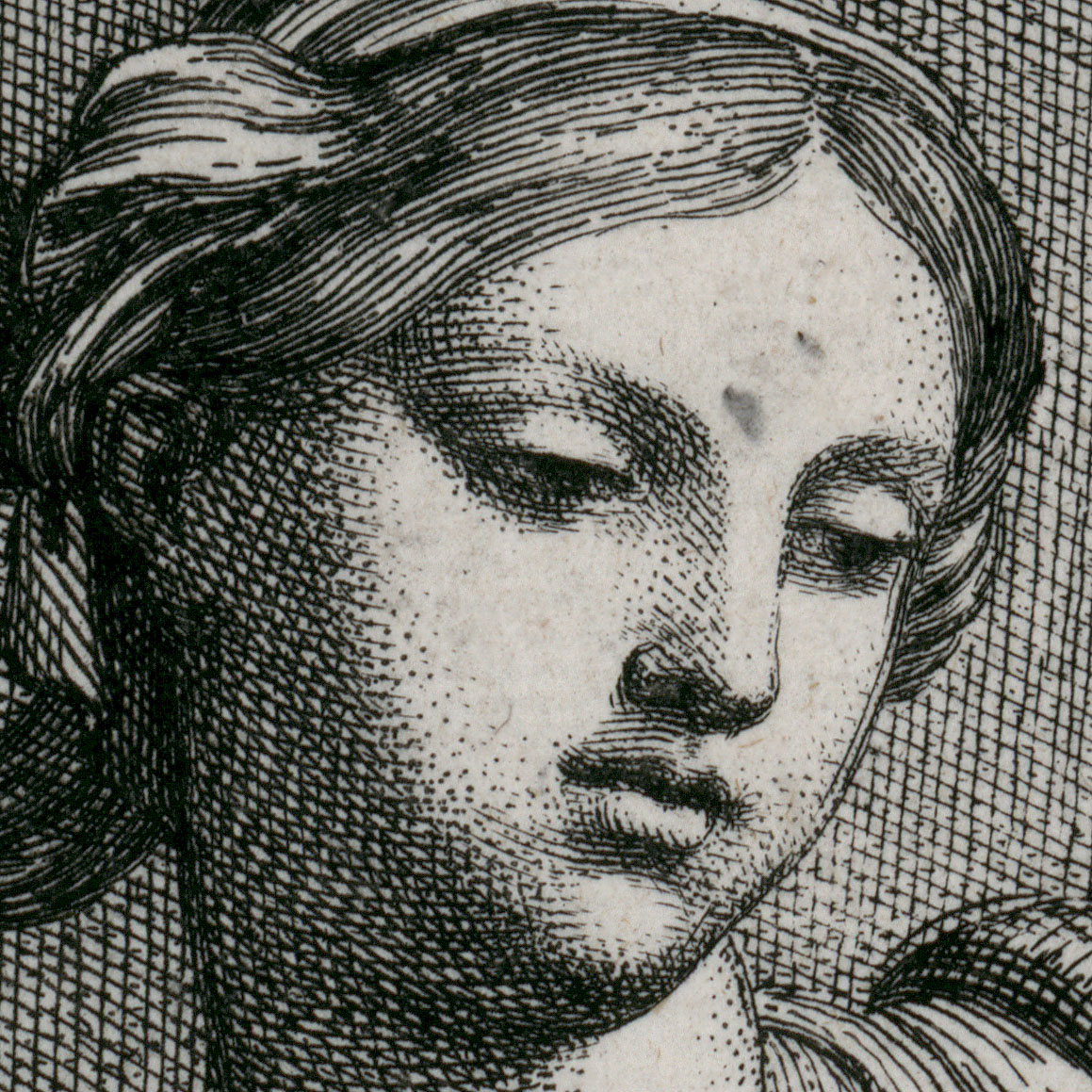
Girard Audran, “Saint Aurelius Augustine, Bishop of Hippo”, c. 1679

Girard Audran (also known as Gérard Audran) (1640–1703)

“Saint Aurelius Augustine, Bishop of Hippo” (also known as “Sancti Aurelii Augustini”), circa 1679

Technical Details & Condition:

Etching on heavy laid paper with small margins, backed with a support sheet. The design is by Jean Baptiste de Champaigne (1631–1681), and the print was published in Paris by François Muguet (c. 1630–1702). It is understood that this print served as an illustration in one of the volumes of “Sancti Aurelii Augustini,... Opera omnia post Lovaniensium theologorum recensionem castigata... opera et studio monachorum Ordinis sancti Benedicti e Congregatione S. Mauri. Editio Parisina altera, emendata et aucta...”, published in 1679. For further reference, see IFF 27 (URL in references), and the first volume of this publication available on Google Books: https://books.google.com.au/books/about/Sancti_Aurelii_Augustini_Opera_omnia_pos.html?id=l0QM-UXESpEC&redir_esc=y.

The impression is strong and well-printed. Despite some minor holes (primarily in the upper and lower margins), and surface marks, the sheet remains in good condition—free from tears, folds, or significant stains.

Dimensions:

• Sheet: 41.5 x 26.6 cm

• Platemark: 39.4 x 24.8 cm

• Image borderline: 36.9 x 24 cm

Plate Lettering:

• Within the image borderline inscribed on scroll: “Charitas ex Deo est./ Oremus ergo ut abilo/ detur à quo jubetur.” (Translation: “Charity is from God./ Let us therefore pray that it may be given to the one who is able/ to whom it is commanded.”)

• Along lower edge of the image borderline: (left) “I.B. de Champaigne in.”, (centre) “ex Typog. F. Muguet”, and (right) “G. Audran Sculp.”

• Below the image borderline: (centre) “Hunc legat omnis qui salutem æternam adipisci desiderat, humiliter orans misericordiæ Dominum/ vt eundem spiritum intelligentiæ legens accipiat, quem ille accepit vt Scriberet, et eamdem illuminationis/ gratiam adipiscatur vt discat, quam kille adeptius est vt doceret. S. Fulg. L. 2. de ver. præd. et grat. C. 18.”

Translation of Latin text below the image: “Let everyone who desires to attain eternal salvation read this, humbly praying to the Lord of mercy/ that he may receive the same spirit of intelligence in reading that he received in writing, and may obtain the same grace of illumination in learning that he obtained in teaching.” The reference following this inscription is the recommendation by St. Fulgentius of Ruspe (c. 448–533 AD) for the study of St. Augustine's writings.

References:

• IFF 27 (Roger-Armand Weigert, “Inventaire du Fonds Français Graveurs du XVIIe: ALIX (Jean)–BOUDEAU (Jean)”, 1939, Paris, Bibliothèque Nationale de France, Département des Estampes, vol. 1, p. 129, cat.no. 27) (See https://gallica.bnf.fr/ark:/12148/bpt6k5489424r/f133])

• R-D 24 (Robert-Dumesnil, “Le Peintre-Graveur Français”, 1835–71, vol. 9, cat.no. 24)

Price & Shipping:

AU$224 (approximately US$150.20 / €128.77 / £111.54), inclusive of worldwide express shipping. Please note that import duties and taxes are the buyer’s responsibility.

If you are interested in this sensitively executed etching depicting St Augustine interrupted from his studies by the descending Holy Spirit in the form of a dove and a flaming heart, please contact me at oz_jim@printsandprinciples.com. I will gladly send you a PayPal invoice for a secure and straightforward purchase.

This print has been sold


Sunday, 19 January 2025

Girard Audran, “King David Dances and Plays the Harp”, c.1667, after Domenichino

Girard Audran (aka Gérard Audran) (1640–1703)

“King David Dances and Plays the Harp”, c.1667 (1666–1668), from the series of four plates, “Scenes from the Old Testament in the San Silvestro in Rome” after the frescoes by Domenichino (aka Domenico Zampieri) (1581–1641) in the pendentives of the Bandini Chapel in San Silvestro al Quirinale in Rome (c.1628), with privilege from Louis XIV (King of France).

Etching with engraving on heavy laid paper.

Size: (sheet) 54.3 x 40.4 cm; (plate) 49.5 x 36.8 cm; (outer image borderline) 43.4 x 36.5 cm.

Lettered in plate: (lower left) “Dominiq. Pinx.”: (lower centre) “Vilior fiam plusquam factus sum, et humilis ero in occulis meis. 2 Regum. Cap.6.“ ([transl.] I will become more base than I have been made, and I will be humble in my own eyes. 2 Kings. Chapter 6.); (lower right) “G.Audran, Sculp. Ro”.

IFF 109 (Roger-Armand Weigert 1939, “Inventaire du Fonds Français Graveurs du XVIIe: ALIX (Jean)–BOUDEAU (Jean)”, Paris, Bibliothèque Nationale de France, Département des Estampes, vol. 1, p. 142, cat. no. 109 [Scènes de l’Ancen Testament] [see https://gallica.bnf.fr/ark:/12148/bpt6k5489424r/f146]); Robert-Dumesnil 101 (Robert-Dumesnil 1835–71, “Le Peintre-Graveur Français”, Paris, vol. 9, p. 291, cat. no. 101).

The British Museum offers the following description of this print: “David dances and plays the harp; in an oval: on the right, David, with his head turned to his left, surrounded by young men playing musical in[s]truments; on the left, a young man restraining a sheep; after Domenichino” (https://www.britishmuseum.org/collection/object/P_U-4-28).

Condition: a strong and well-printed impression with reasonably large margins. There is a hole at lower centre and a mark in the margin at left, otherwise, the sheet is in a reasonably good condition for its age and large size with no tears, folds or significant stains.

I am selling this marvellously lively etching after a fresco by Domenichino—for those who like intrigue and drama, Domenichino’s painting was completed thirteen years after (alleged) attempts on his life by an associate who cut planks in his scaffold and finally succeeded in killing him with poison—for AU $312 (currently US $193.74/ EUR 188/GBP158.75 at the time of posting this listing) including Express Mail (EMS) postage and handling to anywhere in the world, but not (of course) any import duties/taxes imposed by some countries. Note that payment is in Australian dollars (AU $312) as this is my currency.

If you are interested in purchasing this very beautiful etching, please contact me (oz_jim@printsandprinciples.com) and I will send you a PayPal invoice to make the payment easy.

This print has been sold


Saturday, 25 November 2023

Girard Audran’s etching with engraving, “Rinaldo and Armida”, c.1687, after Nicolas Poussin

Girard Audran (aka Gérard Audran) (1640–1703)

“Rinaldo and Armida”, c.1687 (1684–1690 [BM dates]), after Nicolas Poussin (1594–1665), published in Paris by Girard Audran (with privilege) and lettered with a description of the scene based on Torquato Tasso’s (1544–1595) “Rinaldo and Armida”, published in 1562: (Google translation) “Armide, seeking revenge on [Rinaldo] who had taken away his prisoners, finds him asleep on a desert island, she wants to stab him in the breast, but the beauty of this young warrior stops her, and suddenly changes [her?] hatred which seemed implacable, in this love which is so well described by Tasso and which makes one of the most beautiful ornaments of his Poem.”

The Eclectic Light Company offers an interesting article, “The Story in Paintings: Poussin’s Rinaldo and Armida” (2016) which includes a view of Poussin’s painting that Audran’s etching reproduces: https://eclecticlight.co/2016/01/24/the-story-in-paintings-poussins-rinaldo-and-armida/.

Regarding this print, the Curator of the British Museum advises: “Poussin's painting in the Dulwich Picture Gallery was made in 1629. This print has been stated to have been made by Benoit I Audran and Jean Audran, retouched by Girard” (BM inv. no. 1928,0313.268).

Etching with engraving on laid paper backed with a support sheet.

Size: (sheet) 45.8 x 55.8 cm; (plate) 43.3 x 53.5 cm; (inner image borderline) 38.5 x 50.7 cm.

Lettered in plate below the image borderline: (left of centre) “N Poussin pinxt”; (centre) “Armide cherchant a se vanger de Regnault qui luy avoit enlevé ses prisonniers, le trouve endormi dans une Isle deserte, elle/ veut luy donner d’un poignard dans le sein, mais La beauté de ce jeuneguerrier l’arreste, et change tout a coup sa haine qui/paroissoit implacable, en cet amourqui est si bien decrit par le Tasse et qui fait un des plus beaux ornemens de son Poeme./ C’est le 15. et 16e. Chant”; (right of centre) “Gravé par Audran. A Paris ruë st. Iacques aux 2 Pilliers d’or.  auec Priuilege.”

IFF 48 (Bibliothèque Nationale de France 1939–, “Inventaire du Fonds Français: Graveurs du XVIIe Siècle”, Paris, Bibliothèque Nationale, Départment des Estampes, vol. 1, p. 132, cat. no. 48); Robert-Dumesnil 104 (Robert-Dumesnil 1835–71, “Le Peintre-Graveur Français”, Paris, vol. 9, p. 272, cat. no. 41).

The British Museum offers the following description of this print: “Armida discovering the sleeping Rinaldo, after Poussin; Armida, armed with a dagger, is crouching at centre and stroking the arm of Rinaldo, who is sleeping on his shield under a tree; Cupid stands at the woman's side, at left. 1684/90 Etching and engraving” (https://www.britishmuseum.org/collection/object/P_1928-0313-268).

See also the description of this print offered by the Rijksmuseum: http://hdl.handle.net/10934/RM0001.COLLECT.72871.

Condition: a richly inked and well-printed (near faultless) impression. Beyond minor marks at upper left, the sheet is in an excellent condition with no tears, holes, folds, significant stains or foxing and is laid onto a support of archival (millennium quality) washi paper.

I am selling this large and visually arresting etching showing the dagger-ready sorceress, Armida, wishing to kill the sleeping Christian Crusader, Rinaldo, but finding herself unable to because of her desire for him—as expressed by the suggestion of hand and hair fondling and being restrained by love personified by the winged Cupid/Amor/Eros—for AU$438 (currently US$292.76/EUR264.89/GBP233.18 at the time of posting this listing) including Express Mail postage and handling to anywhere in the world, but not (of course) any import duties/taxes imposed by some countries.

If you are interested in purchasing this superb etching, please contact me (oz_jim@printsandprinciples.com) and I will send you a PayPal invoice to make the payment easy.

This print has been sold


Thursday, 16 November 2023

Girard Audran’s etching with engraving, “Judith with the Head of Holofernes”, c.1667, after Domenichino

Girard Audran (aka Gérard Audran) (1640–1703)

“Judith with the Head of Holofernes” (aka “Judit met het hoofd van Holofernes” “Erit memoriale nominis tui, cum manus fœminoæ deiecerit eum“; “It will be a memorial to your name, when the hand of a woman casts it down”), c.1667 (1666–68), from the series of four plates, “Scenes from the Old Testament in the San Silvestro in Rome” after the frescoes by Domenichino (aka Domenico Zampieri) (1581–1641) in the pendentives of the Bandini Chapel in San Silvestro al Quirinale in Rome (c.1628), with privilege from Louis XIV (King of France).

Note that Jakob Frey (1681–1752) executed an etching of the same composition in reverse in the early 1700s: see https://mskgent.be/collection/work/data/2015-LY.

Etching with engraving on laid paper (with watermark).

Size: (sheet) 53.6 x 39.7 cm; (plate) 48.7 x 36.3 cm; (outer image borderline) 43.8 x 36.1 cm.

Lettered in plate: (lower left) “Dominique Pinx.”: (centre) “Cum privil. Regis/ Erit memoriale nominis tui, cum manus fœminoæ deiecerit eum. Judith Cap.9.“; (right) “G.Audran Sculp. Rome”.

IFF 112 (Bibliothèque Nationale de France 1939–, “Inventaire du Fonds Français: Graveurs du XVIIe Siècle”, Paris, Bibliothèque Nationale, Départment des Estampes, vol. 1, p. 142, cat. no. 112); Robert-Dumesnil 104 (Robert-Dumesnil 1835–71, “Le Peintre-Graveur Français” , Paris, vol. 9, p. 297, cat. no. 104).

The British Museum offers the following description of this print: “Judith holding up the head of Holophernes to a crowd of Israelites, her maid holding the bag to the left, after Domenichino; within oval/ Etching and engraving” (https://www.britishmuseum.org/collection/object/P_U-4-23).

See also the description of this print offered by the Rijksmuseum: http://hdl.handle.net/10934/RM0001.COLLECT.72896.

Condition: a strong with well-printed (near faultless) impression with reasonably large margins around the platemark in an excellent/museum quality condition with no tears, holes, folds, losses, abrasions, significant stains or foxing.

I am selling this large and visually arresting etching after a fresco by Domenichino—for those who like intrigue and drama, Domenichino’s painting was completed thirteen years after (alleged) attempts on his life by a mate who cut planks in his scaffold but finally succeeded with poison—for AU$312 (currently US$208.54/EUR188.69/GBP166.10 at the time of posting this listing) including Express Mail postage and handling to anywhere in the world, but not (of course) any import duties/taxes imposed by some countries.

If you are interested in purchasing this beautifully executed (but pictorially dreadful) etching, please contact me (oz_jim@printsandprinciples.com) and I will send you a PayPal invoice to make the payment easy.


Wednesday, 16 August 2023

Nicolas Tardieu’s etching with engraving, “Triumph of Constantine over Maxentius”, 1715, after Charles Le Brun

Nicolas Tardieu (aka Nicolas Henri Tardieu) (1674–1749)

“Triumph of Constantine over Maxentius” (aka “Triomf van Constantijn over Maxentius”; “Constantini triumphus devicto Maxentius”; “Triomphe de Constantin apres sa victoire sur Maxence”), 1715, after the design by Charles Le Brun (aka Charles Lebrun) (1619–1690), from the series, “Werken van Charles le Brun” (The work of Charles Le Brun), published in Paris by Nicolas Tardieu with royal privilege.

Etching with engraving on laid paper trimmed around the image borderline and the lines of text, backed with a support sheet.

Size: (sheet) 28.5 x 59.6 cm; (image borderline) 25.2 x 59.6 cm.

Lettered in plate below the image borderline: (left) “Car, le Brun invenit”, (centre in two columns of text) “CONSTANTINI TRIUMPHUS DEVICTO MAXENTIUS … le monde le predicateur.”; (right) “N. Tardieu ex.”

The Hood Museum of Art offers a description of this print that includes the full lines of lettering: https://hoodmuseum.dartmouth.edu/objects/2014.73.91#. Note also that the Hood Museum attributes this print to Gerard Audran (1640– 1703) with Nicolas Tardieu as the printer.

See the description of this print offered by the Rijksmuseum: http://hdl.handle.net/10934/RM0001.COLLECT.417896.

LeBlanc 42-53 (Charles Le Blanc, “Manuel de l'amateur d'estampes: contenant le dictionnaire des graveurs de toutes les nations”, vol. 4, Paris, p. 5, cat. nos. 43–53 [“Histoire de Constantin”]).

Condition: a strong impression, trimmed around the image borderline and text and laid upon an archival support sheet of millennium quality washi paper. The sheet has a flattened centrefold and there are numerous restorations in the text.

I am selling this magnificent and very large etching (with engraving) executed with amazing skill to capture the complexity of this Baroque vision of a Roman triumphal procession, for AU$298 in total (currently US$199.18/EUR180.22/GBP158.65 at the time of this listing) including postage and handling to anywhere in the world (but not, of course, any import duties/taxes imposed by some countries).

If you are interested in purchasing this grand manner print, please contact me (oz_jim@printsandprinciples.com) and I will send you a PayPal invoice to make the payment easy.

This print has been sold