Showing posts with label Lenardi (Giovanni Battista). Show all posts

Sunday, 12 July 2020

Circle of Arnold van Westerhout’s etching, “The Transfiguration”, c1690, after Raphael


Unidentified engraver from the circle of Arnold van Westerhout (1651–1725)

Regarding this attribution, note that Carlo Abruzzi (1837) in “Catalogue raisonné des estampes du cabinet de feu m. le comte Léopold Cicognara …”, advises that there are almost twenty translations of Raphael’s famous painting into prints citing “an anonymous student of Raimondi, carrying the address of Salamanca and the date MDXXXVIII, until that of Raphaël Morghen in 1808” (p. 344). My attribution of this print to the circle of Van Westerhout is partly because the dealer from whom I originally purchased this print proposed van Westerhout as the possible etcher and also because Abruzzi offers this artist’s name. Sadly, I do not believe that Van Westerhout is the etcher of this print because his technique is a little cruder than what is exhibited here, nevertheless, the connection is still relevant as may be seen when comparing the  rendering style and the framing borderline employed by Arnold van Westerhout in the etching, “St Paul Preaching” (1680–1704): https://www.britishmuseum.org/collection/object/P_1949-1008-161.

“The Transfiguration”, c1690, after the intermediary drawing by Giovanni Battista Lenardi (1656–1704), after Raphael’s (1483–1520) final painting (1516–20) in the Pinacoteca Vaticana, Vatican City.

Etching and engraving on laid paper, trimmed along the image borderline and backed with a support sheet.
Size: (sheet/outer image borderline) 48.1 x 31.2 cm.
Lettered on plate along the lower borderline frame: (left) “Rafaele d’Vrbino In. e depinse.”; (right) “Gio. Batta Lenar di desegno”.

Condition: well-printed impression with no sign of wear to the printing plate, trimmed along the image borderline and laid onto a support sheet of millennium quality washi paper. There are replenished losses to the edges (see the restored lower left corner and a few nicks to the edges of the borderline otherwise the sheet is in a good condition for its considerable age (i.e. there are no significant stains or foxing).

I am selling this large and strong translation of Raphael’s famous painting into an etching (with engraving) for AU$354 (currently US$246.09/EUR217.67/GBP195.06 at the time of posting this print) including postage and handling to anywhere in the world (but not, of course, any import duties/taxes imposed by some countries).

If you are interested in purchasing this strong etching after Raphael’s composition, please contact me (oz_jim@printsandprinciples.com) and I will send you a PayPal invoice to make the payment easy.


Saturday, 26 May 2018

Comte de Caylus’ “The Holy Spirit descending on the Apostles” (green variant), c1729–64


Anne Claude Philippe de Tubières, Comte de Caylus (aka Caylus; Anne Claude de Caylus; Anne Claude de Pestels) (1692–1765)

“Le Saint Esprit descendant sur les Apôtres” (The Holy Spirit descending on the Apostles), c1729–64, from the series, “Recueil d'estampes d'après les plus beaux tableaux et d'après les plus beaux desseins qui sont en France” (Collection of prints from the most beautiful paintings and from the most beautiful designs that are in France”) (aka “Recueil Crozat”; “Cabomet Croza”), after the drawing by Giovanni Battista Lenardi (1656–1704).

Etching and aquatint imitating a chiaroscuro woodcut, printed in two shades of green, on laid paper, trimmed unevenly and well within the image borderline with substantial loss to the upper section of the print (see the whole composition at Gallica: http://gallica.bnf.fr/ark:/12148/btv1b6956138w.item ) and backed with a support sheet.
Size: (unevenly trimmed sheet) 27.3 x 23 cm

Condition: crisp, well-inked and well-printed impression, trimmed within the image borderline with significant losses on all sides, otherwise the sheet is in excellent condition for its age (i.e. there are no tears, holes, folds, abrasions, stains or foxing) and backed with a support sheet of archival (millennium quality) washi paper.

I am selling this FRAGMENT of a larger print for study purposes only, for AU$104 (currently US$78.60/EUR67.37/GBP59.10 at the time of posting this print) including postage and handling to anywhere in the world.

If you are interested in purchasing this FRAGMENT of a historically important print (see previous post), please contact me (oz_jim@printsandprinciples.com) and I will send you a PayPal invoice to make the payment easy.

This print has been sold


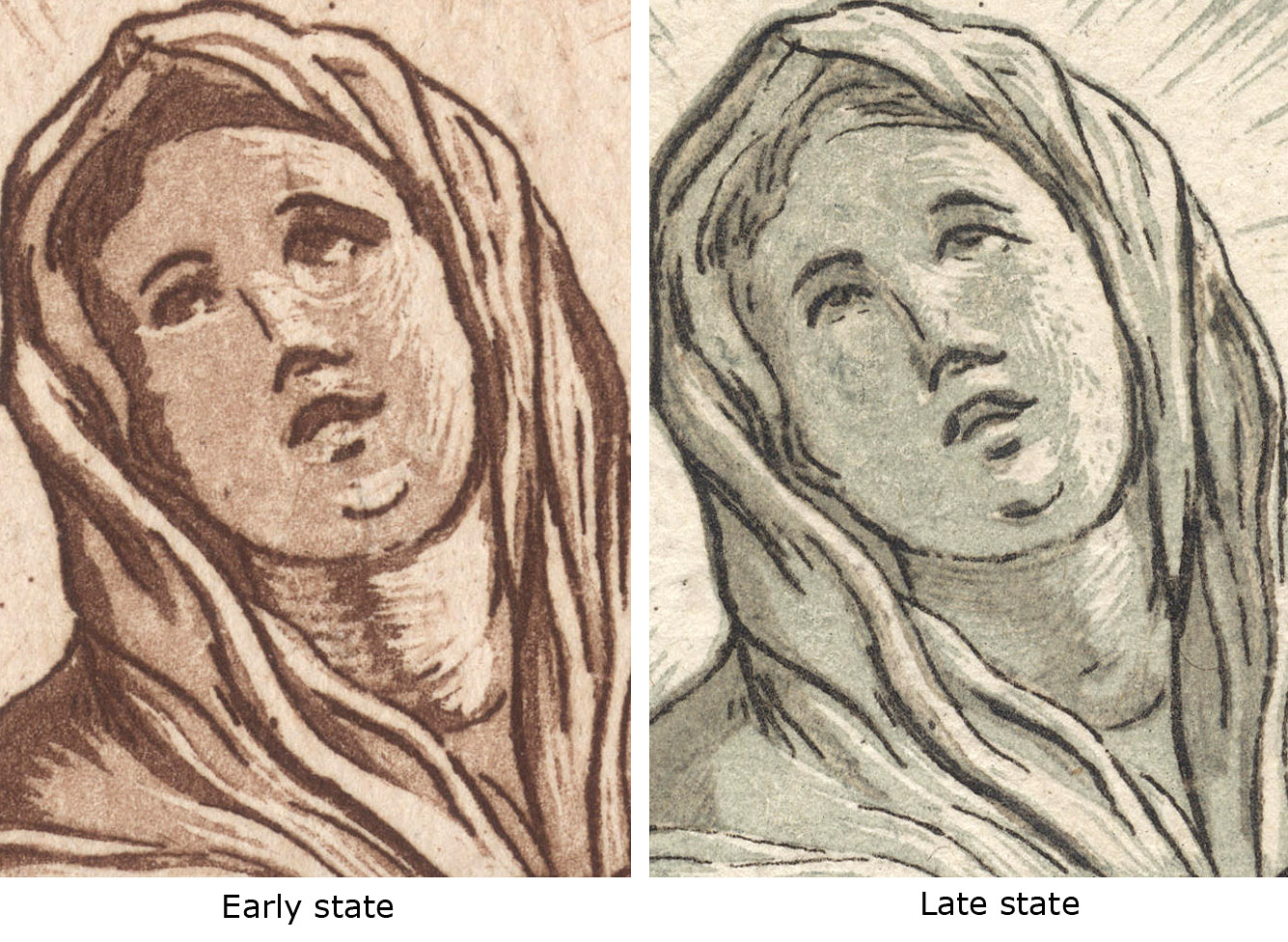
At first glance, this fragment of a print might seem to be a green version of the brown print shown in the previous post, but this is only partly true. Certainly, the composition is the same, but the portrayed figures in this fragment reveal a stage of refinement that is a step beyond the treatment of the same figures in the brown version. Essentially this green fragment is from a late state in the evolution of the print and the brown version of the previous post is from an early state. To my eyes the subtle changes made to the image from the early to the late state—and there are MANY changes—is like a psychological portrait of comte de Caylus in terms of revealing his aesthetic sensitivities. 


Friday, 25 May 2018

Comte de Caylus’ “The Holy Spirit descending on the Apostles”, c1729–64


Anne Claude Philippe de Tubières, Comte de Caylus (aka Caylus; Anne Claude de Caylus; Anne Claude de Pestels) (1692–1765)

“Le Saint Esprit descendant sur les Apôtres” (The Holy Spirit descending on the Apostles), c1729–64, from the series, “Recueil d'estampes d'après les plus beaux tableaux et d'après les plus beaux desseins qui sont en France” (Collection of prints from the most beautiful paintings and from the most beautiful designs that are in France”) (aka “Recueil Crozat”; “Cabomet Croza”), after the drawing by Giovanni Battista Lenardi (1656–1704).

Etching and aquatint imitating a chiaroscuro woodcut, printed in two shades of brown, on laid paper with wide margins (as published).
Size: (sheet) 50.5 x 36.8 cm; (plate) 39.7 x 25.6 cm; (image borderline) 36 x 24.9 cm
Lettered below the image borderline in three lines of French text: “Le S.t Esprit descendant sur les Apôtres. / Dessein de Jean Baptiste Lenardi, qui est dans le Cabinet de Mr Crozat / Gravé à l'eau forte par Mr le C... de C... et en bois sous sa conduite par Nicolas le Sueur […] 130”.
IFF 308 (undescribed state) (Inventaire du Fonds Français: Bibliothèque Nationale, Département des Estampes, Paris, 1930)

The British Museum offers the following description of this print:
“The Pentecost, with the Virgin standing at centre, surrounded by the Apostles, and the Holy Spirit flying above them; after a drawing by Lenardi.”

Condition: near faultless impression that is crisp, well-inked and well-printed with full margins as published. The sheet is in very good condition for its age but the margins are slightly dusty and show minor signs of use (e.g. the lower left corner is bumped and there is a pencil notation at the lower right edge).

I am selling this 18th century curiosity of an intaglio print (viz. etching with aquatint) that is skilfully crafted to simulate the attributes/“look” of a chiaroscuro woodcut (i.e. a woodcut involving more than one tone of a colour) for AU$204 (currently US$154.56/EUR132.04/GBP115.82 at the time of posting this print) including postage and handling to anywhere in the world.

If you are interested in purchasing this historically important print showcasing an 18th century artist’s somewhat deceptive practice, please contact me (oz_jim@printsandprinciples.com) and I will send you a PayPal invoice to make the payment easy.

This print has been sold


Although this intaglio print was clearly intended to deceive the viewer into believing that the image is a relief print, the artist’s motivation was more complex than simply a case of skulduggery.

After all, comte de Caylus was commissioned to execute this print as a late addition to the grand catalogue project, “Recueil Crozat”, by the French collector, Pierre Crozat (1665–1740), who had the vision to create a paper museum reproducing famous paintings and drawings of the era. In the first two volumes (published 1729 and 1737 respectively), Crozat commissioned woodcut prints, but after his death, the famous art dealer and publisher,  François Basan (1723–1797), replaced the woodcut prints in the “Recueil” with intaglio prints such as this one. 

Mindful that the decision to mix mediums—or at least the superficial attributes of mediums—may have been a requirement of the “Recueil” project overseen by Basan helps to explain comte de Caylus’ motivation. After reading Margaret Morgan Grasselli’s (2003) essay in “Colorful Impressions: The Printmaking Revolution in Eighteenth-Century France” (cat. National Gallery of Art, Washington), however, I have a better understanding of comte de Caylus’ choice to use etched line. For example, Grasselli, proposes that intaglio lines “captured the quality of pen lines in a way that woodcut line blocks could not” (p. 6).

In short, comte de Caylus’ motivation was not simple skulduggery, Instead his approach may have been a requirement set by Basan and personal insight about what was needed to make a strong reproductive translation of Lenardi’s drawing.