Showing posts with label Correggio (Antonio). Show all posts

Thursday, 24 July 2025

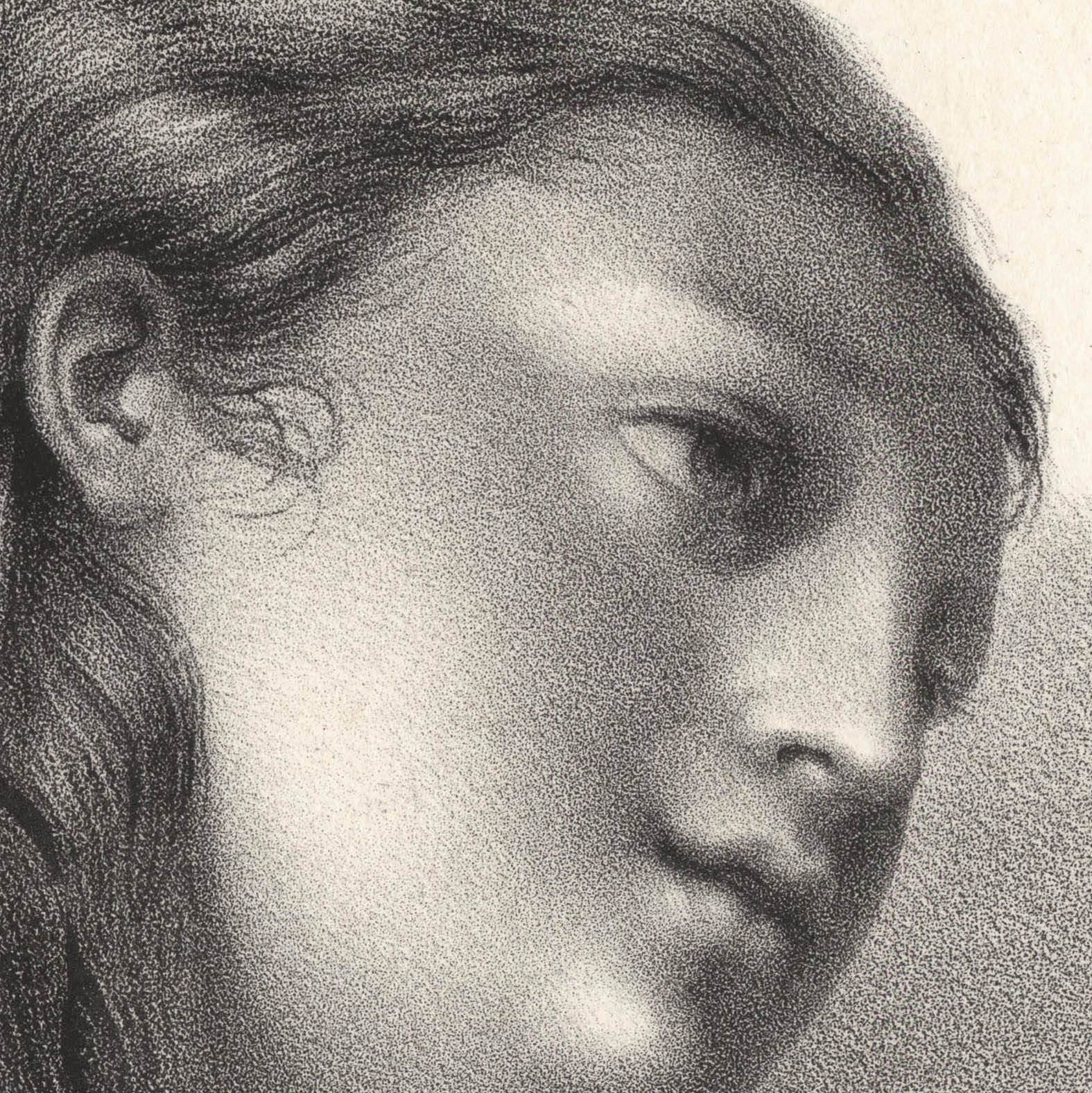
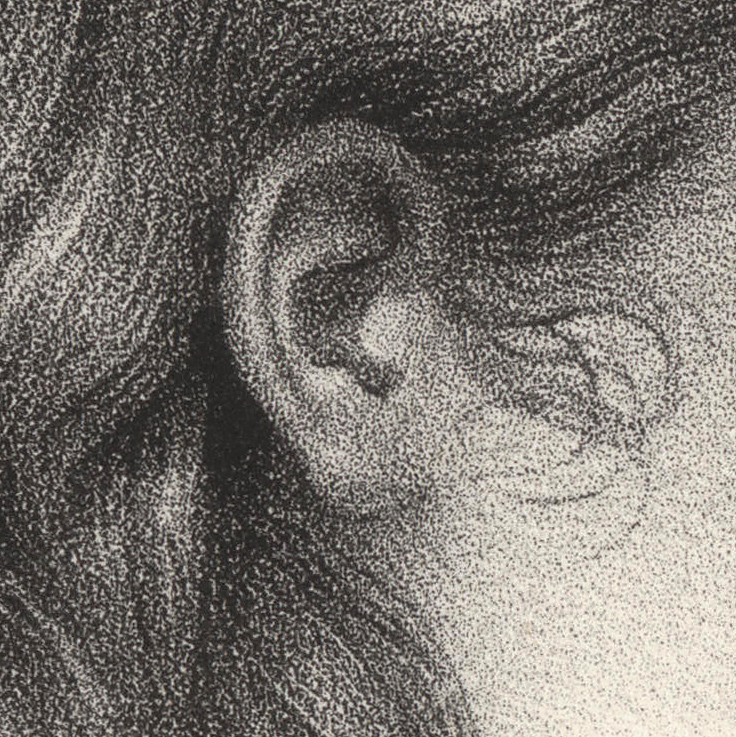
Joseph Burn Smeeton, “Head Study”, mid-1800s, after Correggio

Joseph Burn Smeeton (aka Joseph Burn-Smeeton) (1815–1890; fl.1840–1879)—famous as an English wood engraver working in Paris with Auguste Tilly (1840–1898) as the engraving business, Smeeton and Tilly.

“Head Study” (descriptive title only), mid-1800s, wood-engraving after a chalk drawing by Antonio Correggio (aka Antonio Allegri; Antonio Allegri da Correggio) (1489–1534)—see a reproduction of Correggio’s drawing illustrating the frontispiece to Allen W Seaby’s (1921) “Drawing for Art Students and Illustrators” (https://archive.org/details/drawing-for-art-students-and-illustrators-by-allen-w.-seaby/page/n7/mode/2up)—with a pencil inscribed dedication.

Wood-engraving printed in black on tissue-thin washi paper with a pencil-signed dedication by the artist to his friend, Gilbert, backed with a support sheet.

Size: (sheet) 40.6 x 31.5 cm.

Inscribed in pencil: (lower right) “à l’ami Gilbert/ Souvenir Amical/ J Burn Smeeton” (to friend Gilbert/ Friendly Remembrance/ J Burn Smeeton).

Condition: a strong and well-printed impression with generously wide margins. There are small holes and breaks in the margin, otherwise the sheet is in a good condition with no folds, abrasions or significant stains.

I am selling this incredibly fine wood-engraving that could easily be mistaken for a lithograph (before close inspection reveals the telltale burin marks), for AU$256 (approximately US$168.31, EUR 143.30, or GBP 124.73), with worldwide express shipping included. Please note that any applicable import duties are the buyer’s responsibility.

If you are interested in purchasing this pencil-signed tour de force of engraving that is so rare I have been unable to find another copy—perhaps it was a showpiece of skill for his friend, Gilbert? —please contact me (oz_jim@printsandprinciples.com) and I will send you a PayPal invoice to make the payment easy.


Saturday, 20 April 2024

Achille Désiré Lefevre, “Le Sommeil d'Antiope”, c.1850, after Antonio Correggio

Achille Désiré Lefevre (1798–1864)

Le Sommeil d'Antiope” (Antiope's Sleep), c.1850 (between 1818–1864), after the intermediary design by Auguste Sandoz (aka Auguste Sandos) (fl.late 18thC– early 19thC), after Antonio Correggio’s (Antonio Allegri; Corrège) (1489–1534) painting, “Venus, Satyre et Cupidon” (c.1524/27), in the Musée du Louvre, Paris (inv. 42; see: https://art.rmngp.fr/en/library/artworks/le-correge_venus-satyre-et-cupidon_huile-sur-toile), printed and published in Paris by the Chalcographie of the Musée du Louvre between 1818 and 1864.

Etching and engraving on heavy wove paper with wide margins stamped with the blind seal of the Chalcographie Imperiale du Louvre at lower centre.

Size: (sheet) 65 x 47.1 cm; (platemark) 53.4 x 37.5 cm; (image borderline) 41.8 x 27.8 cm.

Lettered in plate below the image borderline: (left) “LE CORRÈGE PINXT.”; (centre) “SANDOZ DEL./ LE SOMMEIL D'ANTIOPE./ CHALCOGRAPHIE IMPERIALE DU LOUVRE./ [blind stamp of the Chalcographie]”; (right) “ACH. LEFÈVRE SCULPT.”.

Condition: a richly inked and strong (near faultless) impression with generously wide margins. There are minor marks in the margins, otherwise, the sheet is in an excellent condition with no tears, holes, folds or significant stains.

I am selling this huge etching, showing an amorously smitten satyr discovering Venus (possibly not Antiope) and cupid asleep, for the total cost of AU$313 (currently US$200.99/EUR188.53/GBP162.44 at the time of this listing) including Express Mail (EMS) postage and handling to anywhere in the world, but not (of course) any import duties/taxes imposed by some countries.

If you are interested in purchasing this superbly rich impression of a masterwork of etching and engraving with strong—perhaps (at least to my eyes) glowing—contrasts of light and dark tones, please contact me (oz_jim@printsandprinciples.com) and I will send you a PayPal invoice to make the payment easy.

This print has been sold


Wednesday, 15 June 2022

Pierre Langlumé’s lithograph, “La Magdeleine”, 1825, after Antonio Correggio

(From the circle of, or by) Pierre Langlumé (1790–? [fl.1818–1830])

“La Magdeleine”, 1825, lithograph printed by Pierre Langlumé and published in Paris by Sazerac & Duval (fl.c1824–1827) after a detail in reverse of Antonio Correggio’s (aka Antoine Corrége; Antonio Allegri) (1489–1534) painting, “Madonna of St. Jerome”, 1528, in the Galleria Nazionale of Parma, Italy (see https://useum.org/artwork/Madonna-of-St-Jerome-Antonio-da-Correggio-1528).

Note that Sir Robert Strange (1721–1792) executed an etching with engraving after Correggio’s painting that is very close to the design for this lithograph; see https://www.britishmuseum.org/collection/object/P_1868-0808-3162.  

Lithograph in the crayon manner printed in black on wove paper with the publisher’s blind-stamp at lower centre.

Size: (sheet) 39.5 x 28 cm.

Lettered in the stone below the image: (centre) “LA MAGDELEINE,/ d’après le Tableau du Corrége./ (S. Jérome)/ Chez Sazerac et Duval, Passage de l'Opéra, Escalier A.”; (right) “Lith. De Langlumé”.

Blind-stamped with the publisher’s seal at lower centre

Condition: a near faultless impression. There are marks/stains verso, otherwise the sheet is in an excellent condition with no tears, holes, folds, abrasions, foxing or signs of handling.

I am selling this sensitively executed crayon-manner lithograph showing a detail St Mary Magdalene from Antonio Correggio’s painting, “Madonna of St Jerome”, for AU$234 (currently US$161.64/EUR154.32/GBP134.31 at the time of posting this print) including postage and handling to anywhere in the world, but not (of course) any import duties/taxes imposed by some countries.

If you are interested in purchasing this very beautiful (and rare!) lithograph, please contact me (oz_jim@printsandprinciples.com) and I will send you a PayPal invoice to make the payment easy.


Wednesday, 5 August 2020

Hubert Vincent’s engraving, “The Nativity”, 1691, after Antonio da Correggio


Hubert Vincent (aka Huberto Vicenti) (fl.1680–1730)

“The Nativity” (aka “The Holy Night”; “La Notte”; “Adoration of the Shepherds”), 1691, from the series, “Nativita del N. S. Gesù Cristo,” with dedication in Italian text on the banderole to the French diplomat and cardinal, César D'Estrées (1628–1714), published in Rome, after Antonio da Correggio’s (aka Antonio Allegri) (1489–1534) oil painting (c1529–1530) in the Gemäldegalerie Alte Meister, Dresden.

Regarding this print and Correggio’s painting, the Curator of the British Museum offers the following account:

“Print after Correggio's famous panel of the Nativity, called La Notte; originally made for the Pratoneri chapel in the church of San Prospero, Reggio Emilia. Removed in 1640 and brought to Modena; sold to Augustus III of Saxony in 1745-6, now in the Gemäldegalerie, Dresden. See Gould, 1976, pp. 204-206” (BM inv. no. 1837,0408.41).

Etching and engraving on laid paper (with watermark) trimmed along the image borderline.

Size: (sheet) 46.5 x 32.3 cm.

Inscribed on plate within the image borderline: (left) "il Coregio In. e dipinse".

Lettered on the banderole: (left) “H. Vincent scul. e"; (left of centre) “Essendomi riuscito d'intagliare col mio bolino prima d’alcun altro. La fa/ che al gran Nome di V. E. splendore della porpora, gloria della natione francese./ Si degni V.E, di gradirla benignamte. e di honorare del suo potentmo. Patrocino chi con/ D.V.E.”; (right of centre) “Principe Il Sigr./ D’Estree’s/ mosa Notte del celebre Correggio, is non debbo dedicare questa mia fatica,/ Protettore delle arti e delle scienze, e Mecenate generosissimo de’Virtuosi;/ profondissimo rispetto si consagra./ Roma con licentia de Superiori Anno 1691.”; (right) "In Roma da [H]berto Vincenti e in/ piazza a Capranica in faccia alla porticella/ delli Orfanelli/ Hummo Dinotmo et obligmo Serure/ Huberto Vincent.”

Note: there is an additional line of text on the plate below the banderole to the left of centre, but I am unable to decipher the text as it is lost in the cross-hatched linework.

Nagler 1 (G K Nagler 1835–52, “Neus allgemeines Künstler-Lexicon” [22 vols]).

The British Museum offers the following description of this print:

“Nativity (La Notte); the Virgin Mary, centre, embracing the swaddled Child, lying in a manager; to the left three figures contemplating the Virgin and Child; hovering above them a group of tumbling angels; Joseph visible in the background, holding the ass; in a ramshackle stable; shrubs in the foreground. 1691 Etching and engraving”

(https://www.britishmuseum.org/collection/object/P_1837-0408-41).

Note that this print was reissued in the late 18th century by the publisher, C A Mazzoni (fl.late 1770s), with alterations to the size of the plate and to the lettered text below the image (see: https://www.britishmuseum.org/collection/object/P_1837-0408-40).

Condition: strong and well-printed impression, trimmed slightly unevenly along the image borderline. There is a flattened centrefold and remnants of green glue verso, otherwise the sheet is in very good condition for its considerable age (i.e. there are no tears, holes, losses, abrasions, significant stains or foxing).

I am selling this large engraving (with etching) exemplifying the Mannerist leanings of Antonio da Correggio in his painting of this composition, such as the amazing elongation of the shepherd on the left—note also the length (and variation to the girth) of his staff!—the theatrical gestures of the other figures and the chiaroscuro lighting (“à la chandelle” [of the candle]), for the total cost of AU$334 (currently US$240.86/EUR203.39/GBP183.59 at the time of this listing) including Express Mail (EMS) postage and handling to anywhere in the world (but not, of course, any import duties/taxes imposed by some countries).

If you are interested in purchasing this technically superb old-master print—note how the engraver has portrayed the plants in the lower right corner with an underlying rhythm of concentric circlesplease contact me (oz_jim@printsandprinciples.com) and I will send you a PayPal invoice to make the payment easy.


Saturday, 20 April 2019

John Godefroy’s etching (with stipple engraving), “Jupiter et Antiope”, c1803


John Godefroy (aka Jean Godefroy, John Godfrey) (1771–1839)

“Jupiter et Antiope” (see the BM description of the subject below), c1803, from the series, “Le Musée Français”, after the intermediary drawing by Pierre Bouillon (1776–1831), after Antonio Correggio’s (aka Antonio Allegri) (1489–1534) painting (c1524/27) in the Musée du Louvre, Paris (inv.42), published by Pierre Laurent (1739–1809) and Robillard-Péronville in 1803 in Paris.

The Curator of the British Museum offers the following information about the series of which this print is a part:
“Part of 'Musée Français, recueil complet des tableaux, statues et bas-reliefs qui composent la collection nationale, avec l'explication des sujets et des discours historiques sur la peinture, la sculpture et la gravure' ['French Museum, complete collection of paintings, statues and bas-reliefs that make up the national collection, with the explanation of historical subjects and discourses on painting, sculpture and engraving'], , a set reproducing paintings and sculptures from the French collections, and formed by four volumes (published by Robillard-Péronville and Laurent in, respectively, 1803, 1805, 1807, and 1809; accompanied by texts written by Croze-Magnan, then by Eméric-David & Visconti for volumes 3-4).
The series was later re-edited under the title 'Musée Royal, ou Recueil de gravures d'après les plus beaux tableaux, statues et bas-reliefs de la collection royale' “

Etching and stipple engraving on wove paper with margins as published.
Size: (sheet) 50.6 x 39.6 cm; (plate) 44.8 x 34.2 cm; (image borderline) 34 x 24.4 cm.
Lettered on plate below the image borderline: (left) “Peint par Le Correge.”; (centre) “Dessiné par Bouillon. / JUPITER ET ANTIOPE.”; (right) “Gravé par J. Godefroy.”

IFF 13(1) (after 1800) (Département des Estampes 1930, “Inventaire du Fonds, Français: graveurs du XVIIe siècle”, Paris, Bibliothèque Nationale).

The British Museum offers the following description about this print:
“Long believed to represent Jupiter and Antiope, now thought to depict a satyr, Venus and Cupid.”

Condition: near faultless richly inked and well-printed impression in museum quality, virtually pristine condition (i.e. there are no tears, holes, folds, abrasions, stains, foxing or signs of use).

I am selling this large etching that is a wonderful example showing how an artist can not only employ a wide range of different marks to suggest different surface textures but also how an artist can employ both white and black marks to render a scene, for the total price of AU$220 (currently US$157.41/EUR139.96/GBP121.10 at the time of this listing) including postage and handling to anywhere in the world (but not, of course, any import duties/taxes imposed by some countries).

If you are interested in purchasing this masterwork of graphic interpretation of a painting—note in particular how Godefroy is able to differentiate using very subtle changes to his line-work the outer and inner sides of the cloth that the satyr/Jupiter is raising—please contact me (oz_jim@printsandprinciples.com) and I will send you a PayPal invoice to make the payment easy.

This print has been sold