Showing posts with label Collaert II (Jan). Show all posts

Friday, 27 December 2024

Jan Collaert II, “Hunting Quails and Rabbits”, c.1600, after Jan van der Straet

Jan Collaert II (aka Jan Collaert; Hans Collaert) (c.1561–c.1620)

“Hunting Quails and Rabbits”, c.1600, a rare first state impression of plate 69 (before numbering) from the series of 104 plates, “Venationes Ferarum, Avium, Piscium. Pugnae Bestiariorum: & mutuae Bestiarum”, after a drawing by Jan van der Straet (aka Joannes Stradanus; Ioannes Stradanus) (1523–1605) in the Nationalmuseum in Stockholm and a preliminary sketch in the National Design Museum in New York (inv. 1901-39-295v), with Latin text by Cornelis Kiliaan (c1529–1607), published by Philips Galle (aka Philippus Gallaeus; Philippe Galle) (1537–1612) in Antwerp.

Engraving on laid paper trimmed with a small margin around the platemark and backed with a support sheet.

Size: (sheet) 20.6 x 28.3cm; (plate) 19.8 x 27.2cm; (image borderline) 18.1 x 27.1cm.

Inscribed on plate within the image borderline along lower edge: (left) “Ioan. Stradanus inuent.”; (left of centre) Ioan. Collaert Sculp.”; (right) “Phls Galle excud.”

Lettered in plate below the image borderline in two columns of two lines of Latin: (centre) “Nexa Coturnicibut Venator retia tendit./ Cum segetes messæ: Plaudo latrante, pætentem// Grex sese simul in campum velociter infert;/ Collectas Auceps deprendit casse volucres.” (The hunter stretches his nets for the quails./ When the harvest is reaped: I applaud, barking, lamenting// The flock quickly rushes into the field together;/ The birdcatcher catches the birds gathered.)

State i (of iii) before the addition of the number (“69”)

New Hollstein 521 (Johannes Stradanus) (Marjolein Leesberg [comp.] 2008, The New Hollstein: Dutch and Flemish Etchings, Engravings and Woodcuts 1450–1700: Johannes Stradanus, part. 3, Ouderkerk aan den Ijssel, Sound and Vision, p. 196; [illus. p. 229], cat. no. 521); New Hollstein 1523 (Collaert Dynasty) (Ann Diels & Marjolein Leesberg [comp.] 2005–06, The New Hollstein: Dutch and Flemish Etchings, Engravings and Woodcuts 1450–1700: The Collaert Dynasty, vol. 8, Ouderkerk aan den Ijssel, Sound and Vision, cat. no. 1523).

The British Museum offers the following description of this print: “Plate 69, Quail and Rabbit Hunt; on a corn field with sheaves of corn, two men on horseback, coming from the right, are about to drag a net over a covey of quails; to the left, two men draw a net over a rabbit; on the horizon, to the left, a church is seen, while to the right, a farm building is seen” (https://www.britishmuseum.org/collection/object/P_1957-0413-77 [inv. 1957,0413.77]).

See also the Rijksmuseum’s description of this print: https://id.rijksmuseum.nl/200175668.

Condition: a strong and near faultless impression with small margins around the platemark. The sheet is in an excellent condition with no tears, holes, abrasions, losses or significant stains and is laid upon an archival support sheet of millennium quality washi paper providing wide margins.

I am selling this exceptionally rare lifetime impression from the first state—interestingly the New Hollstein mentions only two impressions of this print from the first state held in museum repositories (but I may have misunderstood the advice [see “Johannes Stradanus, part 3, p. 196, cat. no. 521, SI]— for AU $319 in total (currently US $198.43/ EUR 190.36/ GBP 157.69 at the time of posting this print) including Express Mail (EMS) postage and handling to anywhere in the world, but not (of course) any import duties/taxes imposed by some countries. Note that payment is in Australian dollars (AU $319) as this is my currency.

If you are interested in purchasing this exceptionally fine late Renaissance period engraving showing the hunting technique in the 16th century for catching quail and rabbits, please contact me (oz_jim@printsandprinciples.com) and I will send you a PayPal invoice to make the payment easy.

This print has been sold


Saturday, 26 August 2023

Jan Collaert II’s engraving, “Deer Hunt with Bow and Arrow” c.1596, after Jan van der Straet

Jan Collaert II (aka Hans Collaert) (c.1561–c.1620)

“Deer Hunt with Bow and Arrow” (aka “Stag Hunt”), c.1596, after the design by Jan van der Straet (aka Joannes Stradanus; Ioannes Stradanus) (1523–1605), plate 36 from the series of 104 plates, “Venationes Ferarum, Avium, Piscium”, published in Antwerp by Philips Galle (aka Philippe Galle; Philippus Gallaeus) (1537–1612).

Engraving on fine laid paper trimmed with a small margin around the platemark and backed with a support sheet providing wider margins.

Size: (sheet) 21.1 x 28.2 cm; (plate) 20 x 27.2 cm; (image borderline) 18.2 x 27 cm.

Inscribed in plate within the image borderline: (lower left) “Ioan. Stradanus inuent.”; (lower centre) “Ioan. Collaert Sculp. [...] Phls Galle excud.”

Numbered and lettered in plate below the image borderline: (left) “36.”; (centre in two columns of two lines of Latin verse) “Dum cornu Cerui, Iaculator forte Sagittâ;/ Attingit, Muscæ Ceruus morsum putat, atq[ue]// Sublato cornu Scalpit pede: nec mora, telum/ Inter vtrumque pedem prompta volat arte Secundum.”

New Hollstein Dutch 502 (Marjolein Leesberg [comp.] 2008, “Dutch and Flemish Etchings, Engravings and Woodcuts ca. 1450-1700: Cranach–Drusse”, vol. 6, Amsterdam, Sound and Vision, cat. no. 502).

The British Museum offers the following description of this print: “Plate numbered 36, Deer Hunt with Bow and Arrow; in the centre foreground, a deer scratches its ear with its hind hoof; beyond, to the right, a huntsman targets the animal with a bow and arrow; two deer are seen in the mid-ground beyond” (https://www.britishmuseum.org/collection/object/P_1957-0413-65).

Condition: a richly inked and near faultless impression with small margins laid onto a support of archival (millennium quality) washi paper. Beyond a restored tear in the margin at centre and minor darkening in the text area, the sheet is in an excellent condition with no holes, folds, abrasions, significant stains or foxing.

I am selling this magnificent impression—note the strong tonal contrasts and the crisp linework—of a very beautiful engraving showing a stag that has been bitten by a fly (“Muscæ”, based on my reading of the Latin inscription) at a critical moment of distraction for a strike from a Persian hunter with his bow (a “Kaman”), for the total cost of AU$320 (currently US$213.89/EUR193.53/GBP170.36 at the time of posting this listing) including postage and handling to anywhere in the world (but not, of course, any import duties/taxes imposed by some countries).

If you are interested in purchasing this superb engraving executed with great sensitivity and care, please contact me (oz_jim@printsandprinciples.com) and I will send you a PayPal invoice to make the payment easy.

This print has been sold 


Saturday, 22 May 2021

Jan Collaert II’s engraving, “Entombment of Christ”, c1585, after Jan van der Straet

Jan Collaert II (aka Hans Collaert; Jan Baptist I Collaert) (c1561–c1620)

“Entombment of Christ”, c1585 (1584–1587), plate 18 from the series, “Passio, mors et resurrectio dn. Nostri Iesu Christi” (The passion, death and resurrection of our lord Jesus Christ) after the design by Jan van der Straet (aka Joannes Stradanus; Ioannes Stradanus) (1523–1605), initially published by Philips Galle (aka Philippus Gallaeus; Philippe Galle) (1537–1612) and later (as with this impression) by Joannes Galle (aka Johannes Galle; Ioannes Galle; Johann Galle; Jan Galle; Ioan Galle; Joan Galle) (1600-1676) in Antwerp.

Engraving on laid paper trimmed around the image borderline with loss of the ornamental frame and the upper and lower writing edges, backed with a support sheet.

Size: (sheet) 17.6 x 13.1 cm; (image borderline) 16 x 12.8 cm.

Lettered on the plate in four lines of Latin below the image borderline: (centre) “Acceperunt ergo corpus Iesu et ligaverunt illud linteis cum aromatibus sicut/ mos Iudæis sepelire. Erat autem in loco ubi crucifixus est hortus; et in horto/ monumentum novum, in quo nondum quisquam positus erat. ibi ergo propter Paras-/ ceven Iudæorum, quia iuxta erat monumentum, posuerunt Iesum. Ioann. 19. 18/ Ioan Galle excudit.” (They took the body and wrapped it in linen cloths with the spices for burial. And it was the place where he was crucified there was a garden in the; and in the garden a new tomb in which no one had ever been laid. There, therefore, because of the day of the preparation of the Jews, because the tomb was near, they laid Jesus there.)

New Hollstein 107; Baroni Vannucci 695.18.

The British Museum offers the following description of this print:

“Plate 18, The Entombment: Christ is lowered into the tomb on a shroud by Nicodemus and Joseph of Arimathaea; the holy women and St John gather around; the cloak of one the women hangs over into the inscription cartouche; outside the chamber, in the far right, the crucifix is visible; the whole set within an ornamental frame Engraving” (https://www.britishmuseum.org/collection/object/P_Nn-7-4-47).

Condition: a strong and well-printed impression trimmed with a small margin around the image borderline (but with loss of the upper and lower writing edges and ornamental frame). Beyond minor discolouring in the lower text area, the sheet is in an excellent condition for its considerable age with no tears, holes, folds, abrasions, significant stains or foxing.

I am selling this superb example of the period style of Mannerism showing use of raking light, dramatic gestures and use of the lower right woman’s cloak projecting beyond the image borderline—no doubt to engage viewers at a subliminal level so that they may feel a part of the scene—for the total cost of AU$242 (currently US$187.10/EUR153.59/GBP132.20 at the time of posting this print) including postage and handling to anywhere in the world (but not, of course, any import duties/taxes imposed by some countries).

If you are interested in purchasing this very beautiful engraving composed with an ingenious use of the sepulchre’s radiating roof lines and strong raking light to connect the distant cross with the image of Christ being lowered into his tomb, please contact me (oz_jim@printsandprinciples.com) and I will send you a PayPal invoice to make the payment easy.

This print has been sold


Saturday, 20 February 2021

Jan Collaert II’s etching, “King Arsaces Tries to Tame a Leopard”, 1596, after Jan van der Straet

Jan Collaert II (aka Jan Collaert; Hans Collaert) (c1561–c1620)

King Arsaces Tries to Tame a Leopard (Koning Arsaces tracht een luipaard te temmen [Rijksmuseum title]) (aka King Arsaces Dedicating a Panther to Dionysus [MIA title]), 1596, plate 9 from the series of 104 plates, Venationes Ferarum, Avium, Piscium. Pugnae Bestiariorum: & mutuae Bestiarum, after the ink drawing by Jan van der Straet (aka Joannes Stradanus; Ioannes Stradanus) (1523–1605) (see https://collections.artsmia.org/art/9211/king-arsaces-dedicating-a-panther-to-dionysus-joannes-stradanus), with Latin text by Cornelis Kiliaan (c1529–1607), published by Philips Galle (aka Philippus Gallaeus; Philippe Galle) (1537–16120) in Antwerp.

Engraving on laid paper (watermark from 1625 [see WA Churchill 1965, Watermarks in Paper, p. 235/CCXLV, no. 312]) with small margins.

Size: (sheet) 21.6 x 28.3 cm; (plate) 18.7 x 26.3 cm; (image borderline) 18.2 x 26.1 cm.

Inscribed on plate within the image borderline along lower edge: (left of centre) “'Ioan. Stradanus inuent. […] Ioan. Collaert Sculp.”; (right) “Phls Galle excud.”

Numbered and lettered on plate below the image borderline: (left) “9.”; (centre) “Magnus Parthorum maculis Rex versicolorem/ Venatu nactus Pantheram, ornare monili,// Atque feram facili satagit ratione domare: Sed domita in siluas demum transcurrit agrestes.”

New Hollstein Dutch 505 (Johannes Stradanus) (Marjolein Leesberg [comp.] 2008, The New Hollstein: Dutch and Flemish Etchings, Engravings and Woodcuts 1450–1700: Johannes Stradanus, vol. 3, Ouderkerk aan den Ijssel, Sound and Vision, p. 191; p. 220 [illus.], cat. no. 505); New Hollstein Dutch 1501 (Collaert Dynasty) (Ann Diels & Marjolein Leesberg [comp.] 2005–06, The New Hollstein: Dutch and Flemish Etchings, Engravings and Woodcuts 1450–1700: The Collaert Dynasty, vol. 8, Ouderkerk aan den Ijssel, Sound and Vision, p.196; p.210 [illus.], cat. no. 1501)

The Rijksmuseum offers the following description of this print:

(Transl.) “King Arsaces of the Parthians surrounded by his retinue. He has a leopard on a leash next to him. In the background, this tamed leopard walks away. The print has a Latin caption and is part of a series about hunting scenes”

(http://hdl.handle.net/10934/RM0001.COLLECT.97373).

See also the British Museum’s description:

“Panther Caught and Tamed by King Arsaces; centre, King Arsaces tames the panther; another male figure, carrying a bow and arrows, places two fingers on the panther's back; to the left and right, two men look on in amazement; behind, a group of hunters, some holding spears, watch the scene; to far right, a panther runs amongst the trees”

(https://www.britishmuseum.org/collection/object/P_1901-0611-47).

Condition: a near faultless impression in almost pristine condition with no tears, holes, folds, abrasions, losses, stains, foxing or signs of handling.

I am selling this rare and remarkable engraving showing the first king of Parthia (north-eastern Iran) about to touch a tame leopard he holds with a leash—please don’t ask me what happened to the tips of the king’s fingers as they seem to have disappeared!—for the total cost of AU$319 (currently US$251.10/EUR207.08/GBP179.25 at the time of this listing) including Express Mail (EMS) postage and handling to anywhere in the world, but not (of course) any import duties/taxes imposed by some countries.

If you are interested in purchasing this exceptionally fine Renaissance period engraving pf Iranian historical significance, please contact me (oz_jim@printsandprinciples.com) and I will send you a PayPal invoice to make the payment easy.

This print has been sold


Wednesday, 19 August 2020

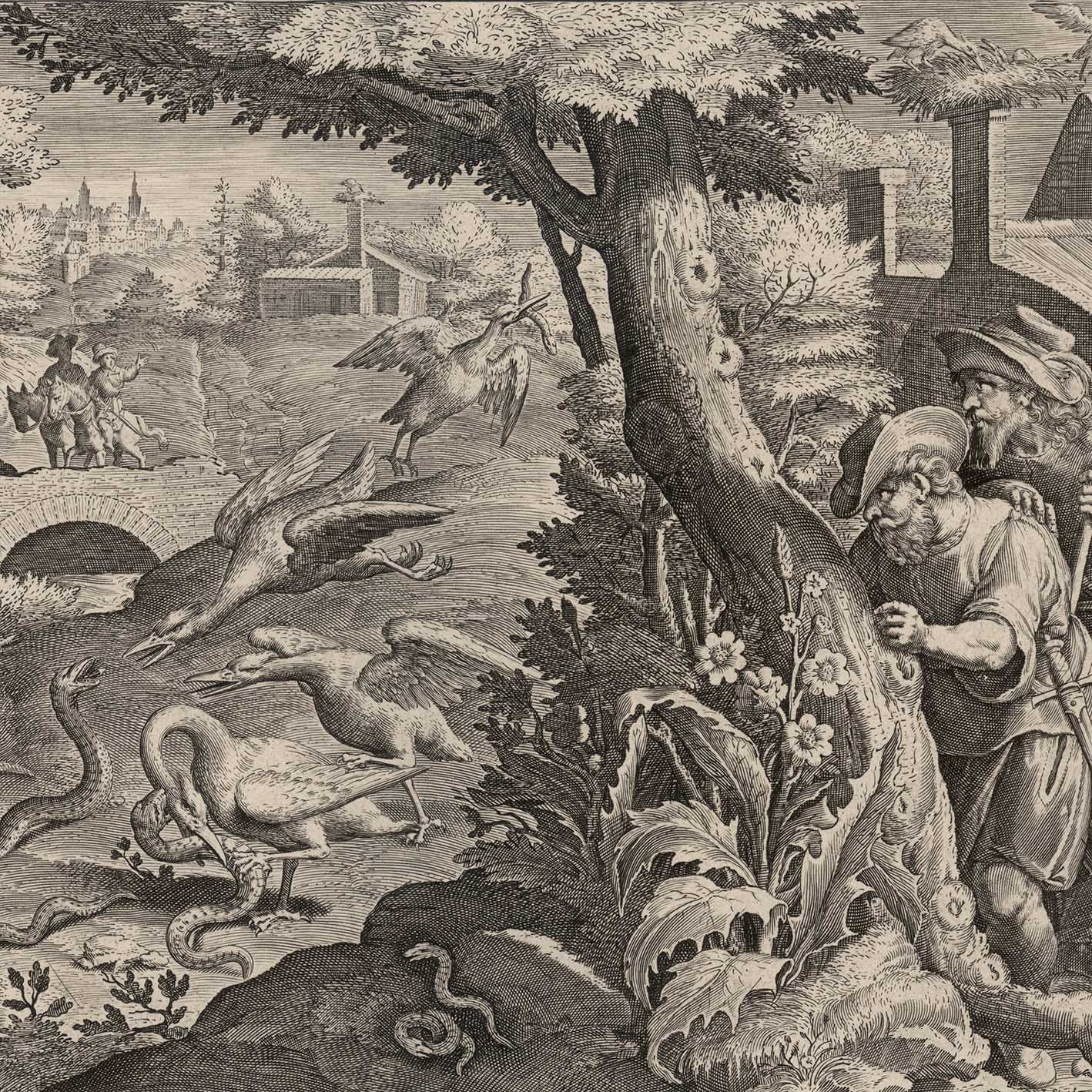
Jan Collaert II’s engraving, “Storks Fighting Snakes,” c1596, after Jan van der Straet

(attrib.) Jan Collaert II (aka Hans Collaert; Jan Baptist I Collaert) (c1561–c1620)


“Storks Fighting Snakes” (aka “Cranes Fighting Snakes on Crete”), 1596, plate 63 from the series of 105 plates, “Venationes Ferarum, Avium, Piscium” (Hunts of wild animals, birds and fish), after a drawing by Jan van der Straet (aka Joannes Stradanus; Ioannes Stradanus) (1523–1605), initially published by Philips Galle (aka Philippe Galle; Philippus Gallaeus) (1537–1612) in 1596 in Antwerp, and later by Joannes Galle (aka Johannes Galle; Jan Galle) (1600–1676) in 1634, also in Antwerp. This impression is from a later (19th century?) chine collé edition.

Engraving on chine collé (China) on laid paper backed with a support sheet.

Size: (sheet) 26 x 34.9 cm; (plate) 20.2 x 27.5 cm; (image borderline) 18.5 x 27 cm.

Inscribed on plate within the image borderline: (lower right corner) “Ioan Galle/ excud./ I. Stradan.inu.”

Numbered and lettered on plate below the image borderline: (Ieft) “63.”; (two columns of two lines at centre) “Nutrit Squamosos Appulia vasta Colubros:/ Istorum inuadunt Grus atque Ciconia pullos:// Hinc rostro et morsu bellum committitur acre./ Ludicra res multis hæ est Spectata spectata colonis. 4”.


State iii with the addition of the later publisher’s name, Joannes Galle (Philips Galle’s grandson).

New Hollstein 508.III (Stradanus) (Manfred Sellink [ed.] 2001, “The New Hollstein: Dutch and Flemish Etchings, Engravings and Woodcuts 1450–1700: Philips Galle”, Rotterdam, Sound and Vision); New Hollstein 1528 (Collaert).

The British Museum offers the following description of this plate:

“Plate numbered 63, Storks Fighting Snakes; in the right foreground, two huntsmen, armed with a spear and daggers, watch from behind a tree as storks attack snakes to the left, one flying off with a snake; beyond, in the left mid ground, three men watch from a bridge; beyond them a town is visible in the distance; behind the huntsmen in the foreground, to the right, storks are nesting in chimneys”

(https://www.britishmuseum.org/collection/object/P_1957-0413-73).

The Bowdoin College Museum of Art which holds Jan van der Straet’s original drawing (gift of Susan Dwight Bliss) offers the following insights about the composition of this print:

“Two hunters shielded by a tree witness a fierce battle of storks against snakes. Royal menageries in sixteenth-century Europe featured bloody spectacles of interspecies fights to the death between exotic beasts, such as tigers and elephants. The bird and snake combat recorded in Book 10 of Pliny’s Natural History is described as taking place in Thessaly, Greece, where laws protected storks because of their snake-slaying potency. The engraving after this drawing has a four-line Latin verse below the image. It adds cranes to Pliny’s description and changes the locale: ‘Vast Appulia nourishes the scaly snakes. The crane and the stork attack their offspring. Here they wage a bitter war with beak and bite. This sportive event is watched by many farmers.’”

(https://artmuseum.bowdoin.edu/objects-1/info/4231).


Condition: well-printed, strong impression with full margins as published. The sheet is in an excellent condition for its considerable age (i.e. there are no tears, folds, holes, losses, abrasions, stains or foxing).

I am selling this visually arresting engraving showing storks making meals of snakes watched by two wide-eyed men, for a total cost of AU$286 (currently US$207.82/EUR174.01/GBP156.75 at the time of this listing) including postage and handling to anywhere in the world, but not (of course) any import duties/taxes imposed by some countries).

If you are interested in purchasing this near faultless early engraving exemplifying the 16th century fascination for grim interspecies battles to the death, please contact me (oz_jim@printsandprinciples.com) and I will send you a PayPal invoice to make the payment easy.

This print has been sold