Showing posts with label Hogarth (William). Show all posts

Saturday, 7 February 2026

William Hogarth, “Time Smoking a Picture”, 1761


William Hogarth (1697–1764)
“Time Smoking a Picture,” 1761

Technical Details & Condition:
Etching, engraving and mezzotint on wove paper with full margins as issued. Published in the esteemed 1822 Heath Edition of Hogarth's works—the final edition printed from Hogarth's original engraved plates.

The Art Gallery of NSW (Australia) provides insightful commentary on this print:
“This is Hogarth's most consciously learned image, using quotations from classical texts to support his challenge to the gentlemanly taste for old and darkened Italian paintings. From the 1730s onwards, he railed against the taste for dubious old master paintings authenticated by dealers and 'dark masters'. Time's scythe pierces the canvas, making the point that time is not a beautifier but a destroyer.” (https://www.artgallery.nsw.gov.au/collection/works/8658/#about)

This is a superb, nearly faultless impression—richly inked and crisply printed. The sheet, with its generously wide margins, is in pristine condition considering its large size and age—free of tears, holes, folds, abrasions, stains, or signs of handling.

Dimensions:
• Sheet: 65.8 x 50.5 cm
• Platemark: 24.5 x 18.6 cm
• Outer image borderline: 22 x 17.4 cm

Lettering on Plate:
• On the edge of the framed painting: “Crates_ [Greek inscription in two lines translated: ‘Time is not a clever craftsman, for he makes everything more obscure’] See Spectator/ Vol: II, Page 83.”
• Lower right: “As Statues moulder into Worth. P: W:” — initials of Paul Whitehead, the satirical poet and Hogarth’s contemporary.
• Lower centre: “To Nature and your Self appeal, / Nor learn of others what to feel_. Anon:”

References:
• Paulson 208 III/III (Ronald Paulson, Hogarth's Graphic Works, 1965, Yale University Press, pp. 173–74, cat. no. 208)
• British Museum (first state impression): https://www.britishmuseum.org/collection/object/P_1857-0509-15
• Art Gallery of NSW (preliminary drawing): https://www.artgallery.nsw.gov.au/collection/works/7624/

Price & Shipping:
AU$318 (approximately US$223.20 / €188.83 / £163.99), including worldwide express shipping. Import duties and taxes are the buyer’s responsibility.

If you are interested in acquiring this powerful allegorical warning against valuing artworks based solely on the effects of time—featuring the personification of Time as a winged figure blowing smoke onto a painting to simulate patina, with his scythe “distressing” the surface while seated upon a broken sculpture (possibly a fake Greek kouros)—please contact me at oz_jim@printsandprinciples.com. I am happy to provide a secure PayPal invoice for a seamless purchase.


Tuesday, 12 March 2024

William Hogarth, “Crowns Mitres, Maces etc.”, 1754

William Hogarth (1697–1764)

“Crowns, Mitres, Maces etc.”, 1754, a subscription ticket for “An Election Entertainment” (a series of four prints), initially published in London by William Hogarth in 1754.

Note that this impression was from the original edition of the third (or fourth) state printed on laid paper, but there is a later edition published in London in 1822 that is printed on wove paper following the reworking/”strengthening” of the plate by James Heath (17571834). (My apologies if there are inaccuracies in this account.)

Etching with engraved text on heavy buff colour laid paper.

Size: (sheet) 27.9 x 21.4 cm; (plate) 22.7 x 19.2 cm.

Inscribed in plate within the image: (on tablet at lower left-of-centre [apologies for any errors in my reading of the text]) “An Act for the Encouragement/ of the Arts of Designing Engrav/ ing & Etching by Vesting the/ Properties thereof, in the/ Inventors & Engravers,/ during ye time therein mentione[d].”

Lettered in plate below the image: (centre) “Design’d, Etch’d & Publish’d, as the Act directs, by Wm. Hogarth, March 20th. 1754.”; (below the first text box in a text box with two columns) “In humble & grateful Acknowledgment/ of the Grace & Goodness of the Legislature,/ Manifested./ In the Act of Parliament for the Encouragement/ of the Arts of Designing Engraving &c;/ Obtain’d/ by the Endeavours & almost at the Sole Expence/ of the designer of this Print in the Year 1735;/ By which/ not only the Professors of those Arts were rescued/ from the Tyranny Frauds & Piracies// of Monopolising Dealers/ and Legally entitled to the Fruits of their own Labours/ but Genius & Industry were also prompted/ by ye most noble & generous Inducements to exert themselves,/ Emulation was Excited,/ Ornamental Compositions were better understood, and every Manufacture where Fancy has any concern/ was gradually rais[e]d to a pitch of perfection before unknown,/ Insomuch that those of Great Britain/ are at present the most Elegant/ and the most in Esteem of any in Europe.”; (lowest text box) “Recd. [blank …] of [blank…] 15s being the first Payment/ for three Prints, representing the Polling for Members of Parliament, Canvassing for Votes, &/ Chairing ye Members; Which I Promise to deliver when finished on ye Payment of 16s. & 6d. more.”; (below the text boxes at centre) “N.B. The Price will be rais’d when the Subscription is over.”

State iii/iv? (of iv) with change of the coronet shown on the right from the coronet belonging to the Prince of Wales (states i–ii) to the coronet worn by younger sons of the King George II (as shown here), possibly indicating Hogarth's support for George II's younger son, the Duke of Cumberland (see the BM’s curator’s comment for inv. no. 1864,0714.28 (https://www.britishmuseum.org/collection/object/P_1864-0714-28).

Paulson (1989) 197 (Ronald Paulson 1989, “Hogarth's Graphic Works”, Third edition, London).

The British Museum offers the following description of this print: “Subscription ticket for ‘An Election Entertainment” with the royal crown as a sun casting its rays on coronets, mitres and other symbols of power, as well as on a copy of ‘Hogarth's’ Act of 1735. 1754 Etching and engraving” (https://www.britishmuseum.org/collection/object/P_Banks-59-96).

Condition: a strong and well-printed impression. Beyond a hole in the lower margin at right, the sheet is in a very good condition for its considerable age with no tears, folds or significant stains.

I am selling this unusual engraving for AU$256 (currently US$169.39/EUR154.94/GBP132.33 at the time of posting this listing) including postage and handling to anywhere in the world, but not (of course) any import duties/taxes imposed by some countries.

If you are interested in purchasing this historically interesting engraving designed to be “filled in” by a potential collector as a contractual agreement/subscription ticket in advance of the publication of a set of three more prints to be engraved by Hogarth—this being the first of four prints in total—please contact me (oz_jim@printsandprinciples.com) and I will send you a PayPal invoice to make the payment easy.

This print has been sold


Sunday, 20 February 2022

William Hogarth’s etching, “Four Heads from the Raphael Cartoons at Hampton Court”, c1729, after Raphael

William Hogarth (1697–1764)—see the inscribed account of this plate and its attribution to Hogarth

“Four Heads from the Raphael Cartoons at Hampton Court”, c1729 (published in 1781), after Raphael (aka Raffaello Sanzio or Santi) (1483–1520), published by Jane Hogarth (aka Mrs. Hogarth) (1709–1789), at the Golden Head, Leicester Fields, London (as inscribed in the plate), blindstamped at lower right (“Chelsea”—a library stamp? [see https://www.christies.com/en/lot/lot-830375]).

In Chia-Chuan Hsieh’s (2009) article, “Publishing the Raphael Cartoons and the Rise of Art-Historical Consciousness in England, 1707–1764”  (“The Historical Journal”, vol., 52, no. 4) the author makes the proposal that “this plate, when it was published in 1781 by Hogarth’s wife, was thought to be evidence of a possible joint venture by Thornhill [James Thornhill is Hogarth’s father-in-law] and Hogarth to publish a book based on the Raphael Cartoons” (p. 917). Chia-Chuan Hsieh (2009) also advises that there is a possibility that the portrayed heads in Hogarth’s etching are based on James Thornhill’s drawings from Raphael’s “Elymas Struck with Blindness” (p. 916).

Etching and aquatint on coarse handmade paper with wide margins.

Size: (sheet) 33.3 x 49.5 cm; (plate) 21.5 x 35.8 cm.

Inscribed in plate: (lower centre) “Mr. Walpole in his Anecdotes of Painting &c. Vol. IV. p. 22. speaking of the Cartoons at Hampton/ Court, observes that Sir James Thornhill "having made copious studies of the heads, hands/ and feet, intended to publish an exact account of the whole, for the use of students: but this/ work has never appeared"./ As the present plate was found among others belonging to the late Mr. Hogarth, it/ is not impossible but that it might have been engraved by him for his father-in-law Sr. James's intended publication./ Published as the Act directs May 14, 1781, by Mrs. Hogarth, at the Golden Head, Leicester Fields.”

Blindstamped at lower right corner (soft impression with the word “Chelsea”).

State ii (of ii)

Paulson 115ii (Ronald Paulson 1970, “Hogarth's Graphic Works”, 2 vols., New Haven, cat. no. 115 ii/ii).

The Metropolitan Museum of Art offers a detailed description of this print: https://www.metmuseum.org/art/collection/search/396576.

See also the brief descriptions of this print at the Dallas Museum of Art, the Philadelphia Museum of Art and the National Gallery of Art: https://collections.dma.org/artwork/4316010; https://www.philamuseum.org/collection/object/106338; https://www.nga.gov/collection/art-object-page.32778.html.

Condition: a strong and well-printed impression with generously wide margins and a soft blindstamp at lower right. The sheet is in an excellent condition with no tears, holes, folds, abrasions, significant stains or foxing.

I am selling this curiously interesting etching inscribed with a fascinating account of its discovery in the belongings of “the late Mr. Hogarth” for AU$367 in total (currently US$263.57/EUR232.71/GBP193.93 at the time of posting this listing) including postage and handling to anywhere in the world, but not (of course) any import duties/taxes imposed by some countries.

If you are interested in purchasing this study by Hogarth after details of four heads in Raphael’s design for the Sistine chapel, “The Conversion of the Proconsul”, c1514 (aka “Elymas Struck with Blindness”) (https://www.rct.uk/collection/themes/trails/the-raphael-cartoons/the-conversion-of-the-proconsul-0), please contact me (oz_jim@printsandprinciples.com) and I will send you a PayPal invoice to make the payment easy.


Monday, 14 February 2022

William Hogarth’s etching with engraving, “Hogarth Painting the Comic Muse”, 1764


William Hogarth  (1697–1764)

“Hogarth Painting the Comic Muse” (aka “William Hogarth, Serjeant Painter to His Majesty”; “William Hogarth 1764”), 1764, etching after the artist’s famous self-portrait, “William Hogarth, Serjeant Painter to His Majesty“, c1758, in the National Portrait Gallery, London.

I wish to draw attention to the following elements in this self-portrait: the serpentine lines of the chair exemplifying Hogarth’s principle, the “line of beauty”; the subject he is painting on the easel shows the Muse Thalia holding a mask of a satyr in one hand and a book—the attribute of Rhetoric—in the other; resting at the foot of the easel is a folio of prints titled, “Analysis”—no doubt referencing his 1753 publication of aesthetic theories (including the notion of the “line of beauty”) titled “Analysis of Beauty”.

Etching and engraving on heavy laid paper trimmed slightly irregularly around the image borderline and backed with a support sheet.

Size: (sheet) 40 x 33.7 cm.

Inscribed in plate within the image borderline: (on painted pedestal) “COMEDY/ 1764”.

Lettered in plate below the image borderline: (centre) “William Hogarth—1764”

State vii (of vii) with the addition of the title.

Paulsen 204 vii (Ronald Paulson 1989, “Hogarth's Graphic Works”, 3 ed., London, p.170 cat. no. 204 vii/vii).

The Library of Congress offers the following description of this print: “Print shows William Hogarth, full-length portrait, seated in a chair, facing right, before an easel with sketch labeled "Comedy 1764", he is holding a palette with brushes in his left hand and may be using a short stick to measure scale. Print depicts ‘Hogarth painting the comic muse, 1758’" (https://www.loc.gov/item/2004669482/).

See also the descriptions of this print offered by the Metropolitan Museum of Art and the Rijksmuseum: https://www.metmuseum.org/art/collection/search/405234http://hdl.handle.net/10934/RM0001.COLLECT.634586.

Condition: a strong and well-printed impression but with small restorations—a few tears and a replenished area around the title of the folio “Analysis” and a replenished lower right corner. The sheet has been laid onto a support of archival (millennium quality) washi paper.

I am selling this large and important original etching (with engraving) by Hogarth which is not only a revealing self-portrait of the great artist painting his muse, “Thalia”—note that he portrays himself holding a measuring stick and has rested some brushes on a chamber pot—but is also fascinating in its reference to his theories—the serpentine “line of beauty” shown in the lines of the chair and his publication resting at the foot of the easel, “Analysis of Beauty”—for AU$396 in total (currently US$280.76/EUR248.25/GBP208 at the time of posting this listing) including postage and handling to anywhere in the world, but not (of course) any import duties/taxes imposed by some countries.

If you are interested in purchasing this major etching executed by the hand of William Hogarth, please contact me (oz_jim@printsandprinciples.com) and I will send you a PayPal invoice to make the payment easy.

This print has been sold 


Monday, 13 January 2014

Reflexive and Reflective Responses: Bidloo, Sadeler, Jacquemart and Hogarth

What are some of the fundamental ways that viewer’s respond to imagery?


Although there are always issues complicating any simple answer to questions such as how an audience is likely to respond to artworks, at the heart of any discussion on this topic there are two fundamental ways. The first is a viewer’s automatic response to a portrayed subject. This is often described as “reflexive” (i.e. a response that is like an involuntary knee-jerk if one’s knee is tapped with a hammer). The second is a viewer’s conscious and mediated response that is often described as "reflective." This response involves the viewer in negotiating (i.e. “thinking about”) meanings based on associations, projections and interrogation of the visual information observed in the artwork.

Regarding a reflexive response, this is a natural reaction like the wish to wave away the fly engraved in Gerard de Lairesse’s (1640/41–1711) anatomical study, Table 52: Abdomen, Posterior Wall (shown below). Based on my own response, this fly and its proximity to the surgically evacuated abdomen cavity, along with its angled alignment towards the cavity and the fly's resting place on material bordering the cavity, gives me an involuntary shiver of unease. I instinctively want to brush it away so that the exposed diaphragm is uncontaminated by the fly’s presence. 

Engraving by Abraham Blooteling (1640–1690) and Pieter Stevens van Gunst (1659–1724) after an illustration by Gerard de Lairesse (1640/41–1711) published in Govard Bidloo's (1649–1713) famous anatomical atlas, Anatomia humani corporis (Utrecht, van Poolsum, 1734 edition) (see video further below)
Table 52: Abdomen, Posterior Wall, 1690
copper engraving on cream laid paper with 2.5 cm chain-lines
(sheet) 50.4 x 34.6; (plate) 47.5 x 32.1 cm
Description of this print: “Large house fly shown on the specimen. Abdomen, posterior wall, in situ. Viscera removed to show diaphragm, crus of diaphragm around divided aorta and esophagus. Vertebrae and psoas muscle shown.
The splendid anatomical work of Bidloo is considered one of the most beautiful ones ever printed. It became famous because of the very elegant and elaborate engraved tables after drawings by Gerard de Lairesse, carried out by Abraham Blooteling and Pieter Stevens van Gunst.” (http://www.worthpoint.com/worthopedia/abdomen-posterior-wall-house-fly-417303811 [viewed 10 January 2014])


Vassar's Millionth Volume [Anatomia humani corporis by Govard Bidloo] (4.06 mins)

This reflexive response to the fly is also accompanied by an equally reflexive reaction of recoil at the grisly and uncommon subject portrayed—a dissected cadaver. Moreover, I have vacillating instinctive responses of revulsion and fascination with the contrast I see between the portrayed mechanical sheen of the dissection pins and the soft flesh that they hold in place (see details above).

The notion that my response vacillates between one moment of wanting to avert my eyes away from the portrayed scene and, at the next, with wanting to examine it in a searching way, is even more apparent when I look at another engraving from Bidloo’s anatomical atlas, Table 86: Dissected Foot (shown below). Here, the apparatus for displaying the dissected muscles and tendons is even more riveting to my eye in the sense that there is a note of theatricality in the way that the various body tissues are drawn apart by posts, pegs, callipers and pins. For me, I feel a twinge of pain, in terms of a gut reaction, when I see the muscles disassembled in this way.

Engraving by Abraham Blooteling (1640–1690) and Pieter Stevens van Gunst (1659–1724) after an illustration by Gerard de Lairesse (1640/41–1711) published in Govard Bidloo's (1649–1713) famous anatomical atlas, Anatomia humani corporis (Utrecht, van Poolsum, 1734 edition)
Table 86: Dissected Foot, 1690
copper engraving on cream laid paper with 2.5 cm chain-lines and a watermark featuring a crowned coat of arms
(sheet) 51.4 x 33.2; (plate) 47.5 x 30.2 cm
Description of this print from the original text: “Exhibits all the Muscles which Appear in the Bottom of the Foot, after the Expansion of the Plantaris is remov'd.”

Condition: Sharp impression with several dots (stains) to the upper-right corner, a repaired tear (2 cm) to the lower-left side and surface dustiness appropriate to the age of the print, otherwise it is in good condition. I am selling this rare and extraordinarily fine engraving for a total cost of $488 AUD including postage and handling to anywhere in the world. This is a large print and will be shipped in a tube. Please contact me using the email link at the top of the page if you have any queries.


There is another type of reflexive response that goes beyond gut-reaction and this is exemplified in Johannes Sadeler’s (1550–c1600) engraving, The Calling of Abraham (shown below). In this image, illustrating a scene from Genesis, the voice of God is portrayed by the Latin words: Egredere de terra tua (from the Genesis 12:1 verse: "dixit autem Dominus ad Abram egredere de terra tua et de cognatione tua et de domo patris tui in terram quam monstrabo tibi" [“the Lord said unto Abraham, get thee out of thy country and from thy kindred, and from thy father's house to the land that I will show you]). The written text is not the reflexive element in the image; rather it is the need for the audience to turn their heads upside down to read the inscription and in the act of doing this—perhaps blasphemously—to assume the position and role of God making the pronouncement from the heavens above. This device of inverting the text in the image is intentional. Sadeler wants the viewer to interact with the image in a physical way that causes the viewer to be God by an automatic unconscious response.

Johannes Sadeler (1550–c1600)
The Calling of Abraham, c1590
Engraving on fine laid paper with 2.8 cm chain-lines
(sheet) 22 x 26.7; (plate) 21.5 x 26.3 cm
Inscribed: (lower middle of the image) "Cu priuilegio / Sac. Cæs. M."; (lower margin) with two-line dedication to Augustinus de Justis: "IN GRATIAM PERILLVSTRIS COMITIS AVGVSTINI DE IVSTIS, PINXIT IACOBVS DE PONTO BASSAN, / VERONAE" and "Scalpsit autem Joann. Sadeler Belg."
Marvellous lifetime impression of the only state
Described by the British Museum: “The Calling of Abraham. Landscape with a couple making cheese (?) in lower right, their animals beyond, a shepherd resting at the foot of a tree at left, Abraham as a shepherd in background and being addressed by the words 'Egredere de terra tua' emerging from a cloud; after Jacopo Bassano”
Hollstein 53: Bartsch 7001.052
Isabelle de Ramaix offers the following information about this print: “The Jacopo Bassano painting which inspired this engraving is now lost, but at the end of the sixteenth century it was in the Giusti collection in Verona.” (de Ramaix, Isabelle 1999, The Illustrated Bartsch: Johan Sadeler l .001–.223, Vol 70, Part1 (Supplement), Abaris Books, Norwalk, p. 76)

Condition: A superb lifetime impression that is neither bleached nor restored. The sheet is hinged with conservator’s tape but is not glued down onto a support sheet. The print shows signs of handling (bumped corners and a light fold mark across the centre but otherwise it is in good condition. I am selling this marvellous engraving for a total cost of $310 AUD including postage and handling to anywhere in the world. Please contact me using the email link at the top of the page if you have any queries or click the “Buy Now” button below.


This print has been sold


To explain the difference between such reflexive responses and those that are reflective, I will return to my issue with flies.


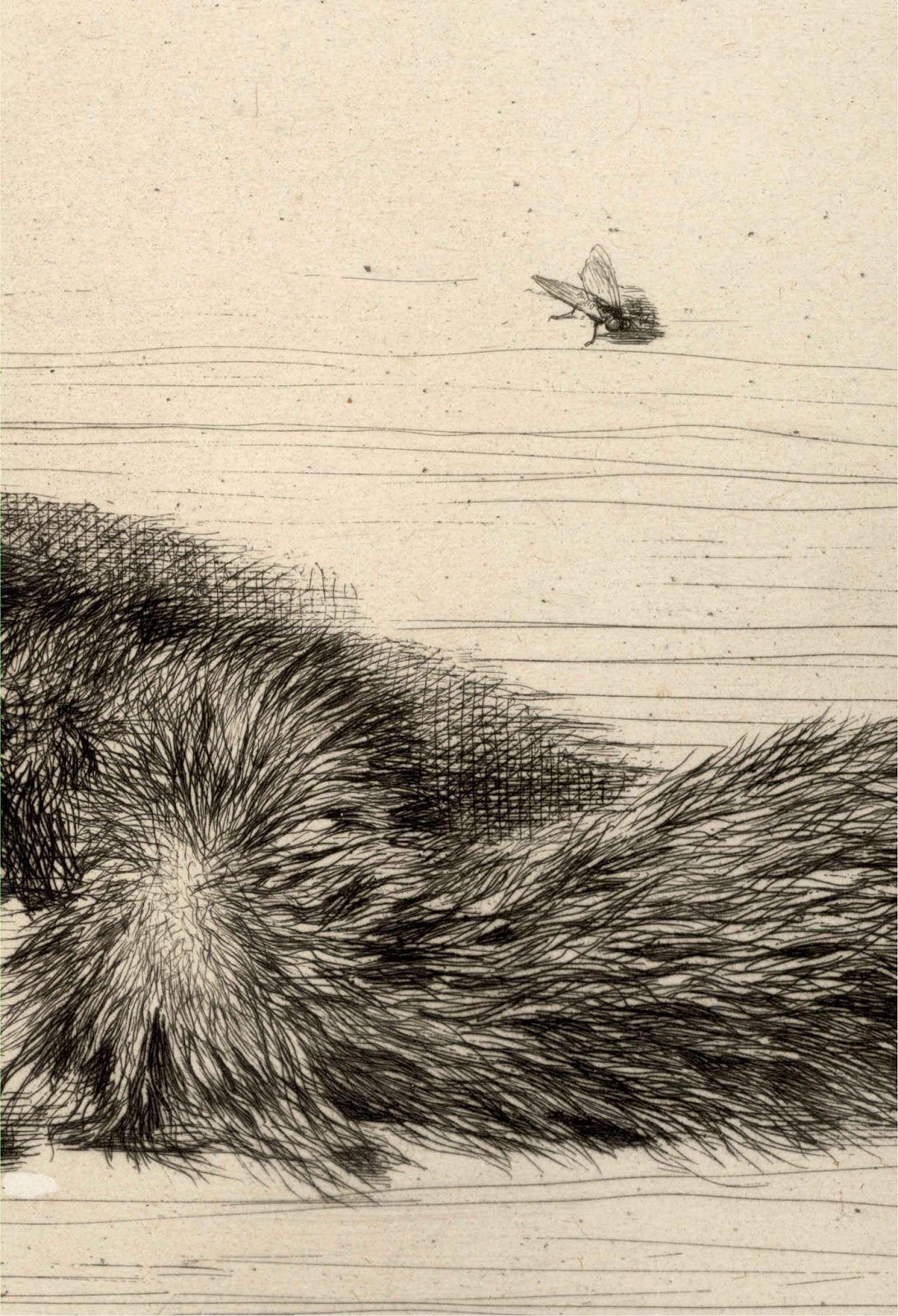
In Jules Jacquemart’s (1837–80), L’Écurueil et la Mouche? [The Squirrel and the Fly?] (shown below), the subject is again about death but when I look at the depicted fly, it does not arouse a reflexive response for me to brush it away. Instead, I ponder the fly’s relationship to the dead squirrel (i.e. I reflect upon the image) in terms of why Jacquemart choose to depict it. For instance, was Jacquemart simply illustrating a scene in a very objective way and the moment portrayed was when the fly landed on the ground beside the squirrel? Alternatively, did Jacquemart wish to allude to the history of vanitas and memento mori symbolism in art reminding us of the transience of life and that we too will die? Or from a more playful mindset, did Jacquemart have a wicked sense of humour in representing the fly as if it were a ball that the squirrel was toying with? In short, the fly does not trigger a reflective response but rather a reflective one in which my mind concocts reasons for what I observe in the print.

Jules Jacquemart (1837–80)
L’Écurueil et la Mouche? [The Squirrel and the Fly?], 1862
Etching on thick wove paper with wide margins
(sheet) 33 x 50.7 cm; (plate) 24.2 x 31.9 cm
Inscribed within the image (upper-right) “34” and in the margin (lower-left) “J. Jacquemart sculpt.”; (lower middle) L’ÉCURUEIL ET LA MOUCHE? / Paris Publié par A. CADART & CHEVALIER, Éditeurs, Rue Richelieu, 66.”; (lower-right) “Imp. Delâtre, St. Jacques, 303, Paris.”
The print dealers, C & J Goodfriend, add to my questions about the significance of this subject with the proposals: “Or was he [Jacquemart] simply interested in delineating the textures and colors of the fur and a dead squirrel gave a far better opportunity than a live one? But then, why the fly? The ultimate question is: what is the significance of the question mark at the end of the title? Or is that a contribution of the typesetter – who didn’t know how to spell L’Écureuil? An interesting oddity and, as expected, supremely well etched.” (http://www.drawingsandprints.com/CurrentExhibition/detail.cfm?ExhibitionID=11&Exhibition=42 [viewed 13 January 2014])
Béraldi 330; Bailly-Herzberg (1863) 34; Gonse 330

Condition: Rich impression in very good condition but there is a light brown spot (more visible on verso) and a fleck/spot in the lower-left margin. I am selling this print for a total cost of $330 AUD including postage and handling to anywhere in the world. Please contact me using the email link at the top of the page if you have any queries or click the “Buy Now” button below.


This print has been sold


To bring this discussion to a close, I have chosen to illustrate the many levels of reflective response that may be triggered with the example of William Hogarth’s (1697–1764), Time Smoking a Picture (shown below). Portrayed in this image is the worldly advice written in Greek on the upper edge of a framed painting: "Time is not a great artist but weakens all he touches.” To ignite a viewer’s reflective response in attempting to rationalise what this inscription could mean, Hogarth depicts the classical figure of Father Time seated on broken sculpture. For most viewers using their powers of reflective thinking, the placement of Father Time on the smashed sculpture suggests that art is destined to be ruined through misadventure over the passage of time. This reading of the impact of time on art is also sustained by Father Time’s scythe shown cutting into the framed painting. There is also the question that needs answering: why Father Time is blowing pipe smoke onto the painting? This may be harder to rationalise—unless a viewer understands that there was a leaning by collectors in the art market during Hogarth's era to value yellowed paintings (i.e. paintings that are antiques or where the varnish had the golden appearance of age).  Hogarth symbolises the notion of time and the patina of grime that it can give artworks by showing Father Time literally darkening the framed painting inscribed with the curious text with smoke. In essence, Time Smoking a Picture is an allegorical warning to art collectors not to be duped into valuing artworks by the effects of time alone; a point that the Art Galley of NSW in its description of this print sums up succinctly: “time is not a beautifier but a destroyer.” (http://www.artgallery.nsw.gov.au/collection/works/8658/  [viewed 13 January 2013])

William Hogarth (1697–1764)
Time Smoking a Picture, 1761
Etching and aquatint on wove paper with wide margins (as published)
Heath edition, 1822, published by Baldwin, Cradock and Joy. This edition was the last printing from the original plates (later editions are smaller in size and are either reproductions or the plate has been recut). 
(sheet) 65.5 x 50.3; (plate) 23.6 x 18.5 cm
Description by the Art Gallery of NSW: “This is Hogarth's most consciously learned image, using quotations from classical texts to support his challenge to the gentlemanly taste for old and darkened Italian paintings. From the 1730s onwards he railed consistently against the taste for dubious old master paintings authenticated by dealers and 'dark masters'. Time's scythe pierces the canvas, making the point that time is not a beautifier but a destroyer.”
See also the drawing for this print: http://www.artgallery.nsw.gov.au/collection/works/7624/ (viewed 13 January 2013)

Condition: Rich impression from the original plate. The wide margins are free of foxing but there is age-darkening to the edges of the sheet, light dustiness and soiling (mainly verso) and there are signs of handling in terms of bumped corners. I am selling this print for a total cost of $286 AUD including postage and handling to anywhere in the world. Please contact me using the email link at the top of the page if you have any queries or click the “Buy Now” button below.


This print is no longer available