Showing posts with label Savery (Roelant). Show all posts

Thursday, 9 January 2020

Isaak Major's engraving, “The Flood”, 1586–1630


Isaak Major (aka Isaac Major; Issak Mayor; Isaac Maior) (c.1576–1630)

“The Flood” (aka “The Deluge”), 1586–1630, illustration to the story of Noah (Genesis 7:10–8:17) possibly after a lost drawing by Roelant Savery (aka Roelandt Savry; Roelant van Saverij) (1576–1639), published by Marco Sadeler (aka Marcus Sadeler; Marc Sadeler) (1614–1660).

Note: although a related drawing by Roelant Savery has not been identified, R.J.W. Evans et al. (1991) advise in “The Stylish Image: Printmakers to the Court of Rudolf II” (Nat. Gall. of Scotland) that this print “bears a strong resemblance to two other images of biblical scenes which are signed by Ma[j]or” (p. 51) (viz. “Moses Striking the Rock” [HI] and “Golgotha”[H5]).

Engraving on laid paper trimmed along the plate mark and backed with a support sheet.
Size: (sheet) 18 x 28.3 cm; (image borderline) 16.9 x 27.9 cm.
Lettered on plate below the image borderline: “Ego pluam super terram quadraginta diebus et quadraginta noctibus, et delebo omnem substantiam, quam feci de superficie terræ. Gen : cap.6. Marco Sadeler excudit.” ([tansl.] “I will rain upon the earth forty days and forty nights, and all the living things that I have made the earth.”)

Hollstein German 2 (Robert Zijlma 1979, “German Engravings, Etchings and Woodcuts, ca. 1400–1700: Erasmus Loy to Jakob Mayr”, vol. 23, Amsterdam, Van Gendt & Co, p. 163, cat. no. 2).

The Rijksmuseum offers the following description of this print:
(transl.) “The flood floods the country. Humans and animals are swallowed up by the water. People try to escape from the rising water” (http://hdl.handle.net/10934/RM0001.COLLECT.148567).

Condition: superb, richly inked lifetime/early impression (based on the crisp lines showing no sign of wear to the printing plate, trimmed around the platemark with replenished loss of the lower right edge beneath the publisher’s details. Beyond the repaired lower right edge, the sheet is in very good condition (i.e. there are no tears, folds, holes, abrasions, stains or foxing) and is laid onto a support of archival (millennium quality) washi paper.

I am selling this magnificent engraving with glowing contrasts of light and dark for a total cost of AU$398 (currently US$273.37/EUR246.03/GBP209.20 at the time of this listing) including postage and handling to anywhere in the world.

If you are interested in purchasing this remarkably beautiful engraving which not only has the Baroque spirit of Aegidius Sadeler and Roelant Savery—the artist’s teachers in Prague—but also foreshadow the treatment of rain in Rembrandt’s famous “The Three Trees” (1643) (https://www.metmuseum.org/art/collection/search/354633), executed thirteen years after Isaak Major passed away in 1630, please contact me (oz_jim@printsandprinciples.com) and I will send you a PayPal invoice to make the payment easy.

This print has been sold


Monday, 19 February 2018

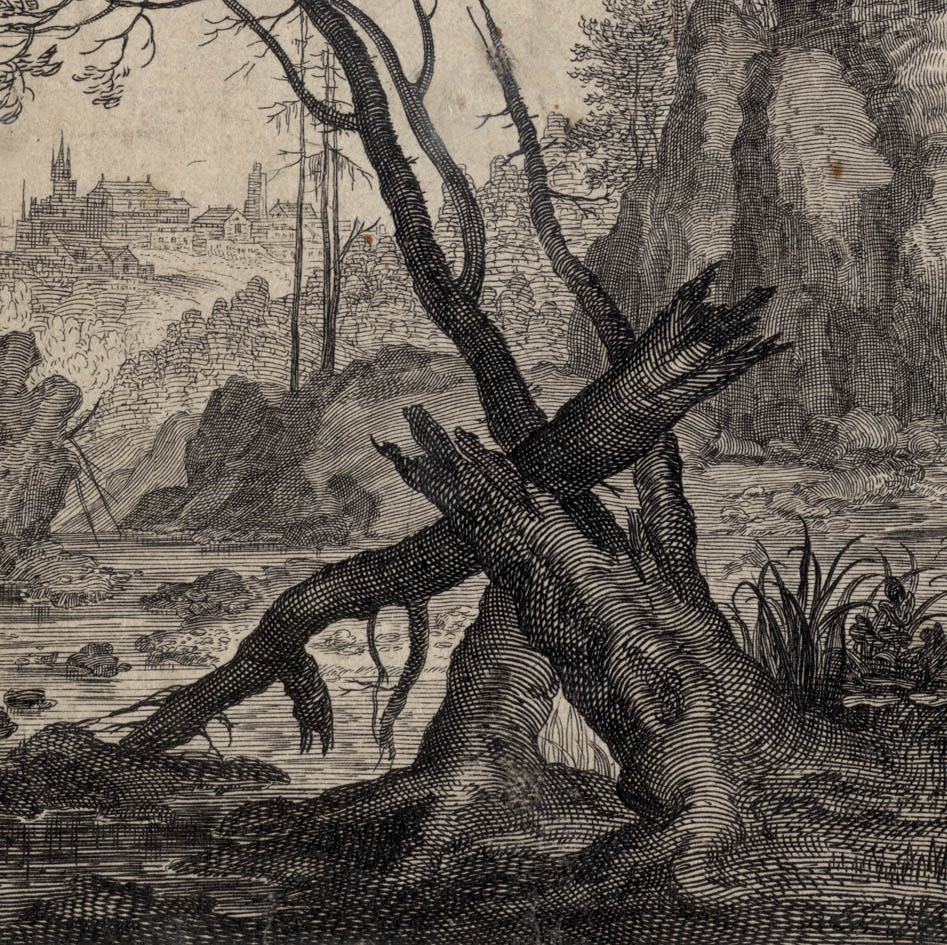
Aegidius Sadeler’s engraving, “Three Hunters at a River in a Forest”, 1609


Aegidius Sadeler II (aka Gillis Sadeler; Egidius Sadeler; Ægedius Sadeler) (c1570–1629)

“Three Hunters at a River in a Forest” (Rijksmuseum title) or “A Forest with a Glade in the Background” (TIB title), 1609, after a drawing by Roelant Savery (1576–1639) in the Fondation Custodia, Paris (inv. 2436). This is the first plate from the series of six plates, “Mountain Landscapes in Tyrol.” Published by Aegidius Sadeler (as inscribed on the plate) and later published by Marco Sadeler (fl1660s) in Prague.

Engraving and etching on laid paper trimmed slightly within the platemark and re-margined on a support sheet.
Size: (re-margined support sheet) 36.8 x 42.1 cm; (sheet) 19 x 26.2 cm.
Inscribed on plate within the image borderline: "R: Sauery In. / Æg: S. ex. 1609”
State i (of ii) Lifetime impression with publication details of Aegidius Sadeler before the rework and the addition of the publication details of Marco Sadeler in the second state.

TIB 1997 7201.233 S1 (Isabelle de Ramaix, “The Illustrated Bartsch”, vol. 72, Part 2, Supplement, p. 29); Hollstein 1980, vol. 21, no. 225; Nagler 1835–52, no. 229; Le Blanc, nos. 198–203; Wurzbach, no. 107; Zwollo 1983, p. 401; Piccin, no. 105.

The Rijksmuseum offers the following description of this print:
“Forest landscape with fallen trees at a river. Right on the shore three hunters and a dog.” (http://hdl.handle.net/10934/RM0001.COLLECT.167923)

Condition: silvery impression trimmed within the platemark in excellent condition (i.e. there are no tears, holes, folds, abrasions, stains or foxing). The sheet has been re-margined with an archival support sheet.

I am selling this bleak view of a broken landscape—arguably a bog— by one of the most famous of the old masters for AU$343 (currently US$272.01/EUR218.97/GBP193.92 at the time of this listing). Postage for this print is extra and will be the actual/true cost.

If you are interested in acquiring this delicately luminous print exemplifying the peculiarly 17th century notion of landscape with dead and regenerating trees among other attributes seen from a high viewpoint—the Weltlandschaft (world landscape)— please contact me (oz_jim@printsandprinciples.com) and I will send you a PayPal invoice to make the payment easy.

When initially framing my thoughts about this print for a discussion, I had thought that I was going to offer a personal proposal of how the notions of “World Landscape”—an early philosophical way of looking at the landscape (see https://en.wikipedia.org/wiki/World_landscape)—and “Lady Landscape” —a not so politically correct mindset in which the landscape’s natural forces are perceived as femininely evil with a facade of beauty (see Udo Becker 2000, “The Continuum Encyclopedia of Symbols”, Continuum, p. 169)—but instead I need to report a MURDER.

I remember years ago seeing the movie, “Blowup” (1966) directed by Michelangelo Antonioni in which a fashion photographer who had been taking shots in a park thought that he had inadvertently captured a murder in the background of one of his photos. Well … the same feeling of finding a murder captured in an image happened when I was zooming in on details of this print.

To be honest, before I started making close-ups, I had only seen the couple of figures standing in the clearing in the far distance. But then I found the two chaps—“shooters”— and their dog concealed in the trees on the escarpment on the right. On even closer examination I then found that their hideous intent was being witnessed by another man walking his dog. The more I looked into the details, more and more figures “popped” up into view. In total I have found seven figures: two on the silhouette edge of the hillside on the far left; the two in the distant clearing; the two bush loving killers on the cliff top and the witness to their activities with his curly tailed dog.


Tuesday, 13 June 2017

Aegidius Sadeler II’s “Inn and Houses near a Bridge”, 1624–c1650, after Roelant Savery


Aegidius Sadeler II (aka Gillis Sadeler; Egidius Sadeler; Ægedius Sadeler) (c.1570–1629)
“Inn and Houses near a Bridge”, 1624–c.1650, after a lost drawing by Roelant Savery (1576–1639) from the series of 5 plates, “Landscapes of Tyrol”, published in the second state by Marco Sadeler (fl.1660s).

Etching and engraving on fine laid paper with thread margins
Size: (sheet) 17 x 22.2 cm; (plate) 16.6 x 22 cm; (image borderline) 15.1 x 21.7 cm
Iettered below the image borderline: (left) “R.S: Inve[n]tor / Eg. S: excu.”; (right) “Marco Sadeler excudit.”
State ii (of iii) (before the erasure of the publishing detail, “Marco Sadeler excudit.”)

TIB 72 (Part 2 Sup.).7201.230 S2 (Walter L Strauss & Isabelle de Ramaix [Eds.] 1998, “The Illustrated Bartsch”, vol. 72, Part 2 [Supplement], p. 27); Hollstein Dutch 226-2 (2) (Hollstein 1980, vol. 21, no. 223); Le Blanc, no. 204–09; Wurzbach, no. 104; Nagler 1835—52, nos. 222–26
See also the description of this print at the Rijksmuseum: http://hdl.handle.net/10934/RM0001.COLLECT.167921

Condition: crisp impression trimmed close to the platemark in excellent condition (i.e. there are no holes, tears, stains or foxing) but with a light fold mark visible verso.

I am selling this delicate impression that seems almost luminous showing rural life around what I believe is a watermill for the total cost of AU$270 (currently US$203.30/EUR181.47/GBP159.73 at the time of posting this listing) including postage and handling to anywhere in the world.
If you are interested in purchasing this very detailed and important print, please contact me (oz_jim@printsandprinciples.com) and I will send you a PayPal invoice to make the payment easy.

This print has been sold


Attribution of the name of an artist to a print is not always as straight forward as believing that the signature on a print MUST signify that the print was executed by the artist who signed it. This is certainly the case with the prints of Aegidius Sadeler II.

I have just been reading Isabelle de Ramaix’s (1998) introduction to the supplementary volume of the catalogue raisonné for Aegidius Sadeler II, “The Illustrated Bartsch” vol. 72 (Part 2) and discovered that at the time when Aegidius Sadeler II was translating Roelandt’s drawings of the Czech countryside, as shown here in this rural scene of a watermill, his apprentices (e.g. the great Isaak Major [c.1576–1630]) may be the true engravers of many of the prints signed with the master’s name. Going further, I read that Marco Sadeler, who published this print in its second state—as is this impression—may have reworked the plates that he published as his editions are slightly darker. I guess that someday there may be a change in attribution when the true artist(s) are formally identified.


Monday, 13 February 2017

Aegidius Sadeler II’s etching, “Wooded Landscape with a Hunter”


Aegidius Sadeler II (1570/75–1629) “Wooded Landscape with a Hunter” (TIB title) also “Forest landscape with wooden bridge” (Rijksmuseum title), 1609, after a drawing in the Louvre by Roelant Savery (1576–1639)
From the series “Six Mountainous Landscapes in Tyrol”
Etching with engraving on fine17th century laid paper with a shield watermark 
Size: (sheet) 19.2 x 26.2 cm

Inscribed within the image at lower-left “Rou. S. In.” State I (of II) (Note that the impression has been trimmed to the borderline. Consequently, the text line with the publisher’s attribution of “Marco Sadeler excudit” that defines the second state cannot be established. Nevertheless, based on the crispness and richness of the impression I propose that this would be a very early impression suggesting the first state.
Bartsch (72, Part 2 Supplement) 7201.238 S1; Nagler 1835–52. No. 229; Le Blanc, nos. 190–203; Wurzbach, no. 107; Hollstein 1980, vol. 21, no. 230; Piccin, no. 108

The Rijksmuseum offers the following description of this print:
“Forest landscape with wooden bridge and single travellers. City in the distance. Sixth picture of a six-part series of mountain landscapes of Tyrol.” (http://hdl.handle.net/10934/RM0001.COLLECT.167931)

Condition: crisp, strong, richly inked impression, trimmed to a thread margin at the borderline of the image. It is an early impression with paper loss and restoration of the upper-left corner, general dustiness appropriate to the age of the print, two closed tears near the top borderline and minor breaks/nicks to the edges.

I am selling this extremely rare original print for a total cost of AU$458 (currently US$350.86/EUR330.86/GBP280.07 at the time of this listing) including postage and handling to anywhere in the world.
If you are interested in purchasing this museum quality etching, please contact me (oz_jim@printsandprinciples.com) and I will send you a PayPal invoice to make your payment easy.

This print has been sold


This museum quality early impression by Aegidius Sadeler II is rare. In fact it is so rare that even the British Museum does not have a copy. Fortunately the Rijkesmuseum holds a copy of it: http://hdl.handle.net/10934/RM0001.COLLECT.167931

To my eyes it is a remarkable image and the composition is worth close examination. Note, for instance, the visual echo of the forked tree effectively “holding” one of its fallen limbs in the foreground with the rickety bridge supported by a mid-stream rocky outcrop in the middle distance. Note also the parallel grouping of the most striking angles in the composition. For example, the tilted angle of the forked tree is shown at the same angle as the large limb of the tree on the right.


Tuesday, 31 January 2017

Aegidius Sadeler’s, “Rabbit Hunting”, after Roelandt Savery


Aegidius Sadeler ll (aka Gillis Sadeler; Egidius Sadler; Ægedius Sadeler) (1570–1629)
“Rabbit Hunting”, c.1610–13 from the series, “Six Landscapes”, after Roelandt Savery (1576–1639)
Etching and engraving on laid paper, trimmed to the image borderline
Size: (sheet) 21.2 x 28 cm
Bartsch: 7201.244; Hollstein: 236

Condition: superb impression of a rare and important print by Sadeler. The print is slightly age-toned, trimmed to the image borderline without text lines; otherwise in excellent condition. (Note the verso shows what may be a support sheet lining but I am uncertain if this is the case).

This print has been sold


This is one of Aegidius Sadeler’s masterworks. Superficially, the print depicts a hunter shooting rabbits—after all, the title of the work is “Rabbit Hunting.” To my eyes, however, the real subject is not about hunting but rather it’s about a shaft of light penetrating into a shadowy forest following the angle of a fallen tree.

If I were asked to explain what makes this print a masterwork, for me, the answer lies beyond what is portrayed and rests with the subtle ways that Sadeler is able to communicate the phenomenon of intense light penetrating darkness. In short, the remarkable quality of this print is not really about WHAT is depicted but HOW the subject is depicted. For a more involved discussion about Sadeler’s treatment of light, see my earlier article: “Representing light: Sadeler, Lalanne, Dananache, Desbrosses & Lepere: What are some of the ways that artists can depict strong light?” (http://www.printsandprinciples.com/2012/10/sadeler-lalanne-dananache-desbrosses.html


Saturday, 19 November 2016

Aegidius Sadeler’s engraving, “Cottage on piles above a canal”


Aegidius Sadeler II (aka Gillis Sadeler; Egidius Sadeler; Ægedius Sadeler) (c.1570–1629)
“Cottage on piles above a canal” (Cottage auf einem Hügel über einem Kanal), c.1610–13, from the series. “SIx Landscapes”, after a lost drawing by Roelant Savery (aka Roelandt Savry; Roelant van Saverij) (1576–1639). Isabelle de Ramaix in “The Illustrated Bartsch” vol. 72, Part 2 (Supplement), p. 36, advises that part of the series, “Six Landscapes”, may have been engraved by Isaac Major; see also Dorothy A Limouze 1990, “Aegidius Sadeler (c.1570–1629) Drawings, Prints and Art Theory”, Ph.D diss,, Princeton University, p. 196. Interestingly, Limouze notes the influence of Gillis van Coninxloo on Roelant Savery’s drawings (p. 194).

Etching and engraving on laid paper trimmed on, or within, the platemark, and lined on a conservator’s support sheet.
Size: (sheet) 22.2 x 28.5 cm
State I or III (of V) Lifetime impression. (Note: both of these states have the text shown on the lower left. In state II, the name of the publisher is shown on the lower right: “Marco Sadeler excudit,” In state IV, the text on the left is erased and substituted with “Sadeler scul.” In state V, the publisher is lettered: “Daumont ex.”)

Bartsch 7201.240 S1 (see vol. 72, Part 2, p. 39); Nagler 1835–52, no. 228; Le Blanc, nos. 204–09; Wurzbach, no. 106; Hollstein 1980, vol. 21, no. 232.

Condition: exceptionally rare (this print is not even in the British Museum collection) richly inked and crisp impression, trimmed on, or within, the platemark and lined on a conservator’s support sheet. The support sheet must have been necessary as I can see a tear at the upper centre that is no longer an issue. Beyond this addressed issue the sheet is in excellent condition (i.e. there are no holes, abrasions, stains, folds or foxing).

I am selling this superbly rich lifetime impression by Sadeler for a total cost of AU$389 (currently US$285.29/EUR269.77/GBP231.18 at the time of this listing) including postage and handling to anywhere in the world.
If you are interested in purchasing this remarkable visual document of life on the canals in the Netherlands during the early 17th century, please contact me (oz_jim@printsandprinciples.com) and I will send you a PayPal invoice to make the payment easy.

This print has been sold


There is true art to sustaining a viewer’s interest and this scene of 17th century rural life exemplifies one way to hold a viewer’s attention. To explain what I mean by the approach employed, I wish to compare the compositional arrangement of this image to the way in which sentences are often constructed, in terms of using commas to frame key points. For example, if one starts reading the composition from the left to the right side, the two trees in the foreground isolate and pictorially frame the first glimpse of landscape populated with rural folk attending to their labours. In my reading of this first segment, I see that the angle of the slender punting pole held by the closer figure guides my eye to the task that another figure is undertaking in the distance: carrying a piece of lumber towards a partly obscured figure in the next segment framed again by trees. 

What I find fascinating to ponder is the skill with which the artists— Roelant Savery (designer) and Aegidius Sadeler (engraver)—have manipulated my reading of this image. Not only have they broken it into visually digestible portions from the left to the right sides, but they have also created a network of barriers and partial barriers to engage my interest by compelling me to navigate my way into the distance. For me, this is a wonderful image and it illustrates very well how visual semantics—framing ideas to communicate meaning—play a role in good composition.


Saturday, 22 October 2016

Magdalena van de Passe’s engraving, “Elijah at the Brook Cherith”


Magdalena van de Passe (aka Magdalene van de Passe (1596?–1638)
“Elijah at the Brook Cherith” (1 Kings 17:1–6), 1520–30, after Roelant Savery (1576–1639), from the series, “Four Landscapes with scenes from the story of Elijah”, published by Crispijn van de Passe the Elder (1564–1637).

Engraving (with etching) on laid paper with tread margins.
Size: (sheet) 21 x 26.4 cm; (plate) 20.7 x 26.3 cm; (image borderline) 18.4 x 25.5 cm
Lettered in the plate margin below the image borderline in one line: "Fecit Helias ... Jordanis" and "3 Reg Cap 17". Below left "Roelant Saverÿ Inventor", centre "Magdaleena van de pas fecit" and at right "Crisp Van de pas exc".

The British Museum offers the following description of this print:
“A landscape with a waterfall, river and wooden pathway; Elijah perches on a rocky outcrop in the distance; at right a resting deer and three fawns; after Roelandt Savery” (http://www.britishmuseum.org/research/collection_online/collection_object_details.aspx?objectId=1550758&partId=1&people=112175&peoA=112175-2-60&page=1)
Franken 1881 1274 (Franken, Daniel, L'oeuvre gravé des van de Passe””, Paris, 1881); Hollstein 18 (Hollstein, F W H, “Dutch and Flemish etchings, engravings and woodcuts c.1450-1700”, Amsterdam, 1949)

Condition: Crisp impression of a print of the utmost rarity in excellent condition for its age (i.e. there are no tears, abrasions, holes, folds or significant stains).

I am selling this rare engraving by one of the few 16th century female engravers that history remembers for the total cost of AU$402 (currently US$305.81/EUR281.24/GBP250.12 at the time of this listing) including postage and handling to anywhere in the world. If you are interested in purchasing is very beautiful print, please contact me (oz_jim@printsandprinciples.com) and I will send you a PayPal invoice to make your payment easy.

This print has been sold


Although history has not remembered many female artists from the 16th century, Magdalena—the daughter of Crispijn van de Passe the Elder—is a well-known engraver from that time. This print has taken me a small lifetime to find a copy. I first saw an impression in a friend’s collection and fell in love with it, but I never imagined that finding a copy would have been so hard. This is a very rare print!

What I love about this image is that it crystallises my vision of women’s perception. Of course, even the suggestion that a man could hold a view about how women see the world is dangerous. Moreover, I were to relate what this “female vision” means to me, I KNOW that my wonderful cook will show me my error in a hideous way. After all, men aren’t supposed know how women see the world. Nevertheless, based on car accident statistics, women are more likely to crash into a car in front of them but are less likely to have a car crash into the side of them then men. The issue with differences of perception separating men and women is all about where each sex tends to focus.

To explain this theory about women’s ways of looking, in this image the centre of focus is a very substantial tree leaning to the left, but where the “real” action is portrayed is in the periphery. If this were an engraving by a man with hairy arms, the “hunter and gatherer” instinct would alter the composition so that the action would be towards the centre of the image. This leaning to centre the “centre of interest” is simply a man’s way of looking at things, but it has become such an entrenched part of traditional composition in a man’s world that it just seems so logical—especially to folk with hairy arms.

For those that do not share this personal belief in perception, please be gentle on me with your comments.