Showing posts with label Schabaelje (Jan Philipsz). Show all posts

Sunday, 21 January 2024

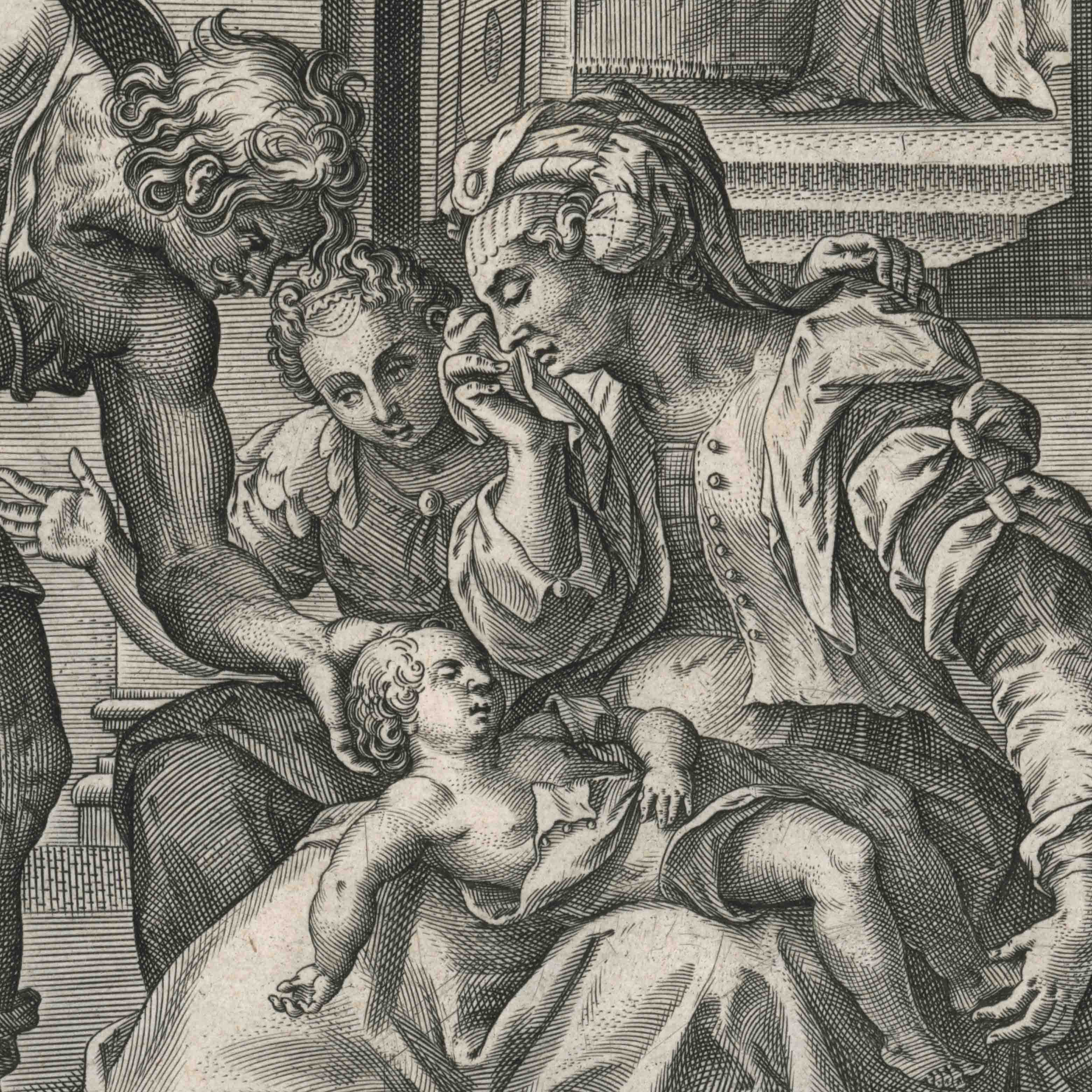
Jan Collaert I’s engraving, “The Shunammite's Son Restored to Life”, c.1579, after Maarten de Vos

Jan Collaert I (aka Hans Collaert) (c1525/30–1580 [BM])

“The Shunammite's Son Restored to Life” (aka “Dood van de zoon van de Sunnemitische vrouw” [Rijksmuseum title]; “Death of the Son of the Sunnemite Woman”), c.1579, plate 3 from the series of 6 plates (Hollstein 122–127 [de Vos]), “The Story of Elisha and the Sunnemite Woman” (aka “Het verhaal van Elisa en de Sunnemitische vrouw”), after the design by Maarten de Vos (aka Maerten de Vos) (1532–1603), initially published by Volcxken Diericx (Volcxken Dierickx; Volcxken Diericx) (fl.1570–1600) and later (as is the case with this impression) by Claes Jansz. Visscher (aka Nicolaes Jansz.Visscher; Piscator) (1587–1652) in Amsterdam in 1643 (possibly in “Thesaurus Sacrarum Historiarum Veteris Testament”) and later still by Jan Schabaelje (aka Jan Philipsz Schabaelie; Jan Schabalje) (fl.1643–1649) in 1646.

Engraving on laid paper.

Size: (sheet) 23.8 x 31 cm; (plate) 20.6 x 28.6 cm; (image borderline) 18.9 x 28.2 cm.

Inscribed in plate within the image borderline: (left of centre on lower edge) “M. de Vos inuent.”

Numbered and lettered in plate below the image borderline: (left) “3”; (centre in two columns of Latin in two lines) “Paruulus ad Patrem properans, dû forte per estus,/ Spicea dum grauidas diffundit Meβis aristas.// Confestim tener heu morbo tentatur acuto,/ Inq[ue] sinu matris vitales deserit auras.”; (right) “2. Regum cap 4 ver. 19./ 3”.

State: iv (of v)

Hollstein 124 (Christiaan Schuckman [comp.] 1996, “The New Hollstein: Dutch and Flemish Etchings, Engravings and Woodcuts 1450–1700: Maarten de Vos,” vol. 44, Rotterdam, Sound and Vision Rijksprentenkabinet, cat. no. 124); New Hollstein (The Collaert Dynasty) 61 (Ann Diels & Marjolein Leesberg [comp.] 2005–2006, “The New Hollstein: Dutch and Flemish Etchings, Engravings and Woodcuts 1450–1700: The Collaert Dynasty,” vol. 1, Ouderkerk aan den Ijssel, Sound and Vision, p. 74, cat. no. 61); Riggs 196 (Timothy A. Riggs 1977, “Hieronymus Cock: Printmaker and Publisher,” New York, Garland Publishing).

The British Museum offers the following description of this print: “The collapsed son brought to his mother; the Shunammite woman weeping with the child in her lap, her husband and a maid attending the child; at left labourers harvest a field of wheat, and Elisha seen talking to the husband of the Shunammite woman and to her child; to right, the Shunammite woman seen putting her child to bed; plate 3; on full sheet; after Maarten de Vos. Engraving” (https://www.britishmuseum.org/collection/object/P_1937-0915-87).

See also the description of this print offered by the Rijksmuseum: http://hdl.handle.net/10934/RM0001.COLLECT.97253.

Condition: a strong and well-printed (near faultless) impression with good margins.
Beyond faded brown ink annotations (recto), the sheet is in an excellent condition for its considerable age with no tears, holes, folds, losses, abrasions or significant stains.

I am selling this superb impression of a beautifully executed engraving exemplifying the Flemish Mannerist leaning towards lively rhythms and theatrical gestures, for AU$289 (currently US$190.87/EUR175.10/GBP150.22 at the time of this listing) including Express Mail (EMS) postage and handling to anywhere in the world, but not (of course) any import duties/taxes imposed by some countries.

If you are interested in purchasing this superb engraving featuring a fascinating layering of complexity in illustrating an episode in the narrative of the Story of Elisha (2 Kings. 4:19)—for example, in the foreground the child of the Sunnemite woman dies in his mother's arms, while in the distant bedchamber at right the Sunnemite woman’s child is shown having being brought back to life—please contact me (oz_jim@printsandprinciples.com) and I will send you a PayPal invoice to make the payment easy.

This print has been sold


Tuesday, 15 August 2017

Philips Galle’s engraving, “Jezebel Seals the Forged Letters”, c1561


Philips Galle (aka Philippe Galle; Philippus Gallaeus) (1537–1612)
“Jezebel Seals the Forged Letters” (TIB title), c1561, from the series of six plates illustrating episodes from the Old Testament, “The story of Ahab, Jezebel and Naboth”, after the design by Maarten van Heemskerck (1498–1574), published by Hieronymus Cock (c.1510–70)

Copper engraving on laid paper, trimmed along the platemark on three sides and within the image borderline on the right.
Size: (sheet) 20.1 x 24.9 cm
Lettered within the image borderline: (lower left) "H Cock Excudebat"; (lower centre) "Martinus van Heemskerck Inventor"; (trimmed at lower right) "2".
Lettered below the image borderline: "Literas … cinitatis"
Lifetime impression. State i (of iii [?])

Note: this impression shows no sign of wear compared to the first state impression reproduced in TIB (1987, vol. 56, Supplement, p. 43); see, for example, the wear in the TIB reproduced print on the platform step below Jezebel. There may be three states of this print as the Rijksmuseum has a later impression showing the inscription, “H Cock Excudebat" erased and published in 1646 by Jan Philipsz Schabaelje [fl1643–49] [see http://hdl.handle.net/10934/RM0001.COLLECT.616069] and there is also an edition published by Claes Jansz. Visscher (II) (1587–1652) but I have no information whether the Visscher edition was before or after that made by Schabaelje or whether Visscher altered the plate following the Cock edition, even though I suspect that Visscher’s name as the publisher would be inscribed.

TIB 1987 5601/013:2 (Arno Dolders & Walter Strauss [Eds.] 1987, vol. 56, Supplement, p. 43); Riggs 1977 123; New Hollstein (Dutch & Flemish) 133 (Maarten van Heemskerck); New Hollstein (Dutch & Flemish) 35 (Philips Galle).

The British Museum offers the following description of this print:
“Jezebel sealing the forged letters; Jezebel, with her entourage, seals a letter with a ring impressed into wax; four men are gathered at a table and a scribe writes a letter; after Heemskerck” (http://www.britishmuseum.org/research/collection_online/collection_object_details.aspx?objectId=1530843&partId=1&searchText=Philips+Galle+Naboth+&page=1)

The Rijksmuseum offers the following description of this print:
(Translation with errors) “King Izebel sends letters to the elders and most significant in Nabot's city in the name of King Ahab. She asks them to announce a fasting day, accusing Nabot of blasphemy and majesty and stoning him. Writers sit at the table and write the letters. Jezebel puts the royal seal under the letters. Under the show a verse in Latin. Picture is part of an album.” (http://hdl.handle.net/10934/RM0001.COLLECT.595486)

Note: the Rijksmuseum also has a copy of this print by Galle engraved by an unidentified printmaker and published by Claes Jansz. Visscher (II) (1587–1652) (see http://hdl.handle.net/10934/RM0001.COLLECT.487153). This copy of Galle’s print should not be confused with the edition that Visscher also published of the original Galle print before/after the Jan Philipsz Schabaelje’s edition in 1646.

Condition: richly inked and crisp impression (near faultless) trimmed within the platemark on the right and laid upon a conservator’s support sheet.

I am selling this fascinating glimpse into Heemskerck’s vision of fashion in biblical times and the Mannerist leanings of Galle in engraving Heemskerck’s ideas—note how Galle renders the portrayed figures as if they were made of shiny metal—for AU$192 (currently US$150.14/EUR128.27/GBP115.79 at the time of this listing) including postage and handling to anywhere in the world.

If you are interested in purchasing this marvellous print engraved only a couple of decades after Michelangelo put down his brushes after completing the “Last Judgement” in the Sistine Chapel, please contact me (oz_jim@printsandprinciples.com) and I will send you a PayPal invoice to make the payment easy.


This print has been sold


Rather than offer a quick and probably highly inaccurate version of what is portrayed in this scene from the Old Testament (see https://www.gotquestions.org/Ahab-and-Jezebel.html if you wish to read a meaningful explanation) I have decided to share a few attributes that I see in the image that makes it special for me.

The first attribute, and probably the hardest one for me to ignore, is that the portrayed figures seem very shiny. In fact, I see them as being so shiny that they appear to be made from polished metal. This attribute of Galle to use strong tonal contrasts (see, for example, the effect of raking light illuminating the figure on the left) is one of the hallmarks of Mannerism. To my eyes, the pattern of lights and darks does more than simply give form to the portrayed subject matter: the pattern creates a visually shimmering effect that gives the scene the suggestion of lively movement.

The second attribute is really an extension of seeing/sensing movement projected by the pattern of tonal contrasts: the notion of agitation projected by waving rhythms linking the figures with the surrounding architecture of arches. This feeling of flow—and I wish to propose that the flow is like a boomerang that returns to its beginnings in an unbroken loop—is one of the hallmarks of the Mannerist period style of the late Renaissance.

For the third attribute catching my eye, I wish to draw attention to a much more subtle feature of this print: Galle’s interest in scalloped edges to drapery. I would love to propose a psychological meaning underpinning the artist’s use of this attribute but rather than enter into minefield of supposition and misinformation, I wish to suggest that his use of this device adds to the overall effect of visual agitation.