Showing posts with label Sandrart (Joachim von). Show all posts

Saturday, 28 October 2023

Georg Christoph Eimmart II’s etching, “Im(peratoris) Titi Judaicus Triumphus”, c.1680

Georg Christoph Eimmart II (aka Georg Christoph Eimart II) (1638–1705)—pupil of Jacob von Sandrart and an illustrator for Von Sandrart.

Note that Sandrart.net (http://ta.sandrart.net/en/artwork/view/3732) showcases a variation of this print by Pietro Santi Bartoli (1635–1700) and a comparison of the two prints is interesting: https://arachne.dainst.org/entity/232770/image/232770 and https://www.worthpoint.com/worthopedia/1680-c-eimmart-master-engraving-titi-1935240718.

“Im(peratoris) Titi Judaicus Triumphus”, c.1680, after a relief on the Arch of Titus in Rome, illustration (plate “FF”) to Joachim von Sandrart’s (aka Jakob von Sandrart) (1630–1708) “L'Academia Todesca della Architectura, Scultura et Pittura, Oder Teutsche Academie der Edlen Bau-Bild- und Mahlerey-Künste …”, vol. 5, published in Nuremburg, inserted with other plates between pages 198 and 199. (BM offers details of this publication: https://www.britishmuseum.org/collection/object/P_1974-1207-30).

Etching on laid paper with wide margins laid onto a support sheet, inscribed below the platemark in brown ink by an old hand.

Size: (sheet trimmed slightly unevenly) 27.8 x 42.2 cm; (plate) 22 x 39.5 cm; (image borderline) 20.5 x 38.5 cm.

Numbered and lettered in plate: (upper left) “2” and “1”; (upper right) “3” and F F.”; (below the image borderline at centre) “IM. TITI JUDAICUS TRIUMPHUS.”

Condition: a strong early impression (based on the quality of line showing no sign of wear to the printing plate) with reasonably wide margins and a flattened centrefold (as published) laid onto a support of archival (millennium quality) washi paper. The sheet has hand-written brown ink notations (faded) and pencil numbers in the margin by an old hand; otherwise, the sheet is in a good condition with no significant stains or foxing.  

I am selling this finely executed interpretation of a bas relief from the Arch of Titus in Rome showing the Goddess of Victory holding a laurel wreath over the head of Titus while a team of four horses bedecked with jewelled necklaces with suspended crescent moons pull the emperor’s chariot in a procession, for AU$262 (currently US$175.12/EUR158.45/GBP141.61 at the time of this listing) including postage and handling to anywhere in the world, but not (of course) any import duties/taxes imposed by some countries.

If you are interested in purchasing this strong etching that was executed (perhaps interestingly) a few decades after Johannes (Jan) Vermeer put down his brushes after completing his “Girl with a Pearl Earring”, please contact me (oz_jim@printsandprinciples.com) and I will send you a PayPal invoice to make the payment easy.

This print has been sold 


Wednesday, 18 May 2022

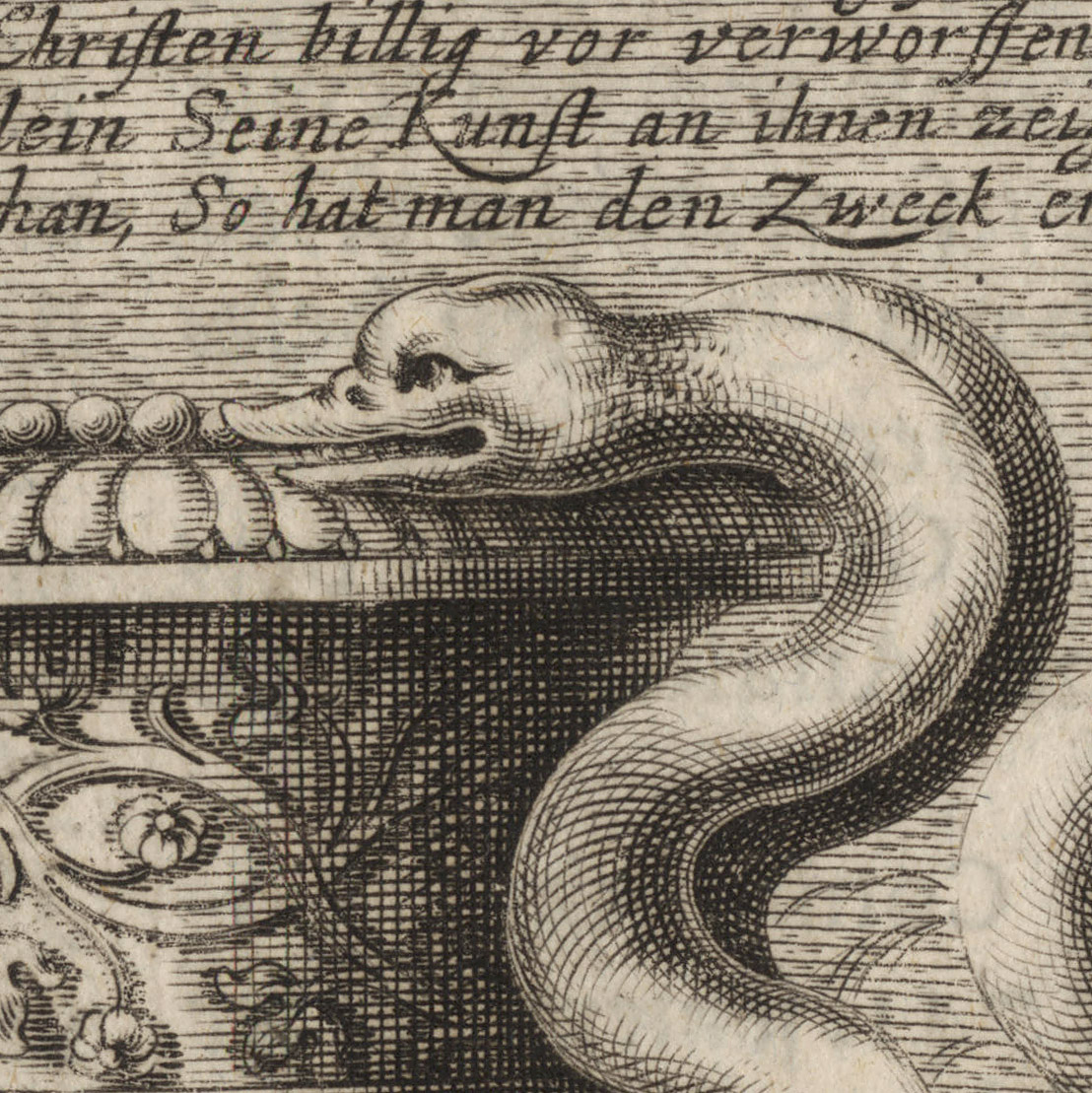
(attrib.) Johann Jacob von Sandrart’s engraving, “Amphora with Serpents as Handles”, 1675, after Agostino Veneziano


(attrib.) Johann Jacob von Sandrart (aka Johann Jakob von Sandrart) (1655–1698), or his father, Jacob von Sandrart (1630-1708)

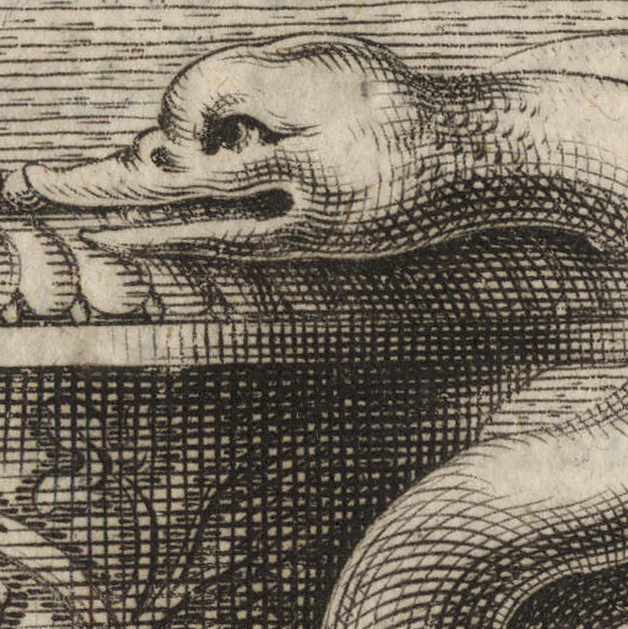
Amphora with Serpents as Handles” (aka “Antique Vessel”; “Antikes Prachtgefäß”), 1675, engraving in reverse after Agostino Veneziano’s (aka Agostino dei Musi) (fl.1509–1536) engraving, 1530 (see https://www.britishmuseum.org/collection/object/P_1873-1213-258), published in 1675 in Nuremberg by Jacob von Sandrart (1630–1708) and in Frankfurt am Main by Matthäus Merian II (1621–1687) as an illustration to Joachim von Sandrart’s (1606–1688), “Teutsche Academie der Edlen Bau- Bild- und Mahlerey-Künste …” (German Academy of the Noble Arts of Architecture, Sculpture and Painting)  (see https://archive.org/details/gri_33125008279545/page/n365/mode/2up).

Engraving on laid paper with letterpress text verso as published, trimmed around the image borderline and backed with a support sheet.

Size: (support sheet) 34.6 x 27.1 cm; (sheet) 19.9 x 15.4 cm.

Inscribed in plate: (upper centre) “Götter, so die blinden Heyden zum anbeten vorgestellt,/ Man von allen rechten Christen billig vor verworffen hält./ Wan man aber nur allein Seine Kunst an ihnen zeiget,/ So ist es gar wol gethan, So hat man den Zweck erreichet.” (Gods, so presented to the blind heathen to worship,/ All true Christians justly hold them to be rejected./ But if one only shows one's art on them, then/ it is well done, then one has achieved the purpose.)

Regarding the inscription, Sandrart.net offers the following explanation: (transl.) “The verse of the vignette … contains two aspects of the relationship to antiquity. On the one hand, Sandrart addresses the overcoming of ‘pagan practice’ by Christianity and, on the other hand, he warns against orienting oneself only to the ancient art form and not to the pagan content (cf.Klemm 1994 , p. 13)” (http://ta.sandrart.net/de/artwork/view/372).  

Condition: a strong, well-inked and well-printed impression backed with a support sheet of archival (millennium quality) washi paper. The sheet is in an excellent condition with no tears, holes, folds, abrasions, significant stains or foxing.

I am selling this very beautiful engraving of an antique amphora with coiled serpent handles and featuring four dancing figures with a putto holding up an Oenochoe (wine jug), for the total cost of AU$239 (currently US$167.50/EUR159.22/GBP134.89 at the time of posting this print) including postage and handling to anywhere in the world (but not, of course, any import duties/taxes imposed by some countries).

If you are interested in purchasing this curiously interesting engraving of a Baroque designed antique amphora, please contact me (oz_jim@printsandprinciples.com) and I will send you a PayPal invoice to make the payment easy.


Wednesday, 27 June 2018

Johann Jacob von Sandrart’s etching, “The Fire in the Borgo”, 1682, after Raphael


Johann Jacob von Sandrart (aka Johann Jakob von Sandrart) (1655–1698)

“The Fire in the Borgo”, 1682, published by Joachim von Sandrart (1606–1688) as Plate 0 (as numbered at upper right) to “Academia Nobilissimae Artis Pictoriae”, printed by Christian Frober (aka Christian Froberger) (fl.c.1675–1700) in 1683, in Nuremberg, after a detail of Raphael’s (aka Raffaello Sanzio da Urbino) (1483–1520) design for the fresco of the same name executed in 1514 that is argued to be painted by Raphael’s assistant, Giulio Romano (aka Giulio Pippi) (c1499–1546) in the Stanza dell'Incendio di Borgo, Palazzi Pontifici, Vatican.

(Note: I may be wrong, but based on a copy of the publication in which this etching features that was auctioned by Christie’s (30 April 2008, London), I believe that there are 47 plates with 3 double-page illustrations—this print being one of these larger plates as there is a centrefold that is now flattened.)

Etching on heavy laid paper with full margins as published. The print consists of two plates abutted: a plate with the image and a plate with the lettered text below it.
Size: (sheet) 50.3 x 39 cm; (abutted plates) 46.8 x 32.7 cm; (image borderline) 41.1 x 31.6 cm
Numbered on plate above the image borderline: (right corner) “0”.
Inscribed on plate below the image borderline: (left) “Raphael d'Urbino pinxit.”; (right) “Joh. Jac: de Sandrart delineavit et sculpsit Norimb. 1682”
Lettered on plate in five lines of Latin text on a separate abutted plate: “Sereniffimo … / … / … / … / … / … confecratq”; (left of centre) “Sereniffimæ Celfitudinis Veftra”; (right) “cultor demiffiffimus / Ioh. Iacobus a Sandrart.” (My apologies if there are errors in my reading of the letters).

Hollstein 350.II

The British Museum offers the following description of this print:
“The fire in the Borgo; after Raphael; with various figures fleeing through an archway and over a wall to right in foreground; in left background the burning city …”

Condition: an almost faultless—well-inked and well-printed—impression that is in near pristine condition (i.e. there are no tears, holes, creases—beyond the now flattened centrefold of publication—abrasions, stains or foxing) for the considerable age of the print. The sheet is backed with a support sheet of archival (millennium quality) washi paper.

I am selling this large etching of exceptional quality and very rare—note that the Rijksmuseum does not hold a copy—for the total cost of AU$246 (currently US$181.50/EUR156.41/GBP137.96 at the time of posting this print) including postage and handling to anywhere in the world (but not, of course, any import duties/taxes imposed by some countries).

If you are interested in purchasing this marvellously intriguing image executed by one of the major oldmaster German printmakers of the 17th century, please contact me (oz_jim@printsandprinciples.com) and I will send you a PayPal invoice to make the payment easy.

This print has been sold


This scene of tumultuous chaos shows fleeing naked Romans with Michelangelesque physiques escaping the AD 847 fire in the Borgo—an area near the Basilica of St Peter in Rome. For sensitive folk that shudder on seeing other folk in distress, you may relax as I can confirm that Pope Leo IV interceded with his faith to extinguish the blaze … but his prayers were sadly ineffective in stopping the old Basillica of St Peter—which may be seen through the gap in the broken wall—from being reduced to rubble (see the Web Gallery of Art for a thorough explanation about the fire and Raphael’s painting: https://www.wga.hu/html_m/r/raphael/4stanze/3borgo/1borgo.html)  


Tuesday, 25 July 2017

Joachim von Sandrart’s engraving, “Satyrvs et Silenvs”, 1679


Joachim von Sandrart (1606–88)
“Satyrvs et Silenvs” (Satyrs and Silenus), 1679, published in "Teutsche Academie", Nuremberg (see vol. 2 [sculpture], plate 00 [after p. 2]. Sandrart.net offers an online view of all the volumes of “Teutsche Academie” (see http://ta.sandrart.net/en/) and details about the print (see http://ta.sandrart.net/-artwork-773).

Engraving on fine laid paper with margins as published.
(sheet) 37.4 x 24.7 cm; (plate) 32.1 x 22.3 cm; (image borderline) 30.9 x 21.2 cm
Lettered above the image borderline: (left) “SATYRVS et SILENVS”; (right) “00.”

Condition: crisp and well-inked impression with margins as published and in execellent condition (i.e. there are no tears, holes, abrasions, folds or foxing but there is a very pale stain at the lower centre margin).

I am selling this large and remarkably well-preserved engraving by one of the most famous of the German old masters—indeed his contribution of creating the first German encyclopaedic treatise on the history of art has earned him the descriptive title of the “German Vasari”—for AU$161 (currently US$127.83/EUR109.62/GBP97.98 at the time of this listing) including postage and handling to anywhere in the world.

If you are interested in purchasing this image of an idyllic scene with the god, Pan, resting contentedly with a quizzical gin below an armless and legless sculpture of Silenus—the unfinished sculpture, “Silen Mattei”, from the Palazzo Mattei di Giove in Rome (?)—please contact me (oz_jim@printsandprinciples.com) and I will send you a PayPal invoice to make the payment easy.

This print has been sold


This print is part of the first major German book on art: "Teutsche Academie" published in 1679. Other plates in the three and later expanded to eight volumes of the book offer formal illustrations of historically significant sculptures and architectural features, but this engraving goes beyond such academic concerns by presenting a very relaxed Pan grinning in a state of reverie beneath a literally legless sculpture of Silenus—the most drunken of the followers of Dionysus.