Showing posts with label Matham (Jacob). Show all posts

Monday, 5 August 2024

Jacob Matham, "Fortitude", 1593, after Goltzius

Jacob Matham (1571–1631)

"Fortitude" (aka “La Force”; “Kracht”), 1593, plate 6 from the series of seven engravings, “The Virtues and the Seven Deadly Sins” (aka “The Virtues [in niche]”), after artist’s teacher and stepfather, Hendrik Goltzius (aka Hendrick Goltzius) (1558–1617).

Engraving on laid paper with a thread margin around the image borderline and backed with a support sheet providing wide margins.

Size: (sheet) 32.6 x 16.7 cm.

Numbered and lettered in plate: (within the image borderline at left) “6”; (within the image borderline at right) “[ligature monogram of Hendrik Goltzius] HG Inue.”; (below the image borderline in two lines of Latin verse) “Strennua in aduersis, et pro iustoq[ué], fideq[ué],/ Dura pati Fortis supero indefessa ferendo. F. E.” (Franco Estius [fl.1580s–1594]—the author of the Latin verse).

TIB 4.130 (164) (Walter L Strauss 1980, “The Illustrated Bartsch: Netherlandish Artists”, vol. 4, New York, Abaris Books, p. 119, cat. no. 130 [164]); New Hollstein (Dutch & Flemish) 45 (George Shepard Keyes [Comp.] 1980, “Dutch and Flemish Etchings, Engravings and Woodcuts ca. 1450–1700: Jan Saenredam to Roelandt Savery”, vol. 23, Amsterdam, Van Gendt & Co, p. 38, cat. no. 45).

See also the description of this print offered by the Rijksmuseum: http://hdl.handle.net/10934/RM0001.COLLECT.150596.

The curator of the BM also gives the following information about the series:

“This is one from a series of seven numbered plates by Jacob Matham (New Hollstein 150-156) after Goltzius …. The set was first published by Goltzius in Haarlem; then by Claes Jansz Visscher in Amsterdam (before 1652); and finally, by Jochem Ottens. Seven preparatory drawings by Goltzius are in the Montreal Museum of Fine Arts, inv.nos.Dr.975.2-8 (Reznicek 89-95)” (https://www.britishmuseum.org/collection/object/P_1857-0613-510). 

Condition: a strong and well-printed impression with a thread margin around the image borderline and laid upon a support of archival (millennium quality) washi paper providing wide margins. Beyond a tear on the lower edge and a flattened fold on the left edge, the sheet is in a very good condition for its considerable age with no significant stains.

I am selling this very beautiful engraving showing one of the four Cardinal Virtues (viz. prudence, justice, fortitude and temperance), for the total cost of AU$390 (currently US$250.11/EUR229.17/GBP196.12 at the time of posting this listing) including Express Mail (EMS) postage and handling to anywhere in the world, but not (of course) any import duties/taxes imposed by some countries. Note that payment is in Australian dollars (AU$390) as this is my currency.

If you are interested in purchasing this finely executed engraving showing the personification of strength holding a column, please contact me (oz_jim@printsandprinciples.com) and I will send you a PayPal invoice to make the payment easy.

This print has been sold


Saturday, 9 March 2024

Jacob Matham’s engraving, "Charity", 1593, after Goltzius

Jacob Matham (1571–1631)

"Charity" (aka “La Charité”; “Liefde”; “Caritas”), 1593, plate 3 from the series of seven engravings, “The Virtues and the Seven Deadly Sins” (aka “The Virtues [in niche]”), after artist’s teacher and stepfather, Hendrik Goltzius (aka Hendrick Goltzius) (1558–1617).

Engraving on laid paper with a narrow margin around the image borderline.

Size: (sheet) 32.5 x 16.8 cm.

Numbered and lettered in plate: (within the image borderline at right) “3”; (within the image borderline at left) “[ligature monogram of Hendrik Goltzius] HG Inue.”; (below the image borderline in two lines of Latin verse) “Blanda Charis diuina Agape., celestis origo,/ Aethera cum terries nodo constringit aheno.// F. E.” (Franco Estius [fl.1580s–1594]—the author of the Latin verse).

TIB 4 (3).127 (164) (Walter L Strauss 1980, “The Illustrated Bartsch: Netherlandish Artists”, vol. 4, New York, Abaris Books, p. 116, cat. no. 127 [164]); New Hollstein (Dutch & Flemish) 147; Hollstein 265.

See also the descriptions of this print offer by the British Museum and the Rijksmuseum: https://www.britishmuseum.org/collection/object/P_1857-0613-505http://hdl.handle.net/10934/RM0001.COLLECT.150593.

The curator of the BM also gives the following information about the series:

“This is one from a series of seven numbered plates by Jacob Matham (New Hollstein 150-156) after Goltzius …. The set was first published by Goltzius in Haarlem; then by Claes Jansz Visscher in Amsterdam (before 1652); and finally, by Jochem Ottens. Seven preparatory drawings by Goltzius are in the Montreal Museum of Fine Arts, inv.nos.Dr.975.2-8 (Reznicek 89-95)” (https://www.britishmuseum.org/collection/object/P_1857-0613-510). 

Condition: a well-printed impression, but slightly abraded/stained on the face of the figure, Charity. The sheet is trimmed with a narrow margin around the image borderline and is in a good condition for its considerable age with no tears, holes or folds.

I am selling this very beautiful engraving, for the total cost of AU$390 (currently US$258.57/EUR236.31/GBP201.08 at the time of posting this listing) including postage and handling to anywhere in the world.

If you are interested in purchasing this finely executed engraving showing the personification of love holding two children in her arms—note also the pelican at upper right (a symbol of the atonement) suckling its chicks on her own blood and on the upper left Christ crucified (symbolising sacrifice and salvation)—please contact me (oz_jim@printsandprinciples.com) and I will send you a PayPal invoice to make the payment easy.

This print has been sold


Thursday, 8 February 2024

Jacob Matham’s engraving, "Hope", 1593, after Goltzius

Jacob Matham (1571–1631)

"Hope" (aka “L’Espérence”; “Hoop”; “Spes”), 1593, plate 2 from the series of seven engravings, “The Virtues and the Seven Deadly Sins” (aka “The Virtues [in niche]”), after artist’s teacher and stepfather, Hendrik Goltzius (aka Hendrick Goltzius) (1558–1617).

Engraving on laid paper with a narrow margin around the image borderline and an ink inscription by an old hand in French verso.

Size: (sheet) 32.6 x 17 cm; (image borderline) 32.3 x 16.6 cm.

Numbered and lettered in plate: (within the image borderline at left) “2”; (within the image borderline at right) “[ligature monogram of Hendrik Goltzius] HG Inue.”; (below the image borderline in two lines of Latin verse) “Spes humiles luiquit, terras, ect nubile tranat,/ In [que] Deum rapitur, cęli[que] per atria sertur.// F. E.” (Franco Estius [fl.1580s–1594]—the author of the Latin verse).

Inscribed in ink verso by an old hand in French (with many possible errors in the reading): “

“L'esperence soutient les humbles,

eclaire leur esprit et dissipe tous

les tenebres qui se rependent sur

Lesprit les superbes.”

(Hope sustains the humble,

enlighten their minds and dispel all

the darkness that spreads over

The spirit is superb.)

TIB 4 (3).126 (164) (Walter L Strauss 1980, “The Illustrated Bartsch: Netherlandish Artists”, vol. 4, New York, Abaris Books, p. 115, cat. no. 126 [164]); New Hollstein (Dutch & Flemish) 146; Hollstein 264.

See also the descriptions of this print offer by the British Museum and the Rijksmuseum: https://www.britishmuseum.org/collection/object/P_1857-0613-504; http://hdl.handle.net/10934/RM0001.COLLECT.150592.

The curator of the BM also gives the following information about the series:

“This is one from a series of seven numbered plates by Jacob Matham (New Hollstein 150-156) after Goltzius …. The set was first published by Goltzius in Haarlem; then by Claes Jansz Visscher in Amsterdam (before 1652); and finally by Jochem Ottens. Seven preparatory drawings by Goltzius are in the Montreal Museum of Fine Arts, inv.nos.Dr.975.2-8 (Reznicek 89-95) (https://www.britishmuseum.org/collection/object/P_1857-0613-510). 

Condition: a well-printed impression trimmed with a narrow margin around the image borderline. The verso has an ink inscription from a previous collector, otherwise the sheet is in a very good condition for its considerable age with no tears, holes or significant stains.

I am selling this marvellous impression of an important and very beautiful engraving, for the total cost of AU$390 (currently US$253.31/EUR235.07/GBP200.74 at the time of posting this listing) including postage and handling to anywhere in the world.

If you are interested in purchasing this masterwork of engraving showing the female personification of hope holding the anchor of trust/faith sustaining hope (forgive me if my understanding of the symbolism is incorrect), please contact me (oz_jim@printsandprinciples.com) and I will send you a PayPal invoice to make the payment easy.

This print has been sold


Friday, 14 October 2022

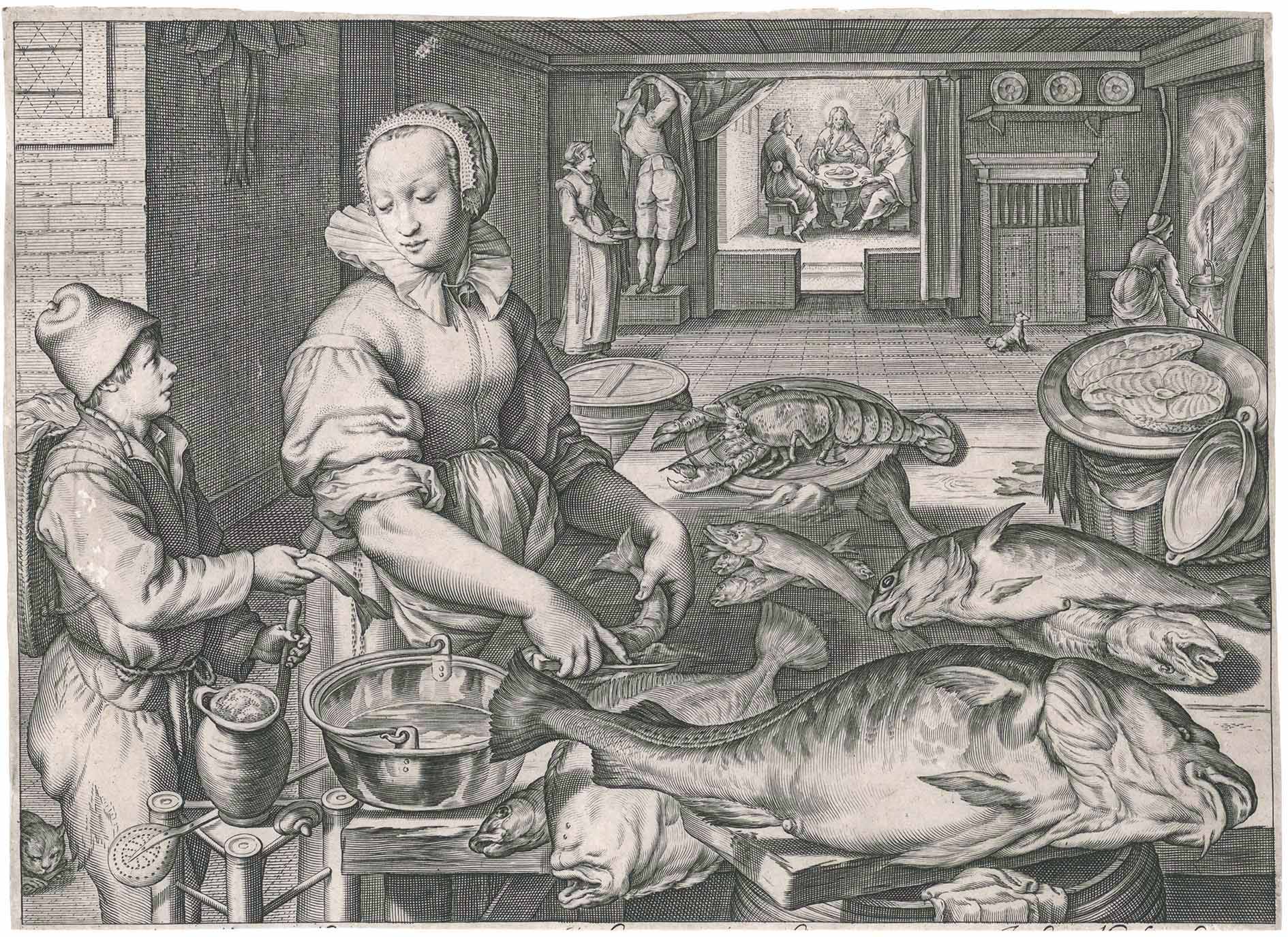
Jacob Matham’s engraving, “Kitchen Scene with the Meal in Emmaus”, 1603, after Pieter Aertsen

Jacob Matham (1571–1631)

“Kitchen Scene with the Meal in Emmaus”, 1603, after Pieter Aertsen (aka Langepier) (1508–1575), from a series of five plates (Hollstein 319-323), “Kitchen and Market Scenes with Biblical Scenes”, published in Haarlem.

Engraving on fine laid paper, trimmed around the image borderline with loss of the lower text line.

Size: (sheet) 23.6 x 32.5 cm; (image borderline) 23.2 x 32 cm.

TIB 4 (3).165 (171) (Walter L Strauss [ed.] 1980, “The Illustrated Bartsch: Netherlandish Artists”, vol. 4, New York, Abaris Books, p. 150, cat. no. 165 [171]); New Holstein Dutch 161 (Léna Widerkehr [comp.] 2007–08, “The New Hollstein: Dutch and Flemish Etchings, Engravings and Woodcuts 1450–1700: Jacob Matham”, Ouderkerk aan den Ijssel, Sound and Vision, p. 41, cat. no. 161).

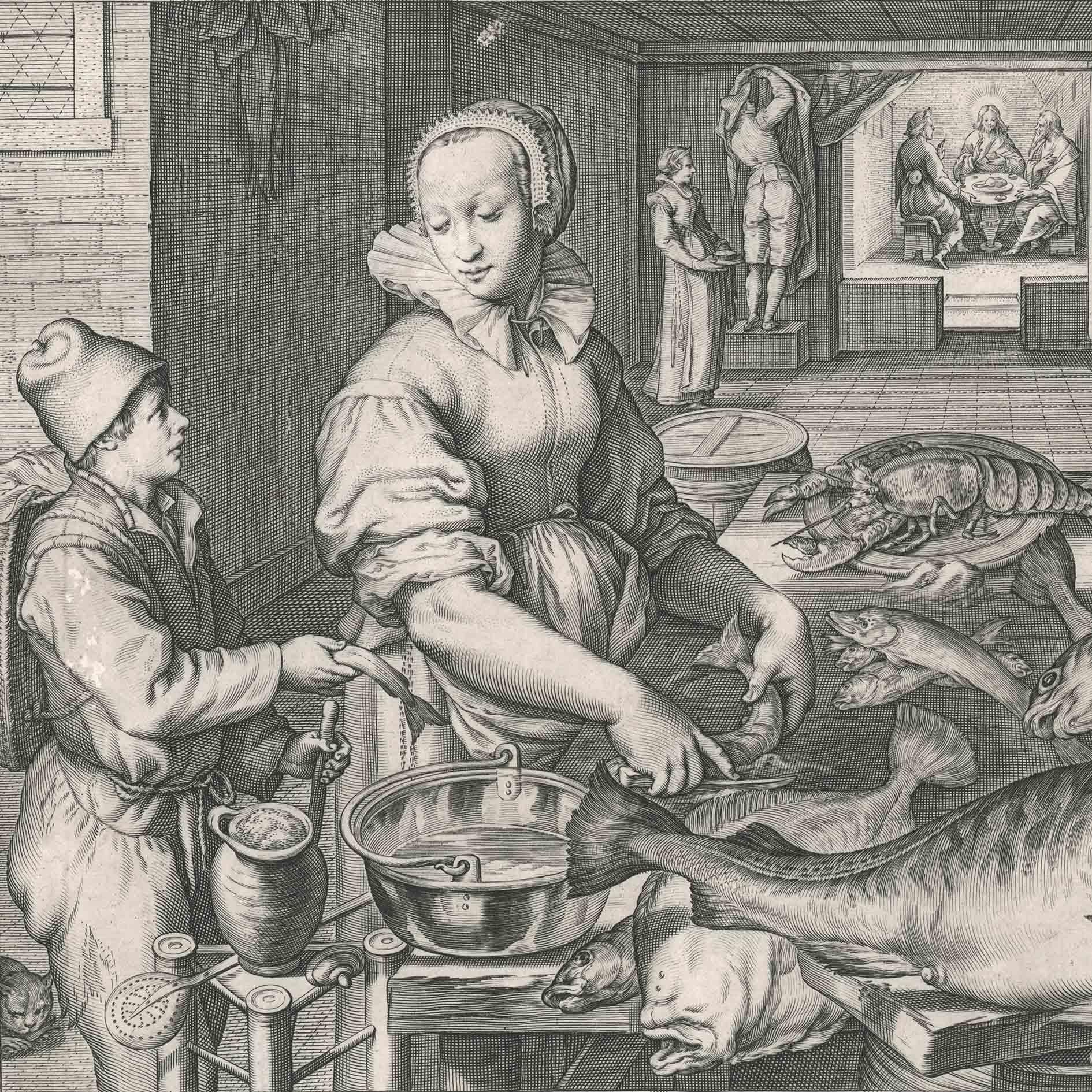
The British Museum offers the following description of this print: “A kitchen scene with a cook preparing fish and a lobster at a large table; a youth interrupts the cook at left and holds out a small fish; beyond, a maid tends a pot cooking over a fire and a man hangs a curtain through which is a small room with Christ at a table flanked by two disciples (the inn at Emmaus); after Aertsen” (https://www.britishmuseum.org/collection/object/P_1857-0613-524).

See also the description of this print offered by the Rijksmuseum: https://www.rijksmuseum.nl/en/collection/RP-P-OB-27.174.

Condition: a strong, near faultless, lifetime impression (based on the quality of line showing no sign of wear to the printing plate), trimmed around the image borderline with loss of the line of text below. There are areas of thinness and a few minor abrasions, otherwise the sheet is in a remarkably good condition for its size and age with no tears, holes, folds, significant stains or foxing.

I am selling this rare masterwork of engraving for the total cost of AU$598 (currently US$378.09/EUR387.01/GBP334.64 at the time of this listing) including postage and handling to anywhere in the world, but not (of course) any import duties/taxes imposed by some countries.

If you are interested in this exceptionally fine engraving showing the somewhat odd mix of imagery involving a Dutch kitchen scene of fish and a lobster being prepared with a scene from the bible (Luke 24:28–32) wherein Christ reveals to two of his disciples that is has risen/resurrected from the dead, please contact me (oz_jim@printsandprinciples.com) and I will send you a PayPal invoice to make the payment easy.

This print has been sold 


Thursday, 19 September 2019

Jacob Matham's engraving, “The Four Elements”, 1588


(attrib.) Jacob Matham (1571–1631)

“The Four Elements”, 1588, after Hendrik Goltzius (aka Hendrick Goltzius) (1558–1617), plate 1 from the series of eight engravings (TIB 278–283), “Mythological Subjects”, published by Hendrik Goltzius in Haarlem.
Engraving on laid paper trimmed along the image borderline (with the text lines) and backed with a support sheet.
Size: (sheet) 30.2 x 21 cm; (image borderline) 29.3 x 21 cm.
Inscribed on plate within the image borderline along lower edge: (left): "1”; (right) “HGoltzius inue./ et excud. Ao. 1588”.
Inscribed on plate below the image borderline in two lines of Latin text in two columns: “Sub cęlo Pater omnipotens Elementa …/ …// …/ …Nectar alit.”
State i (of iii) before the change of the publisher’s address.

TIB 4 (3). 278 (200) (Walter L Strauss [ed.] 1980, "The Illustrated Bartsch 4: Netherlandish Artists”, vol. 4, New York, Abaris Books, p. 255, cat. No. 278 [200]); New Hollstein Dutch 348-1(3) (Huigen Leeflang [ed.] Léna Widerkehr [comp.] 2007–08, “The New Hollstein : Dutch and Flemish Etchings, Engravings and Woodcuts 1450-1700: Jacob Matham”, vol. 3, Ouderkerk aan den IJssel, Sound and Vision, p. 101, cat. no. 348); Hollstein 237.I; Hollstein 266-273 (after Goltzius); New Hollstein (Dutch & Flemish) 641.I (Hendrick Goltzius; Prints after inventions by Goltzius).

The British Museum offers the following description of this print:
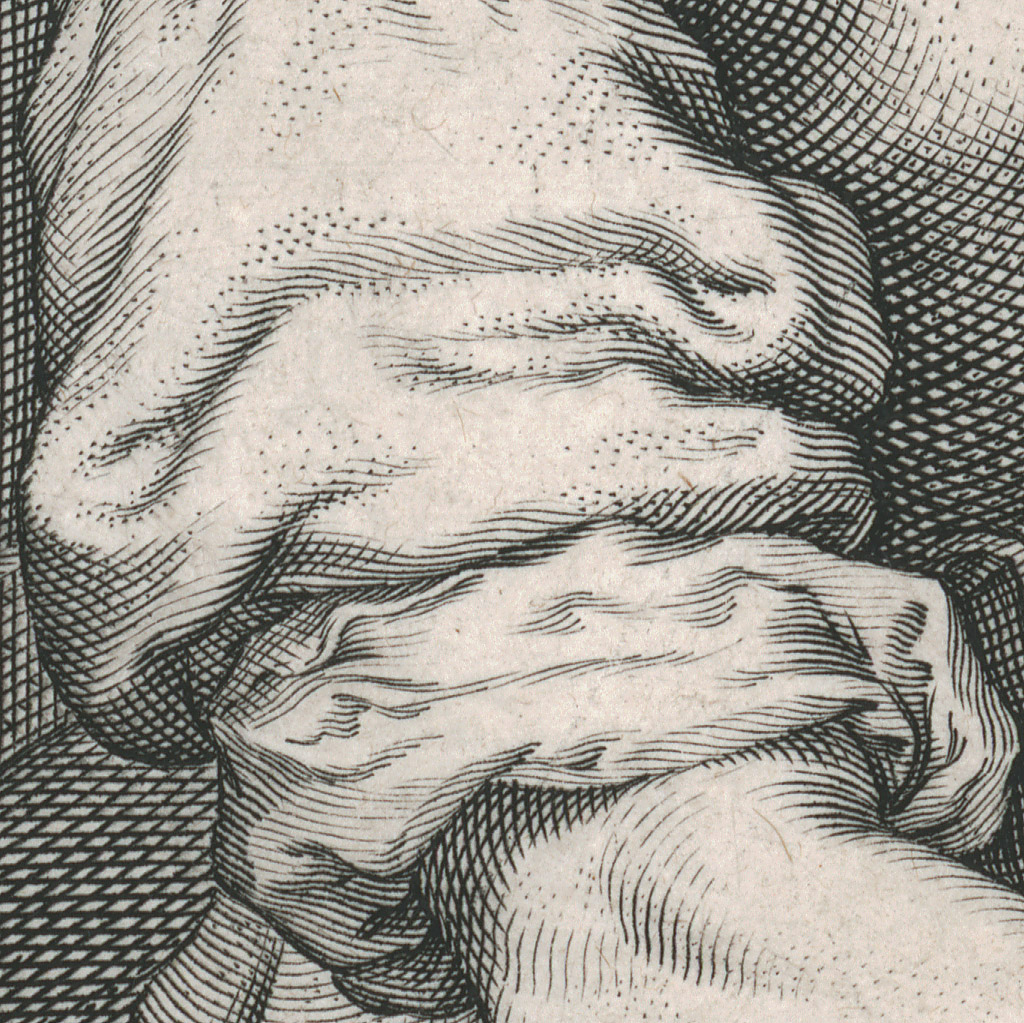
“Plate 1: The Four Elements. Allegorical scene with Fire in top right corner (as naked man with flaming crown, seated on a dragon and holding a rock and lightning in his hands), Air in top left corner (as a naked woman with cloudy hair, seated on billowing clouds, a lizard on her right hand), Earth in lower left corner (as a man, seen from behind, with plants on his head and holding reed and fruits), Water at centre (as a naked woman with a model of a ship on her head and holding a conch); first state published by Goltzius; after Goltzius.”

The Rijksmuseum offers the following description of this print:
(Transl.) “The four elements Earth, Water, Air and Fire, personified as two female and two male figures. Left in the foreground, seen from the back, is Earth (Terra) with grain shovels in his hand. Water (Aqua) is also in the foreground as a female figure with a ship on her head and a stream beside her. In the sky between the clouds is Lucht (Aer) with a chameleon on her hand. At the back right a male figure depicting Fire (Ignis), sitting on a dragon and on his head a crown of flames. The sun is behind his head.”

Condition: richly inked and well-printed first state (lifetime) impression trimmed to the image borderline and laid upon an archival support sheet of millennium quality washi paper. There are restorations to the lower left corner, the text box below the image borderline and the upper corners.

I am selling this superb engraving, glowing with strong tonal contrast and exemplifying the period style of Mannerism of the late 16th century, for AU$420 in total (currently US$285.38/EUR258.30/GBP227.81 at the time of posting this listing) including postage and handling to anywhere in the world.

If you are interested in purchasing this rare first state engraving personifying the four elements, please contact me (oz_jim@printsandprinciples.com) and I will send you a PayPal invoice to make the payment easy.

This print has been sold