Showing posts with label Bartsch (Adam). Show all posts

Sunday, 5 November 2023

Adam Bartsch’s etching, “Four oxen in a stream, in the background a shepherd in front of a ruin”, 1806, after Willem Romeyn

Adam Bartsch (aka Johann Adam Bartsch; Adam von Bartsch; Johann Adam Bernhard Ritter von Bartsch) (1757–1821)

“Four oxen in a stream, in the background a shepherd in front of a ruin” (aka “Vier ossen in een beek, in de achtergrond een herder voor een ruïne” [Rijksmuseum title]), 1806, after Willem Romeyn (c.1624–1694)—a Haarlem painter influenced by his teacher, Nicolaes Berchem (1621/2–1683). This is an impression is before the addition of the publisher’s address for Johann Friedrich Frauenholz (1758–1822) in Nuremberg (see http://hdl.handle.net/10934/RM0001.COLLECT.75442); nevertheless the sheet is blindstamped on the lower-right corner within the platemark with the Johann Friedrich Brauenholz’s seal (Lugt 174) as the  publisher of this impression.

The Gemäldegalerie (Staatliche Museen, Berlin), holds a related drawing by Willem Romeyn dated 1695, “Italian landscape with a cowherd, in the background the ruins of the temple of Vespasian in the Roman Forum in Rome” (inv./cat. no. Z 13678; cat. Bock-Rosenberg 1930, p. 249): https://rkd.nl/nl/explore/images/16632.

Note that in the description of a related painting by Willem Romeyn offered by Sotheby’s Auctions (September 20, 1019) advises: “… the columns in the background of this painting [and this etching] are a frequently recurring motif in the painting of the Bamboccianti: they formed part of the portico to the Temple of Vespasian in the Forum at Rome. They are seen partly buried in this picture; they remained so until their excavation in 1813” (see https://www.sothebys.com/en/buy/auction/2019/old-masters-online-part-i-property-from-the-soer-rusche-collection-part-ii-property-from-various-owners/willem-romeyn-cattle-and-sheep-with-peasants-and

Etching on laid paper with small margins, blindstamped at lower right with the mark of the publisher (Johann Friedrich Brauenholz [Lugt 174]).

Size: (sheet) 29 x 22.4 cm; (plate) 26.9 x 20.1 cm; (image borderline) 23.7 x 19.3 cm.

Inscribed in plate within the image borderline: (lower left) “WROMEYN.”

Inscribed in plate below the image borderline: (right) “A. Bartsch sc. 1806.”

State ii [Rieger] (of iii) before the addition of the publisher’s address.

Rieger 404 (Rudolf Rieger 2014, “Adam von Bartsch (1757-1821): Leben und Werk des Wiener Kunsthistorikers und Kupferstechers unter besonderer Berücksichtigung seiner Reproduktionsgraphik nach Handzeichnungen …”, vol. 2, Petersberg, Michael Imhof Verlag, p. 300, cat. no. 404); Bartsch 187 (Frédérique de Bartsch 1818, “Catalogue des estampes de J. Adam Bartsch”, Vienna, p. 81, cat. no. 187).

The V&A offer the following description of this print: “Four horned cattle in a stream, the cow in the centre of the composition looking out toward the viewer. In the near-distance behind them, a man lies on his side against an earth bank turned away from the viewer, with a dog by his side. The background shows some decorative ruinous pillars and in the distance to the left of the picture a figure with two sheep can be seen” (https://collections.vam.ac.uk/item/O938954/print-bartsch-adam-von/).

Condition: a strong and well-printed impression with minor marks towards the top edge; otherwise, the sheet is in a very good condition with no tears, holes, folds, significant stains or foxing.

I am selling this finely executed etching by one of the most famous of all catalogue writers documenting early prints—Wikipedia describes Bartsch’s catalogue of old master prints, “Le Peintre Graveur” as “the foundation of print history” and the updated version of his catalogue, abbreviated as “TIB”, for “The Illustrated Bartsch”, is still my first point of call when researching prints—for the total cost of AU$268 (currently US$179.13/EUR162.08/GBP142.67 at the time of this listing) including postage and handling to anywhere in the world, but not (of course) any import duties/taxes imposed by some countries.

If you are interested in purchasing this interesting bucolic scene—a true scene of fantasy curiously featuring a section of the ruined temple of Vespasian from the Roman Forum in Rome that was fully excavated only seven years after this etching was completed—please contact me (oz_jim@printsandprinciples.com) and I will send you a PayPal invoice to make the payment easy.


Friday, 21 July 2023

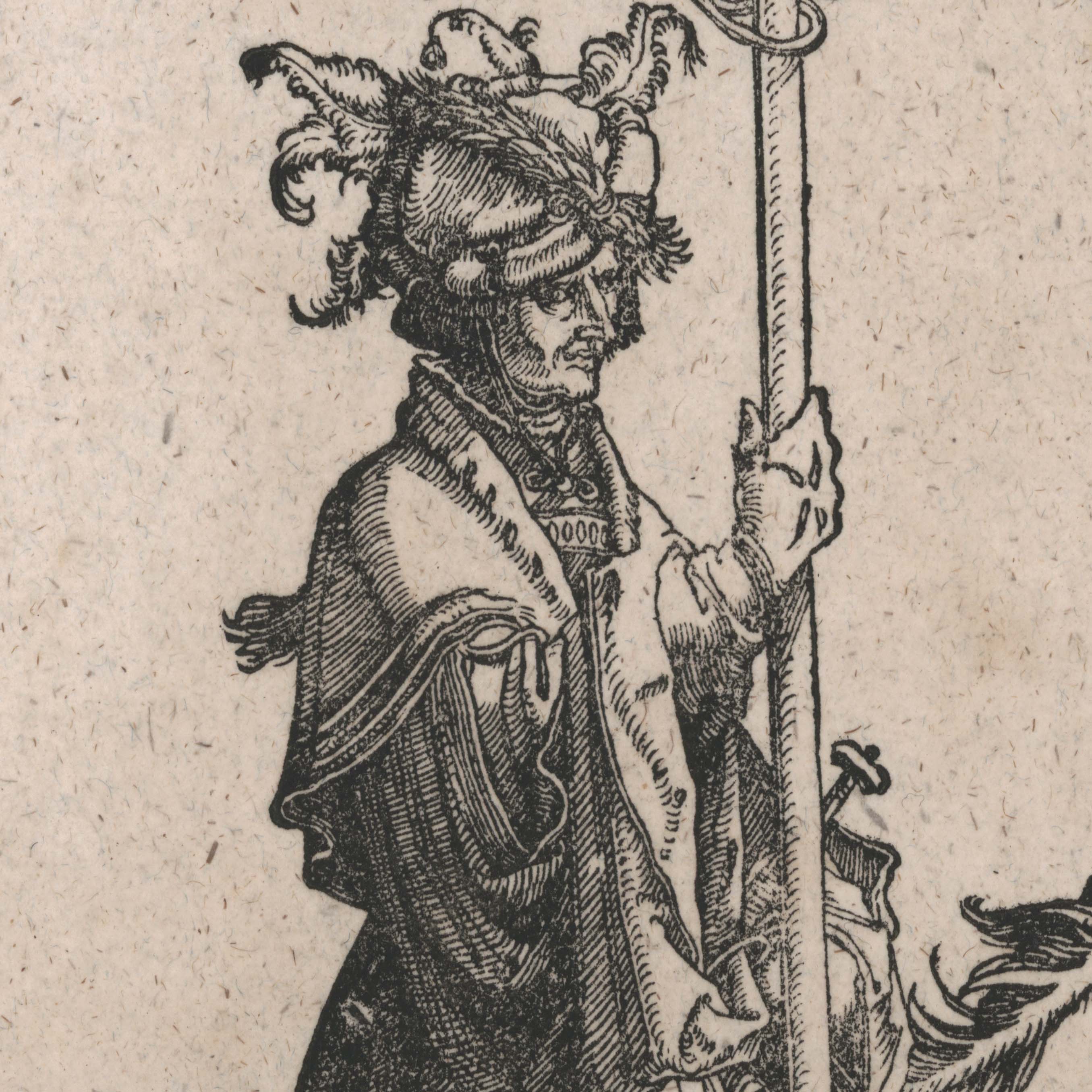
Hans Burgkmair the Elder’s woodcut, “Standard Bearer”, c1517

Hans Burgkmair the Elder (1473–1531)

“Standard Bearer” (TIB title) (aka “Eberpach as Marshal of the Five Offices of Court”; “Standaarddrager”), c1517 (commissioned in 1512; executed between 1516 and 1519), a giant woodcut from the frieze of 139 plates extending to around 54 meters in length titled, “Triumphal Procession of Emperor Maximilian I”, cut by Jost de Negker's (aka Jost Dienecker) (c1485–1548) team of block-cutters (see https://collections.vam.ac.uk/item/O972923/triumph-of-the-emperor-maximilian-woodcut-maximilian-i-holy/). This impression may be from the 1777 edition of 192 plates published by Adam Bartsch (1757–1821).

The Rijksmuseum offers the following description of this print: (transl.) “Standard carrier with standard and rectangular shield that offers space for a verse. The stand is decorated with laurel wreaths and curly ribbons. An empty text band is shown at the height of the rider's head. This man precedes the group of five seneschal in the series of the triumph of Emperor Maximilian I. They are referred to in the text of the verse, which is missing here” (http://hdl.handle.net/10934/RM0001.COLLECT.30899).

Woodcut printed in black on fine buff coloured laid paper, trimmed slightly into the image at top.

Size: (sheet) 38.2 X 26.7 cm.

TIB 11.15 (Tilman Falk [ed.] 1980, “The Illustrated Bartsch: Sixteenth Century German Artists”, vol. 11, New York, Abaris Books, p. 166, cat. no. 15).

The Victoria and Albert Museum offers the following very interesting information about the “Triumphal Procession of Emperor Maximilian I” plates: … “This was one of three large-scale mural projects which together reflected Emperor Maximilian I's (1459-1519) status as Holy Roman Emperor and linked him symbolically with ancient Rome. The project was not finished by the time of Maximilian's death but the set was published later, in 1526.

Hans Burgkmair designed much of the procession, begun in about 1512, with contributions from Albrecht Altdorfer, Hans Springinklee, Hans Beck and Hans Scheufelein. The designs were cut by Jost de Negker's large team of block-cutters.

The two other mural projects include a large Triumphal Arch, about 12 feet high by 10 feet wide and made up of 192 blocks, and a Triumphal Carriage about 8 feet long made up of 8 blocks. These were designed by Albrecht Dürer, with assistance from Hans Springinklee, Wolf Traut and Albrecht Altdorfer.

The procession was not intended for sale. The city of Nuremberg apologised to the Emperor for some impressions from the blocks having been sold. The friezes were intended as gifts for wall display. According to surviving correspondence, Maximilian wanted the procession to 'grace the walls of council chambers and great halls of the empire, proclaiming for posterity the noble aims of their erstwhile ruler'” (http://collections.vam.ac.uk/item/O972804).

Condition: a strong and well-printed impression in an excellent condition for its considerable age, trimmed slightly within the image borderline with loss of the standard bearer’s upper finial. The upper and lower left corners are chipped and the verso of the sheet has pencil notations and shows traces of previous mounting in the sense that it must once has been glued to another sheet.

I am selling this extraordinarily large Renaissance period woodcut from from the famous series, “Triumphal Procession of Emperor Maximilian I”, for AU$430 (currently US$287.41/EUR260.05/GBP228.92 at the time of listing this print) including postage and handling to anywhere in the world (but not, of course, any import duties/taxes imposed by some countries).

If you are interested in purchasing this exceptionally rare woodcut, please contact me (oz_jim@printsandprinciples.com) and I will send you a PayPal invoice to make the payment easy.


Saturday, 27 May 2023

Hans Burgkmair the Elder’s woodcut, “Knights Bearing the Banners of Unterwaldsee, Oberwaldsee and Duino”, c1517

Hans Burgkmair the Elder (1473–1531) or possibly by/or with assistance from Albrecht Altdorfer (1482/5–1538) based on the numbering on the upper right (see the V&A description of this print: https://collections.vam.ac.uk/item/O675713/triumph-of-the-emperor-maximilian-woodcut-maximilian-i-holy/).  

“Knights Bearing the Banners of Unterwaldsee, Oberwaldsee and Duino”, c1517, a giant woodcut from the frieze of 139 plates extending to around 54 meters in length titled, “Triumphal Procession of Emperor Maximilian I”, c1517. This impression may be from the 1777 edition of 192 plates published by Adam Bartsch (1757–1821).

The Victoria and Albert Museum offers the following very interesting information about the “Triumphal Procession of Emperor Maximilian I” plates: … “This was one of three large-scale mural projects which together reflected Emperor Maximilian I's (1459-1519) status as Holy Roman Emperor and linked him symbolically with ancient Rome. The project was not finished by the time of Maximilian's death but the set was published later, in 1526.

Hans Burgkmair designed much of the procession, begun in about 1512, with contributions from Albrecht Altdorfer, Hans Springinklee, Hans Beck and Hans Scheufelein. The designs were cut by Jost de Negker's large team of block-cutters.

The two other mural projects include a large Triumphal Arch, about 12 feet high by 10 feet wide and made up of 192 blocks, and a Triumphal Carriage about 8 feet long made up of 8 blocks. These were designed by Albrecht Dürer, with assistance from Hans Springinklee, Wolf Traut and Albrecht Altdorfer.

The procession was not intended for sale. The city of Nuremberg apologised to the Emperor for some impressions from the blocks having been sold. The friezes were intended as gifts for wall display. According to surviving correspondence, Maximilian wanted the procession to 'grace the walls of council chambers and great halls of the empire, proclaiming for posterity the noble aims of their erstwhile ruler'” (http://collections.vam.ac.uk/item/O972804).

Woodcut printed in black on fine buff coloured laid paper (with watermark) backed with a support sheet.

Size: (sheet) 40 X 40.2 cm.

Letterpress numbered at upper right corner: “73”.

TIB 11.73 (Tilman Falk [ed.] 1980, “The Illustrated Bartsch: Sixteenth Century German Artists”, vol. 11, New York, Abaris Books, p. 173, cat. no. 73); Bartsch 73; Schestag 73; Winzinger 215.

Condition: a strong and well-printed impression in excellent condition for its considerable age and laid upon an archival support sheet of millennium quality washi paper.

I am selling this extraordinarily large woodcut from the Renaissance—note that close examination of the print shows the matrix of smaller blocks joined together to create this huge print—for AU$430 (currently US$287.41/EUR260.05/GBP228.92 at the time of listing this print) including postage and handling to anywhere in the world (but not, of course, any import duties/taxes imposed by some countries).

If you are interested in purchasing this exceptionally rare woodcut, please contact me (oz_jim@printsandprinciples.com) and I will send you a PayPal invoice to make the payment easy.

This print has been sold