Showing posts with label Rugendas (Johann Christian). Show all posts

Monday, 18 December 2023

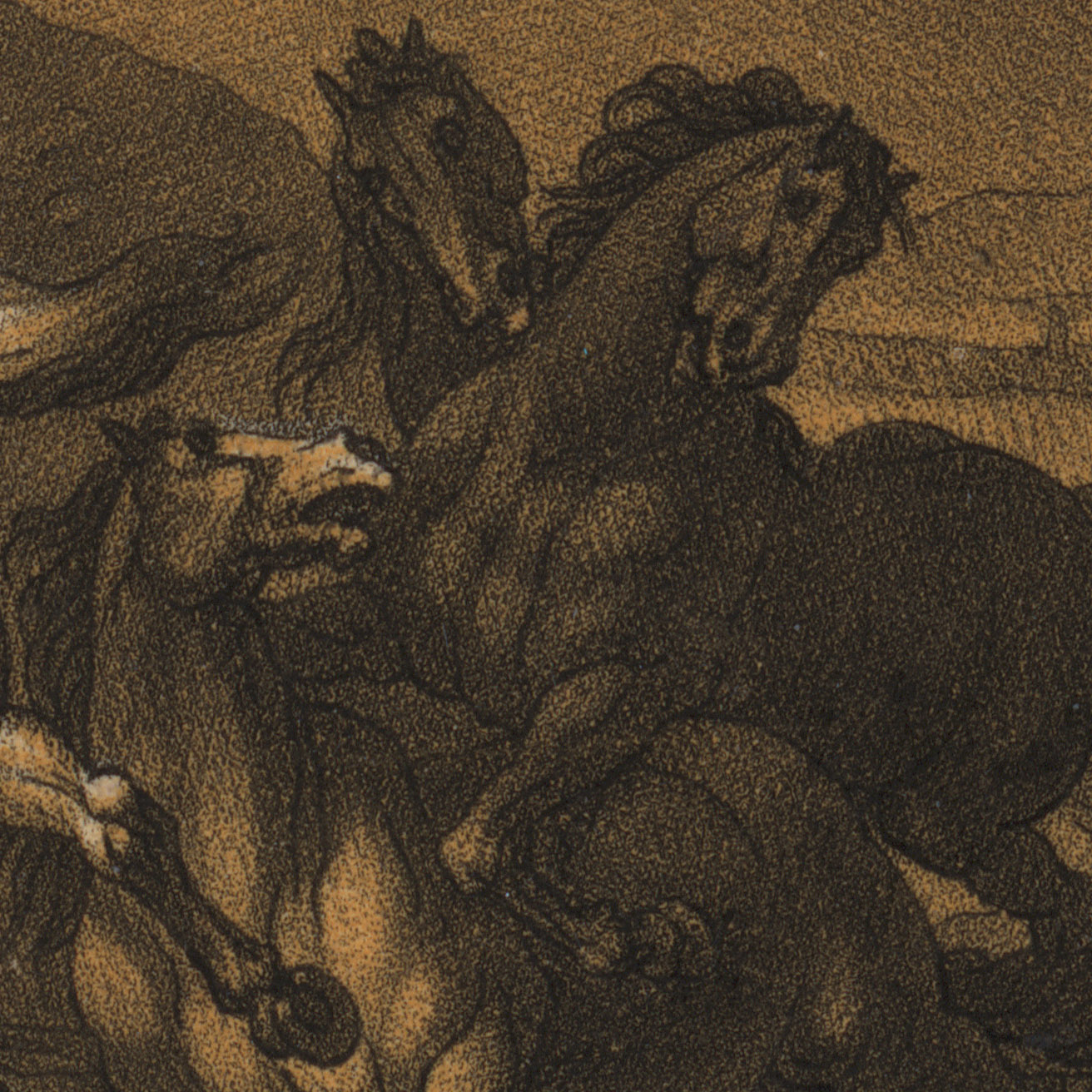
Johann Christian Rugendas’ mezzotint and etching, “Horses in Pasture”, c.1740, after Georg Philipp Rugendas

Johann Christian Rugendas (1708–1781)

“Horses in Pasture”, c.1740, plate 26 from the series of 69 plates, "Horsemen, Horses and Battles" (Ruiters, Paarden en Veldslagen), published by Johann Christian Rugendas in Augsburg, after a painting of the same composition executed in 1705 by his father, Georg Philipp Rugendas I (1666–1742), possibly showing a scene in Augusto, Turkey.

Etching and mezzotint printed from two plates in ochre and black ink on laid paper trimmed with a narrow margin around the platemark and backed with a support sheet.

Size: (sheet) 13 x 18.1 cm; (plate) 11.8 x 17.2 cm; (image borderline) 10.2 x 16.7 cm.

Lettered in plate below the image borderline: (left) “G. P. Rugendas A.1705. die 26. gbre. pinx. et del. Augustæ.”; (centre) “t. 1.”; (right) “Christian Rugendas Sculpsit et excud. Aug. Vind.”

Teuscher 631 (Andrea Teuscher 1998, “Die Künstlerfamilie Rugendas 1666-1858; Werkverzeichnis zur Druckgraphik”, Augsburg, Wißner, p. 160, cat. no. 631).

Condition: a strong and well-printed impression with a small margin around the platemark and laid onto a support of archival (millennium quality) washi paper providing wide margins. Beyond minor surface marks outside the image borderline, the sheet is in a good condition with no tears, holes, folds, abrasions, significant stains or foxing.

I am selling this small and jewel-like mezzotint showing bucking horses portrayed in a somewhat theatrical (chiaroscuro) light, for the total price of AU$258 (currently US$172.45/EUR156.03/GBP137.35 at the time of posting this listing) including postage and handling to anywhere in the world.

If you are interested in purchasing this glowing twilight scene with horses, executed in the delicate medium of mezzotint by the son of the great master of the technique and arguably the foremost battle scene painter of the 17th century, Georg Philipp Rugendas I, please contact me (oz_jim@printsandprinciples.com) and I will send you a PayPal invoice to make the payment easy.


Sunday, 30 January 2022

Johann Christian Rugendas’ mezzotint and etching, “Field Camp with Carousing Soldiers”, c1750, after Georg Philipp Rugendas I

Johann Christian Rugendas (1708–1781)

“Field Camp with Carousing Soldiers” (aka “Lagertreiben mit zechenden Soldaten” [Teuscher title]), c1750 (1723–1781), after the painting of the same composition (1696) executed in Rome by his father, Georg Philipp Rugendas I (1666–1742), from the series of 69 plates, "Battle Scenes with Horses", published by Johann Christian Rugendas in Augsburg.

Etching and mezzotint printed from two plates in orange-brown and black ink on laid paper trimmed around (or slightly within) the platemark and backed with a support sheet.

Size: (sheet) 17.9 x 30.3 cm; (image borderline) 16.7 x 29.6 cm.

Lettered in plate below the image borderline: (left) “G. P. Rugendas pinx. et del. A.1696. li 6. Ottobre Augusta.”; (centre) “c. 2.”; (right) “Christiano Rugendas Sculp et excud: Aug. Vindel.”

Teuscher 604 (Andrea Teuscher 1998, “Die Künstlerfamilie Rugendas 1666-1858; Werkverzeichnis zur Druckgraphik”, Augsburg, Wißner, p. 153, cat. no. 604).

See also the technical description of this print offered by MHK (Museumslandschaft Hessen Kassel): https://datenbank.museum-kassel.de/298774/

Condition: a strong and well-printed impression trimmed around (or slightly within) the platemark and laid on a support of archival (millennium quality) washi paper. There are few minor surface marks outside the image borderline, otherwise the sheet is in a very good condition with no tears, holes, folds, abrasions, significant stains or foxing.

I am selling this luminous and velvety mezzotint showing the matter-of-fact events that happen in a 17th century military field camp in the evening—cooking, eating, drinking chatting, making music, dancing and lolling around—rendered with a somewhat startling theatrical (chiaroscuro) lighting—note in particular the way that the artist has captured the muscled haunches and raised tail of the urinating horse in the foreground—for the total price of AU$298 (currently US$209.57/EUR187.65/GBP156.13 at the time of posting this listing) including postage and handling to anywhere in the world.

If you are interested in purchasing this glowing twilight scene of a army camp, executed in the delicate medium of mezzotint by the son of the great master of the technique and arguably the foremost battle scene painter of the 17th century, Georg Philipp Rugendas I, please contact me (oz_jim@printsandprinciples.com) and I will send you a PayPal invoice to make the payment easy.


Monday, 27 May 2019

Johann Christian Rugendas' mezzotint, “Nach de Schlacht”, c1740


Johann Christian Rugendas (1708–81)

“Nach de Schlacht” (After the Battle), c1740, after the painting executed in Rome in 1698 by Georg Philipp Rugendas I (1666–1742), plate 1 from the series of 69 plates, "Battle Scenes with Horses", published by Johann Christian Rugendas in Augsburg.

Mezzotint and etching printed in sepia coloured ink over an underlying impression printed in ochre on laid paper trimmed close to the image borderline, backed with a support sheet.
Size: (sheet) 19.3 x 32.4 cm; (image borderline) 18.5 x 32.1 cm
Lettered below the image borderline: (left) “G. Phil. Rugendas in[v]entor pinx. et delin. Li 13. Marzio Ao. 1698.”; (right) “Christiano Rugendas sculp. et excudit. Aug. Vindel.”

State i? (of ii?) Although I do not have the Teuscher (1998) catalogue raisonné for Rugendas, this impression is a state before the addition of the publication detail, “M 2.” (see a later state impression offered by The Print Collector: https://www.amazon.com/Antique-Master-Print-BATTLE-WAR-CANNON-HORSES-Johann-Christian-Rugendas-1698/dp/B00FB9FAIM)

Condition: richly inked and well-printed impression trimmed close to the image borderline and retaining the publication details. The sheet is in an excellent condition for its age (i.e. there are no tears, holes, losses, abrasions, stains, foxing or significant signs of use), laid on a support of archival (millennium quality) washi paper.

I am selling this luminous and velvety mezzotint showing the matter-of-fact events that happened on a 17th century battlefield (e.g. attending to the injured as shown by the priest giving the last rites to a mortally injured man resting against the cannon at right and a priest attending to the fallen in the distance at far right; stripping the dead as shown at the centre of the scene; collecting booty from the dead as shown by the figures in the foreground) for the total price of AU$298 (currently US$206.36/EUR184.30/GBP162.71 at the time of posting this listing) including postage and handling to anywhere in the world.

If you are interested in purchasing this glowing twilight scene of a battlefield, executed in the delicate medium of mezzotint by the son of the great master of the technique and arguably the foremost battle scene painter of the 18th century, Georg Philipp Rugendas I, please contact me (oz_jim@printsandprinciples.com) and I will send you a PayPal invoice to make the payment easy.


Wednesday, 8 February 2017

Johann Christian Rugendas’ mezzotint (with etching) of a battle scene after Georg Philipp Rugendas I


Johann Christian Rugendas (1708–81)
“Battle Scene”, c.1745, after the design (1694) executed in Rome by his father, Georg Philipp Rugendas I (1666–1742), from the series of 69 plates, "Battle Scenes with Horses", published by Johann Christian Rugendas in Augsburg.

Etching and mezzotint printed in orange-brown ink on laid paper trimmed at the platemark.
Size: (sheet) 20.6 x 40 cm; (image borderline) 19.9 x 39.4 cm
Lettered below the image borderline: (left) “G. P. Rugendas questo fece in Roma. Ao. 1694. 3 palmi alto: et 6. palmi lungo.”; (right) “Christian Rugendas Sculp:et excudit Aug. Vind.”

Condition: crisp impression trimmed at the platemark. The sheet has light creasing and a few scuff marks (restored with pencil touches) and a water stain that is only visible verso; otherwise the sheet is in good condition for its age (i.e. there are no tears, holes, losses, foxing or significant stains).

I am selling this luminous and velvety mezzotint full of fascinating incidents on a battle field illuminated with almost theatrical lighting for the total price of AU$298 including postage and handling to anywhere in the world.
If you are interested in purchasing this panoramic scene executed by the son of the great master of mezzotint and arguably the foremost battle scene painter of the 18th century, Georg Philipp Rugendas I, please contact me (oz_jim@printsandprinciples.com) and I will send you a PayPal invoice to make the payment easy.


Sadly, the word “mood” has fallen out of favour with many contemporary writers as it is too imprecise. Nevertheless, I need to resurrect it as this image projects MOOD: an inexplicably heavy mood of quiet melancholy. No doubt this feeling arises in part from the portrayed desolation of the aftermath of a battle gently lit by a shaft of light—a visual device called chiaroscuro lighting that was popular at the time for the theatrical effect that it gave to an image. And, no doubt, the small incidents (e.g. dead bodies being stripped of their clothes, a priest performing the last rites over a dying figure and a scattering of grieving men) also contribute to this mood of profound sadness. For me, however, the ultimate reason must lie with the artist who conceived the composition, Philipp Rugendas I, as he was one of the first war artists who actually worked in battles to record what really occurred. In short, the genius of this image lies with the authenticity of what is portrayed.

From a technical standpoint, this print is very interesting to me as it fits neatly within the mould of a very German approach to rendering tone. What I mean by this sweeping categorisation is best explained by comparing the traditional Italian approach with the German approach to simplifying tones into flat patterns (i.e. posterisation). Essentially the German approach, as exemplified here, is to use an outline around a tone whereas the Italian approach is to abut tones without outlines. The reason that I mention this bold generalisation of cultural propensity is that (all going well) I will be discussing the English approach to using tone in an upcoming post.