Showing posts with label Tintoretto (Jacopo). Show all posts

Monday, 4 November 2024

Circle of Marco Sadeler, “The Massacre of the Innocents”, c.1660, after Aegidius Sadeler II

Unidentified engraver from the circle of Marco Sadeler (aka Marcus Sadeler; Marc Sadeler) (fl.1660s), “The Massacre of the Innocents” (aka “Infanticide in Bethlehem”), c.1660, copy in the reverse direction after Aegidius Sadeler II’s (aka Ægedius Sadeler; Egidius Sadeler; Gillis Sadeler; Gillis Sadler) (c.1570–1629) engraving of the same composition (TIB 7201.036), that, in turn, is a copy in reverse after (possibly) Philippe Thomassin (1562–1622) reproducing Jacopo Tintoretto’s (aka Jacopo Robusti) (1519–1594) painting at the Scuola of San Rocco, Venice, published by Marco Sadeler.

Engraving on laid paper backed with a support sheet.

Size: (sheet) 24.9 x 29.8cm; (plate) 21.4 x 25.9cm; (image borderline) 19.2 x 25.4cm.

Lettered in plate below the image borderline: (left) “Jacobus Tinctoretus [sic] Ïnuentor.”; (center in three columns of two lines) “Pvgna ardet …/ …// …// …// …/ … inualidos”; (right) “Marco Sadeler excudit.”

TIB 7201.036 C2 (Isabelle de Ramaix [ed.] 1997, “The Illustrated Bartsch: Ægidius Sadeler II”, vol. 72, Part 1 [Supplement]), New York, Abaris Books, p. 59, cat. no. [7201] .036 C2).

Condition: a strong and well-printed impression. There is a wormhole in the text lines at lower right and a replenished hairline printer’s crease in the lower centre, otherwise the sheet is in a good condition with no tears or significant stains and has been laid onto a sheet of archival (millennium quality) washi paper.

I am selling this sensitively executed engraving reproducing Tintoretto’s famous oil painting (see https://www.wga.hu/html_m/t/tintoret/3b/3ground/4massac.html) —interestingly, the engraving portrays the arm of the woman protecting her child in the foreground at centre, whereas her arm in Tintoretto’s painting is cropped at the lower edge of the painting and possibly, as the Web of Art proposes (see URL above), “Tintoretto may have attached an arm made of plaster or stucco to the picture, as many Baroque painters later did”—for the total cost of AU$279 (currently US$177.41/EUR163.06/GBP136.90 at the time of posting this listing) including Express Mail (EMS) postage and handling to anywhere in the world, but not (of course) any import duties/taxes imposed by some countries. Note that payment is in Australian dollars (AU$279) as this is my currency.

If you are interested in purchasing this minutely detailed engraving published in the 1660s, please contact me (oz_jim@printsandprinciples.com) and I will send you a PayPal invoice to make the payment easy.

This print is still available


Tuesday, 25 October 2022

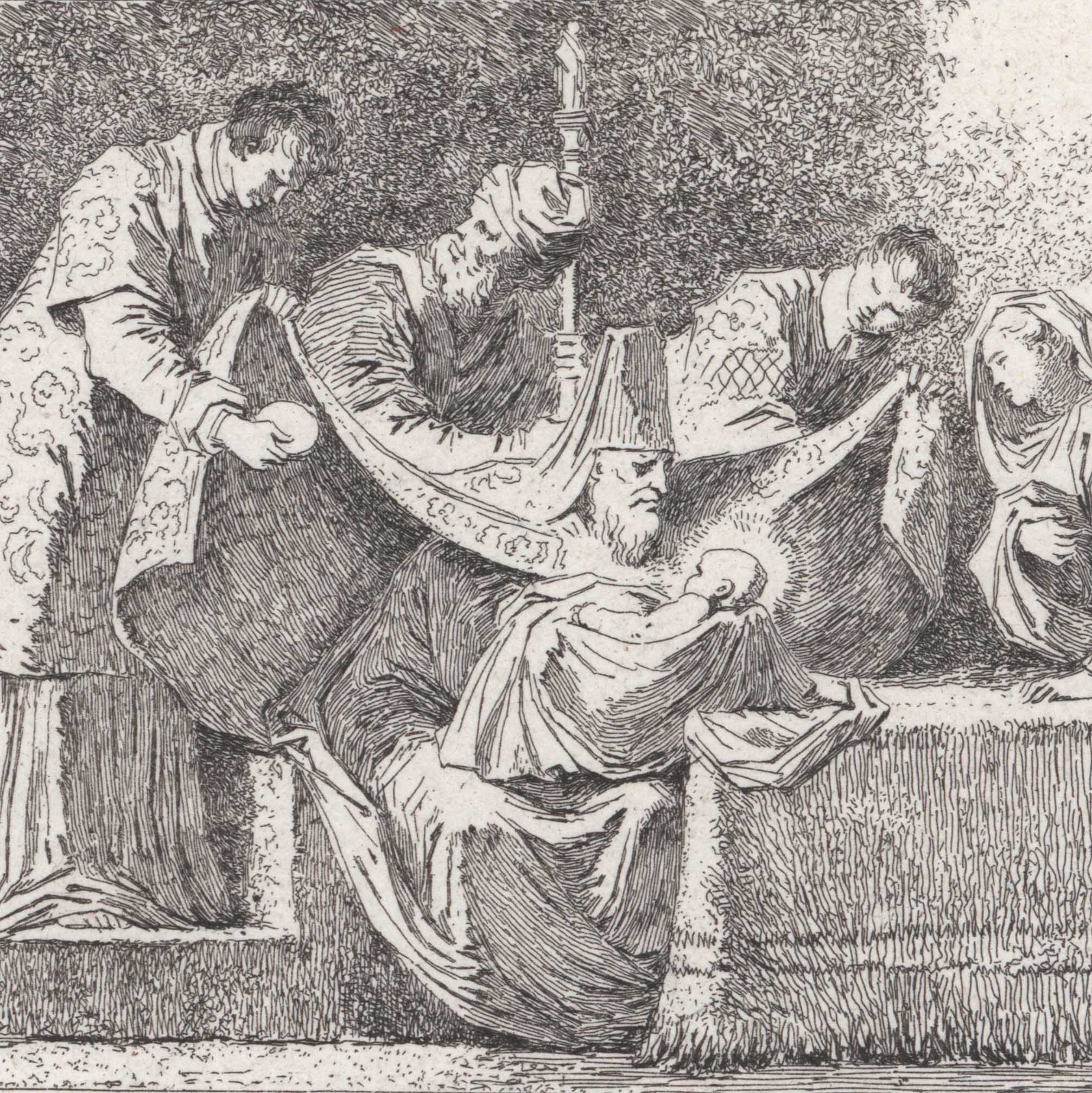
Jean-Honoré Fragonard’s etching, “The Circumcision”, c1764, after Tintoretto


Jean-Honoré Fragonard (aka Jean-Honoré Nicolas Fragonard) (1732–1806)

“The Circumcision” (aka “La Circoncision”), c1764, first state lifetime impression (before numbering as plate "16") from a series of sixteen etchings executed in Paris, c1763–64. This etching is after Jacopo Tintoretto’s (aka Jacopo Robusti) (1519–1594) painting in the Scuola Grande di San Rocco. The Metropolitan Museum offers the following insight about the composition: “Fragonard focused on the central scene, reducing the number of figures, suggesting a more intimate space” (see https://www.metmuseum.org/art/collection/search/399390).

Etching on laid paper trimmed along the platemark with a small margin around the image borderline.

Size: (sheet) 10 x 13.8 cm; (plate) 9.5 x 13.9 cm; (image borderline) 10.8 x 12.8 cm.

Inscribed in plate: (lower left, on step) “frago”.

State i (of ii) a lifetime impression before the addition of the plate number.

Wildenstein XXII. I (Georges Wildenstein 1956, “Fragonard Acquafortiste. Études et documents pour servir à l'histoire de l'art français du dix-huitième siècle”, Paris, p. 31, cat. no. XXII [1]); Baudicour 11 (Prosper de Baudicour 1859, “Le Peintre-Graveur Français continué, ou Catalogue raisonné des estampes gravées par les peintres et les dessinateurs de l'école fran̨caise nés dans le XVIIIe siècle, ouvrage faisant suite au Peintre-graveur français de M. Robert-Dumesnil”, vol. 1, Paris, F. de Nobele, p. 164, cat. no. 11).

Prosper de Baudicour (1859) offers the following description of this print: (transl.) “Behind a table, covered with a carpet, placed on the right, and on which the Blessed Virgin is leaning, the high priest, seated, holds the child Jesus in his arms; two assistants clad in tunics lift their cloaks, and behind them a third leans on a golden staff mounted with a statuette. On the clear part of the step, on the left, we read: frago” (p. 164 [see https://archive.org/details/lepeintregraveu00baudgoog/page/n178/mode/1up]); IFF 11.

See also the description of this print offered by the British Museum: https://www.britishmuseum.org/collection/object/P_1882-0311-1149.

Condition: a well-printed impression with small margins. Beyond thinning at the corners, the sheet is in an excellent condition for its considerable age with no tears, holes, folds, significant stains (but there are minor brown dots at upper right) or foxing.

I am selling this small but magnificent first state (lifetime) impression by one of most famous of the French Rococo artists, for the total cost of AU$669 (currently US$428.19/EUR430.17/GBP373.98 at the time of this listing) including postage and handling to anywhere in the world.

If you are interested in purchasing this original Fragonard—as opposed to a print after Fragonard and mindful that prints of this rarity and quality are seldom seen on the market place—please contact me (oz_jim@printsandprinciples.com) and I will send you a PayPal invoice to make the payment easy.

This print has been sold


Monday, 2 September 2019

Claude Mellan's engraving, “Jacob Draws Water for Rachel's Animals”, c1640, after Paolo Veronese


Claude Mellan (1598–1688)

“Jacob Draws Water for Rachel's Animals” (aka “Jacob abreuve le troupeau de Rachel”), c1636–1645, after Paolo Veronese (aka Paolo Caliari) (1528–1588), published by Pierre Mariette (1596–1657) and wrongly inscribed on plate as being after Jacopo Tintoretto (aka Jacopo Robusti) (1519–1594) (see Terisio Pignatti 1995, “Veronese: l'opera completa', Milan, Mondadori Electa, p. 161, no. 309).

Engraving on laid paper, trimmed along the image borderline (with loss of publication details below the image borderline) and backed with a support sheet.

Size: (sheet) 38.2 x 43.4 cm.

Inscribed on plate on the side of a water trough at lower left: "Cum priuilegio”; “Iacobus / Tinctoretus / pinxit / Cl. Mellan Gall. / sculp."

IFF 2 (Inventaire du Fonds Français: Bibliothèque Nationale, Département des Estampes, Paris, 1930); Montaiglon 1856 3 (Anatole de Montaiglon 1856. “Catalogue raisonne de l'oeuvre de Claude Mellan d'Abbeville” Abbeville, P Briex, pp. 79–80 256; this publication is available online at archive.org and may be downloaded free of charge: https://archive.org/details/catalogueraisonn00mont_0/page/78).

The British Museum offers the following description of this print:
“Jacob drawing water from the well to water Rachel's flock. c.1636/45”

See also the descriptions of the two copies of this print at the Metropolitan Museum of Art:

For those wondering about the figures in this scene, I was surprised when reading Anatole de Montaiglon’s (1856) catalogue raisonné description of this print (p. 79) that Rachel is seated at right on the edge of the well holding the halter of a camel—my surprise was that I assumed that the lady with the plunging neckline on the left would have been Rachel—while a servant of Abraham draws water from the well in a bucket. Rachael’s servant is shown at left washing her foot on a water trough for the sheep being directed—somewhat AGGRESSIVELY!—by a shepherd behind her.

Condition: richly inked and near faultless impression, trimmed with narrow margin around the image borderline (with loss to the lettered text below the image), laid onto a support of archival (millennium quality) washi paper. There is a restored (closed) tear at the upper edge of the sheet otherwise the sheet is in excellent condition (i.e. there are no holes, abrasions, stains or foxing).

I am selling this superb impression of a very rare (and large) engraving by the artist famous for his technical masterpiece of engraving inscribed with a single spiralling line, “Sudarium of Saint Veronica” (aka “Veil of St Veronica”), for the total cost of AU$526 (currently US$353.52/EUR322.27/GBP292.75 at the time of this listing) including postage and handling to anywhere in the world (but not, of course, any import duties/taxes imposed by some countries).

If you are interested in purchasing this sublimely beautiful engraving—a true masterwork of printmaking—please contact me (oz_jim@printsandprinciples.com) and I will send you a PayPal invoice to make the payment easy.

This print has been sold


Tuesday, 27 August 2019

Andrea Zucchi's etching, “The Last Supper”, 1720, after Tintoretto


Andrea Zucchi (1679 - 1740)

“The Last Supper” (aka “Cena di Cristo”), c1720, after the Intermediary design by Silvestro Manaigo (c1670–1734), after the painting by Jacopo Tintoretto (aka Jacopo Robusti) (1519–1594) in the Chapel of the Sacrament (right hand side) of the Church of San Trovaso in Venice, published by Domenico Lovisa (fl.1710–1750) in the series of 57 prints by Andrea Zucchi after paintings in the second part of “Il gran Teatro di Venezia, ovvero raccolta delle principali vedute e pitture che in essa si contengono” (the first part of this publication features 65 views of Venice), first editioned in c1720 in Venice.

Etching on laid paper with margins above and below, trimmed along the platemark on the sides, backed with a support sheet and stamped with an unidentified collector’s mark at lower centre of the margin.
Size: (sheet) 42.3 x 58.2 cm; (plate) 40 x 58.2 cm; (image borderline) 35 x 57 cm.
Lettered on plate below the image borderline: (left) “Siluestro Manaigo delineò”; (centre) “Cena di Cristo del Tintoretto nella Chiesa de SS. Geruaso, e Protaso detto S. Trouaso in Venetia.”; (right) “Andrea Zucchi Sculp/ Per Domenico Louisa in Rialto.”

Le Blanc IV.267.14 (Charles Le Blanc 1854–88, "Manuel de l'amateur d'estampes: contenant le dictionnaire des graveurs de toutes les nations", 4 vols., Paris, cat. no. 14, p. 267).

Condition: richly inked and well printed impression in excellent condition (i.e. there are no tears, folds, holes, abrasions, significant stains or foxing) trimmed along the platemark on the sides and with a margin at the upper and lower edges of the sheet. There is a collector’s ink stamp on the margin at the lower edge. The sheet is laid upon an archival support sheet of millennium quality washi paper.

I am selling this large etching transcribing the details and tones of Tintoretto’s painting of the same composition in line, for AU$197 (currently US$133.03/EUR119.70/GBP108.61 at the time of this listing) including postage and handling to anywhere in the world (but not, of course, any import duties/taxes imposed by some countries).

If you are interested in acquiring this marvellous etching capturing Tintoretto’s love of skewed perspective, extreme foreshortening, dramatic gestures, theatrical lighting and unusual viewpoints exemplifying the period style called Mannerism, please contact me (oz_jim@printsandprinciples.com) and I will send you a PayPal invoice to make the payment easy.

This print has been sold


Sunday, 13 May 2018

Lucas Kilian’s engraving, “The Miracle of the Loaves and the Fishes”, 1602, after Tintoretto


Lucas Kilian (1579–1637)

“The Miracle of the Loaves and the Fishes” (aka “Die wundersame Brotvermehrung”; “Multiplication of Bread and Fishes”), 1602 (as inscribed on the plate “M.DCII”), after the painting (1578–81) by Jacopo Tintoretto (1518–94) in the Scuola Grande di San Rocco (Sala Superiore) in Venice, published by Pierre Mariette (1596–1657).

Engraving and etching on laid paper with small margins backed with a support sheet.
Size: (sheet) 49.2 x 39 cm; (plate) 46.8 x 37.7 cm; (image borderline) 42.1 x 36.8 cm

Inscribed on plate within the image borderline at the lower edge: (left of centre) “A Paris chez Pierre Mariette.”; (right of centre) “Jacobus Tinctoretus pinxit.”; (left) “Lucas Kilian. Augs. scalpsit Venctiis.”
Lettered on plate below the image borderline in five lines with a coat of arms breaking the text at the centre of each line: “BIS DVO PAVISTI QVONDAM QVI MILLIA, SEPTEM […] ET TVA NVNC POTIS EST PAVCIS BENEDICERE, MVLTOS / PANIBVS, ÆTHERII CHRISTE PROPAGO PATRIS: […] VT SATIENT, POTIS ET DEXTERA SEMPER ERIT. / REVERENDISS.mo ET ILL.mo PRINCIPI. DÑO. D. WOLFGAN: […] GO EPISCOPO RATISPONENSI PRÆPOSITO ELVA. / CENSI DÑO SVO. OMNI OBSERVANCIA COLEN: […] DISS. DOMINICVS CVSTOS AVG. VIND. DDdt. / AÑ. P.C.N. […] M.DCII."

Hollstein: 13.1
See the description of this print at the Met: https://www.metmuseum.org/art/collection/search/766954
See also Anette Michels in J.R.Paas (ed.) 2001, “Augsburg, die Bilderfabrik Europas”, Augsburg, pp. 41–54.

Condition: crisp, well-inked and well-printed impression with small margins (approx. 1 cm) in very good condition for the age of the print (i.e. there is a closed tear on the right edge of the sheet and minor abrasions otherwise there are no significant holes, folds, stains or foxing). The sheet is backed with archival (millennium quality) washi paper.

I am selling this exceptionally rare, large and superbly executed engraving for the total cost of AU$323 (currently US$243.76/EUR204/GBP180) including postage and handling to anywhere in the world.

If you are interested in purchasing this important print that has been professionally cleaned and backed with a support sheet, please contact me (oz_jim@printsandprinciples.com) and I will send you a PayPal invoice to make the payment easy.

This print is reserved pending confirmation about its purchase


Sometimes when a painting is translated into a print the reproductive artist captures a special essence in the print that is hidden in the original painting. Let me explain …

This evening when I was comparing Tintoretto’s painting with Kilian’s translation of it into this line engraving, I remembered reading about a sign that Tintoretto is purported to have had in his studio:  “Il disegno di Michelangelo ed il colorito di Tiziano” ("Michelangelo's design and Titian's colour").

Mindful of Tintoretto’s esteem for Michelangelo, I was surprised that Kilian’s engraving seemed to have more of Michelangelo in it than I could see in Tintoretto’s painting. For example, note how the two figures in the lower left foreground of the engraving are rendered with a flow of rhythms that actively invite the eye to move around them. By contrast, when I look at the same figures in Tintoretto’s painting, I do not see the same Michelangeloesque conception of three-dimensional voluminous space.  Instead, Tintoretto’s figures appear somewhat flattened in this comparison.

In terms of compositional design, I believe that Killian has again captured more of Michelangelo’s understanding of design than Tintoretto has been able to express in his painting. For example, note how Kilian has clarified the pivotally important line of separation in the composition between the dark foreground and the light background. By contrast, Tintoretto still has the same division separating both spatial zones but, to my eyes, Tintoretto “muddies” the tonal juxtaposition by introducing his love of Mannerist light spots within the dark zone and dark silhouette shapes of trees within the light zones.

In short, what I am proposing—and I may be very wrong—is that in the case of Kilian’s translation of Tintoretto’s painting into an engraving, Kilian may have captured the strength of design that Tintoretto professed to seek.