Showing posts with label Caragaggio (Polidoro da). Show all posts

Friday, 25 August 2023

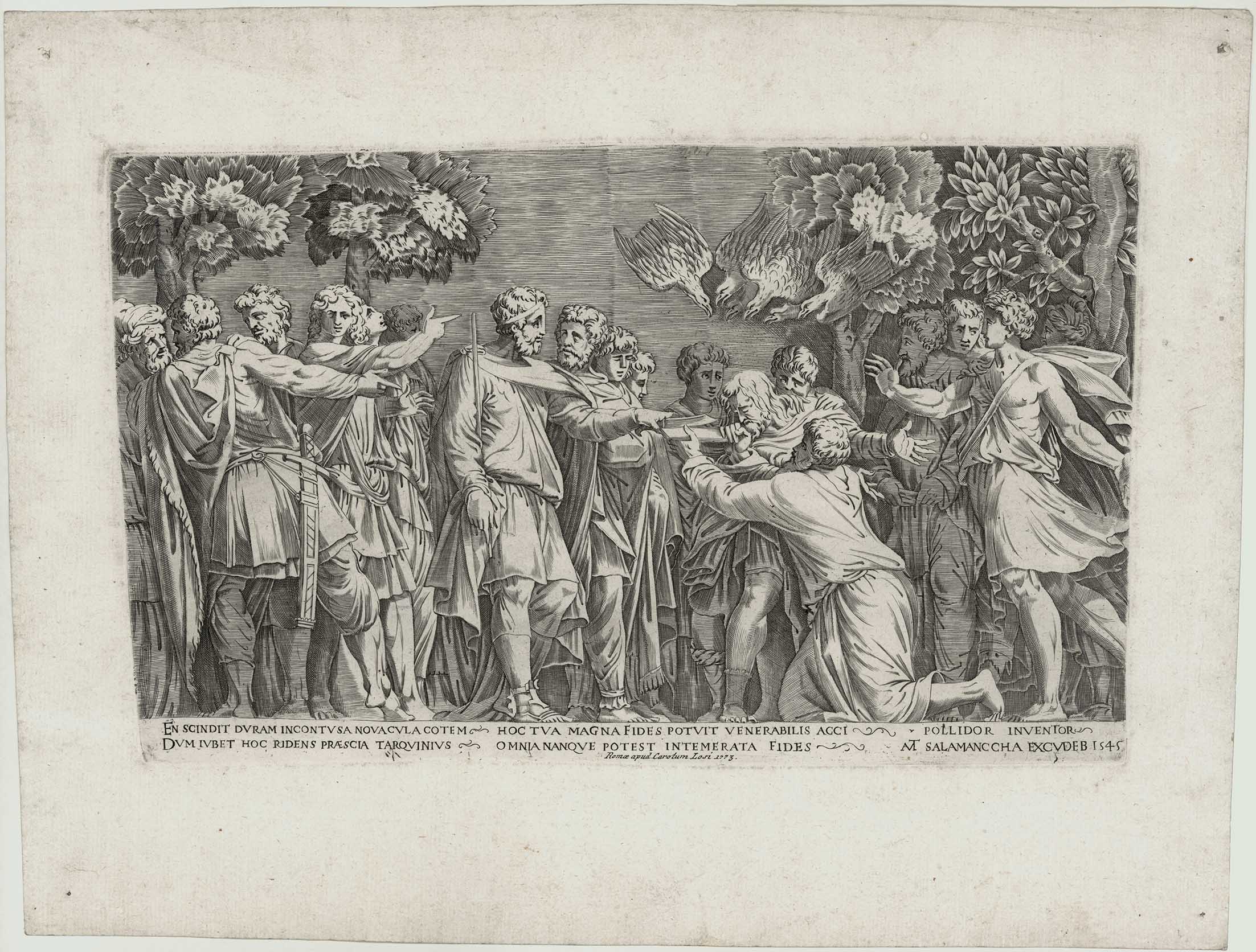
(Attrib.) Michele Lucchese’s engraving, “Tarquinius Priscus Cutting the Whetstone”, 1545, after Polidoro da Caravaggio

(Attrib.) Michele Lucchese (aka Michele Crecchi; Michele Grechi; Michele Greco) (fl.1534–1564), formerly attributed to Nicolas Beatrizet (aka Nicolas Beatricetto) (c.1507–c.1566)

“Tarquinius Priscus Cutting the Whetstone”, 1545, after Polidoro da Caravaggio (aka Polidoro Caldara; Polidoro da Caravagio) (c.1499–1543), possibly relating to a lost façade on Monte Citorio (see the Curator of the BM comment; inv. no. V,8.76), published in Rome by Antonio Salamanca (1478–1562) and later in 1773 (as is the case with this impression) by Carlo Losi (fl.Rome 1757–after 1805).

Engraving on heavy laid paper with wide margins.

Size: (sheet) 36.3 x 47.6 cm; (plate) 24.2 x 40.5 cm; (image borderline) 22.1 x 40.4 cm.

Lettered in plate below the image borderline: “EN SCINDIT DVRAM INCONTVSA NOVA CVLA COTEM ... POLLIDOR INVENTOR/ DVM IVBET HOC … [ANT] SALAMANCCHA EXCVDEB 1545/ Romæ apud Carolum Losi 1773.”

State ii (of ii) with the addition of the publication details for Carlo Losi.

Mariette I, p. 257 (as Caldara); Passavant 119 (as Beatrizet); Bianchi D 14 (attributed to Beatrizet).

See also the description of this print offered by the British Museum: https://www.britishmuseum.org/collection/object/P_1871-0429-615.

Condition: a strong and well-printed impression with wide margins. Beyond a pinhole in each corner of the margin and minor surface dustiness, the sheet is in an excellent condition with no tears, losses, abrasions, significant stains or foxing.

I am selling this rare engraving for AU$376 (currently US$251.32/EUR227.39/GBP200.17 at the time of posting this listing) including postage and handling to anywhere in the world (but not, of course, any import duties/taxes imposed by some countries).

If you are interested in purchasing this strong impression showing at left-of-centre, Tarquinius Priscus—by tradition, the fifth king of Rome (reigning between c.616–578 BC)—slicing through a whetstone (tool sharpener) with his knife to demonstrate his divine power, contact me (oz_jim@printsandprinciples.com) and I will send you a PayPal invoice to make the payment easy.

Note that I have previously listed another engraving by Michele Lucchese, “The Martyrdom of St. Lawrence” (c.1520), after Marcantonio Raimondi (and Baccio Bandinelli) that is currently still available: https://www.printsandprinciples.com/2017/02/luccheses-engraving-1539-after.html.

This print has been sold


Saturday, 8 May 2021

Cherubino Alberti’s engraving, “The Triumph of Two Roman Emperors”, c1590, after Polidoro da Caravaggio

Cherubino Alberti (aka Zaccaria Mattia; Borghegiano) (1553–1615)

“The Triumph of Two Roman Emperors”, c1590 (1570–1615), after Polidoro da Caravaggio (aka Polidoro Caldara; Polidoro da Caravagio) (c1499–1543), published in Rome.

This is the left panel of a frieze of two engravings joined horizontally. The right panel I will list at a later date (once I find it). Sebastian Buffa (1982) in TIB, vol.34, advises: “According to Bartsch, though these [panels] are marked nos. 4 and 5, and are the same height as “The Rape of the Sab[i]ne Women”, they are not part of the preceding series” (p. 290)—note that I will be listing “The Rape of the Sabine Women” also once I find it!

Engraving on laid paper trimmed along the borderline on the upper edge and with a margin around the borderline on the remaining edges.
Size: (sheet) 16.9 x 41.3 cm; (image borderline) 12.5 x 39.5 cm,

Inscribed on plate within the image borderline: (lower left corner with Alberti's monogram) “C/ A”.

Lettered on plate in cartouche below the image borderline: (centre) “ALBERTVS ALBERTVS OBSERVANTIAE ERGO . D.D./ [inreverse] 4 […] Cherubinus Albertius Alberti F Fecit Romæ Cum Priuilegio S.mi Pontificis.”

TIB 34 (17).160 (109) (Sebastian Buffa 1982, “The Illustrated Bartsch: Italian Artists of the Sixteenth Century”, vol. 34, New York, Abaris Books, p. 290, cat. no. 160 [109]).

Interestingly, The British Museum does not view this engraving as a triumphal procession as titled by Bartsch/TIB and offers the following description:

“A Roman battle (Massacre of the Innocents?), a soldier to the right on a rearing horse has a spear in his left hand” (https://www.britishmuseum.org/collection/object/P_1873-1213-285-1).

The Curator of the British Museum offers the following insights about this print:

“The imperial subject of this sheet is not altogether convincing and might be an imaginative blend of Roman history and the Massacre of the Innocents. The text in the cartouche below seems to allude to Albert II, 1397–1439, Holy Roman Emperor, king of Hungary and Bohemia (1438–39), duke of Austria (1404–38). The plate is numbered '4' and the second sheet '5'. This suggests they were considered contiguous with Alberti's Rape of the Sabine frieze that has the same format, size and are numbered 1,2 and 3.”

Condition: a strong and well-printed impression, trimmed close to the outer image borderline. The sheet is stained on the upper left, on the upper right and on the rearing horse and rider (right of centre); otherwise, the sheet is in a good condition for its considerable age.

I am selling this superb engraving by one of the most famous of the Italian Mannerist engravers showing a panel of a frieze designed by Polidoro da Caravaggio, for the total cost of AU$339 (currently US$266.03/EUR218,62/GBP190.16 at the time of this listing) including Express Mail (EMS) postage and handling to anywhere in the world, but not (of course) any import duties/taxes imposed by some countries.

If you are interested in purchasing this very dramatic scene of a bas-relief showing families fleeing advancing soldiers—note the marvellous concentric contour lines rendering the rump of the rearing horse and that the foot of the shield-bearing soldier on the far right has “broken free” of the image borderline—please contact me (oz_jim@printsandprinciples.com) and I will send you a PayPal invoice to make the payment easy.

This print has been sold 


Thursday, 25 February 2021

Giovanni Battista Galestruzzi’s etching, “The Soldiers of Cyrus Attacking the Army of Spargabise”, c1650, after Polidoro da Caravaggio

Giovanni Battista Galestruzzi (1619-c1678)

The Soldiers of Cyrus Attacking the Army of Spargabise” (MET title) (aka “The Soldiers of Cyrus Tearing Apart the Army of Spargabise” [TIB title]; “Les soldats de Cyrus taillant en pièces l'armée de Spargabise”; ), c1650 (1640–1660 [BM dates]), plate 4 in the series, “Subjects from Roman History” [Havard title]), after Polidoro da Caravaggio’s (aka Polidoro da Caravagio; Polidoro Caldara da Caravaggio; Polidoro Caldara) (c1500–1536/7 [BM dates]) fresco on the façade of the Palazzo Milesi in Rome—sadly the frescoes on the façade have almost completely vanished by deterioration.

Etching on laid paper trimmed with a thread margin around the image borderline and backed with a support sheet.

Size: (sheet) 10.9 x 12.3 cm.

Inscribed on plate in lower left tablet: “POLIDORO. INVENTORE. Gio. Batta. Galestruzzi 4/ fe.”

TIB 46 (21).6 (54) (Paolo Bellini [ed.] 1982, “The Illustrated Bartsch: Italian Masters of the Seventeenth Century”, vol. 46, Abaris Books, New York, p. 79, cat. no. 6[54]); Bartsch XXI.54.6.

See the descriptions of this print offered by the British Museum and the Harvard Art Museum: https://www.britishmuseum.org/collection/object/P_1856-1213-49; https://hvrd.art/o/234737.

Condition: a strong and well-printed impression, showing no sign of wear to the printing plate, trimmed with a thread margin around the image borderline and laid upon a support sheet of archival (millennium quality) washi paper. There is a minor restoration to chipping at the upper left corner, otherwise the sheet is in excellent condition with no tears, holes, folds, stains or foxing.

I am selling this historically important etched frieze that is a surviving visual record of Polidoro da Caravaggio’s now lost—in the sense of badly deteriorated—fresco on the façade of the Palazzo Milesi in Rome, for the total cost of AU$287 (currently US$229.47/EUR188.08/GBP162.21 at the time of posting this print) including Express Mail (EMS) postage and handling to anywhere in the world, but not (of course) any import duties/taxes imposed by some countries.

If you are interested in purchasing this small but visually arresting battle scene from the mid-1600s, please contact me (oz_jim@printsandprinciples.com) and I will send you a PayPal invoice to make the payment easy.

Note that I have listed another three-panel etching by Giovanni Battista Galestruzzi that is currently available for the same price: https://www.printsandprinciples.com/2018/11/giovanni-battista-galestruzzis-etching.html.

This print has been sold 


Monday, 28 September 2020

Unidentified engraver from the circle of Cherubino Alberti and Aegidius Sadeler II, “Vase No. 6”, after Polidoro da Caravaggio

Unidentified engraver from the circle of Cherubino Alberti (1553–1615) and Aegidius Sadeler II (aka Egidius Sadeler; Gillis Sadeler; Ægedius Sadeler; Gillis Sadler) (c1570–1629)

“Vase No. 6” (TIB title for Aegidius Sadeler’s engraving [TIB 7201.413]) (aka “Plate 6: Vase or Ewer with a Frieze Containing Naked Figures, Supported Below by Two Female Sphinxes” [MET title]), c1600s (after 1605), plate 6 in the series of ten engravings, “Antique Vases” (“Vasa a Polydoro Caravagino”), in reverse after Cherubino Alberti’s 1582 engraving of the same vase (see https://www.britishmuseum.org/collection/object/P_1873-1213-290) and in the same direction as Aegidius Sadeler II’s 1605 engraving (see https://www.metmuseum.org/art/collection/search/652408) after Polidoro da Caravaggio’s (aka Polidoro Caldara; Polidoro da Caravagio )(c1500–1536/7?) frescoes above the first floor windows of the Palazzo Milesi in the via della Maschera d'Oro in Rome (see L. Ravelli 1978, “Polidoro Caldare da Caravaggio”, Bergamo, fig. 667, p. 369 and Michael Bury 2001, “The Print in Italy 1550-1620”, British Museum Press, London, p. 146).

Etching and engraving on laid paper backed with a support sheet.

Size: (sheet) 39 x 26 cm; (plate) 24 x 15.9 cm.

Ref. Cherubino Alberti: TIB 34 (17).166 (110) (Sebastian Buffa 1982, “The Illustrated Bartsch: Italian Artists of the Sixteenth Century”, vol. 34, New York, Abaris Books, p. 197, cat. no. 166 [110]).

Ref. Aegidius Sadeler II: TIB 7201.413 (Isabelle de Ramaix 1998, “The Illustrated Bartsch: Ægidius Sadeler II”, vol. 72, Part 2 [Supplement], New York, Abaris Books, p. 299, cat. no. [7201].413; illus. p. 300).

The British Museum offers the following description of Cherubino Alberti’s print that was copied in reverse by Aegidius Sadeler II:

“Plate 6: vase depicting naked figures surrounding a vessel, supported by two sirens; from a series of ten prints after Polidoro da Caravaggio of antique vases decorated with various scenes. c1582” (https://www.britishmuseum.org/collection/object/P_1873-1213-290).

Condition: well-printed early impression showing no wear to the printing plate. There are tears and a few holes in the margins and the edges to the sheet are ragged, but the image area has no tears, holes, folds, abrasions or significant stains.

I am selling this early engraving in reverse of Cherubino Alberti’s print after Polidoro da Caravaggio’s fresco of the same subject for AU$220 in total (currently US$154.90/EUR133.09/GBP120.98 at the time of posting this listing) including Express Mail (EMS) postage and handling to anywhere in the world, but not (of course) any import duties/taxes imposed by some countries.

If you are interested in purchasing this superb example of Baroque ornamental design, please contact me (oz_jim@printsandprinciples.com) and I will send you a PayPal invoice to make the payment easy.

Note that I have similar engraving that is presently still available; see https://www.printsandprinciples.com/2018/06/engraving-by-unidentified-printmaker.html.

This print has been sold


Friday, 17 July 2020

Giovanni Battista Galestruzzi’s etching, “The Slaughter of Niobe’s Chlidren”, 1656, after Polidoro da Caravaggio


Giovanni Battista Galestruzzi (1619–1678)

“The Slaughter of Niobe’s Chlidren” (TIB title) (aka “Niobid frieze of the Palazzo Milesi”), 1656, plate five in the series of five plates, “History of Niobe”, after Polidoro da Caravaggio’s (aka Polidoro da Caravagio; Polidoro Caldara da Caravaggio; Polidoro Caldara) (c1500–1536/7 [BM dates]) fresco on the façade of the Palazzo Milesi in Rome—sadly the frescoes on the façade have almost completely vanished by deterioration.

Etching on fine laid paper trimmed with a narrow margin around the image borderline and backed with a support sheet.
Size: (sheet) 11.6 x 34.5 cm; (image borderline) 11 x 34.2 cm.
Inscribed on plate on horse at lower left: “GIO. BAT. GALESTRVZZI/ FECE / GG (monogram); (abraded below the image borderline at lower left corner): “D”.

Early impression before numbering with “5” below the image borderline at centre (see a similar unnumbered impression held by the Harvard Art Museums: https://www.harvardartmuseums.org/collections/object/234880?position=18).

TIB 46 (21).20 (59) (Paolo Bellini [ed.] 1982, “The Illustrated Bartsch: Italian Masters of the Seventeenth Century”, vol. 46, New York, Abaris Books, p. 89, cat. no. 20 [59]); Bartsch XXI.59.20.

The British Museum offers the following description of this print:
“Apollo and Diana killing with their arrows the children of Niobe, in five sheets: sheet 5. 1656”

Condition: well-printed impression but with minor spots of abrasion (e.g. lower left corner), edge tears (e.g. lower edge towards the right) and restored small holes (e.g. on the extended arm of the young woman at lower right). The sheet has mellowed with age-toning and is laid upon an archival support sheet of millennium quality washi paper.

I am selling this historically important etched frieze that is a surviving visual record of Polidoro da Caravaggio’s now lost—in the sense of badly deteriorated—fresco on the lower register of the façade of the Palazzo Milesi in Rome, for AU$315 (currently US$220.02/EUR192.54/GBP175.36 at the time of this listing) including postage and handling to anywhere in the world (but not, of course, any import duties/taxes imposed by some countries).

If you are interested in purchasing this visually arresting old master etching exemplifying the Baroque period style, please contact me (oz_jim@printsandprinciples.com) and I will send you a PayPal invoice to make the payment easy.

This print has been sold