Showing posts with label Bol (Hans). Show all posts

Friday, 4 November 2022

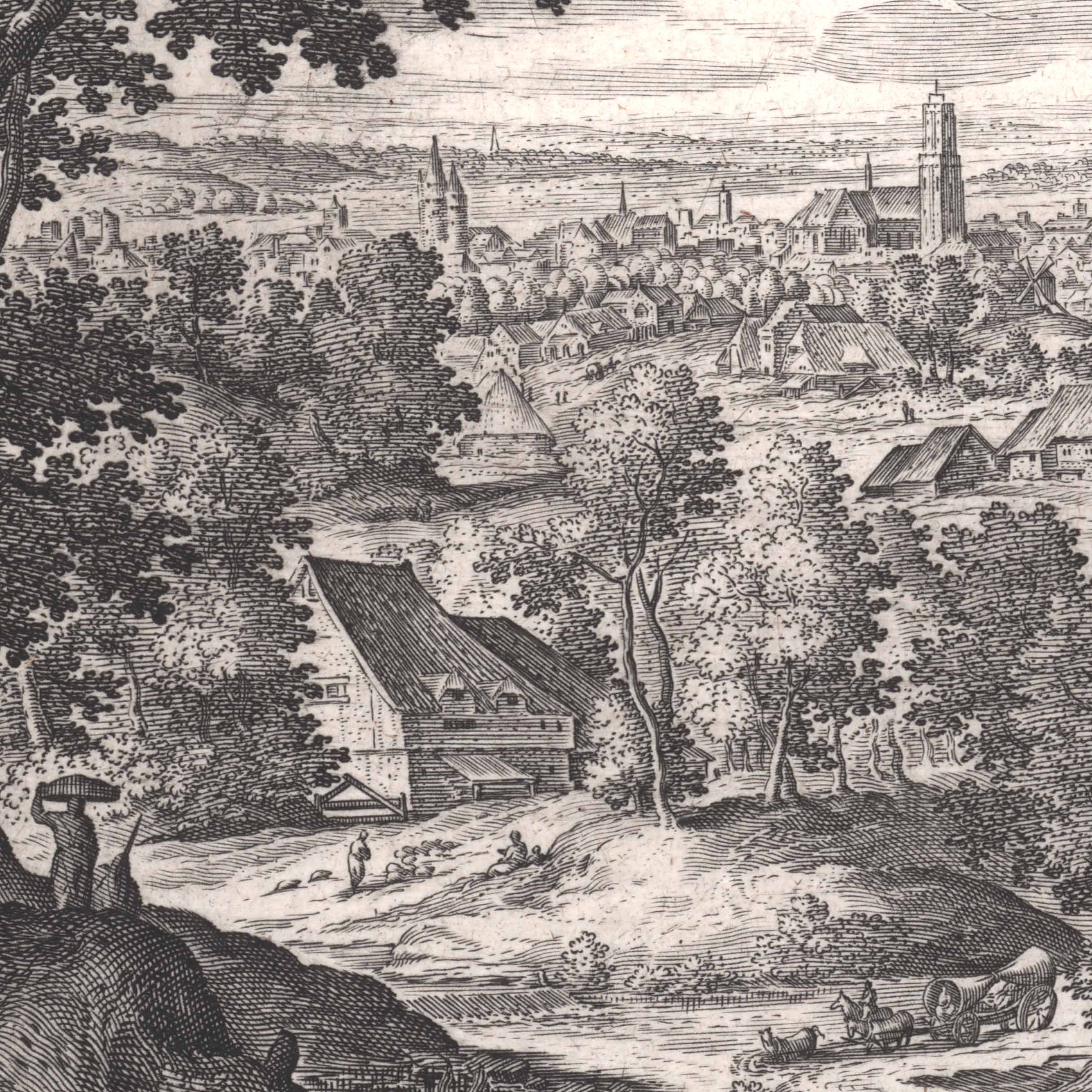
Jan Sadeler I’s engraving, “Landscape with a Hunter Aiming His Bow at a Bird”, c1599, after Hans Bol

Jan Sadeler I (aka Johann Sadeler; Johannes Sadeler) (1550–1600)

“Landscape with a Hunter Aiming His Bow at a Bird” (TIB title], c1599, published in Vencie, after a lost drawing by Hans Bol (aka Jan Bol) (1534–1593) with lettered Latin text by Andrea Alciati (aka Andreas Alciatus) (1492–1550), copied after “Emblemata” (Venice, 1599) (see https://archive.org/details/emblemataandreae00alcia/page/83/mode/1up).

Engraving on laid paper with partial “Sun” watermark.

Size: (sheet) 24.4 x 35.2 cm; (plate) 22 x 26.7 cm; (image borderline) 19.4 x 26.6 cm.

Inscribed in plate along lower edge within the image borderline: (left of centre) “Ioa Sadeler sculpsit Venetijs”; (right) “I. Bol.”

Lettered in three columns of two lines of Latin below the image borderline: “Dum turdos visco, pedica dum fallit alaudas,/ Et iacta altivolam figit harundo gruem,// Dipsada no prudens auceps pede perculit, ultrix/ Illa mali, emissum virus ab ore inacit.// Sic obot extento qui Sydera respicit arcu,/ Securus fati quod iacet ante pedes./ And. Alciat.”

State i (of i)

TIB 7001.519 (Isabelle de Ramaix 2003, “The Illustrated Bartsch”, vol. 70, Part 3 [Supplement], New York, Abaris Books, p. 129, cat. no. [7001].419); Hollstein (Johann Sadeler I) 563 (Dieuwke de Hoop Scheffer [comp.] 1980, “Dutch and Flemish Etchings, Engravings and Woodcuts ca. 1450–1700: Aegidius Sadeler to Raphael Sadeler II: text”, vol. 21, Amsterdam, Van Gendt & Co, p. 176, cat. no. 563); Le Blanc 185; Edquist, p. 207, no. 41a.

The Rijksmuseum offers the following description of this print: (transl.) “Hilly landscape with farms. To the right a covered wagon wading through the river. In the foreground left, a hunter tries to shoot a bird. However, he is bitten in the foot by a snake. This is the depiction of an emblem where the moral of the story teaches that pride comes before a fall. The print has a Latin caption with the caption of the emblem Qui Alta Contemplantur Cadere by Andrea Alciati.” (http://hdl.handle.net/10934/RM0001.COLLECT.168706)

Condition: a strong and well-printed (near faultless) impression in an excellent/near pristine condition for its age with no tears, holes, folds, abrasions or significant stains.

I am selling this sensitively executed and very beautiful engraving by one of the most famous of the Flemish old masters, for AU$305 (currently US$193.70/EUR198.01/GBP172.53 at the time of posting this print) including Express Mail (EMS) postage and handling to anywhere in the world, but not (of course) any import duties/taxes imposed by some countries.

If you are interested in purchasing this illustration of the fable of the “Bird Catcher and the Serpent” with the moral that pride comes before a fall, please contact me (oz_jim@printsandprinciples.com) and I will send you a PayPal invoice to make the payment easy.

This print has been sold


Friday, 27 September 2019

Adriaen Collaert's engraving, "Fishing", 1582. after Hans Bol


(Attrib. according to the BM) Adriaen Collaert (c1560–1618) or the studio of Philips Galle (1537–1612) (according to the Rijksmuseum).

“Fishing” (“Hengelsport”), 1582, plate 43 from the series of forty-eight engravings (BM) or fifty-four engravings (Rijksmuseum), “Venationis, piscationis, et aucupii typi” (Hunting, Fishing and Fowling Scenes) after Hans Bol (1534–93), published by Philips Galle (according to the BM) and/or Theodoor Galle (1571–1633) (according to the Rijksmuseum) in Antwerp.


Engraving on fine laid paper trimmed along the platemark and backed with a conservator’s support sheet.
Size: (sheet) 8 x 21.9 cm; (image borderline) 6.8 x 21.6 cm.
Inscribed below the image borderline: (from the left) “43”; "Piscis inescato capitur sic squāmiger hamo, […] Dum tremula pendet ceratum ab arúdine filum." ([transl.] "Scaly fish are thus caught with a hook, a waxed line being attached to a quivering rod.")

State ii? (of ii?) After the addition of the plate number, “43”. My uncertainty about the number of other states is that I understand that there were alterations to the number sequences in the later 1633 edition (e.g. plate 37 became plate 47). This impression is certainly an early one as there is very little wear to the printing plate.

New Hollstein Dutch R20-2 (2) (Marjolein Leesberg [comp.] Manfred Sellink [ed.] 2001, “The New Hollstein: Dutch and Flemish Etchings, Engravings and Woodcuts 1450–1700”, vol 4, Rotterdam, Sound and Vision, p. 250, cat. R20); Hollstein Dutch 152 (FWH Hollstein 1950, “Dutch and Flemish Etchings, Engravings and Woodcuts ca. 1450–1700”, vol. 3, Amsterdam, Menno Hertzberger, p. 52, cat. 152).

The British Museum offers the following description of this print:
“A cityscape with a large bridge (with a tower) over a river; fishermen use rods to cast their lines from the riverbank, left and right, and others on the bridge use a basket at the end of a long pole; two figures on horseback are crossing the bridge; at far right a woman carries water on a yoke; at bottom left a man puts his catch into a sack; after Hans Bol”

See also the description of this print at the Rijksmuseum:
(transl.) “On the banks of a river, some men catch fish with the help of a fishing rod. In the background a bridge over the river. There men try to catch fish with a landing net. The print has a Latin signature and is part of a series of 54 prints.”

Condition: marvellous early impression showing virtually no wear to the plate from the numbered publication state (state ii?). The sheet has been trimmed along the platemark and is laid upon an archival support sheet of millennium quality washi paper. The sheet has the patina of handling marks appropriate to the age of the print and there is an ink smudge on the first word of the text (perhaps made at the time of printing?); otherwise the sheet is in excellent condition (i.e. there are no tears, holes, abrasions, folds, stains or foxing).

I am selling this museum-quality rare engraving showing fishing practices in the late 1500s, for the total cost of AU$320 (currently US$216.30/EUR197.96/GBP175.42 at the time of this listing) including postage and handling to anywhere in the world.

If you are interested in purchasing this jewel-like panoramic illustration featuring rod fishermen in the foreground with net fishermen on a double arched bridge in the middle distance and a city beyond, please contact me (oz_jim@printsandprinciples.com) and I will send you a PayPal invoice to make the payment easy.

This print has been sold


Thursday, 19 October 2017

Adriaen Collaert’s engraving, “Ox hunt”, 1582, after Hans Bol


(Attrib.) Adriaen Collaert (c1560–1618) or the studio of Philips Galle (1537–1612)

“Ox Hunt”, 1582, plate 2 from the series of forty-eight engravings (BM) or 54 engravings (Rijksmuseum), “Venationis, piscationis, et aucupii typi” (Hunting, Fishing and Fowling Scenes) after Hans Bol (1534–93), published by Philips Galle (according to the BM) and/or Theodoor Galle (1571–1633) (according to the Rijksmuseum)


Engraving on fine laid paper trimmed along the platemarks and lined onto a conservator’s support sheet
Size: (sheet) 8.3 x 21.8 cm
Inscribed below the image borderline: (from the left) “2”; "Sic passim spiculis, gladijs, leuibusq[ae] sagittis”;  “In foueas agitant armatos cornibus Vros." (advised trans. "Thus with darts, swords, and light arrows men everywhere drive the horned Aurochs into pits.")
State ii? (of ii?) After the addition of the plate number, “2”. My uncertainty about the number of other states is that I understand that there were alterations to the number sequences in later editions (e.g. plate 37 became plate 47). This impression is certainly an early one as there is very little wear to the plate.

Hollstein 110–163 (after Hans Bol); New Hollstein (Dutch & Flemish) 1532.I (The Collaert Dynasty)

The British Museum offers the following description of this print:
“A group of men, some on foot, some on horseback, and dogs, surround and attack an aurochs, at the centre of a wooded landscape; the animal has an arrow stuck in its back, and its heels are nipped at by some of the dogs; after Hans Bol”
See also the description of this print at the Rijksmuseum:

Condition: marvellous early impression showing no wear to the plate from the numbered publication state (state ii?). The sheet has been trimmed to the platemark and laid onto a support sheet. The sheet has the patina of light handling marks appropriate to the age of the print; otherwise the sheet is in excellent condition (i.e. there are no tears, holes, abrasions, folds, stains or foxing).

I am selling museum-quality early impression showing a hunt for the wild European ox—the anurochs—only 45 years before this species of animal became extinct, for the total cost of AU$280 (currently US$220/EUR186.54/GBP167.38 at the time of this listing) including postage and handling to anywhere in the world.

If you are interested in purchasing this panoramic illustration of the drama of a 16th century hunt, please contact me (oz_jim@printsandprinciples.com) and I will send you a PayPal invoice to make the payment easy.

This print has been sold


For those, like me, who may not be familiar with animal called an anurochs (the spelling of a herd of anurochs is the same as that of a single anurochs) being hunted here, according to www.merriam-webster.com/dictionary, it is “an extinct large long-horned wild ox (Bos primigenius) of Europe that is the ancestor of domestic cattle.” Interestingly—perhaps the adverb, “poignantly”, might be more appropriate—as the scene portrayed here in 1582 must be one of the last recorded hunts for an anurochs as the breed was exterminated in 1627 with the last one killed in Poland. So sad …


Thursday, 16 March 2017

Adriaen Collaert’s (?) engraving of hawk trapping, 1582, after Hans Bol


(after?) Adriaen Collaert (c.1560–1618)
(The curator of the British Museum advises: “Attributed to an anonymous engraver by New Hollstein (not catalogued with Adriaen Collaert).”

Plate 26: “Catching Hawks”, 1582, after Hans Bol (aka Jan Bol) (1534–93), from the series of 48 engravings, “Venationis, piscationis, et aucupii typi” (Hunting, Fishing and Fowling Scenes), published by Philips Galle (1537–1612)

Engraving on laid paper trimmed close to the plate mark and lined onto a conservator’s support sheet.
Size: (sheet) 8 x 21.8 cm

Lettered "Aucupe sic verso, fallaci Buteo visco/Inclusis capitur vel mure, aut virmine rana."; numbered "26"; typewritten translation: "A mouse or a frog having been enclosed in a wicker-work snare, the hawk is thus caught with treacherous bird lime, the fowler having turned himself away from view."

Hollstein 110-163 (after Hans Bol); New Hollstein (Dutch & Flemish) undescribed (The Collaert Dynasty)

The British Museum offers the following description of this print:
“Three men hide behind the clump of bare trees at centre, and another hides at far left, watching over the wicker traps they have set and baited; a hawk approaches the trap at left; at top right, a bird has taken off with a trap, and is being pulled in by one of the men at centre; in the background chickens in a field and several buildings with thatched rooves, as well as a castle and church; after Hans Bol Engraving” (http://www.britishmuseum.org/research/collection_online/collection_object_details.aspx?objectId=3262800&partId=1&searchText=1923,0306.1.1.+26&page=1)

Condition: crisp impression in excellent condition but with a few printer’s creases. The sheet is trimmed close to the platemark and is lined onto a conservator’s support sheet.

I am selling this historically important visual document showing how hawks were once trapped, for AU$280 in total (currently US$215.47/EUR200/GBP174.20 at the time of posting this listing) including postage and handling to anywhere in the world.
If you are interested in purchasing this wide panoramic view of a 16th century landscape filled with intriguing incidents, please contact me (oz_jim@printsandprinciples.com) and I will send you a PayPal invoice to make the payment easy.

This print has been sold