Showing posts with label Caylus (Comte de ). Show all posts

Tuesday, 22 April 2025

Comte de Caylus, “Holy Family with St. John the Baptist”, c.1720–28, after Girolamo Mazzola Bedoli

Anne Claude Philippe de Tubières, Comte de Caylus (aka Caylus; Anne Claude de Caylus; Anne Claude de Pestels; Anne Claude Philippe de Thubiéres; Anne Claude Philippe de Tubières) (1692–1765)

“Holy Family with St. John the Baptist”, c.1720–28, a later 19th century impression(?) with the additional plate number, “124”, inscribed at upper left, after a drawing by Girolamo Mazzola Bedoli (aka Girolamo Bedoli) (c.1505–c.1570), plate 124 (as inscribed in plate, previously 120) from the series, “Recueil de Dessins Gravés du Comte de Caylus”.

Etching with plate tone printed in brown ink on heavy wove paper.

Size: (sheet) 27.1 x 35.1 cm; (plate) 21.5 x 28.4 cm; (image borderline) 19.8 x 26.9 cm.

Inscribed in plate: (upper left) “124”; (lower left) “Girolamo Mazzola In”; (lower centre) “Cab. du Roy.”; (upper right) “120”; (lower right) “Cx Sculp”.

IFF 356 (Marcel Roux 1940, “Inventaire du Fonds Français, Graveurs du XVIIIe Siècle: CATHELIN-COCHIN Père (Charles-Nicolas)”, vol. 4, Paris, Bibliothèque Nationale de France, Département des Estampes, p. 111, cat. no. 356 [see https://gallica.bnf.fr/ark:/12148/bpt6k5489575d/f115.image.r=111]).

See also the description of this print offered by the Metropolitan Museum of Art (MET): https://www.metmuseum.org/art/collection/search/385185.

Condition: a richly inked and well-printed (near faultless) impression with substantial margins. The sheet is in a near pristine condition with no tears, holes, abrasions or significant stains.

I am selling this very strong etching showing the Virgin on the left and Joseph on the right watching the infant Jesus embracing the infant, St. John the Baptist, for AU$297 (equivalent to approximately US$190.03, EUR 166.86, or GBP 142.84 at the time of listing) and includes Express Mail Service (EMS) postage and handling to any worldwide destination. Please note that any import duties or taxes levied by the destination country are the responsibility of the buyer and are not included in the purchase price. Payment is requested in Australian dollars (AU$297).

If you are interested in purchasing this animated scene of the Holy Family exemplifying the Mannerist spirit of the time in which Girolamo Mazzola Bedoli (the designer of the image) worked, please contact me (oz_jim@printsandprinciples.com) and I will send you a PayPal invoice to make the payment easy.


Tuesday, 23 July 2024

Comte de Caylus, “L'Empereur Henry IV aux pieds du Pape Grégoire VII”, 1742, after Federico Zuccaro

Anne Claude Philippe de Tubières, Comte de Caylus (aka Caylus; Anne Claude de Caylus; Anne Claude de Pestels; Anne Claude Philippe de Thubiéres) (1692–1765)

“L'Empereur Henry IV aux pieds du Pape Grégoire VII”, 1742, published in 1763, plate 90 from the series, “Recueil d'estampes d'après les plus beaux tableaux et d'après les plus beaux desseins qui sont en France” (Collection of prints from the most beautiful paintings and from the most beautiful designs that are in France) (aka “Recueil Crozat”; “Cabinet Crozat”), after a drawing now in the Cabinet des Dessins, Louvre (https://collections.louvre.fr/en/ark:/53355/cl020101701 [inv. 4452, recto]) by Federico Zuccaro (aka Federico Zuccari; Federigo Zuccaro; Federico Zucchero) (c1542–1609) that the Curator of the BM advises is “a study for the decoration of the Sala Regia, Palazzi Vaticani, Rome” (see BM inv. no. 1855,0609.170).

Etching and aquatint, imitating the chiaroscuro woodcut by Nicolas Lesueur (aka Nicolas Le Sueur) (1690–1764) (see https://gallica.bnf.fr/ark:/12148/btv1b6956097d.item) printed in two shades of brown (Raw Sienna) ink on heavy wove paper trimmed around the platemark and backed with a support sheet providing wide margins.

Size: (sheet) 45.5 x 22.2 cm; (image borderline) 40.8 x 21 cm.

Lettered in plate below the image borderline: (centre) “L'Empereur Henry IV. aux pieds du Pape Gregoire VII./ Dessein de Frederic Zuccari, qui est dans le Cabinet de Mr. Crozat/ Gravé à l’eau forte par Mr. le C… de C.., et en bois sous sa conduit par Nicolas le Sueur.”

IFF 503 (Inventaire du Fonds Français: Bibliothèque Nationale, Département des Estampes).

The British Museum offers the following description of this print: “Emperor Henry VI submitting to pope Gregory VII in Canossa; the Emperor, dressed as a penitent, kneels before the pope, who sits on an elevated throne at left; many attendants observe; on the right, a window opening onto a scene showing Gregory III being threatened by soldiers; after a drawing by Federico Zuccaro. 1742” (https://www.britishmuseum.org/collection/object/P_1855-0609-170).

Condition: a strong and well-printed impression. The sheet has no tears, holes, folds, abrasions or significant stains and is trimmed around the platemark and laid onto a support of archival (millennium quality) washi paper providing wide margins.

I am selling this large curiosity of a print employing etching and aquatint designed to look like a chiaroscuro woodcut (i.e., a woodcut involving more than one tone of a colour) for AU$282 in total (currently US$186.96/EUR171.74/GBP144.73 at the time of posting this listing) including Express Mail (EMS) postage and handling to anywhere in the world, but not (of course) any import duties/taxes imposed by some countries. Note that payment is in Australian dollars (AU$282) as this is my currency.

If you are interested in purchasing this lifetime impression (based on the quality of line showing minimal signs of wear to the printing plate) of a technically fascinating print, please contact me (oz_jim@printsandprinciples.com) and I will send you a PayPal invoice to make the payment easy.


Wednesday, 10 April 2024

Comte de Caylus & Nicolas Lesueur, “A Holy Abbot Restoring Sight to a Blind Man”, c.1729, after Giovanni Bonatti

Anne Claude Philippe de Tubières, Comte de Caylus (1692–1765) (etching component) in collaboration with Nicolas Lesueur (aka Nicolas Le Sueur) (1690–1764) (woodcut component)

“A Holy Abbot Restoring Sight to a Blind Man” (aka “Un Saint Abbé Rendant la Vûe à un Aveugle”), c.1729, plate 126 from the series, “Recueil d'estampes d'après les plus beaux tableaux et d'après les plus beaux desseins qui sont en France” (Collection of prints from the most beautiful paintings and from the most beautiful designs that are in France) (aka “Recueil Crozat”; “Cabinet Crozat”), after a drawing by Giovanni Bonatti (aka Joannes Bonatus; Giovannino del Pio) (1635–1681).

This is a rare early impression before the woodcut component was replaced with aquatint when published by François Basan (1723–97) in 1764. The British Museum holds a copy of the later state where aquatint was introduced in 1763 by Francois Philippe Charpentier (1734–1817)—a pioneer of early aquatint—with the intention of imitating Nicolas Lesueur’s woodcut component (as shown here); see https://www.britishmuseum.org/collection/object/P_1855-0609-207.

Regarding the publication of the series, “Recueil Crozat”, the Curator of the British Museum offers the following insights: “… a series of plates commissioned by Crozat [Pierre Crozat (1665–1740)] … reproducing famous paintings and drawings of the era; 140 plates were published in 1729. A second volume formed by 42 prints (instead of the 110 plates initially planned) was issued in 1740.

After Crozat's death, the plates were sold to a company of booksellers who commissioned Mariette to reorganize the 'Recueil'; Mariette divided the plates into two volumes, added some missing descriptions, and advertised the set to the public in 1742.

In 1764, Basan [François Basan] bought the plates and the text, and republished the 'Recueil', but replaced the woodcuts by intaglio prints. … where an attempt to imitate the effect of a chiaroscuro woodcut is made by using aquatint instead …” (https://www.britishmuseum.org/collection/object/P_1907-1121-14).

Etching and chiaroscuro woodcut printed in black (the etching component) and three tones of yellow-brown (the woodcut component) on heavy laid paper with wide margins.

Size: (sheet) 45.8 x 30.8 cm; (plate) 31.7 x 16 cm; (image borderline) 20.5 x 15 cm.

Lettered in plate below the image borderline: (centre) “Vn St. Abbé rendant la vûe à un aveugle/ Dessein de Jean Bonnatti, qui est dans le Cabinet de Mr. Crozat/ Gravé à l’eau forte par Mr. le C… de C.., et en bois sous sa conduit par Nicolas le Sueur.”; (right) “126”.

IFF 38 (Inventaire du Fonds Français: Bibliothèque Nationale, Département des Estampes).

Condition: a strong and well-printed impression. There is age-toning, pale patches and a few spots/stains, otherwise, the sheet is in a good condition with no tears, holes, folds, abrasions or significant stains.

I am selling this curiosity of a composite print employing etching and chiaroscuro woodcut (i.e., a woodcut involving more than one tone of a colour) for AU$319 (currently US$211.34/EUR194.64/GBP166.63 at the time of posting this print) including postage and handling to anywhere in the world, but not (of course) any import duties/taxes imposed by some countries.

If you are interested in purchasing this early impression of a technically important print, please contact me (oz_jim@printsandprinciples.com) and I will send you a PayPal invoice to make the payment easy.


Sunday, 26 February 2023

Comte de Caylus & Nicolas Le Sueur’s etching and chiaroscuro woodcut, “The Virgin Accompanied by Saints”, c1729, after Pietro Antonio de' Pietri

Anne Claude Philippe de Tubières, Comte de Caylus (1692–1765) (etching component) in collaboration with Nicolas Le Sueur (1690–1764) (woodcut component)

“The Virgin Accompanied by Saints” (aka “La Ste. Vierge Accompagnée de Pusieurs Saints”), c1729, plate 135 from the series, “Recueil d'estampes d'après les plus beaux tableaux et d'après les plus beaux desseins qui sont en France” (Collection of prints from the most beautiful paintings and from the most beautiful designs that are in France) (aka “Recueil Crozat”; “Cabinet Crozat”), after a drawing by Pietro Antonio de' Pietri (aka Pietro de Pietri; Pierre de Pietri) (1663/5-1716).

This is a rare early impression before the woodcut component was replaced by aquatint when published by François Basan (1723–1797) in 1764. The British Museum holds a later impression where an aquatint plate is employed to imitate the woodcut plate: https://www.britishmuseum.org/collection/object/P_1855-0609-216.

Regarding the publication of the series, “Recueil Crozat”, the Curator of the British Museum offers the following insights: “… a series of plates commissioned by Crozat [Pierre Crozat (1665–1740)] … reproducing famous paintings and drawings of the era; 140 plates were published in 1729. A second volume formed by 42 prints (instead of the 110 plates initially planned) was issued in 1740.

After Crozat's death, the plates were sold to a company of booksellers who commissioned Mariette to reorganize the 'Recueil'; Mariette divided the plates into two volumes, added some missing descriptions, and advertised the set to the public in 1742.

In 1764, Basan [François Basan (1723–1797)] bought the plates and the text, and republished the 'Recueil', but replaced the woodcuts by intaglio prints. … where an attempt to imitate the effect of a chiaroscuro woodcut is made by using aquatint instead …” (https://www.britishmuseum.org/collection/object/P_1907-1121-14).

Etching and chiaroscuro woodcut printed in black (etching component) and two shades of blue (woodcut component) on heavy laid paper with wide margins.

Size: (sheet) 54.6 x 40.7 cm; (plate) 41.9 x 24.2 cm; (image borderline) 37.8 x 22.7 cm.

Lettered in plate below the image borderline: (centre) “La Ste. Vierge accompagnée de pusieurs Saints./ Dessein de Pierre de Pietri, qui est dans le Cabinet de Mr. Crozat/ Gravé à l’eau forte par Mr. le C… de c., et en bois sous sa conduit par Nicolas le Sueur.”; (right) “135”.

Le Blanc 9 (Charles Le Blanc 1854-1888, “Manuel de l'amateur d'estampes: contenant le dictionnaire des graveurs de toutes les nations” [4 vols.], Paris, p. 543, cat. no. 9); IFF 370 (Inventaire du Fonds Français: Bibliothèque Nationale, Département des Estampes).

The British Museum offers the following description of this print: “The Virgin and child with saints; the Virgin and Child sit on a pedestal at centre, at right a monk approaches and offers a flower, behind him stand a female figure carrying a vase, and a bearded man; in the foreground, to the right, a bearded saint carrying a book kneels before the Virgin, and at left St Lawrence stands with his hand resting on the gridiron; after a drawing by Pietri. c.1729 Etching and chiaroscuro woodcut printed in two shades of blue” (https://www.britishmuseum.org/collection/object/P_2014-7072-1).

Condition: a strong and well-printed impression in excellent (near pristine) condition with no tears, holes, folds, losses, abrasions, significant stains or foxing.

I am selling this curiosity of a composite print employing etching and chiaroscuro woodcut (i.e., a woodcut involving more than one tone of a colour) for AU$319 (currently US$214.61/EUR203.47/GBP179.72 at the time of posting this print) including postage and handling to anywhere in the world, but not (of course) any import duties/taxes imposed by some countries.

If you are interested in purchasing this early impression of a technically important print, please contact me (oz_jim@printsandprinciples.com) and I will send you a PayPal invoice to make the payment easy.

This print has been sold


Tuesday, 27 September 2022

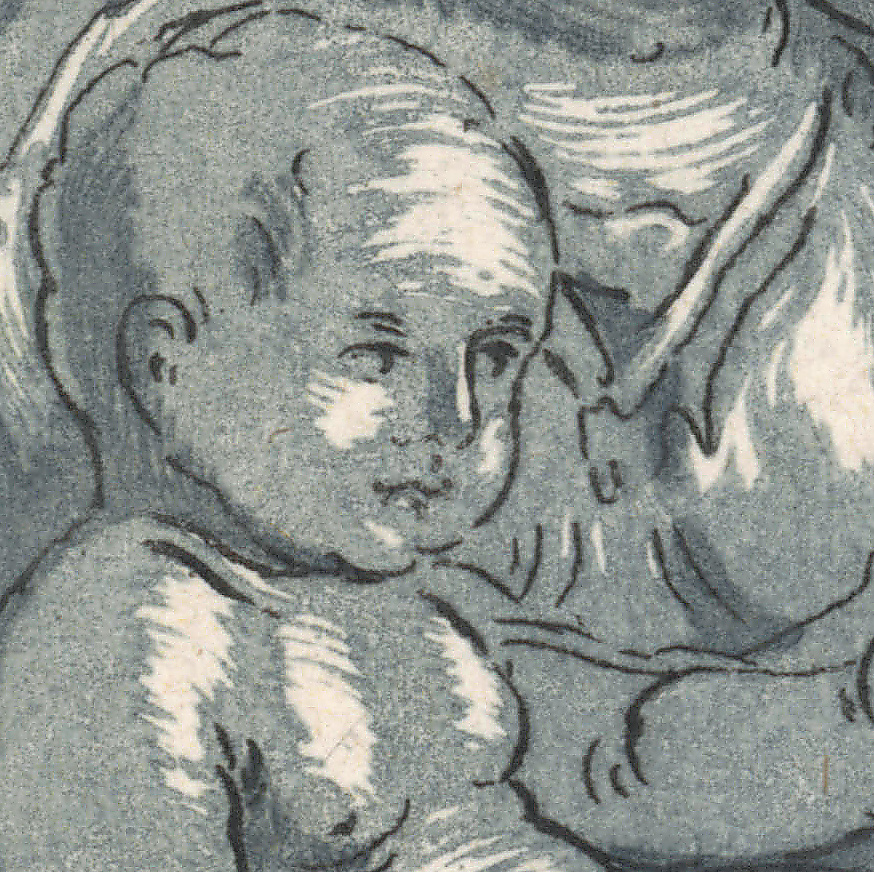
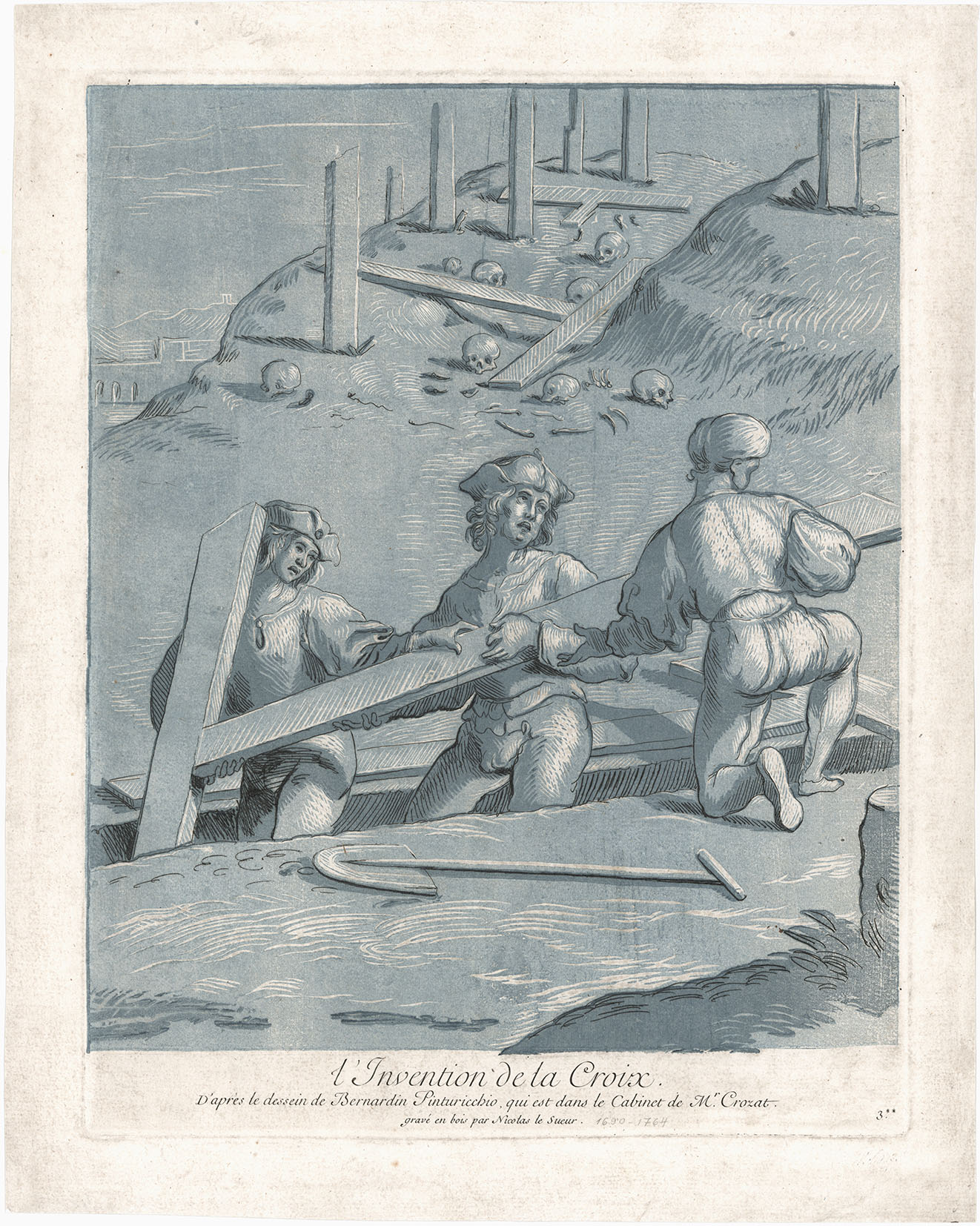
Comte de Caylus & Nicolas Le Sueur’s “Discovery of the True Cross”, c1729/64, after Bernardino Pintoricchio

Anne Claude Philippe Comte de Caylus (1692–1765) (etching component) in collaboration with Nicolas Le Sueur (1690–1764) (aquatint component)

“Discovery of the True Cross” (aka “l'Invention de la Croix”; “Discovery of the True Cross by St Helena”), c1729/64, plate 3 from the series, “Recueil d'estampes d'après les plus beaux tableaux et d'après les plus beaux desseins qui sont en France” (Collection of prints from the most beautiful paintings and from the most beautiful designs that are in France) (aka “Recueil Crozat”; “Cabinet Crozat”), after a drawing by Bernardino Betti Biagi Pintoricchio (aka Bernardino Betti Biagi Pinturicchio) (c1454–1513), published by François Basan (1723–1797) in 1764.

Etching and aquatint with tone woodblock imitating a chiaroscuro woodcut, printed in two shades of blue with black on heavy laid paper with wide margins.

Size: (sheet) 46.8 x 37.2 cm; (plate) 41 x 32 cm; (image borderline) 34.4 x 31.3 cm.

Regarding the publication of the series, “Recueil Crozat”, the Curator of the British Museum offers the following insights: “… a series of plates commissioned by Crozat [Pierre Crozat (1665–1740)] … reproducing famous paintings and drawings of the era; 140 plates were published in 1729. A second volume formed by 42 prints (instead of the 110 plates initially planned) was issued in 1740.

After Crozat's death, the plates were sold to a company of booksellers who commissioned Mariette to reorganize the 'Recueil'; Mariette divided the plates into two volumes, added some missing descriptions, and advertised the set to the public in 1742.

In 1764, Basan [François Basan (1723–1797)] bought the plates and the text, and republished the 'Recueil', but replaced the woodcuts by intaglio prints. … where an attempt to imitate the effect of a chiaroscuro woodcut is made by using aquatint instead …” (https://www.britishmuseum.org/collection/object/P_1907-1121-14).

Lettered in plate below the image borderline: (centre) “l'Invention de la Croix./ 'D'après le dessein de Bernardin Pinturicchio, qui est dans le Cabinet de Mr. Crozat/ gravé en bois par Nicolas le Sueur”; (right) “3.**”

The British Museum offers the following description of this print: “The invention of the Cross, or the discovery of the True Cross by St Helena, after a drawing attributed on plate to Pinturicchio: three men lifting a cross; two are standing in a trench, the third one is kneeling on the edge at right. c.1729/64/ Aquatint imitating a chiaroscuro woodcut, printed in two shades of brown, on etched lines (https://www.britishmuseum.org/collection/object/P_1855-0609-82).

See also the description of this print offered by the Metropolitan Museum of Art: https://www.metmuseum.org/art/collection/search/698050.

Condition: a strong and well-printed impression in excellent condition with no tears, holes, folds, losses, abrasions, significant stains or foxing.

I am selling this curiosity of an intaglio print (viz. etching with aquatint) that is skilfully crafted to imitate a chiaroscuro woodcut (i.e., a woodcut involving more than one tone of a colour) for AU$296 (currently US$191.90/EUR199.54/GBP177.81 at the time of posting this print) including postage and handling to anywhere in the world (but not, of course, any import duties/taxes imposed by some countries).

If you are interested in purchasing this technically important print showcasing a somewhat deceptive practice of the 1700s, please contact me (oz_jim@printsandprinciples.com) and I will send you a PayPal invoice to make the payment easy (but not, of course, any import duties/taxes imposed by some countries).

This print has been sold