Showing posts with label Mantegna (Andrea). Show all posts

Thursday, 25 December 2025

Lambert Suavius, “St Philip”, c. 1545

Lambert Suavius (also known as Lambert Zutman, Lambert Zoetman, and Lambert Le Doux) (circa 1510–1567)
“St Philip” (aka “Apostle Philip”), circa 1545

Technical Details & Condition:
Engraving on fine laid paper, trimmed with a narrow margin around the plate mark and backed by a sheet of archival-quality washi paper for support, and to provide wide margins. This engraving is Plate 8 from the series of 14 plates, “Christ, the Apostles and St Paul.”

The Curator of the British Museum offers the following insights regarding the series in which this print features: “… from a series of fourteen plates showing Christ and the apostles and St Paul (Hollstein 9-22). Twelve of these plates are numbered 1–12; the plates with St Matthias and St Thomas are not” (https://www.britishmuseum.org/collection/object/P_1873-0712-80).

The impression is strong and well-printed (near faultless). Aside from a replenished worm-hole, the sheet is in excellent condition—free from tears, folds, abrasions, or stains.

Dimensions:

  • Sheet: 20.2 x 9.5 cm
  • Plate mark: 20 x 9.3 cm

Plate Lettering:

  • Lower left: “SVAVIVS INVE”—abbreviation of “Sauvius invenit” (Suavius designed it)
  • Lower right: “8”

References:

Price & Shipping:

AU$304 (approximately US$204 / €173.01 / £151), including worldwide express shipping.
Import duties and taxes are the buyer’s responsibility.

If you are interested in acquiring this marvellous engraving—an artwork that, in my view, echoes the tradition of Andrea Mantegna (1431–1506) through its low-horizon monumentality and classical references, as well as drawing from Giulio Campagnola (1482–1515) in its use of stippling to render light and shade—please contact me at oz_jim@printsandprinciples.com. I am happy to send a PayPal invoice to ensure your purchase is straightforward and secure.

This print has been sold


Sunday, 7 July 2024

Lambert Suavius’ engraving, “St Peter”, 1545–48

Lambert Suavius (aka Lambert Zutman; Lambert Zoetman; Lambert Le Doux) (c1510–1567)

“St Peter”, 1545–48, plate 11 from the series of fourteen plates showing Christ, the Apostles and St Paul, “Christ and the Apostles” (Hollstein 9–22).

Engraving on laid paper, trimmed around the image borderline with significant restoration of the lower right corner and backed with a support sheet providing wide margins.

Size: (sheet) 20 x 9.3 cm.

Lettered in in plate: (lower left corner) ”SVAVIVS/ II NIVEN".

Hollstein 10 (Dieuwke de Hoop Scheffer & George S. Keyes [comp.] 1984, “Dutch and Flemish Etchings, Engravings and Woodcuts ca.1450–1700: Louis Spirinx to M. Suys”, vol. 28, Blaricum, Van Gendt, p. 169, cat.no. 10).

The British Museum offers the following description of this print: “Plate 11: St Peter; The saint, whole-length to right in profile, perched on a block and holding a book; behind him is a key and at the right is a headless statue on a plinth and a ruined fragment of an arch/ Engraving” (https://www.britishmuseum.org/collection/object/P_1925-1117-23).

See also the description of this print offered by the Rijksmuseum: http://hdl.handle.net/10934/RM0001.COLLECT.181149.

There are several things that I find fascinating about this print. The first is that Suavius has introduced the use of stippling along with hatching to render light and shade. This is interesting for me as stippling had been used for the first time only a few years earlier by Giulio Campagnola. The second thing that I find worthy of pondering is the setting for the saint in a classical ruin. Although this may seem to be a minor concern, if one considers that Suavius’ brother-in-law and teacher was Lambert Lombard and Lombard adhered to the view that “it was better to imitate a single statue than all the work of the moderns” (see Stephen J Campbell & Jeremie Koering [eds.] 2016, “Andrea Mantegna: Making Art”,  John Wiley & Sons, p. 158)—here we are talking about Renaissance era “moderns”—then the antique setting and the artist’s approach to treating the saint as if he were a monumental sculpture has some meaningful resonance.

Condition: a strong and well-printed impression but with significant restoration of the lower right corner, trimmed around the image borderline and laid upon a support sheet of archival (millennium quality) washi paper providing wide margins.

I am selling this marvellous engraving that (to my eye) follows in the tradition of Andrea Mantegna (1431–1506)—in terms low-horizon monumentality and referencing the antique—and certainly shows significant borrowings from Giulio Campagnola (1482–1515)—viz. the use of stippling to render light and shade—for the total cost of AU$298 (currently/approximately US$201.03/EUR185.71/GBP156.95 at the time of posting this listing) including Express Mail (EMS) postage and handling to anywhere in the world, but not (of course) any import duties/taxes imposed by some countries. Note that payment is in Australian dollars (AU$298) as this is my currency.

If you are interested in purchasing this marvellously strong and curious image of St Peter—note St Peter’s key to heaven resting near his backside—please contact me (oz_jim@printsandprinciples.com) and I will send you a PayPal invoice to make the payment easy.

This print has been sold


Thursday, 28 July 2022

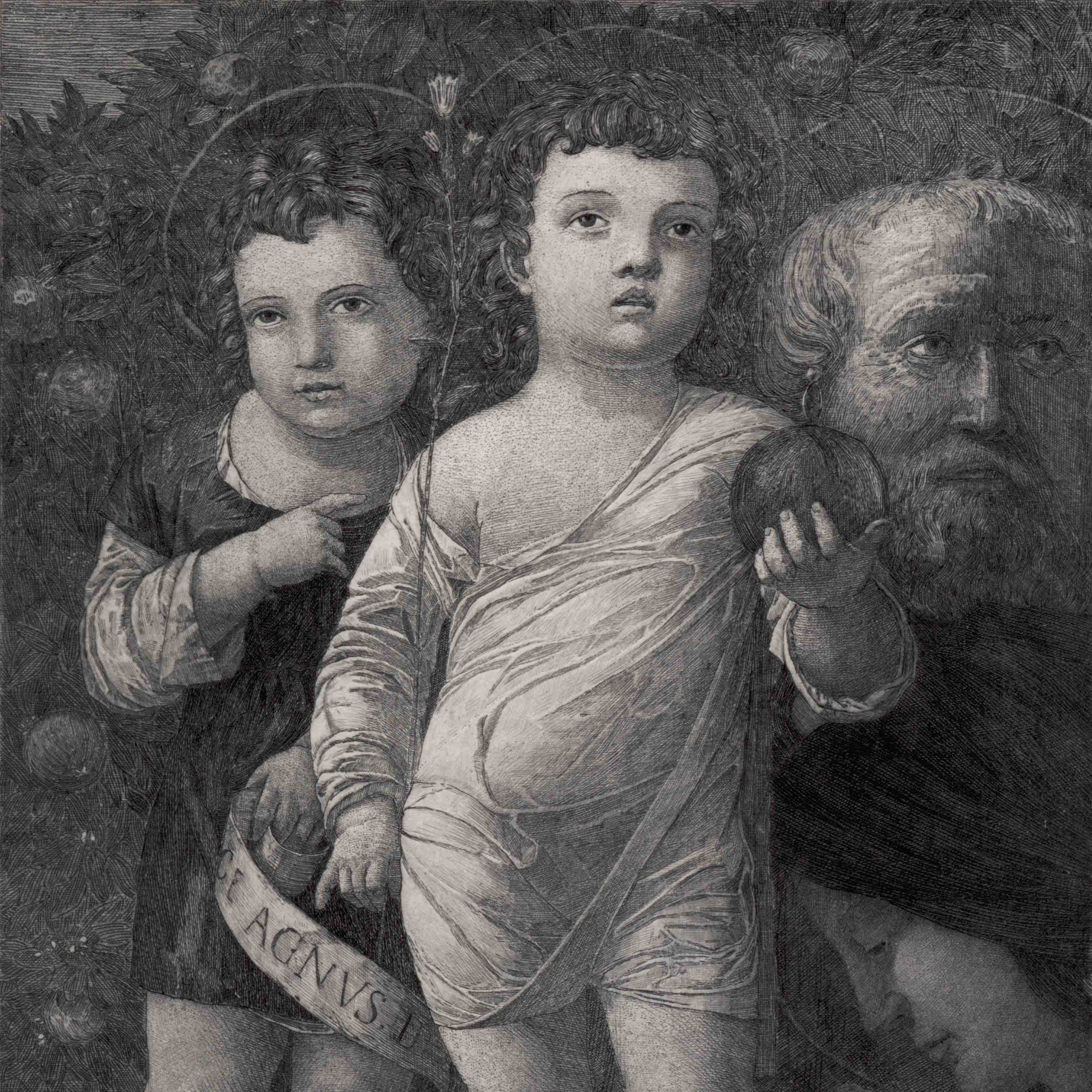
Antoine Valérie Bertrand’s etching, “Sainte Famille”, 1893, after Andrea Mantegna


A Bertrand (possibly Antoine Valérie Bertrand [1823–c1908])

“Sainte Famille”, 1893, after Andrea Mantegna’s (c1431–1506) painting, “The Holy Family with Saint John the Baptist”, c1500, in the National Gallery, London (inv. no. NG5641) (see https://www.nationalgallery.org.uk/paintings/andrea-mantegna-the-holy-family-with-saint-john-the-baptist), printed by Eudes & Chassepot (fl. c1891–1895) and published in Paris as an illustration to the periodical, “Gazette des Beaux-Arts”, 1893, vol. 9, opposite p. 226.

Etching on wove paper backed with a support sheet.

Size: (support sheet) 41.3 x 32 cm; (sheet) 27.2 x 18 cm; (image borderline) 18 x 12.8 cm.

Lettered in plate below the image borderline: (left) “Mantegna pinx./Gazette des Beaux-Arts.”; (centre) “SAINTE FAMILLE/ Collection de M. Louis Mond.”; (right) A. Bertrand, sculp./ Eudes & Chassepot. Imp.”

Condition: a strong and well-printed impression with small margins and laid upon a sheet of millennium quality washi paper providing wide margins. Beyond glue marks from the original binding, the sheet is in an excellent condition with no tears, holes, folds, abrasions or significant stains.

I am selling this sensitive translation of Mantegna’s painting into etched lines and dots for AU$190 (currently US$133.03/ EUR130.36/GBP109.17 at the time of posting this listing) including postage and handling to anywhere in the world, but not (of course) any import duties/taxes imposed by some countries.

If you are interested in purchasing beautiful and very fine etching—interesting to note that Bertrand has not attempted to adopt the famous “return stroke” employed by Mantegna in his prints (see https://www.printsandprinciples.com/2017/06/photogravure-of-engraving-by.html) —please contact me (oz_jim@printsandprinciples.com) and I will send you a PayPal invoice to make the payment easy.


Friday, 2 June 2017

Photogravure of an engraving by an unidentified artist after Mantegna’s, “Roman Soldiers Carrying Trophies”, 1495


Unidentified engraver (School of Mantegna) (attributed to Andrea Zoan [fl.1475–1519])
“Roman Soldiers Carrying Trophies”, 1495, PHOTOGRAVURE copy in reverse after Andrea Mantegna (c.1431–1506), but with a pilaster added at the right.
Regarding the copy of this print held by British Museum, the BM’s curator offers the following information:
“A good impression of Hind's second copy. This print was issued as a black and white facsimile by the British Museum in 'Prints and Drawings in the British Museum, Reproduced by Photographic Process', [First Series] Part I (Italian Prints), Published by the Trustees in 1882, where it was number XXII and described there as 'Andrea Mantegna. Soldiers Bearing Trophies, 1431-1506.'; (Shelfmark 245*.b.12).” (http://www.britishmuseum.org/research/collection_online/collection_object_details.aspx?objectId=1343986&partId=1&searchText=mantegna+triumph&page=1)

Photogravure on buff coloured laid paper.
Size: (sheet) 29.4 x 32.9 cm

TIB 25 (13).14 (236) (Walter L Strauss & Mark Zucker [Eds.] 1980, “The Illustrated Bartsch”, vol. 25, p. 47); Hind 1938-48 15.b (Arthur Mayger Hind 1938, “Early Italian Engraving, a critical catalogue”, 7 vols, London); Bartsch XIII.236.14 (Adam Bartsch 1803, “Le Peintre graveur”, 21 vols, Vienna)

Condition: PHOTOGRAVURE in very good condition. There is a light centrefold and a thin spot in the centre (verso) that has a patch of tape supporting it.

I am selling this photogravure of Mantegna famous engraving translated in reverse by an unidentified artist from the School of Mantegna for the total cost of AU$170 including postage and handling to anywhere in the world.

If you are interested in purchasing this photogravure as described by the British Museum (see above), please contact me (oz_jim@printsandprinciples.com) and I will send you a PayPal invoice to make the payment easy.


There is a secret lying behind many of the engravings by Mantegna: his use of a return stroke (i.e. a stroke where the drawing instrument isn’t lifted from the end of a quickly laid line and leaves a trace of the artist’s movement in returning to the beginning of the next line). Unlike a pencil or ink drawing, however, engravings are made with a sharp pointed instrument—the burin—designed to make a scored mark into the metal printing plate. Using a burin limits an artist’s freedom to make “natural” return strokes and this is the secret of Magenta: he faked the “look” of return strokes. Magenta was not the first to fake such marks as this honour goes to Antonio del Pollaiuolo (1431–98) who surprisingly seems to have only made a single engraving … but what a masterpiece it is: “Battle of the Nudes”, c.1470 (see a wonderful article on this print by the Cleveland Museum of Art: http://www.clevelandart.org/exhibcef/battle/html/4286621.html).

Interestingly, Francesco Rosselli (c.1445–c.1513) went a step further in the use of fake return strokes in the sense that he retains the “hooks” of the return line (i.e. the twist at the start and conclusion of each return-stroke) without showing a fully inscribed zigzag of return stroke lines. For those interested in this topic, see my discussion: http://www.printsandprinciples.com/2012/08/rembrandt-courtry-chauvel-passion-in.html