Showing posts with label Henriet (Israël). Show all posts

Tuesday, 6 January 2026

Stefano della Bella, “Entrance to a Fortress”, c. 1645 (2nd copy)

Stefano della Bella (1610–1664)
“Entrance to a Fortress”, circa 1645 (1642–1647)

Technical Details & Condition:

Etching on fine laid paper, trimmed with a narrow margin around the platemark and backed with a support sheet. This work is plate 2 from the series of twelve plates (including the title plate), titled “Dessins de quelques conduits de troupes” (“Troops, Weapons and Attacks”) (see De Vesme/Massar pp. 246–257). Published by Israël Henriet (c. 1590–1661) in Paris with the privilege of the French Crown, and dedicated (as inscribed on the title plate) to Henri Roger du Plessis-Liancourt (1620–1646). His coat-of-arms is depicted on the arcade wall at the right side of the print.

This impression is a richly inked and nearly faultless lifetime impression from the first state (out of three), prior to the erasure of the artist’s name inscribed on the arcade wall in the second state. The sheet’s margins show minor surface marks; otherwise, it is in excellent condition—free from tears, holes, folds, abrasions, or significant stains.

Please note that this is the second impression of this print I have listed. The previous copy, a second state impression, is still available and can be viewed here: https://www.printsandprinciples.com/2023/03/stefano-della-bellas-etching-entrance.html.

Dimensions:

• Sheet: 6.7 x 13.3 cm
• Platemark: 6.4 x 12.7 cm
• Image borderline: 5.8 x 12.4 cm

Plate Lettering:

• Inscribed on the arcade wall with the artist’s name: “Stefanus Della Bella f.”
• Numbered and lettered below the image border: (left) “2”; (right) “Israel ex. SDBella f.”

References:

• De Vesme/Massar 247 (Alexandre de Vesme & Phyllis D. Massar, “Stefano della Bella. Catalogue Raisonné”, 1971, New York, Collectors Editions, p. 84, cat. no. 247; illustrated p. 65, cat. no. 247)
• Jombert (Della Bella) 92 (Charles Antoine Jombert, 1772, “Essai d'un catalogue de l'oeuvre d'Etienne de la Belle, peintre et graveur florentin”, Paris, p. 101, cat. no. 92)
• The Rijksmuseum describes this print: https://id.rijksmuseum.nl/200449937
• The British Museum describes this print: https://www.britishmuseum.org/collection/object/P_1868-0612-1453

Price & Shipping:

AU$271 (approximately US$183.29 / €156.68 / £135.69), including worldwide express shipping. Import duties and taxes are the buyer’s responsibility.

If you are interested in acquiring this intriguing glimpse into a quiet moment at a guardhouse in the mid-1600s, created by one of the most renowned old master printmakers, please contact me at oz_jim@printsandprinciples.com. I will gladly send a PayPal invoice to facilitate a smooth and secure transaction.

This print has been sold 


Sunday, 21 December 2025

Circle of Jacques Callot, “Crossing of the Red Sea”, c. 1630, after Callot

Unidentified printmaker from the circle of Jacques Callot (1592–1635)
“Crossing of the Red Sea” (also known as “Le Passage de la Mer Rouge”), circa 1630

Technical Details & Condition:

This etching is executed on fine handmade paper with reasonably wide margins (2–3 cm). It is a copy after Jacques Callot’s etching of the same design and in the same direction (Lieure 665 copy 3), published in Rome by Israël Henriet (c.1590–1661). The scene depicts Moses and Aaron in the foreground, with the Israelites further back, carrying the Ark of the Covenant through a passage in the Red Sea, which is seen engulfing Pharaoh’s army in the distance. The impression is well-printed, and the sheet is in excellent condition, free from tears or stains. On the reverse, there is a faint blind stamp and pencil notations from a previous collector.

Dimensions:

  • Sheet: 18 x 27.2 cm
  • Plate mark: 12.7 x 23.2 cm
  • Image borderline: 11.4 x 22.8 cm

Plate Lettering:

  • Within the lower right image borderline: “Callot. in.”
  • Lower centre: “Tabulam Hanc Æream Proprio et Exquisito Marte Incisam Iacobus Calottus Nobilis Lotharingus Dono Dedit Israeli Henrichetto Opus / Perfectissimum Amicorum Optimo et Sincerissimo.” (Latin dedication praising Callot’s skill and gifting the print as a “most perfect work” to his dear friend, Israel Henrichetto. Translated: “This copper plate, engraved by his own excellent skill, Jacobus Callottus, Nobleman of Lorraine, presented as a gift to Israel Henrichetto, most perfect work, to his best and sincerest friend.”)
  • Lower left: “Romæ ex Chalcographia R.C.A. apud Pedem Marmorcum”—meaning “From the Chalcography of the R.C.A. [Reverenda Camera Apostolica] in Rome, at the Marble Foot [a location near a landmark marble fragment in Rome].”

References:

  • Lieure 665, copy 3 (Jules Lieure, Jacques Callot: Catalogue Raisonné de l’Œuvre Gravé, 1989, San Francisco, Alan Wofsy, vol. 1, p. 26, cat. no. 665, copy 3).
  • Meaume 1, copy (Édouard Heaume, Recherches sur la vie et les ouvrages de Jacques Callot: suite au peintre-graveur français de M. Robert-Dumesnil, 1860, vol. 1, Paris, J. Renouard, p. 41 [see https://archive.org/details/gri_33125001461884/page/n203/mode/2up])

Please note: the original etching by Jacques Callot is still available and can be viewed here: https://www.printsandprinciples.com/2019/12/jacques-callots-etching-crossing-of-red.html

Price & Shipping:

AU$271 (approximately US$179.24 / €153 / £133.97), including worldwide express shipping. Import duties and taxes are the buyer’s responsibility.

If you are interested in acquiring this remarkable Baroque etching—despite its small size, it captures a vast biblical narrative—please contact me at oz_jim@printsandprinciples.com. I am happy to provide a secure PayPal invoice for a seamless purchase.


Wednesday, 27 March 2024

Jacques Callot, “Le Jeudy Saint”, c.1632/35

Jacques Callot (1592–1635)

“The Last Supper” (aka “Le Jeudy Saint”; “Maundy Thursday”; “Holy Thursday”), c.1632/35, Plate 2 from the series of twelve compositions featuring the variable feast days from the Christian calendar, “Images des Fêtes Mobiles”, published in Paris in 1636 (a year after the death of Callot) by Israël Henriet (c.1590–1661). This impression is the final state of the remarkable evolution of this plate.

I understand that in states i and ii this print was a part of a larger plate consisting of four images in a series of 124 plates with a total of 490 images. In state iii the large plate featuring four images including this one was cut into four small plates. This plate was then grouped as a part of a series of twelve small plates with this print being numbered as second plate/image. By design, the twelve prints represent the variable feast days/holidays in the Christian calendar. Regarding this series, Jules Lieure (1989) advises: (transl.) “The images of the mobile festivals are original etchings, absolutely of the same type as the previous ones, to which they follow. ... the 12 images were... printed separately with a title of the same size engraved for this purpose by Abraham Bosse” (p. 57).

Etching on laid paper trimmed with a narrow margin around the platemark and backed with a support sheet.

Size: (sheet) 10 x 5.7 cm; (platemark) 9.7 x 5.3 cm; (outer image borderline) 9.3 x 5 cm.

Inscribed in plate below the image: (lower left) “J. Callot Inv: et Fec.”; (centre) “Le Jeudy Saint./ Desideriô desider ani hoc Pascha/ manducare vobis cum ante quam pas/ tiar Luc. XXII.15./ J’Ay souhaité avec ardeur de man-/ ger cette Pasque avec vous avant/ que de souffrir.”; (lower right) “2.”

State vi (of vi) with additional work (compare with state v shown by Polona: https://polona2.pl/item/le-jeudy-saint,ODY4NTAzNA/).

Lieure 1285 (Jules Lieure 1927 [revised 1989], “Jacques Callot: Catalogue Raisonné de l’Œuvre Gravé”, vol. 1 [text], San Francisco, Alan Wofsy Fine Arts, pp. 57–59, cat. no. 1285).

Condition: a strong impression still retaining the guidelines for the inscription before they were worn away. Beyond a few minor marks, the sheet is in a very good condition with no tears, holes, folds, abrasions or significant stains and is laid onto a sheet of archival (millennium quality) washi paper providing wide margins.

I am selling this seldom seen final state impression of a plate that has a remarkable history in its evolution, for the total cost of AU$209 (currently US$136.40/EUR125.99/GBP108.03 at the time of this listing) including postage and handling to anywhere in the world, but not (of course) any import duties/taxes imposed by some countries.

If you are interested in purchasing this very small etching by one of the major old master printmakers—mindful that Callot developed the échoppe as an etching-needle enabling artists to make swelling lines in etchings similar to those made by engravers—please contact me (oz_jim@printsandprinciples.com) and I will send you a PayPal invoice to make the payment easy.

This print has been sold


Saturday, 8 April 2023

Jacques Callot’s etching, “Frontispiece ‘Gloriosissimæ’”, c1625


Sometimes when looking at the collectors’ stamps on the back of prints one’s mind takes a metaphorical leap back in time to enter into the mindset and experiences of a print’s previous owners. In the case of today’s etching—the frontispiece to “Gloriosisimæ Virginis Dei Paræ Elogivm” (Praise the Most Glorious Virgin of God) by one of the most famous of all printmakers, Jacques Callot—this tiny print was once owned by a Hungarian nobleman with the name, Görgey, as the back show his estate-stamp featuring his family’s coat-of-arms with the words below: “GÖRGEY/ HAGYATEK [i.e., his estate]”. Certainly, this is undoubtedly the stamp signifying nobility as the “y” on the end of the name signifies this even beyond the arms shown above it. Perhaps even more interestingly, however, is that the “y” at the end of the name clarifies that the stamp was placed on this print before the Hungarian revolution of 1848–49, as this date is when those of noble birth were prudent to change the last letter of their name from “y” to “i”, hence this collector's stamp is earlier than 1848. Although I do not have a strong grip on possible collectors of Hungarian noble descent, I would like to believe (and I may well be very wrong) that the stamp belongs to one of the greatest generals of the Hungarian Revolutionary Army, Artúr Görgei or Artúr Görgey (1818–1916)—the latter being his name at birth.

The reason I mention all this detail is because my head is at the moment reeling from the knowledge that next week I’ll be walking in the streets of Budapest where this general earned his fame. In short, I’m going back to the hometown of where this print rested for some of its life … wacko! See you in another week, Budapest!

Also on the back of this print is the delicately fine collector’s stamp of the Austrian writer, Count Franz Jozef von Enzenberg (1802–1879) (Lugt 845). From reading the account about this collector in Frits Lugt’s (2002) “Les Marques de Collections de Dessins & d’Estampes” (p. 151) I understand that this collector amassed pieces of what Lugt describes (in transl.) as “the greatest rarity” and owned the Castle of Tratzberg in Tirol. He must have been a very focused and interesting chap and I'm honoured to be briefly in his head!


Jacques Callot (1592–1635)

“Frontispiece ‘Gloriosissimæ’” (Lieure title) (aka “Frontispiece ‘Gloriosisimæ Virginis Dei Paræ Elogivm’” [Praise the Most Glorious Virgin of God]), c1625 (BM: 1621–1633), published by Israël Henriet (c1590–1661) with Royal privilege and designed for a publication written by Alphonse de Rambervillers (1552–1633) (as inscribed in plate), with a dedication to Henri de Bourbon, Duc de Verneuil (1601–1682).

The Curator of the British Museum advises: “The production and publication line [were] probably added by Henriet after Callot's death” (https://www.britishmuseum.org/collection/object/P_1861-0713-165).

Etching on fine laid paper, trimmed close to the image borderline. Stamped verso with the collector marks of Count Franz Jozef von Enzenberg (1802–1879) (Lugt 845) and the estate stamp of the Hungarian Nobleman, “[coat-of-arms]/ GÖRGEY/ HAGYATEK”—possibly Artúr Görgei/Görgey (1818–1916).

Size: (sheet) 9.8 x 7.2 cm.

Lettered in plate: (oval) “GLORIOSISIMÆ/ VIRGINIS DEI PARÆ ELOGIVM/ Omnia lœtitiœ, doloris, & gloriœ mis-/ teria artificiola breuitate complectes./ …/ Ad Illustrissimum & / Reuerendissimum Principem, Henricvm/ BORBONIVM, Episcopum Metensem,/ Sac. Rom. Imp. P. etc./ Al. de Ramb. IC ’cecinit./ Callot fecit. Israël ex. cum/ priuil. Reg.”; each one of the small oval scenes is captioned and numbered.

State iii (of iii) with the addition of the text lines “Callot fecit. Israël ex. cum/ priuil. Reg.”

Lieure 512 iii (Jules Lieure 1989, “Jacques Callot: Catalogue Raisonné de l’Œuvre Gravé, San Francisco, Alan Wofsy Fine Arts, pp. 47–48, cat. no. 509 3e); Meaume 90.

The British Museum offers the following description of this print: “Large oval cartouche with engraved inscription, surrounded by six putti and five oval medallions illustrated with scenes from the life of the Virgin: anti-clockwise, birth of Christ. Virgin and St Joseph worshipping Christ Child, Christ on Cross, Christ appearing to Virgin, and triumph of Virgin; with production and publication detail. 1621/33 Etching” (https://www.britishmuseum.org/collection/object/P_X-4-36).

Condition: a richly inked and well-printed (near faultless) impressions with no tears, holes, abrasions, significant stains or foxing. Verso has ink stamps of two collectors and remnants of previous mounting along with pencil and ink notations by previous collectors.

I am selling this superb impression of a small and rare etching for AU$322 in total (currently US$214.81/EUR196.94/GBP172.97 at the time of posting this listing) including postage and handling to anywhere in the world, but not (of course) any import duties/taxes imposed by some countries.

If you are interested in purchasing this tiny frontispiece by one of the major old master printmakers, please contact me (oz_jim@printsandprinciples.com) and I will send you a PayPal invoice to make the payment easy.

This print has been sold


Monday, 6 March 2023

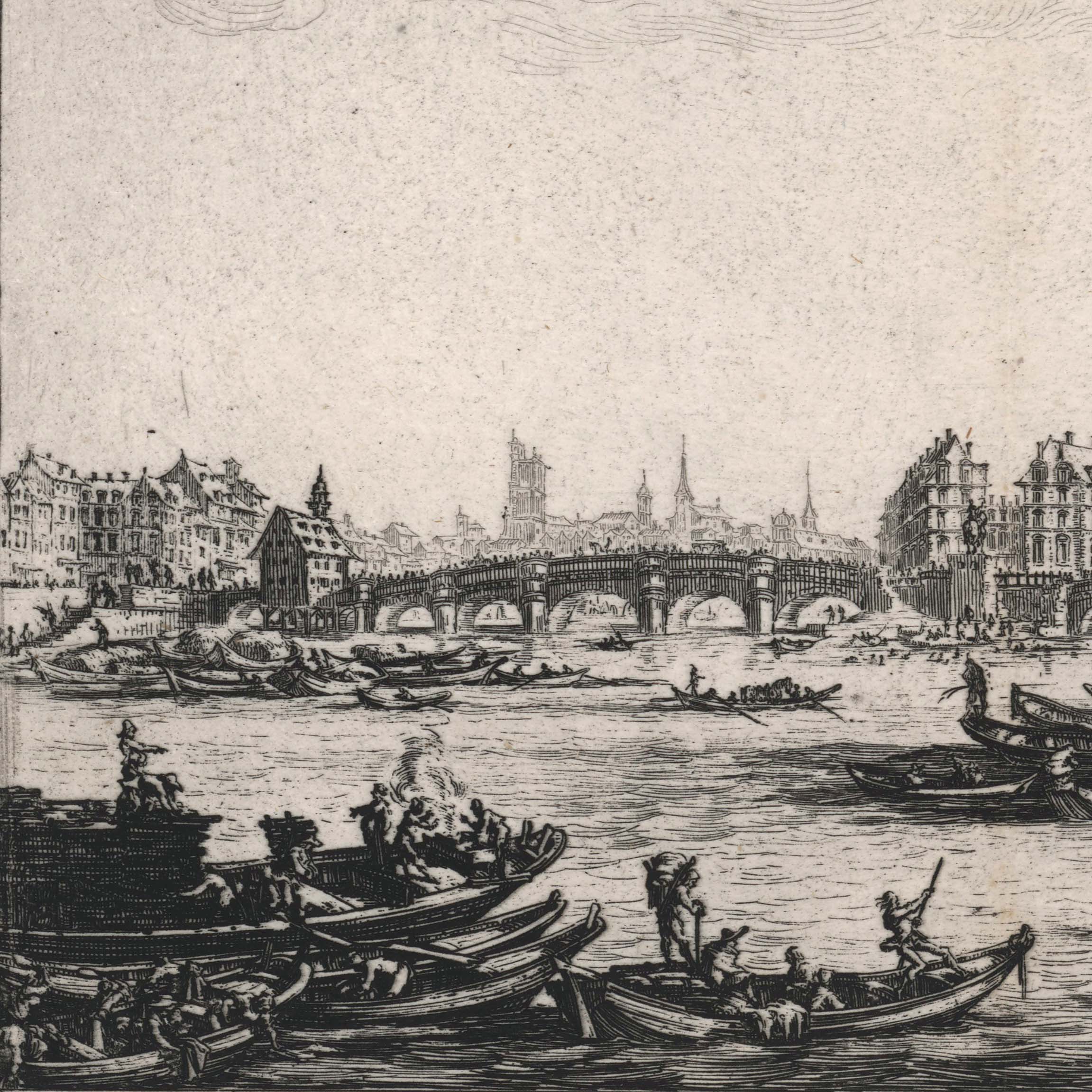
Jacques Callot’s etching “View of the Pont-Neuf”, c1630 and copy


Jacques Callot (1592–1635)

(upper) “View of the Pont-Neuf”, c1630, etching with plate tone on laid paper with margins and (flattened) folds as published. Size: (sheet) 25.1 x 38.8 cm; (plate) 16.2 x 33.8 cm; (image borderline) 15.8 x 33.4 cm. Inscribed in plate within the image borderline: (lower right) “Callot fec.” State v (of v) with the vertical scratch below the hanging bucket. This impression was printed from the original plate and published in Philip Gilbert Hamerton’s “Etching and Etchers”, 1868.

(lower) copy by an unidentified etcher, View of the Pont-Neuf with the Tour de Nesle”, c1630, after Jacques Callot, published by Israël Henriet (c1590–1661) (as inscribed in plate; see Jules Lieure [1989] copy no. 5, [text vol.] p. 28). Etching on laid paper, trimmed with a small margin around the image borderline (and writing edge) and backed with a support sheet. Size: (sheet) 17.3 x 34 cm; (image borderline) 15.6 x 33 cm. Inscribed in plate below the image borderline: (left) “Jac Callot sculp 1629.”; (centre) “Vue du Pont-neuf, avec la Tour de Nesle.”; (right) “Israel exc. Parisijs”.

The British Museum holds the original chalk drawing upon which this print is based (see https://www.britishmuseum.org/collection/object/P_1861-0713-2) and offers the following description of this print: “A view of Paris, with water joust taking place on a river at the bottom of a high tower (tour de Nesle) standing at centre in the foreground; bridge (Pont-Neuf) in the background, at left. c.1630 Etching” (https://www.britishmuseum.org/collection/object/P_1861-0713-956).

The Curator of the British Museum offers the following insights regarding this print: “The present plate was made after a drawing probably executed during the artist's stay in Paris in 1629, and representing the annual water joust that was taking place on the Seine every 25 August” (https://www.britishmuseum.org/collection/object/P_1861-0713-955).

Condition: both prints are excellent impressions with no tears, holes, abrasions, significant stains or foxing. The lower etching is trimmed with a narrow margin around the image borderline and writing edge and is laid onto a support sheet of archival (millennium quality) washi paper.

I am selling this pair of etchings showing the second of Callot’s large views of Paris offering an interesting comparison between Callot’s original print and a very fine—perhaps even deceptive—copy published by Callot’s friend, Israël Henriet (as inscribed on the plate) for AU$468 in total for the pair (currently US$314.14/EUR293.85/GBP260.85 at the time of posting this listing) including postage and handling to anywhere in the world, but not (of course) any import duties/taxes imposed by some countries.

If you are interested in purchasing this marvellous pair of etchings, please contact me (oz_jim@printsandprinciples.com) and I will send you a PayPal invoice to make the payment easy.

This pair of prints has been sold