Showing posts with label Hondius (Hendrick). Show all posts

Wednesday, 5 August 2026

Hendrik Hondius I, “Composita. s. Tactus”, c. 1607, after Paul Vredeman de Vries

Hendrik Hondius I (1573–1650)

“Composita. s. Tactus” (also known as “Portal of a Building with Composite Columns and the Sense of Touch”), circa 1606/7

Technical Details & Condition:

Etching with engraving on fine laid paper, with full margins as issued upon publication. The impression is strong, crisp, and evenly printed. The sheet has been professionally stabilised and backed with a support sheet of archival-quality washi paper.

Aside from minor handling marks in the margin (primarily along the lower edge) and a restored abraded area in the upper-right corner of the margin, the sheet remains in good condition for its considerable age.

This work is Plate 5 in the five-part series “The Five Senses,” which is integrated into the larger series of thirty-one plates, “Architectura” (also known as “The Books of Architecture”). This print is inscribed as Plate KK at the lower right.

The composition is based on a design by the Flemish painter and draughtsman Paul Vredeman de Vries (1567–circa 1630). The print was initially published in The Hague in 1606 by Hondius, with a later edition issued in Amsterdam in 1617.

Iconography:

This print allegorically links the physical sensation of touch with the Classical architectural style of the Composite Order. The scene is depicted in dramatic one-point perspective, featuring a grand building’s portal with theatrical poses of two figures embodying the sense of touch.

On the left, a woman recoils as a bird pecks her outstretched finger, illustrating the sensation of sharpness. On the right, a boy winces as a dog bites his leg, signifying pain.

The title inscription explicitly reinforces this dual theme using the Latin word “s.” (an abbreviation for sive, meaning “or” / “namely”), structurally declaring the scene to be either the architectural order or the sensation itself: COMPOSITA. s. TACTVS. (Composite, or Touch). The other four companion prints in this series align the remaining classical architectural styles with the human senses: 

• Tuscan Order with Sight 
Doric Order with Hearing 
• Ionic Order with Smell 
• Corinthian Order with Taste 

Dimensions:

• Sheet: 26.3 x 37 cm
• Platemark: 23.6 x 33.6 cm

Plate Lettering (below the image):

• Left: “Paul de vriese Invent.”
• Centre: “COMPOSITA. 5. TACTVS.”
• Right: “Hh form. Cum priuill. KK”

References:

• Hollstein Dutch 619 (F.W.H. Hollstein, “Dutch and Flemish Etchings, Engravings and Woodcuts ca. 1450–1700,” Vol. IX: Hendriksen–Hoppenbrouwers)
• Hollstein Dutch 161 (Nested under Paul Vredeman de Vries volume entries, Vol. X, p. 91, cat. no. 161 [Les Cinq Rangs de l'Architecture])
• New Hollstein Dutch 606 (Nadine Orenstein, “The New Hollstein: Hendrick Hondius,” entry within the 576–606 series allocation)
• Rijksmuseum: Object Number BI-1897-A-1240-26 —
https://id.rijksmuseum.nl/200614047
• British Museum: Museum Number 1933,0614.132—
https://www.britishmuseum.org/collection/object/P_1933-0614-132

Price & Shipping:

AU$287 (approximately US$202.35 / €175.32 / £150.27—subject to daily currency fluctuations) including worldwide express shipping. Import duties and taxes (if any) are the buyer’s responsibility.

If you’re interested in acquiring this rare allegorical etching, connecting the sense of touch with the principles of classical architecture, please contact me directly at oz_jim@printsandprinciples.com. I will gladly provide a secure PayPal invoice for a smooth, fully protected transaction.

This print has been sold 


Thursday, 27 February 2025

Simon Frisius, “Village in a Mountain Landscape”, 1614, after Matthijs Bril

Simon Frisius (aka Simon Wynhoutsz Frisius; Simon de Vries) (c.1580–1628)

“Village in a Mountain Landscape”, 1614, a lifetime impression from the first state (of three) before numbering (as plate 6?) from the series of twenty-seven plates, “Topographia Variarum Regionum” (Various topographical views), after the design by Matthijs Bril (aka Mattheus Bril; Mattheus Brill; Mattheus Brillo) (c.1550–1583) and (following the description by the Rijksmuseum) Josse van Liere (aka Joos van Lier; Jodocus Lireus) (?–1583), published in The Hague by Hendrik Hondius I (1573–1650).

Etching on fine laid paper trimmed around the image borderline with restorations and backed with a support sheet.

Size: (unevenly trimmed sheet) 10.6 x 15.5 cm; (image borderline) 9.7 x 15.5 cm.

Lettered in plate below the image borderline: (centre) “Mathias bril Inventor Hhondius excudit.”

State i (of iii) before numbering

New Hollstein (Dutch & Flemish) 143.I.

The Rijksmuseum and the British Museum offer descriptions of this print: https://id.rijksmuseum.nl/200193124; https://www.britishmuseum.org/collection/object/P_1947-0319-7-15.

Condition: a strong and well-printed impression unevenly trimmed. The lower right edge has been replenished, otherwise there are with no significant stains. The sheet is laid onto a support of millennium quality washi paper providing wide margins.

I selling this exceptionally rare first state impression of this marvellous jewel of a small etching for AU$322 (equivalent to approximately US$202.80, EUR 193.61, or GBP 160.15 at the time of listing) and includes Express Mail Service (EMS) postage and handling to any worldwide destination. Please note that any import duties or taxes levied by the destination country are the responsibility of the buyer and are not included in the purchase price. Payment is requested in Australian dollars (AU$322).

If you are interested in purchasing this superb and seldom seen old-master print on the art market, please contact me (oz_jim@printsandprinciples.com) and I will send you a PayPal invoice to make the payment easy.

This print has been sold


Monday, 10 April 2023

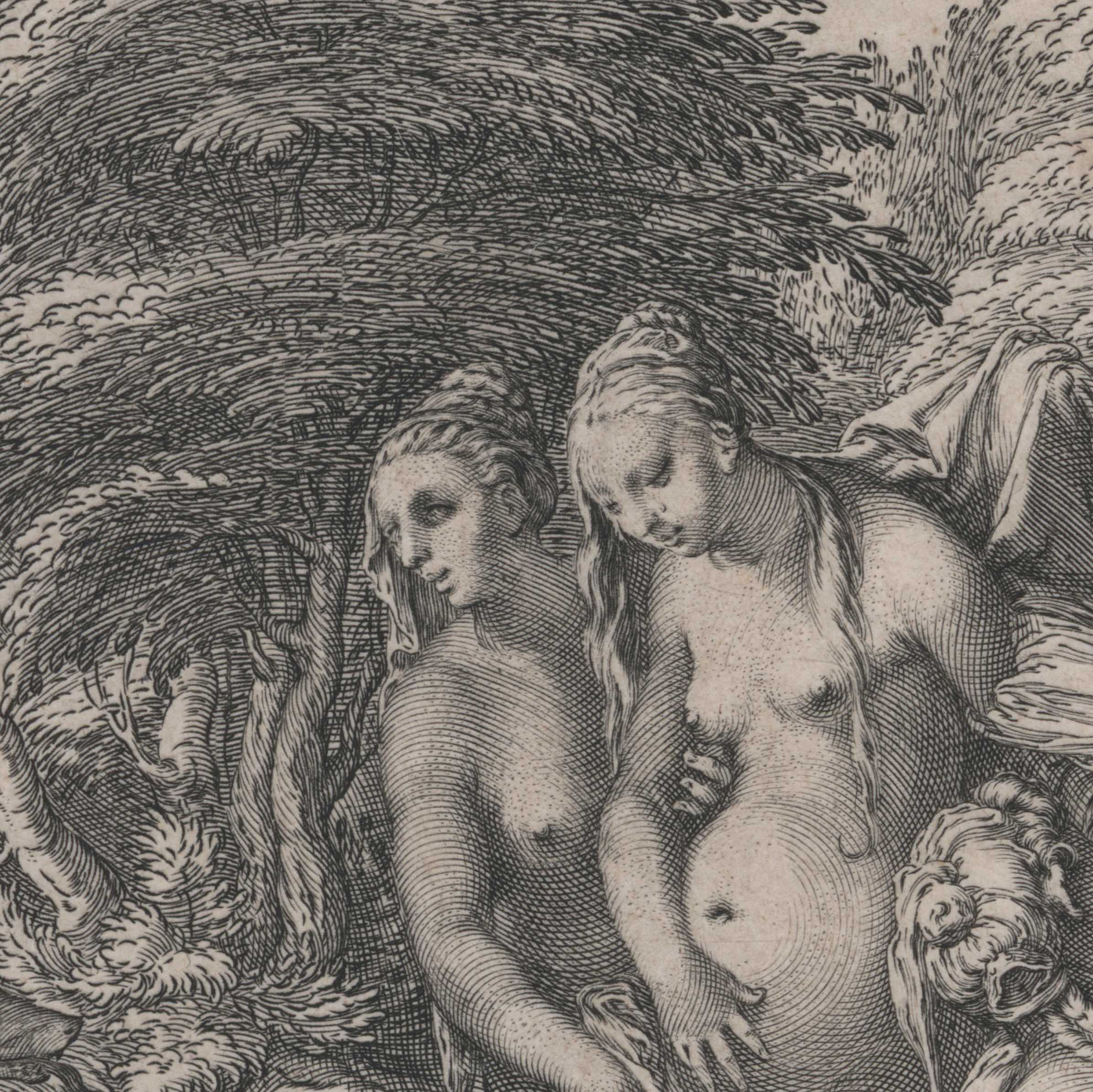
Jan Saenredam’s engraving, “Diana discovers Callisto's pregnancy”, 1599, after Goltzius Jan Saenredam (c1565–1607)

Jan Saenredam (c1565–1607)

“Diana discovers Callisto's pregnancy” (aka “Diana ontdekt de zwangerschap van Callisto” [Rijksmuseum title]); “Diana Ordering Her Nymphs to Strip Callisto Who Tries in Vain to Hide Her Pregnancy” [TIB title]; “Dine ordonnant à ses nymphes de dépouiller Calisto” [Bartsch title]), 1599, after the design of Hendrik Goltzius (aka Hendrick Goltzius) (1558–1617), with Imperial Privilege from Rudolf II van Habsburg (1552–1612) and two lines of Latin lettered below the image by Cornelis Schonaeus (1541–1611). This is a first state, lifetime impression before the addition of the publication details for Hendrick Hondius I (1573–1650) (state ii) and the details for Claes Jansz. Visscher II (1587–1652) (state iii).

Engraving on laid paper trimmed close to the image borderline on the top and sides and with the writing edge below, backed with a support sheet.

Size: (sheet) 21.7 x 30.3 cm; (image borderline) 20.1 x 30 cm.

Inscribed in plate within the image borderline: (lower left) “HGoltzius Inuent./ I. Saenredam Sculp.”; (centre) “Cum privil. Sa. Cæ. M./ 1599.”

Lettered in plate below the image borderline: (left of centre) “Dum detrectanti .../ … crimen.”; (right of centre) “Cornelius Schoneus.”

State i (of iii)

TIB 4.52 (Walter L. Strauss [ed.] 1980, “The Illustrated Bartsch: Netherlandish Artists: Matham; Saenredam; Muller”, vol., 4, New York, Abaris Books, p. 368, cat. no. 52); Hollstein Dutch 77-1(3) (George Shepard Keyes [comp.] 1980, “The New Hollstein: German Engravings, Etchings and Woodcuts c1450–1700: Jan Saenredam to Roelandt Savery”, vol., 23, Amsterdam, Van Gendt & Co, p. 60, cat. no. 77).

The Rijksmuseum offers the following description of this print: (transl.) “The naked Diana with her nymphs in the wilderness. Diana points accusingly at Callisto, whose clothes are pulled aside by the nymphs to reveal her pregnancy. The print has a Latin caption” (http://hdl.handle.net/10934/RM0001.COLLECT.169282).

Condition: a well-printed lifetime impression in an excellent condition with no tears, holes, folds, abrasions, significant stains or foxing and laid onto a support of archival (millennium quality) washi paper providing wide margins.

I am selling this superb lifetime (first state) impression of what I see as a masterwork of engraving executed in 1599, for the total cost of AU$689 (currently US$459.82/EUR421.34/GBP370.14 at the time of this listing) including postage and handling to anywhere in the world, but not (of course) any import duties/taxes imposed by some countries.

If you are interested in purchasing spectacularly fine engraving, please contact me (oz_jim@printsandprinciples.com) and I will send you a PayPal invoice to make the payment easy.

This print has been sold


Wednesday, 14 July 2021

Johannes Wierix’s engraving, “Portrait of the Painter Willem Key”, 1572

Johannes Wierix (aka Jan Wierix) (1539–1620)

“Portrait of the Painter Willem Key” (aka “Portrait of William Cayo”; “Guilielmo Caio Bredano, Pictori”), 1572, plate 20 from the series of 23 engravings, “Pictorum Aliquot Celebrium Germaniae Inferioris Effigies” with Latin verses by Dominicus Lampsonius (1532–1599). This impression is from the third edition published in Antwerp by Theodoor Galle (aka Theodor Galle; Dirck Galle) (1571–1633).

English Books Online offers the following accompanying description to this engraving of the portrayed Flemish painter (Willem Key [1515/16–1568]):

“Born at Breda; beloved of all for his virtuous manner of life, he chiefly set himsel to draw faces by the life, which he did with that approbation, that there was scarce a person of Quality of his time in that Countrey, but were drawn by him; that of Cardinal Granvil, and the Prince of Orange, above others are most admired; The Duke of Alva Governor of the Low Countries at that time for the K. of Spain sent for him to Brussels to draw his picture, which while he was doing, struck with horror (as he confessed to some of his friends a little before his death) at the bloody resolutions and actions of the said Duke, he fell sick of a fever and died, the same day that the Counts Egmont and Horne, two of the most Illustrious Per∣sons of the Low Countries lost their heads” (see “20. William Cayo”: https://quod.lib.umich.edu/e/eebo2/A57086.0001.001/1:5?rgn=div1;view=fulltext).

Engraving on early laid paper (i.e. the paper shows the attribute of a strong accumulation of paper pulp beside the laid lines). Note that in the first state the Latin text is letterpress printed and in this impression from the fourth state the text is engraved in the plate.

Size: (sheet) 29.2 x 19.1 cm; (plate) 21 x 12 cm.

Inscribed in plate within the image borderline: (upper edge) “Obijt Antuerpiæ anno 1568 [Died in Paris in the year 1568]/ Z0 [20].”; (lower right corner) “IHW” [engraver’s monogram].

Lettered in plate below the image borderline: (lower left) “Th. Galle excud.”; (centre) “GVILIELMO CAIO, BREDANO,/ PICTORI./ Quas hominum facies, vt eos te cernere credas,/ Expressit Caij pingere docta manus,/ Si tamen excipias vnum, me iudice, + Morum/ Culpari Belgæ nullius arte​ timent.”; (lower right) “+ Antonius Morus Vltraiectinus,/ Philippi II. Hisp. Regis pictor.”

Hand inscribed in faded brown ink below the image borderline: “20”.

State iv (of v) with the letterpress verses replaced with engraved text (state ii); the addition of Galle as the publisher (state iii); the addition of the line of text above Willem Key's head (state iv).

Mauquoy-Hendrickx 1746.IV (Marie Mauquoy-Hendrickx 1978, “Les Estampes Des Wierix”, vol. 3, [text] p. 345, cat. no. 1746 IV, [ill.] p. 245); Hollstein 2032; Riggs 269.

The British Museum offers the following description of this print from its first state:

“Plate 20: Portrait of Willem Key, three quarter length, facing right; with a beard and a bonnet, holding a palette and some brushes; first state; from the first edition published by the widow of Hieronymus Cock in Antwerp in 1572” (https://www.britishmuseum.org/collection/object/P_1879-0510-452).

Interestingly, Jan Wierix’s pupil, Hendrik Hondius I (1573–1650), published a copy in reverse after his master’s engraving (see https://pictura-prints.com/product/antique-print-portrait-willem-key-painter-hondius-1610/).

Condition: a near faultless, strong and well-printed impression with substantial margins. Beyond a brown ink inscription (now faded) of the plate number, the sheet is in pristine condition with no tears, holes, folds, abrasions, stains, foxing or signs of handling.

I am selling this marvellously preserved engraving showing the Flemish painter, Willem Key—famous for painting flattering portraits and (sadly for the wrong reason) for dying from shock following the public execution of conspirators in an assassination plot he had overheard while painting the portrait of the Duke of Alba—for AU$243 (currently US$180.96/EUR153.40/GBP130.65 at the time of this listing) including postage and handling to anywhere in the world, but not (of course) any import duties/taxes imposed by some countries.

If you are interested in purchasing this exquisitely fine engraving, please contact me (oz_jim@printsandprinciples.com) and I will send you a PayPal invoice to make the payment easy.

This print has been sold