Showing posts with label Pencz (Georg). Show all posts

Friday, 7 April 2023

Master IB’s engraving, “Genius of History”, c1523–1530.

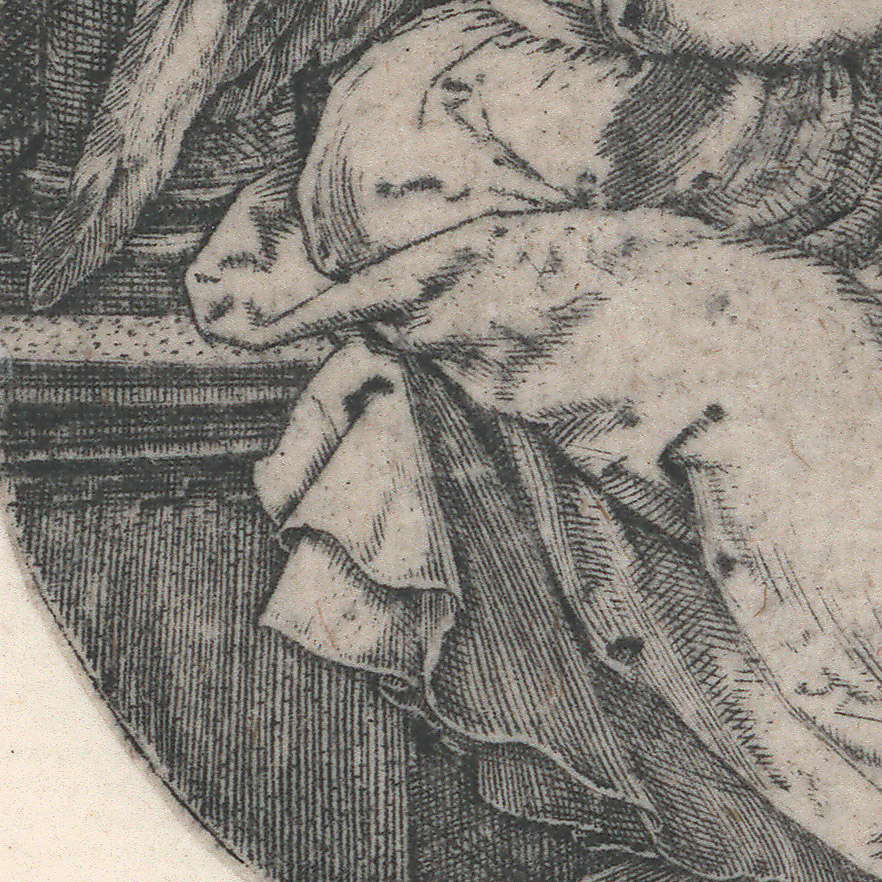
When I selected this very beautiful tiny engraved roundel by one of the Nuremberg Little Masters to showcase tonight, I was hoping that my background research about it would be straight forward; after all, the print is in the collection of the British Museum. I was wrong. The more I searched who the Master/Monogrammist IB might “really” be the more the proposed attributions flowed … I even found an auction house that had this print as being by Master FG (aka Girolamo Faccioli), but to my eye the monogram is clearly “IB”. Certainly, if I were to adopt the attribution given by “The Illustrated Bartsch” (vol., 16, p. 77, cat. no. 31), I should feel comfortable proposing that the printmaker might be Georg Pencz (c1500–1550) as Georg Pencz’s name is bracketed after Master I.B. Nevertheless, the biographical notes for Master IB provided by the British Museum are a tad unsettling: “Nuremberg Little Master printmaker; sometimes wrongly identified with the young Georg Pencz or Jacob Binck” (https://www.britishmuseum.org/collection/term/BIOG146405). I would have loved to follow the BM’s dismissal of Georg Pencz as being the true identity of Master IB, but after close examination of little details (e.g., how Master IB uses strokes to render his figures’ necks or the manner of representing the directional curls in hair, I am still uncertain who is correct).

Master IB (aka Monogrammist IB; Georg Pencz [TIB attrib.]; Jacob Binck [Nagler former attrib.]) (fl.1523–1530)

“Genius of History” (aka “Le genie de l’histoire” [Bartsch title]), c1523–1530.

Engraving on fine laid paper trimmed around the borderline and backed with a support sheet.

Size: (sheet dia.) 5.7 cm.

Inscribed in plate: (lower right) “IB”.

TIB 16.31 (Robert A. Koch [ed.] 1980, “The Illustrated Bartsch: Early German Masters: Jacob Bink; Georg Pencz; Heinrich Aldegrever”, vol., 16, New York, Abaris Books, p. 77, cat. no. 31); Bartsch 31 (Adam von Bartsch 1860, “Le Peintre-Graveur“, vol. 8., Leipsic, R. Weigel, p. 309, cat. no. 31 [see https://archive.org/details/lepeintregraveu10weiggoog/page/309/mode/1up).

Adam von Bartsch offers the following description of this print: (transl.) “The genius of history, expressed by the figure of a winged woman writing on a table. She is seated, seen in profile and turned to the right, where we see a cuirass, a shield and a helmet placed on the ground in the background. The letters I B are engraved at the bottom of this same side. Round piece.” See also the description of this print offered by the British Museum: https://www.britishmuseum.org/collection/object/P_1850-0810-581.

Condition: a well-printed, slightly silvery impression, trimmed around the borderline and laid onto a support of archival (millennium quality) washi paper providing wide margins. There is a dot stain (printer’s ink?) below the tablet otherwise the sheet is in a good condition with no tears, holes, folds, abrasions or foxing.

I am selling this very small engraved roundel from the early 1500s, executed by a master from the circle known as the Nuremberg Little Masters, showing an angelic female personification of history seated beside armour while she records all that has happened through time on a stone tablet, for the total cost of AU$514 (currently US$342.66/EUR314.22/GBP276.08 at the time of this listing) including postage and handling to anywhere in the world, but not (of course) any import duties/taxes imposed by some countries.

If you are interested in purchasing this exceptionally beautiful, jewel-like tiny engraving, please contact me (oz_jim@printsandprinciples.com) and I will send you a PayPal invoice to make the payment easy.

This print has been sold


Monday, 5 July 2021

Georg Pencz’s engraving, “The Triumph of Eternity”, c1539

Georg Pencz (c1500–1550)

“The Triumph of Eternity” [TIB title] (aka “Le triomphe de l’éternité”; “The Triumph of Eternity on Death, from The Triumph of Petrarch”), c1539 (1537–1541), the final print in the series, “The Six Triumphs of Petrarch”.

Engraving on laid paper trimmed irregularly around the platemark and backed with a support sheet.

Size: (sheet) 14.9 x 20.8 cm.

Lettered in plate below the image borderline: (centre) “VT VENTO RAPITVR FVANTIS SIC GLORIA MVNDO/ OMNIA RRETEREVNT PRETERE AVTARE DEVM// PG [ligature monogram of Pencz]”.

TIB 16 (8).122 (358) (Walter L Strauss & Robert A Koch [eds.] 1980, “The Illustrated Bartsch: Early German Masters”, vol.16, p. 132, cat. no. 122 [358]); Bartsch 122; Hollstein 102; Nagler 123.

The Rijksmuseum offers the following description of this print:

(Transl.) “Triumph of the Christian faith with Christ standing in heaven with a banner of the cross between the symbols of the four evangelists while appearing to be addressing scholars. Angels blow trumpets. Beneath this scene the earth burns and the other triumphs, Love (Amor), Chastity (wise virgin with banner), Fame, Time and Death lie defeated on the ground” (http://hdl.handle.net/10934/RM0001.COLLECT.31532).

See also the descriptions offered by the British Museum and the Metropolitan Museum of Art: https://www.britishmuseum.org/collection/object/P_E-4-270 & https://www.metmuseum.org/art/collection/search/432578.

Condition: a well-printed impression, trimmed slightly unevenly and laid upon an archival support sheet of millennium quality washi paper. There is a small replenished loss at the upper right corner and a few a pale stains (the most significant stain is on Christ’s cloak), otherwise the sheet in in very good condition for its considerably age.

I am selling this veritable masterwork of engraving—and one of the larger engravings by Pencz—showing Christ in heaven holding the flag of his triumphant resurrection surrounded by prophets and the attributes of his four evangelists, while on earth, depicted below, is a fiery cleansing of temporal concerns—my apologies for any inaccuracies—for the total cost of AU$633 (currently US$476.62/EUR401.46/GBP344.71 at the time of this listing) including postage and handling to anywhere in the world, but not (of course) any import duties/taxes imposed by some countries.

If you are interested in purchasing this major engraving by one of the leading "Little Masters" (Kleinmeister), please contact me (oz_jim@printsandprinciples.com) and I will send you a PayPal invoice to make the payment easy.

This print has been sold 


Thursday, 5 March 2020

Heinrich Aldegrever's engraving, “St. Mark”, 1539


Heinrich Aldegrever (1501/2–1555/61)

“St. Mark” (aka “S. Marc”; “Saint Marc l’Evangéliste”), 1539, plate 2 from the series of four engravings, “The Four Evangelists” (TIB 16.57–60) (aka “Vier Evangelisten”), after Georg Pencz (c.1500–50).

Engraving trimmed along the image borderline on fine laid paper.
Size: (sheet) 12 x 7.6 cm
Signed and dated on plate with Aldegrever's monogram at upper right and with Pencz's monogram on a tablet at lower right.

TIB 16(8).58 (383) (Robert A Koch [ed.] 1980, “The Illustrated Bartsch”, vol. 16, New York, Abaris Books, p. 166, cat. no. 58 [383]); Bartsch VIII.383.58; New Hollstein (German) 58 (Aldegrever) (Ursula Mielke 1998, The New Hollstein : German Engravings, Etchings and Woodcuts 1400–1700: Heinrich Aldegrever”, Rotterdam, Sound and Vision Interactive, p. 71, cat. no. 58).

The British Museum offers the following description of this print:
“St Mark; turned to right, writing in a book, the lion at right; from a series of four engravings of the evangelists seated among clouds with their attributes” (https://research.britishmuseum.org/research/collection_online/collection_object_details.aspx?objectId=1508033&partId=1&searchText=St.+Mark&people=134630&page=1).

See also the description of this print offered by the Rijksmuseum:

Condition: a good but not magnificent impression (i.e. it is slightly dull) that has been trimmed around the image borderline. The sheet is in good condition for its considerable age (i.e. there are no tears, folds, abrasions, significant stains or foxing).

I am selling this original engraving that is possibly a lifetime impression from the Renaissance era by one of the major old masters strongly influenced by Albrecht Dürer—note Aldegrever’s adaptation of Albrecht Dürer’s monogram for his own—for AU$686 (currently US$454.06/EUR404.65/GBP350.57 at the time of posting this listing) including postage and handling to anywhere in the world (but not, of course, any import duties/taxes imposed by some countries).

If you are interested in purchasing this small masterpiece of engraving exemplifying Aldegrever’s use of what the British Museum succinctly describes in this artist’s biographical details as “slim, attenuated figures and puckered, agitated drapery“, please contact me (oz_jim@printsandprinciples.com) and I will send you a PayPal invoice to make the payment easy.

This print has been sold


Thursday, 31 January 2019

Georg Pencz's engraving, “Tobit Buries One of the Children of Israel”, 1543


Georg Pencz (c1500–1550)

“Tobit Buries One of the Children of Israel” (Tobie donnant la sépulture à un des enfans d’Israel), 1543, second plate from the series of seven plates, “The Story of Tobit” (TIB 16.13[324]–19[325]).

Engraving on fine laid paper trimmed with a narrow margin around the plate-mark and backed with a support sheet.
Size: (sheet) 6.6 x 10.1 cm
Inscribed on plate: (lower left corner) “THOBIE . 2 . CAP [artist’s monogram, ‘P’ & ‘G’]”
Lifetime impression. State i (of i) (Note: TIB and Bartsch do not propose additional states, but Hollstein and Landau describe three states; compare BM’s no. E,4.253 [first state] with Rijksmuseum’s no. RP-P-OB-10,976 [second state] and BM’s no. 1850,0810.565 [third state].)

TIB 16(8).13(324) (Walter L Strauss & Robert A Koch [eds.] 1980, “The Illustrated Bartsch: Early German Masters”, vol.16, p. 90); Landau 1978 13 (David Landau 1978, “Catalogo completo dell' opera grafica di Georg Pencz”, Milan, p. 86); Hollstein 27 (F W H Hollstein 1954, “German engravings, etchings and woodcuts c.1400-1700”, Amsterdam); Bartsch VIII.324.14 (Adam Bartsch 1803, “Le Peintre graveur”, 21 vols, Vienna).

The Rijksmuseum offers the following description of this print:
(transl.) “Tobit and Tobias buried the body of a man who was strangled on behalf of the Assyrian king. Tobit is mocked by two men about the lack of his fear of being caught. According to the biblical text, Tobias is not present at this event and this scene takes place at night but that is not apparent … [in this engraving] (Tobit 2: 7-8).”

Condition: crisp and well-printed impression, trimmed with a narrow margin around the plate mark. There is a replenished nick in the narrow margin on the lower right side otherwise the sheet is in excellent condition (i.e. there are no tears, significant holes—there is a pin hole on the elbow of shrouded body—folds, abrasions, stains or foxing). The sheet has been laid onto a support sheet of archival (millennium quality) washi paper.

I am selling this very small and exquisite masterpiece of engraving by Pencz—one of the famous German Little Masters—for AU$405 (currently US$294.52/EUR256.32/GBP224.44 at the time of this listing). Postage for this print is extra and will be the actual/true cost of shipping.

If you are interested in purchasing this precious and exceptionally rare print, please contact me (oz_jim@printsandprinciples.com) and I will send you a PayPal invoice to make the payment easy.

This print has been sold


Thursday, 1 February 2018

Georg Pencz’s engraving, “The Good Samaritan”, 1543


Georg Pencz (c1500–1550)

“The Good Samaritan”, 1543
Engraving on fine laid paper trimmed along the platemark and re-margined on a support sheet.
Size: (support-sheet) 25.5 x 26.8 cm; (sheet trimmed unevenly) 7.5 x 11.4 cm
Signed with the artist’s monogram, "PG", and dated, “1543”, in the plate at upper right corner.

TIB 16 (8).68 (339) (Walter L Strauss & Jacob Bink et al [Eds.] 1980, “The Illustrated Bartsch”, vol.16, p. 105); Landau 1978 71 (David Landau 1978, “Catalogo completo dell' opera grafica di Georg Pencz”, Milan); Hollstein German 36 (F W H Hollstein 1954, “German engravings, etchings and woodcuts c.1400-1700”, Amsterdam); Bartsch VIII.339.68 (Adam Bartsch 1803, “Le Peintre graveur”, 21 vols, Vienna).

The British Museum offers the following description of this print:
“The Good Samaritan; tending to the wounds of the injured traveller in left foreground; in right background the man falling among thieves and the priest and the Levite walking past; at left the Samaritan taking the traveller to the innkeeper.”
See also the description of this print at the Rijksmuseum: http://hdl.handle.net/10934/RM0001.COLLECT.31463

Condition: crisp, early impression (based on lack of wear to the plate) with replenished lower corners, trimmed along the platemark and re-margined on a support sheet. The sheet is in excellent condition for its age with only minor traces of handling and stains.

I am selling this very small and exquisite masterpiece of engraving by Pencz—one of the famous German Little Masters—for AU$403 (currently US$321.99/EUR258.94/GBP226.24 at the time of this listing). Postage for this print is extra and will be the actual/true cost of shipping.

If you are interested in purchasing this precious and exceptionally rare print of the famous parable of Good Samaritan, please contact me (oz_jim@printsandprinciples.com) and I will send you a PayPal invoice to make the payment easy.

This print has been sold


I guess that the fundamental tenet of the “Parable of Good Samaritan” (Luke 10: 25–37)—which I understand to mean that I need to be an actively compassionate chap regardless whether those that I engage with are strangers or even “foes”— is to be found in most religions. But, of course, the principle is morphed in different ways as can be seen daily in the world news regarding religious conflicts.

What I find fascinating about this print is that it is showcases (to my eyes) common Christian notions of how an actively compassionate person should behave, as shown by the Samaritan attending to the wounds of the young Jewish man in the foreground. Perhaps more interesting, this beautifully engraved illustration also hints that there may be consequences for those who are not actively compassionate: as revealed in the far distance with what must have been an “unhelpful” traveller assailed by thieves.

If one were to compare this illustration to the way that a Buddhist monk might portray the same parable, I have no doubt that the scene would be quite different. For instance, I suspect (and as I am not a Buddhist monk I can only speculate) that the meaning might shift from the notion of “reward” and “punishment” to a cleansing of the mind of self-gratification to more of a mindless/egoless holistic love.


Friday, 3 November 2017

Georg Pencz’s engraving, “Christ Healing the Man Possessed”, 1534


Georg Pencz (c1500–1550)
“Christ Healing the Man Possessed”, 1534–1535, Plate 13 from the series of 26 engravings, “The Life of Christ.”

Engraving on laid paper trimmed along the platemark
Size: 4 x 6 cm
Signed with the artist’s monogram, "PG", in the plate at upper right edge and numbered, “13” at right of upper centre.

TIB 16 (8).41 (331) (Walter L Strauss & Jacob Bink et al [Eds.] 1980, “The Illustrated Bartsch”, vol.16, p.98); Landau 1978 43 (David Landau 1978, “Catalogo completo dell' opera grafica di Georg Pencz”, Milan); Hollstein 53 (F W H Hollstein 1954, “German engravings, etchings and woodcuts c.1400-1700”, Amsterdam); Bartsch VIII.331.41 (Adam Bartsch 1803, “Le Peintre graveur”, 21 vols, Vienna).

The British Museum offers the following description of this print:
“Plate 13: Christ healing the possessed man; Christ standing at centre left; facing him the possessed man, held back by a companion; the evil spirit escaping at upper right”

Condition: crisp, early impression (based on lack of wear to the plate) with replenished upper left corner (virtually invisible), trimmed along the platemark. There are two previous collectors’ ink stamps and numerous inscriptions in pencil and remnants of mounting hinges (verso).

I am selling this very small but exquisitely rendered engraving by one of the famous German Little Masters —the shared interest of the group in executing little prints is exemplified by this postage-stamp sized masterpiece—for the total cost of AU$403 (currently US$309.48/EUR266.12/GBP233.31 at the time of this listing) including postage and handling to anywhere in the world.

If you are interested in purchasing this precious and exceptionally rare print with a 16th century vision of an exorcism and what a demon looks like, please contact me (oz_jim@printsandprinciples.com) and I will send you a PayPal invoice to make the payment easy.


This print has been sold


When I was studying this tiny miracle of engraving I felt that the composition seemed odd—wrong even. And then the realisation hit me. Of course! The composition was originally conceived and engraved in reverse. After all, the print is actually a mirror image of how Pencz drew it. In short the printing process has made this composition seem curiously odd to my eye and when I held the print up to a mirror everything “fell” into place as a well-crafted composition.

In the mirror I saw the scene lit from the top-front-left which is the more usually lighting direction for Occidental compositions. Moreover, the shadowy zone that I previously saw on the left—an area that pictorially blocked my reading of the image from left-to-right—is transposed in the mirror to the right side and in that position the darkness acts as an effective visual “break” stopping my eye from "sliding" out of the composition.

I could go on and discuss how devils don’t usually fly out of a composition towards the right as this wee demon does in the print but I suspect that I have made my point: even demons have a "proper" flight path.