Showing posts with label Veuve Cadart. Show all posts

Friday, 13 September 2024

Eugene Tommasi, “À Tanger”, 1879

Eugene Tommasi (born 19th century)—an Italian Orientalist artist (see the following example of his work: “The Moroccan Wedding Dance” (https://www.artrenewal.org/artworks/eugene-tommasi/the-morrocan-wedding-dance/9016)

Note that the publisher of this plate, the widow of Alfred Cadart (1828–1875) publishing as Veuve A. Cadart (1868–1881), has identified the printmaker of this print as “Tomassi” (see plate 492: https://gallica.bnf.fr/ark:/12148/btv1b8527606k/f51.item), but this information is inconsistent with the name inscribed on the plate, “E. Tommasi”. Of course, there may be variations in the spelling of the artist’s name and this would explain the anomaly.

“À Tanger” (In Tangier), 1879, after a painting by the artist (as inscribed in the plate) published and printed in Paris by Veuve A. Cadart in the art periodical “L'Illustration Nouvelle”, vol. 11, 1879 (see https://gallica.bnf.fr/ark:/12148/btv1b8527606k/f36.item).

Etching with plate tone on cream laid paper with deckle edges on three sides and wide margins as published.

Size: (sheet) 48.8 x 33.6 cm; (platemark) 24.3 x 16.2 cm.

Inscribed in plate at lower left: “E. Tommasi”.

Lettered in plate along the lower edge: (left) “E. Tommasi pinx et sculp”; (right) “Vve A. Cadart Edit. Imp. 56 Bard Haussmann Paris”.

Condition: a strong impression showing minor movement to the printing plate. Beyond minor marks in the margins, the sheet is in an excellent condition with no significant stains.

I am selling this strong image of a swaggering bare-chested Moor holding with self-assured pride his Moroccan snaphance or Afedali rifle (see https://www.alamy.com/morocco-snaphance-or-afedali-rifle-of-the-19th-century-image244357638.html) — his posturing is understandable mindful that only a year before this etching was executed a shipment of a thousand of these flintlock rifles were imported into Morocco (forgive me if I’m wrong about this)—for the total cost of AU$232 (currently US$155.59/EUR140.44/GBP118.55 at the time of posting this listing) including Express Mail (EMS) postage and handling to anywhere in the world, but not (of course) any import duties/taxes imposed by some countries. Note that payment is in Australian dollars (AU$232) as this is my currency.

If you are interested in purchasing this seldom seen etching on the art market, please contact me (oz_jim@printsandprinciples.com) and I will send you a PayPal invoice to make the payment easy.


Friday, 20 October 2023

Ludovic Napoléon Lepic’s etching, “Environs de Dordrecht”, c.1876

Ludovic Napoléon Lepic (aka Viscomte Ludovic-Napoléon Lepic) (1839–1889)

Environs de Dordrecht”, c.1876, from the series, “Croquis Hollandais et Autres”, published in 1876 in Paris by Alfred Cadart (aka [publications made by his widow] Veuve Cadart) (1875–1882) as plate 325 to “L'Illustration Nouvelle”, vol. 8.

Etching with plate tone on laid paper.

Size: (sheet) 27 x 32.7 cm; (platemark) 16.1 x 24.1 cm; (image borderline) 15 x 23.2 cm.

Numbered in plate: (upper right corner) “325.”

Inscribed in plate within the image borderline: (lower left corner) “Lepic”.

Lettered in plate below the image borderline: (left) “L.Lepic, prinx. et sculp.”; (centre) “ENVIRONS DE DORDRECHT”; (right) “Vve A.Cadart,Edit.Imp.56.BardHaussmann,Paris.”

Beraldi 4 (Henri Beraldi 1889, “Les Graveurs du XIXe Siècke; guide de l'amateur d'estampes modernes”, vol. 9, Paris, L Conquet, p. 143, cat. no. 4 [series]); IFF 108 (Inventaire du Fonds Français après 1800, Paris, 1937–1985, XIV.66.108).

Henri Beraldi (1889) offers the following insight about Lepic’s approach to wiping the etching plate: (Transl.) “… Count Lepic was particularly attached to the question of the impression, and the varieties of effects that obtained from a plate according to the inking mode. ... he would say, ‘the secret of etching as I get it … is the use of ink and rag: with these two weapons you can get anything from a plate. I am master in front of my plate as in front of a canvas, I can transform all the subjects according to my fancy, modify their effects. This process existed from the time of great master engravers, and I have found it’. ... Count Lepic called this kind of printing with the rather singular name ‘mobile etching’ [l’eau-forte mobile]." (p. 144).

Condition: a strong and skilfully wiped impression (e.g., the controlled wiping of the centre sail and suggestion of distance). Beyond a few minor marks in the margin, the sheet is in an excellent condition.

I am selling this bold etching exemplifying the artist’s confidence and free handling of the etching needle for AU$288 in total (currently US$192.50/EUR174.17/GBP153.32 at the time of posting this listing) including postage and handling to anywhere in the world, but not (of course) any import duties/taxes imposed by some countries.

If you are interested in purchasing this marvellous evocation of light and breeze on the Dordrecht's canals (havens)—note, for instance, how Lepic has wiped/removed the plate tone from the centre sail to capture the effect of bright light and, in doing so, draws attention to the freely drawn ripples in the sail—please contact me (oz_jim@printsandprinciples.com) and I will send you a PayPal invoice to make the payment easy.

This print has been sold


Friday, 7 July 2023

Pierre Billet’s etching with drypoint, “Pêcheuses à Granville”, 1878


Pierre Billet (aka Pierre-Célestin Billet) (1837–1922)

“Pêcheuses à Granville” (aka “Fisherwomen in Granville”; “Rustende Vrouwen aan de Kust” [Rijksmuseum title]; “Resting Women on the Seashore), 1878, after a painting by Pierre Billet, plate 441 printed and published in Paris by Veuve A. Cadart (fl. 1867–1870/1) as plate 441 in “L'Illustration Nouvelle par une Société de Peintres-Graveurs à l'Eau-Forte”, vol. 10, in 1878 (see https://gallica.bnf.fr/ark:/12148/btv1b85276055/f32.item.r=L'Illustration%20Nouvelle%201878).

Etching with drypoint with plate tone on laid paper trimmed with a small margin around the platemark and backed with a support sheet providing wide margins.

Size: (sheet) 18.4 x 13.5 cm; (plate) 16.2 x 12 cm; (image borderline) 15.4 x 11.5 cm.

Numbered and inscribed in plate within the image borderline: (upper right) “441.”; (lower right) [artist’s monogram] “PB”.

Lettered in plate below the image borderline: (left) “Pierre Billet, pinx et sc.”; (centre) “PÊCHEUSES À GRANVILLE.”; (right) “Vve A. Cadart,Edit,Imp,Paris.”

IFF 3 (Département des Estampes 1939–, “Inventaire du Fonds Français après 1800”, vol. 2, Paris, Bibliothèque Nationale, p. 449, cat. no. 3).

See also the descriptions of this print offered by the Rijksmuseum and the Musée d’Art et d’Histoire de Genève: http://hdl.handle.net/10934/RM0001.COLLECT.80619; https://www.mahmah.ch/collection/oeuvres/pecheuses-granville/e-2015-0443-030.

Condition: a strong and well-printed impression trimmed with a small margin around the platemark and laid onto a support of archival (millennium quality) washi paper. Beyond a minor mark in the margin at lower left, the sheet is in a good condition with no tears, holes, folds, abrasions, significant stains or foxing.

I am selling this marvellous etching—note how the artist has insightfully drawn attention to the closer woman’s head and pointing hand by losing the focal clarity as the eye moves away from this area of focus—for AU$243 (currently US$162.42/EUR146.96/GBP129.37 at the time of this listing) including postage and handling to anywhere in the world, but not (of course) any import duties/taxes imposed by some countries.

If you are interested in purchasing this confidently executed etching that is clearly by the hand of a master draughtsman, please contact me (oz_jim@printsandprinciples.com) and I will send you a PayPal invoice to make the payment easy.


Monday, 3 April 2023

Félix Buhot’s etching and drypoint, “The Cab Stand”, 1876

This is a fascinating print and the number of documented states in its evolution is remarkable. Initially, there were only four states proposed in Gustave Bourcard’s original 1899 catalogue raisonné: “Félix Buhot: Catalogue Descriptif de son Oeuvre Gravé.” This number doubled to eight states in 1938 in J H Bemder’s description of the plate in “Print Collector’s Quarterly”, Vol. 25, No. 2, with a tentative proposal that there may be nine states. The number of states then increased to an amazing fifteen states documented in James Goodfriend’s 1979 revised supplement to Bourcard’s catalogue, with (again) an acknowledgement that there may be still more states. From my standpoint, this number of states draws attention to Buhot’s desire to refine his plate to perfection and, no doubt, to refresh the plate in the later state as it wore from repeated printing due to its popularity—mindful that this is an important print in Buhot’s oeuvre.

This impression is from an early state (state v) where Buhot was making subtle changes to the image and the publication details. Note for example that he has added four extra chimneys (and they are VERY small) to the distant buildings above the closer cab and the plate number (“19”) of the previous state has been erased (see the previous state [state iv] held by the British Museum: https://www.britishmuseum.org/collection/object/P_1879-1011-571).  

Félix Buhot (aka Félix Hilaire Buhot; Tohub [Buhot, in reverse]) (1847–1898)

“The Cab Stand” (aka “Une Matinée d'Hiver au Quai de l'Hôtel-Dieu”; “Winter Morning on the Quai de l'Hôtel-Dieu”), 1876, published and printed by Veuve A. Cadart (1875-1882) (Alfred Cadart’s [1828–1875] firm continued by his widow after his death) in Paris. This impression was published in the “Album Cadart” and “Album Boëtzel”.

Etching, drypoint and dot roulette with pale plate tone on buff chine collé on wove paper with full margins (as published).

Size: (sheet) 29.8 x 44 cm; (plate) 23.8 x 32 cm: (image borderline) 21.6 x 31.2 cm.

Inscribed within the image borderline: (lower left corner) “Felix Buhot/ pinxt et sc.”

Lettered below the image borderline: (left) “Félix Buhot, pinx.et sculp.”; (centre) “UNE MATINÉE D'HIVER AU QUAI DE L'HÔTEL-DIEU.”; (right) Vve A.Cadart,Edit Imp.56,Bard Haussmann,Paris.”

State v (of xv)

Bourcard/Goodfriend 123 (Gustave Bourcard & James Goodfriend 1979, “Félix Buhot: Catalogue Descriptif de son Oeuvre Gravé”, New York, Martin Gordon Inc., pp. 71–73, cat. no. 123 [see also unpaginated supplement]); IFF  87 (Jean Laran 1930, “Inventaire du fonds français: graveurs du dix-huitième siècle”, Bibliothèque nationale de France, vol. 3, p. 508, cat. no. 87).

The British Museum offers the following description of this print: “Rainy street scene with row of four horse-drawn carriages, and three passers-by on the right; also known as 'The Cab stand'; published state, with engraved inscription. 1876 Etching and drypoint” (BM inv. no. 1879,1011.571). 

Condition: a strong and well-printed impression with margins as published. Beyond light age-toning on the edges, the sheet is in an excellent condition with no tears, holes, folds, abrasions, significant stains or foxing.

I am selling this major print in the oeuvre of one of the most creatively inventive printmakers of the etching revival period, for the total cost of AU$524 (currently US$350.43/EUR323.62/GBP284.67 at the time of this listing) including Express Mail (EMS) postage and handling to anywhere in the world, but not (of course) any import duties/taxes imposed by some countries.

If you are interested in purchasing this very beautiful etching executed around the time of the second Impressionist exhibition (1876), please contact me (oz_jim@printsandprinciples.com) and I will send you a PayPal invoice to make the payment easy.


Friday, 17 March 2023

Jules Élie Delaunay’s etching, “Ixion”, 1876

Jules Élie Delaunay (1828–1891)

“Ixion”, 1876, etching after the artist's painting, “Ixion Précipité dans les Enfers” (Ixion Thrown into the Underworld) (1876), shown in the Salon of 1876 and now in the Musée d'Arts de Nantes (https://commons.wikimedia.org/wiki/File:JulesElieDelaunayIxionPrecipiteDansLesEnfers.jpg), scratch-lettered before formal lettering for publication by Veuve Cadart (fl.1875–1882) in Paris in the art periodical, "Gazette des Beaux Arts" (1st June 1876, pp. 722–23).

Etching and drypoint on laid paper with wide margins.

Size: (sheet) 22.7 x 30.4 cm; (plate) 10.8 x 14 cm.

Inscribed in plate: (upper centre) “10”; (lower left) “[…]ire der Beaux Arts”; (lower centre) “S. DELAUNAY”; (lower right) “-IXION- . Salon de 1876”.

Condition: A strong and near faultless impression showing no sign of wear to the printing plate with generously wide margins. The sheet is in a near pristine condition with no tears, holes, folds, abrasions, significant stains or signs of handling.

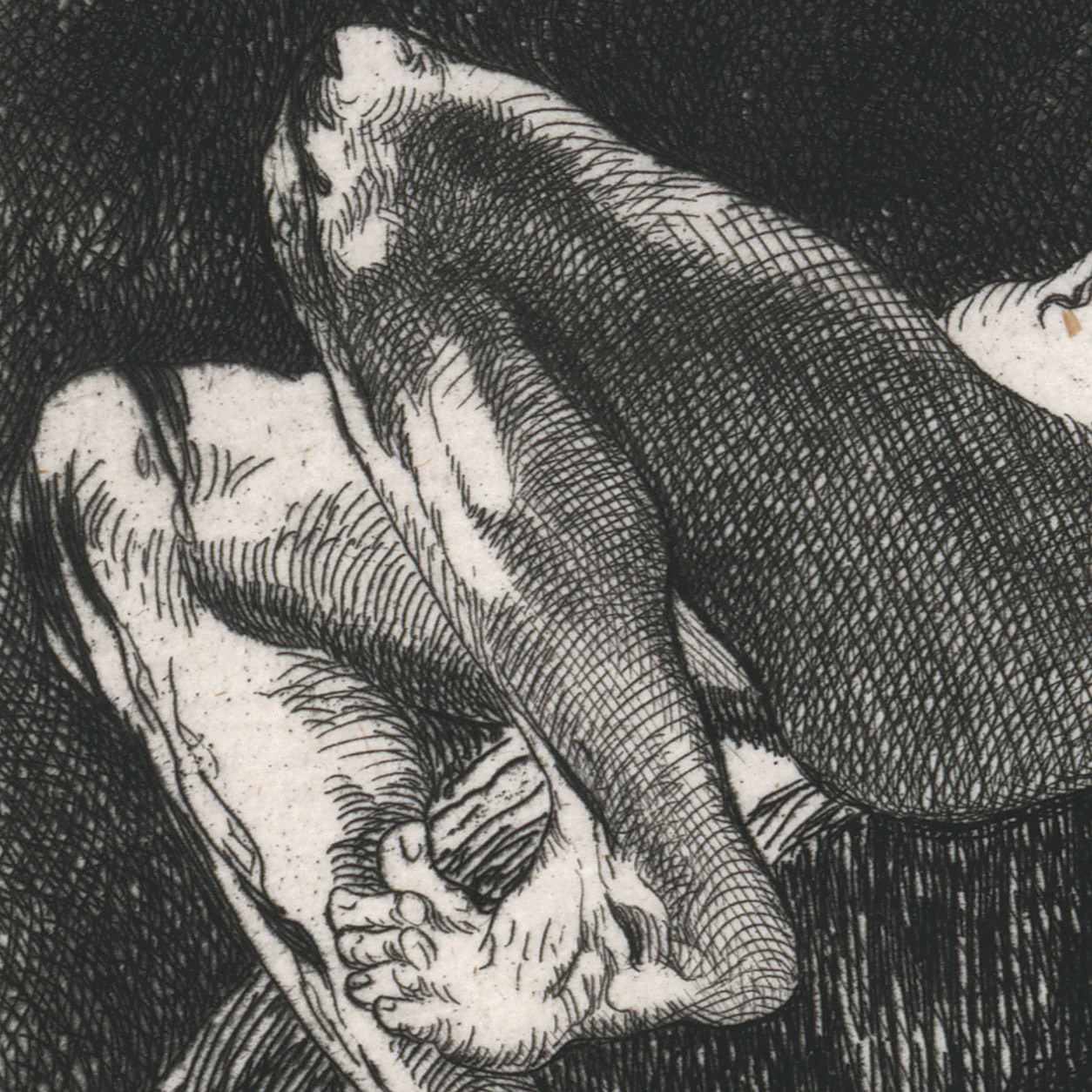
I am selling this visually arresting etching showing the mythological figure, Ixion, suffering in torment in the Underworld after killing his father-in-law—I understand that Ixion was feeling a tad guilty for not having paid the “bride price” and invited his father-in-law to dinner to make peace and upon his father-in-law’s arrival, Ixion pushed him into a bed of hot coals (shocking!)—for the total cost of AU$227 (currently US$152.29/EUR142.85/GBP125.40 at the time of posting this print) including Express Mail (EMS) postage and handling to anywhere in the world, but not (of course) any import duties/taxes imposed by some countries.

If you are interested in purchasing this marvellous etching of the first man to kill his father-in-law, please contact me (oz_jim@printsandprinciples.com) and I will send you a PayPal invoice to make the payment easy.